{
“title”: “Large Dog Crate Ideas: 10 Setups That Actually Fit Big Dogs”,
“slug”: “large-dog-crate-ideas”,
“excerpt”: “Large dog crate ideas that actually fit big dogs: XL sizing by weight, heavy-duty crates for strong chewers, and 10 setups from wire crates to furniture crates.”,
“meta_description”: “Large dog crate ideas that actually fit big dogs: XL sizing by weight, heavy-duty crates for strong chewers, and 10 setups from wire crates to furniture crates.”,
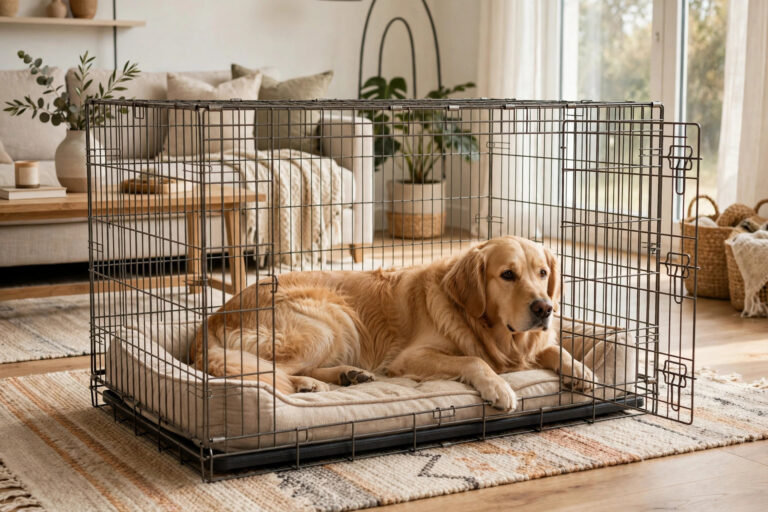
“featured_image_alt”: “Large golden retriever resting inside a spacious XL wire dog crate in a bright living room.”,
“content_html”: “
A crate that fits a beagle will not fit a labrador — and a crate that fits a labrador will not hold a rottweiler. Big dogs need more than a scaled-up version of a small crate: they need the right length, the right height, the right strength, and enough room to actually stretch out and sleep properly.
\n
Get the crate wrong and you get a dog that refuses to go in, a crate that rattles and bends, or a dog that escapes and chews the door. Get it right and the crate becomes the place your big dog chooses to nap — their own den, in the middle of your home.
\n
Here are 10 large dog crate ideas that actually work for big dogs, from a 30 kg border collie to a 50 kg German Shepherd, plus the sizing rules that matter more than any brand name.
\n
Why big dogs need a different crate
\n
A small dog’s crate is mostly about containment. A big dog’s crate is about three things at once: size, strength and comfort.
\n
Size first. A large dog needs to stand up fully without ducking, turn around without scraping their back, and lie stretched out on their side with their legs extended — not curled into a ball because the crate is too short. If your dog can only sleep curled up in their crate, the crate is too small, however \”XL\” the box said.
\n
Strength second. A 40 kg dog leaning on a flimsy wire door, or a determined chewer working on a plastic latch, will find the weak point in a day. Large-dog crates need thicker wire, stronger latches and a frame that does not flex when the dog moves.
\n
Comfort third. Big dogs are heavy, and heavy dogs feel a thin crate floor through any bed. A crate that fits a proper orthopaedic bed — with room to spare — is worth more than a crate with fancy features. Our best dog beds for crates guide covers which beds actually fit inside standard crate sizes.
\n
How to measure your dog for a crate
\n
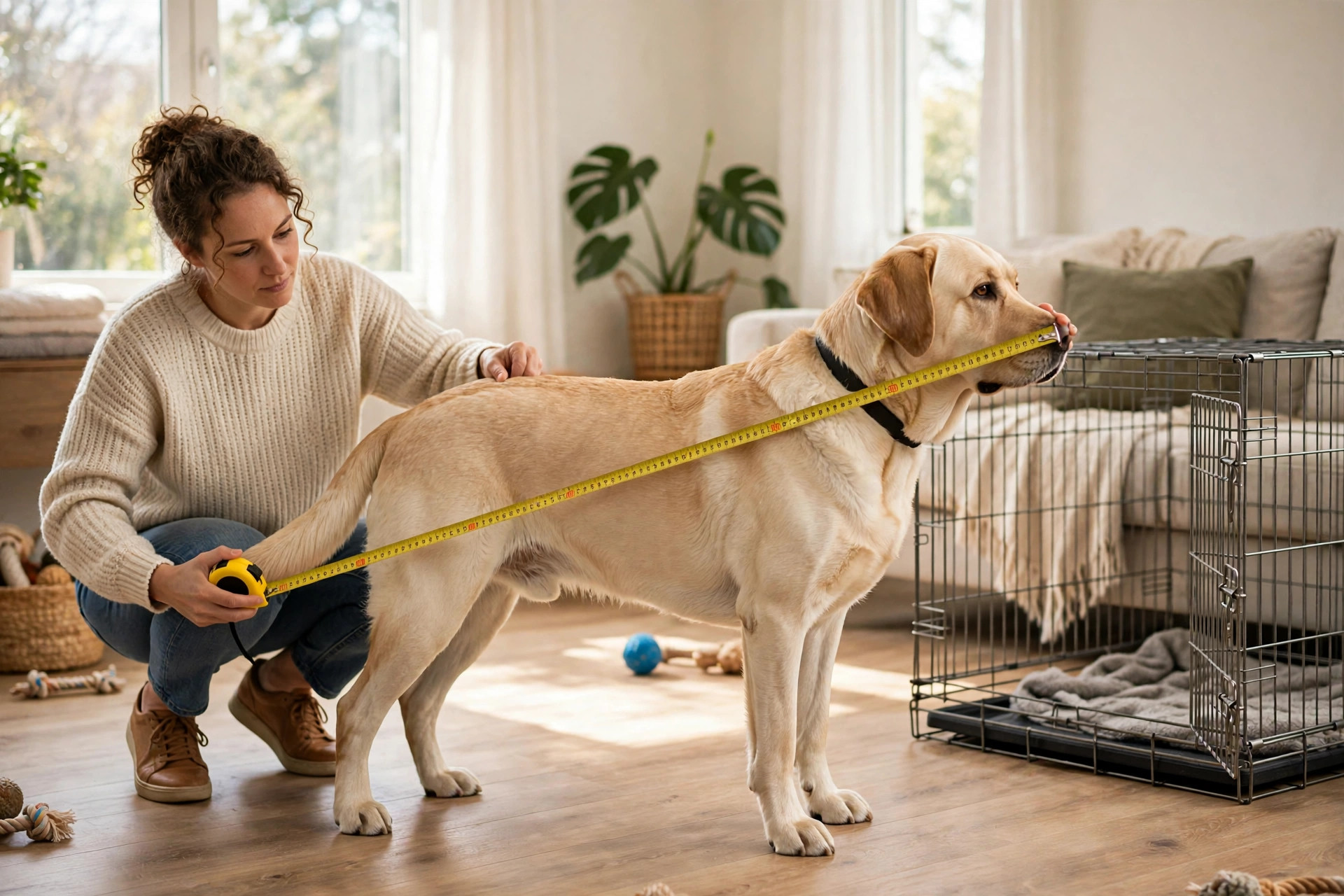
Do not buy by the label. \”Large\” means something different to every manufacturer. Measure your dog, then match the numbers.
\n
Length: measure from the tip of the nose to the base of the tail, then add 10–15 cm. That is the minimum internal length of the crate.
\n
Height: measure from the top of the head (or the tips of the ears, whichever is higher, while the dog is sitting) to the floor, then add 10–15 cm. That is the minimum internal height.
\n
Width: your dog should be able to turn around comfortably and lie on their side with legs out. As a rule of thumb, the crate should be at least as wide as your dog is long when lying down — most XL crates are 105–120 cm long and 70–80 cm wide.
\n
Crate sizes by dog weight (the table)
\n
| Dog’s weight | Typical breeds | Crate length to look for |
|---|---|---|
| 20–30 kg | Border collie, staffy, boxer | 105–110 cm (42 in) |
| 30–40 kg | Labrador, golden retriever, German Shepherd | 110–120 cm (42–48 in) |
| 40–50 kg | Rottweiler, doberman, akita | 120–125 cm (48 in) |
| 50 kg+ | Great Dane, mastiff, Newfoundland | 130–140 cm (54 in) |
\n
If your dog is between sizes, always go up a size. A crate that is slightly too big is a comfort problem you can fix with a divider; a crate that is too small is a welfare problem you cannot fix at all. Our dog crate size calculator works out the right crate from your dog’s actual measurements.
\n
1. The XL wire crate with a divider panel
\n
The workhorse. A 48-inch wire crate with a divider panel is the single most useful large-dog crate setup there is, and it is where most big-dog owners should start.
\n
The divider is the clever part: it lets you shrink the space for a puppy (so they do not toilet in one end and sleep in the other), then slide it back as the puppy grows into the full crate. One crate lasts from 8 weeks to adulthood.
\n
Look for: wire gauge thick enough that the panels do not bow when you push them, a double latch on the door, a removable tray that slides out without lifting the crate, and rounded corners on the wire ends. Cheap wire crates rattle; good ones feel solid when you shake them.
\n
2. The heavy-duty steel crate for strong chewers and escape artists
\n
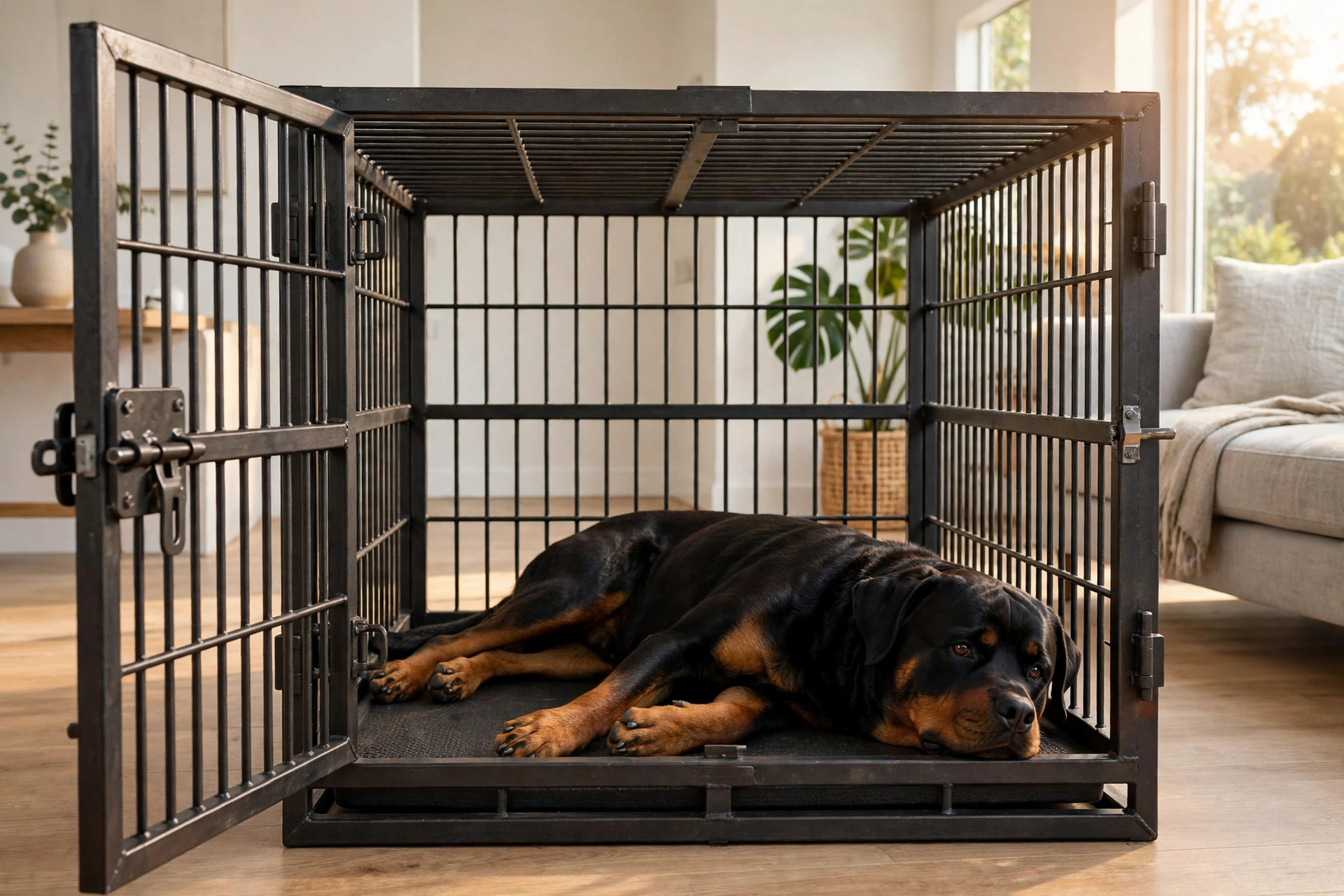
Some big dogs do not just sit in their crate — they test it. If your dog has bent a wire door, chewed through a plastic latch, or learned to lift a sliding bolt with their nose, a standard wire crate will not hold them.
\n
Heavy-duty steel crates use thicker bars (often 20 mm steel tube), welded corners instead of folded wire, and latches that need a deliberate two-step action to open. They are heavier, more expensive and harder to move — but they are the only crate that reliably holds a determined 45 kg dog.
\n
A warning: a heavy-duty crate is not a substitute for training. If your dog is panicking in the crate, a stronger crate just means a stronger dog hurting itself trying to get out. Fix the anxiety first — crate training, short sessions, positive associations — and use the strong crate as backup, not as a cage.
\n
3. The XXL furniture crate that looks like a sideboard
\n
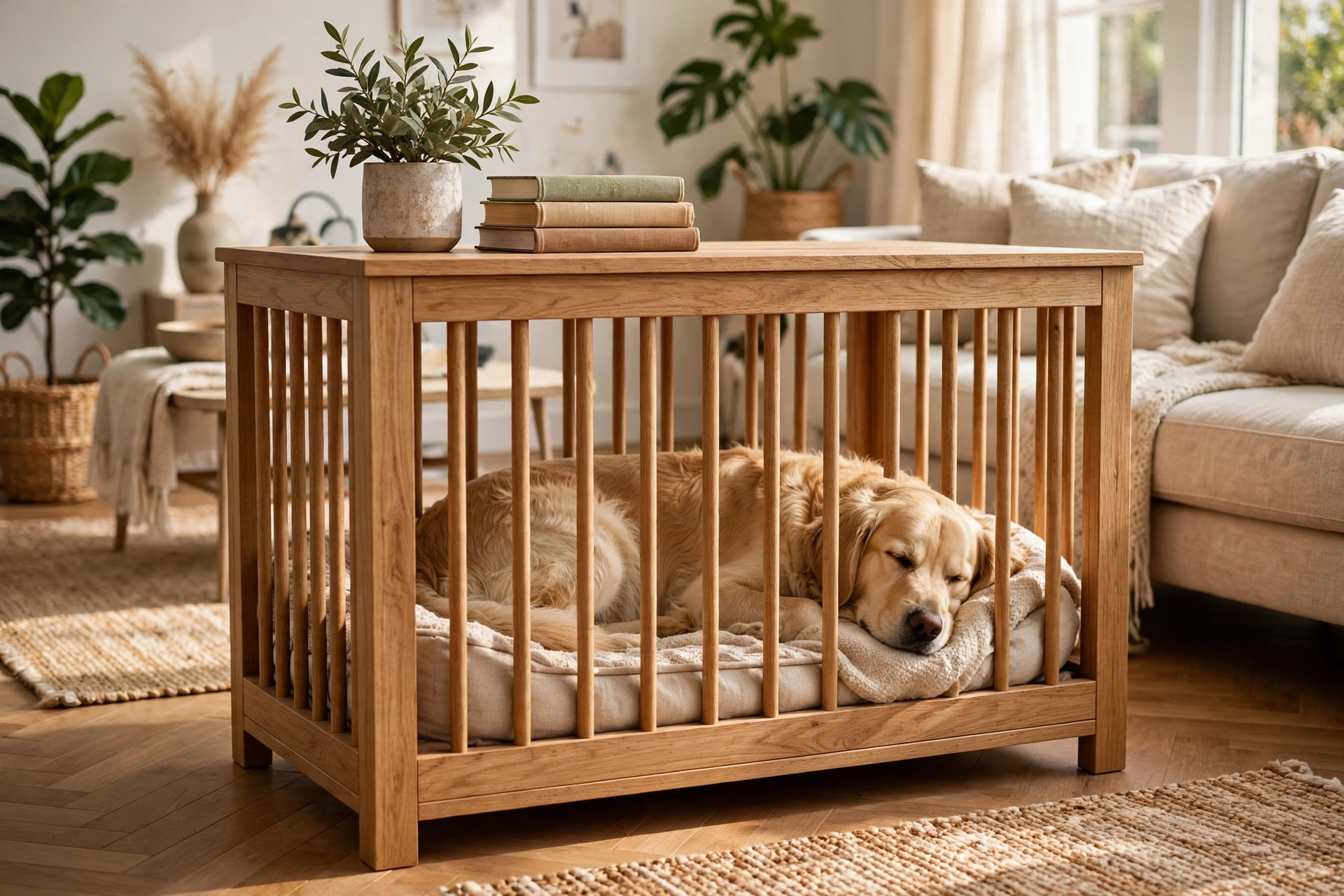
A 48-inch crate takes up a lot of living room. If the crate lives in the main room — and for most families it does — a furniture-style crate is the difference between a crate you tolerate and a crate you actually like having in the house.
\n
These are wooden crates built to look like a sideboard, a console table or a TV unit, with a flat top you can put a lamp or books on. The best ones for large dogs have a steel inner frame (wood alone will not hold a big dog that leans), a door with a proper latch, and ventilation gaps that are wide enough for airflow but narrow enough that paws cannot get caught.
\n
Our dog crate furniture ideas guide has 10 designs that blend into a home like real furniture — including several that work at XXL size.
\n
4. The double-door crate
\n
A crate with a door on the front and a door on the side sounds like a small luxury. For a large dog in a tight room, it is the difference between the crate fitting and not fitting at all.
\n
A side door lets you push the crate against a wall lengthways and still get the dog in and out. It also gives you options: put the crate in a corner with the side door facing the room, and the dog gets a den-like feel with a clear view out. For dogs that are nervous about going in head-first, a side door is often less intimidating — they can walk in sideways, the way they would walk into a den.
\n
When you buy, check that both doors latch properly and that the side door is the same size as the front door — some cheaper crates have a side door that is barely big enough for a medium dog.
\n
5. The crate + attached playpen combo
\n
A big dog that is crated for a few hours while you are out does not need more crate — they need more space to move, stretch and change position. A crate with an attached playpen gives them exactly that: the crate as the sleeping den, the pen as the daytime area, with a water bowl and a chew in the pen.
\n
Set it up with the crate door open into the pen, the pen panels clipped to the crate frame so the dog cannot push them apart, and a non-slip mat under the pen (hard floors + big dogs + playpen panels = a pen that slides across the room). This setup is ideal for puppies growing into large dogs, and for adult dogs that are fine alone for a few hours but should not have the run of the house.
\n
6. The travel crate for big dogs
\n
A crate that lives at home and a crate that travels in the car are two different jobs, and most owners try to make one crate do both. It rarely works well.
\n
A travel crate for a large dog needs to be crash-tested or at least properly secured — a 40 kg dog becomes a 40 kg projectile in a sudden stop. Look for a crate with tie-down points, a door that locks shut, and ventilation on at least three sides. Measure your boot or back seat before you buy: a 48-inch crate does not fit in most cars, and a 42-inch crate with a dog that is 110 cm long is not a safe fit either.
\n
If the car cannot take a full-size crate, a crash-tested harness on the back seat is a better answer than a crate that is too small.
\n
7. The under-stairs crate nook for large dogs
\n
The space under the stairs is the most wasted space in most houses — and it is almost exactly the shape of a large dog’s den. A built-in crate nook turns it into a proper sleeping space with a door, lighting and ventilation, and it frees up the living room entirely.
\n
The rules for a large dog are stricter than for a small one: the nook needs to be at least as long as the dog lying stretched out, tall enough for the dog to stand without ducking, and ventilated — a closed cupboard under the stairs gets hot and stuffy fast. Add a vent at the top and bottom, a light on a timer, and a bed that fits the full floor area. And keep the door openable from outside without tools, in case you ever need to get the dog out quickly.
\n
8. The DIY wooden crate for big breeds
\n
If nothing on the market fits your dog or your room, building a wooden crate is a realistic weekend project for a large dog — and it is the only way to get a crate that is exactly the right size for an awkward space.
\n
The build is simple: a frame of 5 × 5 cm timber, plywood panels for the sides and top, and a front made of vertical dowels or steel bars spaced 5–6 cm apart (wide enough to see through, narrow enough that a nose cannot get stuck). Hinge the front as a door with a proper bolt latch — not a magnetic catch, which a big dog will open with one push.
\n
Two warnings from experience: first, seal the wood — unsealed plywood absorbs smells and is impossible to clean after an accident. Second, do not use a crate you built as a punishment space. A DIY crate is a den, and the dog should choose to go in.
\n
9. The outdoor kennel-run combo
\n
For dogs that spend part of the day outside, a crate indoors plus a kennel run outdoors is a better setup than either one alone. The kennel gives the dog fresh air, space to move and a toilet area; the crate gives them a warm, dry den to sleep in.
\n
The kennel needs a solid roof, a raised floor that stays dry, wind protection on at least two sides, and shade in summer — a big dog in a metal kennel in direct sun will overheat fast. The run should be at least 3 × 2 metres for a large dog, with a latch the dog cannot nose open. Our dog kennel guide covers run sizing, flooring and safety in detail.
\n
10. The soft-sided crate — when it works and when it does not
\n
Soft-sided crates are light, fold flat and look friendly — and for most large dogs, they are the wrong choice. A big dog can push through the mesh, chew through the fabric, or simply lean on the side until it collapses. They work for calm, crate-trained large dogs that already love their crate and just need a portable version for holidays or the car. They do not work for puppies, chewers, nervous dogs or any dog that has not yet learned that the crate is a good place.
\n
If you do use one for a large dog, buy the largest size, check the frame is steel rather than fibreglass, and never leave a dog unsupervised in it until you have watched them settle in it three or four times without testing the walls.
\n
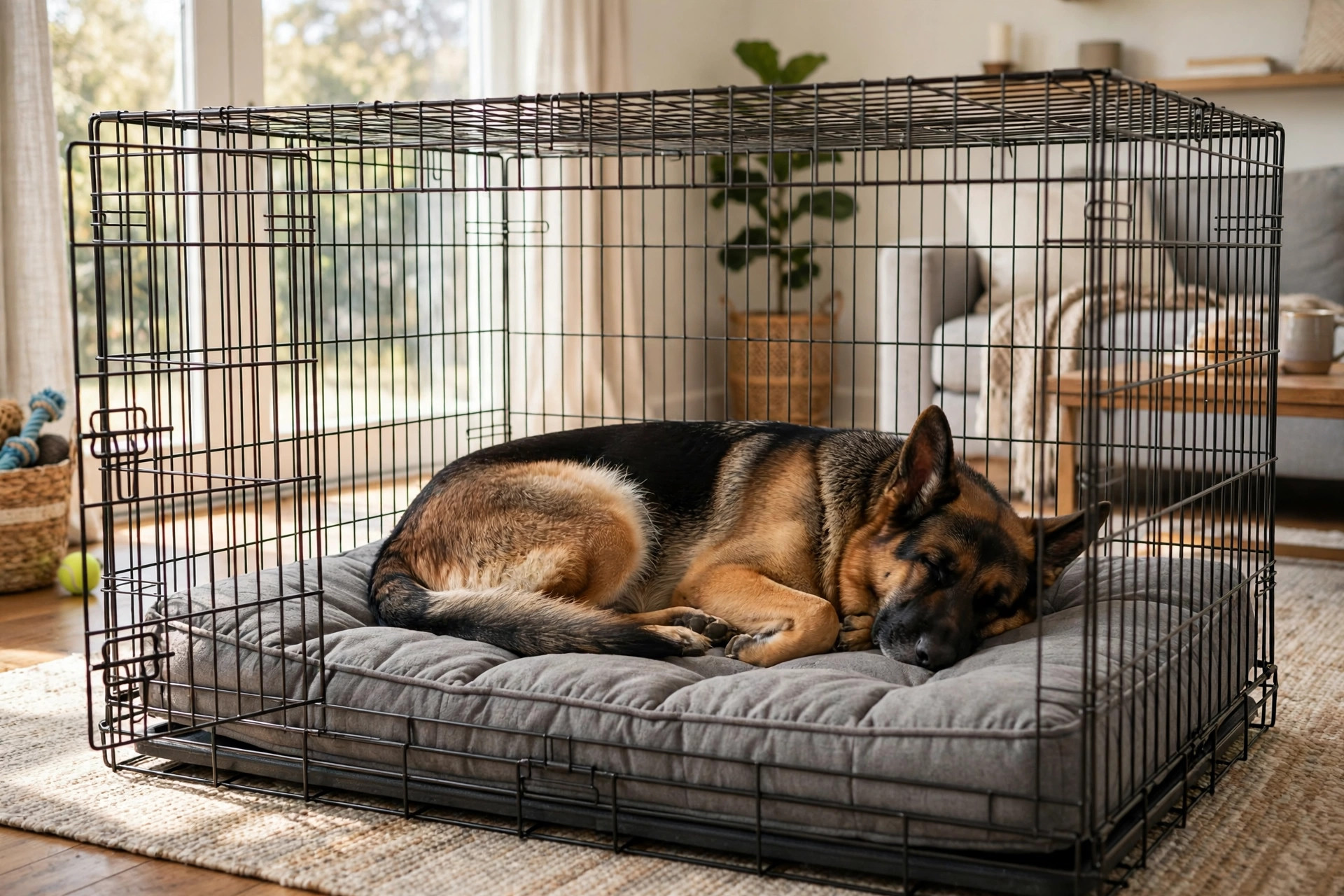
The bed inside matters as much as the crate
\n
A crate is only as comfortable as the bed inside it, and big dogs are heavy enough to feel a thin bed through to the crate floor. Measure the internal floor of the crate, then buy a bed that fills it edge to edge — a bed that slides around is a bed the dog will push into a corner and ignore.
\n
Orthopaedic foam matters more for large dogs than for small ones: a 40 kg dog puts real pressure on elbows and hips, and a thin pad will not protect them. Our big dog bed ideas guide covers XXL beds that hold up for large dogs, and our orthopedic dog beds guide explains foam density — the number that actually tells you whether a bed will support a big dog.
\n
Safety rules for crating a large dog
\n
- \n
- Never crate a dog in a crate they cannot stand up and turn around in. If the dog has to duck or shuffle, the crate is too small.
- Remove collars before crating. A collar tag or buckle can catch on wire and strangle a dog — this is the most common crate injury, and it is entirely preventable.
- Ventilation always. A crate in a warm room, in direct sun, or covered with a thick blanket can overheat a big dog fast. If you cover the crate, leave at least two sides open.
- Water for long stays. If the dog will be crated for more than two hours, attach a water bowl that cannot be tipped — a clip-on bowl or a heavy ceramic bowl that fits the crate floor.
- Four hours is the limit for most adult dogs. Puppies need far less. A crate is a den, not a storage box — if your dog is crated for most of the day, the setup is wrong, not the dog.
- Never use the crate as punishment. A dog that is sent to the crate when they are naughty learns to fear it. A dog that is sent to the crate with a chew learns to love it.
\n
\n
\n
\n
\n
\n
\n
Mistakes to avoid
\n
- \n
- Buying by the label, not the tape measure. \”Large\” on the box means nothing. Measure the dog, measure the crate, compare the numbers.
- Buying the crate for the puppy, not the adult. A puppy grows into a large dog in months. Buy the adult size with a divider, not a small crate you will replace twice.
- Choosing looks over strength. A beautiful furniture crate with a weak latch is a crate your dog will open. Check the latch before you check the finish.
- Putting the crate in the busiest spot in the house. A crate in the middle of the hallway is not a den — it is a thoroughfare. Put it in a quiet corner where the dog can see the room but is not in the traffic.
- Skipping the bed. A bare crate floor is cold, hard and slippery. A big dog will not choose to sleep on it, however much you want them to.
- Crating a dog that has never been crate trained. A large dog that panics in a crate can injure itself badly. Train in short, positive sessions — a few minutes at a time, with the door open, then closed, then with you out of the room.
\n
\n
\n
\n
\n
\n
\n
FAQs
\n
What size crate does a large dog need?\nMost large dogs (30–40 kg, like labradors and German Shepherds) need a 42–48 inch crate — 110–120 cm long. Dogs over 50 kg need a 54-inch crate (130–140 cm). Measure your dog from nose to tail base and add 10–15 cm for the minimum length, and from the floor to the top of the head while sitting, plus 10–15 cm, for the minimum height.
\n
Is a 42-inch crate big enough for a labrador?\nUsually yes — a 42-inch (107 cm) crate fits most adult labradors, who are typically 90–100 cm from nose to tail base. Measure your own dog rather than trusting the breed average: a tall male labrador may need a 48-inch crate.
\n
What is the best crate for a large dog that chews?\nA heavy-duty steel crate with welded bars and a two-step latch. Standard wire crates bend under a determined chewer, and plastic crates can be chewed through at the door. Pair the strong crate with crate training — a dog that is calm in the crate does not chew it.
\n
Can a large dog sleep in a crate every night?\nYes, if the crate is the right size, has a proper bed, and the dog has been crate trained positively. Many large dogs choose to sleep in their crate with the door open. If your dog is distressed in the crate at night, the crate is not the problem — the training or the size is.
\n
Should a large dog’s crate have a divider?\nYes, if you are buying the crate for a puppy. The divider lets you use the full-size adult crate from day one, shrinking the space while the puppy is small and expanding it as they grow. For an adult dog, a divider is unnecessary.
\n
Where should I put a large dog’s crate?\nIn a quiet corner of the room where the family spends the most time — close enough that the dog feels part of the household, far enough from the main walkway that they are not disturbed. Avoid draughty spots, radiators and direct sun.
\n
How long can a large dog stay in a crate?\nFour hours is a reasonable maximum for a healthy adult dog during the day, with a break to stretch, toilet and drink. Puppies need much shorter periods — roughly one hour per month of age. Overnight, an adult dog that is crate trained will happily sleep 7–8 hours in their crate.
\n
The bottom line
\n
A large dog’s crate is not a bigger version of a small dog’s crate — it is a different purchase, with different rules. Measure the dog, not the box. Buy the adult size with a divider if you have a puppy. Spend the money on strength and a proper bed, not on features you will never use. And put the crate where the dog can be part of the family, because a crate that sits in a cold garage is a crate the dog will hate.
\n
Get those four things right and the crate stops being a cage and becomes what it is meant to be: your big dog’s own room, in the middle of your home.
\n
Pin this for later 📌 — and if you are still setting up your dog’s space, our dog crate ideas cover the furniture-style designs, our DIY dog house ideas cover outdoor builds, and our dog kennel guide covers the outdoor run.
“,
“source_draft”: “/home/hatch/workspace/goals/pinterest-pin-automation-for-petsmush-com/files/large-dog-crate-ideas-post-draft.md”,
“status”: “publish”
}