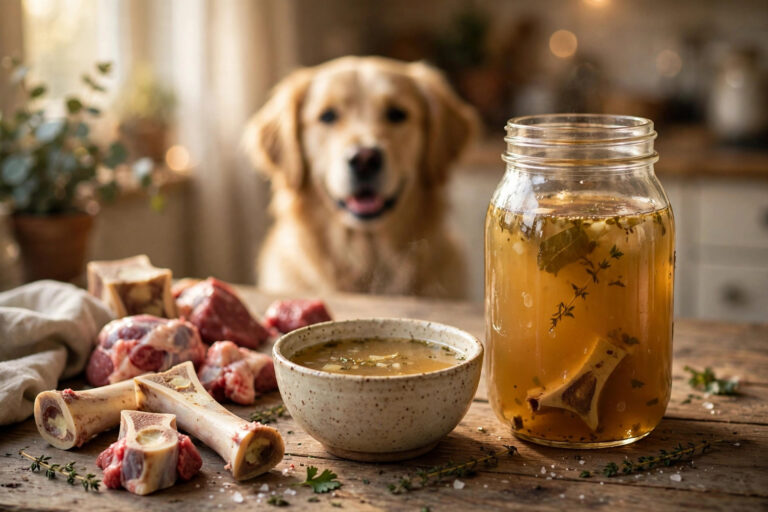
Simmer bones low and slow and you get something magic: a
golden, collagen-rich broth that dogs go absolutely wild for. Bone
broth has moved from old-fashioned kitchen habit to a genuine
functional food — vets now recognise its collagen and amino acids as
real support for early-stage joint stiffness, gut health and
hydration. And the best part? The safe homemade version costs a
fraction of the store-bought pouches.
But not every broth in your kitchen is dog-safe. This guide covers
what bone broth actually does for dogs, a foolproof slow-simmered
recipe, the three ingredients that must never go in the pot, and the
smart ways to serve it — from picky-eater bribery to frozen summer
treats.
Is bone broth good for dogs?
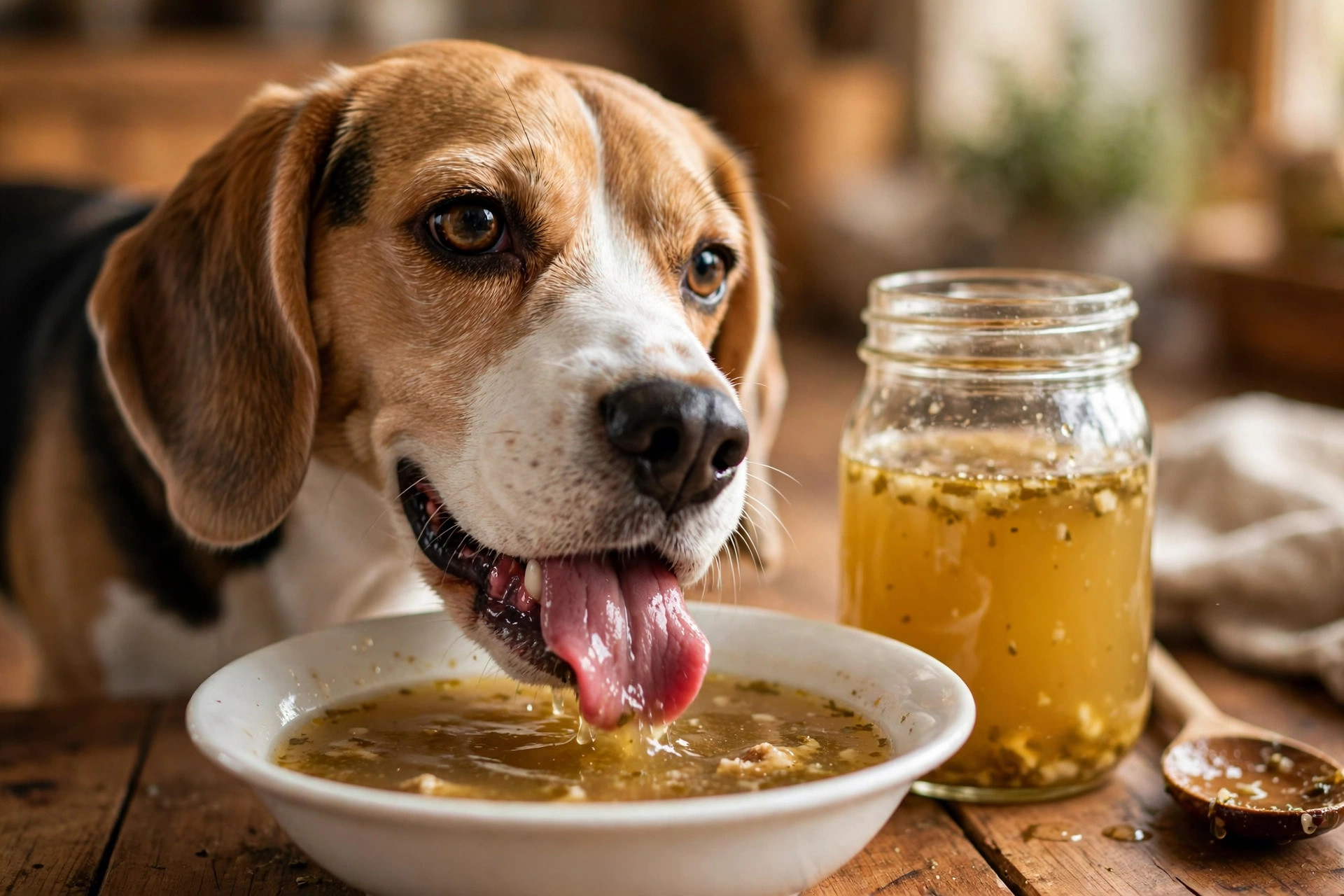
Yes — plain, dog-safe bone broth is one of the simplest functional
foods you can give your dog. The long, low simmer pulls gelatin,
collagen, amino acids and minerals out of the bones and connective
tissue into the liquid. Here’s what that means in practice:
-
Joint support. Collagen breaks down into glucosamine, chondroitin
and hyaluronic acid — the same compounds in joint supplements. In
2026, veterinary boards formally recognised bone broth collagen as
a reasonable dietary support for dogs showing early signs of
arthritis. It won’t rebuild a damaged joint, but it is a genuinely
useful daily topper for seniors and active dogs. -
Gut health. Gelatin helps support the mucosal lining of the
digestive tract, which is why bone broth is the classic “bland
recovery food” vets suggest after stomach upsets. It’s gentle,
hydrating and easy to digest. -
Hydration. Many dogs — especially those on dry kibble — don’t
drink enough water. A splash of broth on dinner or a warm bowl on a
cold day gets meaningful extra fluid into them without a fight. -
Appetite and palatability. Bone broth is the picky-eater cheat
code. A quarter-cup drizzled over kibble turns a boring bowl into
something irresistible, which matters a lot for recovering, senior
or fussy dogs that need to eat. -
Skin and coat. The amino acids (glycine, proline) and collagen
support skin elasticity and coat condition from the inside out. -
Post-illness recovery. Warm, bland and easy to digest, broth is
ideal for dogs bouncing back from vomiting, diarrhoea or surgery —
ask your vet about timing after a GI episode.
Think of it as a daily health topper rather than a meal: a
nutritional sidekick that makes the main diet work harder.
Store-bought vs homemade: which is better?
The grocery aisle now stocks “pet bone broth” pouches, and some are
perfectly fine — but homemade wins on three counts: cost (pennies
per batch from bones you’d otherwise bin), control (you know
exactly what went in), and concentration (homemade slow-simmered
broth gels in the fridge; most commercial broths don’t, because
they’re too dilute to carry much collagen).
If you buy instead of making, check the label ruthlessly: no onion
or garlic (powdered counts), no excessive salt, no “natural flavours”
you can’t identify, and no xylitol in flavoured products. Plain,
low-sodium pet-formulated broth is the safe pick.
The safe homemade bone broth recipe
This is the classic slow-simmered version — set it up in five
minutes, then let time do the work.
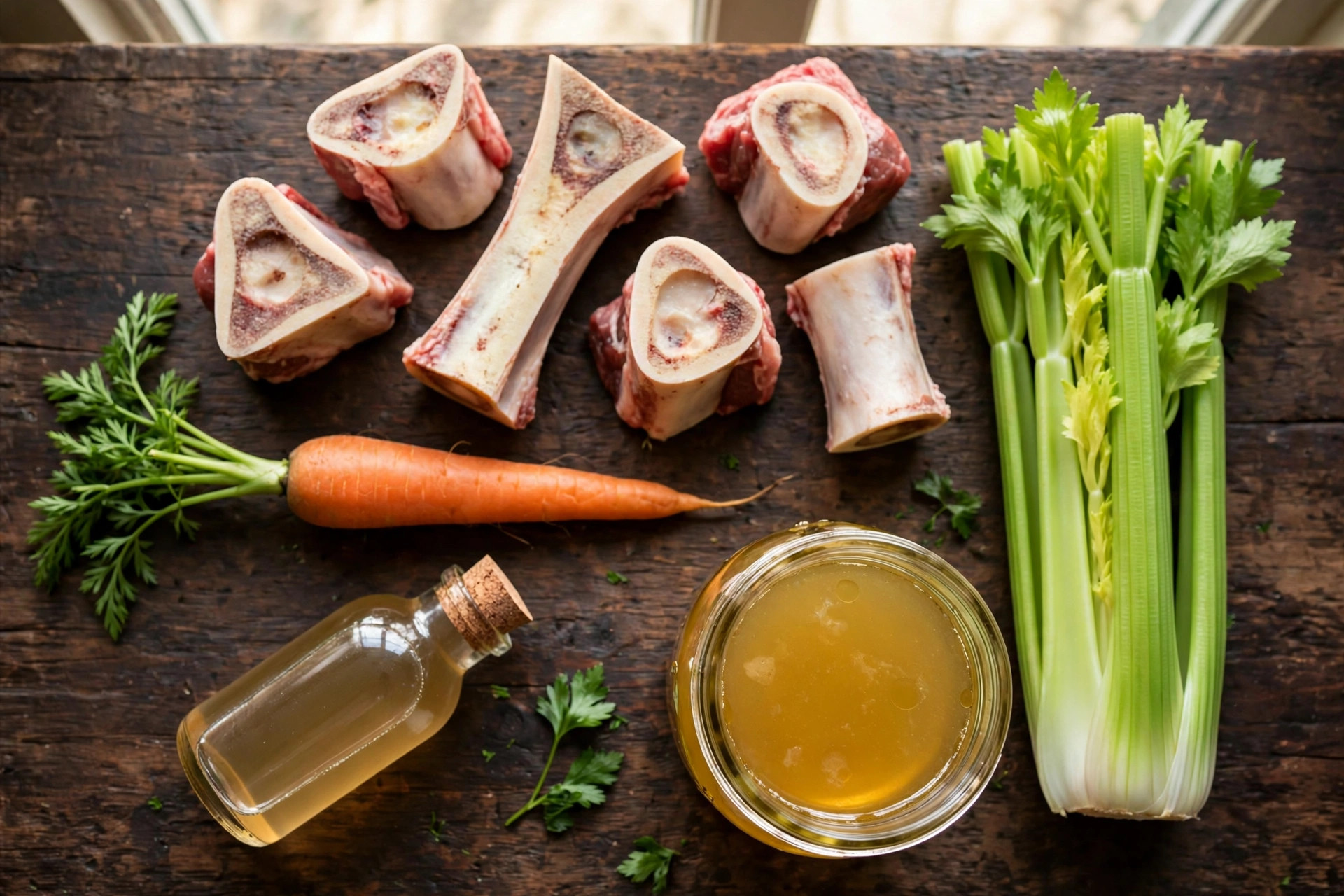
What you need
-
Bones: 1–1.5 kg of raw or roasted beef marrow bones, knuckles,
oxtail or chicken carcasses/feet. A mix of meaty bones and joint-y
bones gives the best gel. Chicken feet are collagen gold if you can
find them. -
Water: enough to cover the bones by 3–5 cm.
-
Apple cider vinegar: 1–2 tablespoons. This is the secret
ingredient — the mild acid helps pull minerals and collagen out of
the bones. Your dog won’t taste it. -
Optional veg: a carrot or two and a stalk of celery, roughly
chopped. Dog-safe and adds flavour. (Optional — skip if your dog
has a sensitive stomach.)
The 3-step method
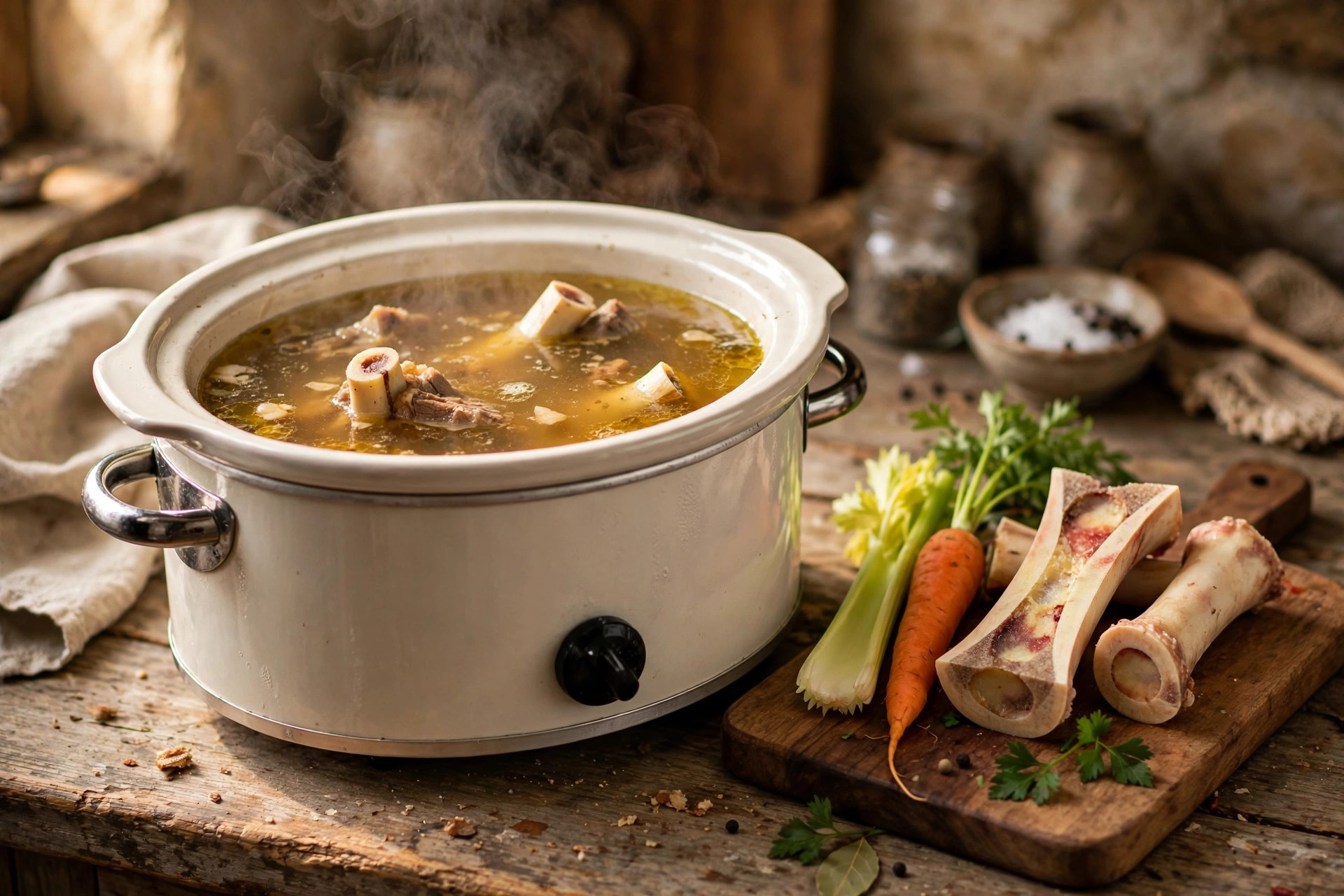
Step 1 — Load the pot. Put the bones in your largest pot or slow
cooker, cover with water, and add the apple cider vinegar (and veg if
using). Let it sit for 30 minutes before heating — this gives the
acid a head start on the bones.
Step 2 — Simmer low and slow. Bring to a gentle boil, skim off
any foam that rises, then drop to the lowest simmer. Cook for
12–24 hours (slow cooker on LOW is ideal and the safest
hands-off option). The broth should barely bubble. Top up with water
if it drops below the bones.
Step 3 — Strain, cool, store. Strain everything through a fine
mesh sieve — remove every bone and bone fragment, as cooked bones
are brittle and dangerous. Cool the broth, refrigerate overnight, and
skim the fat cap off the top in the morning. What remains should
wobble like jelly when cold: that’s the collagen, and it’s exactly
what you want.
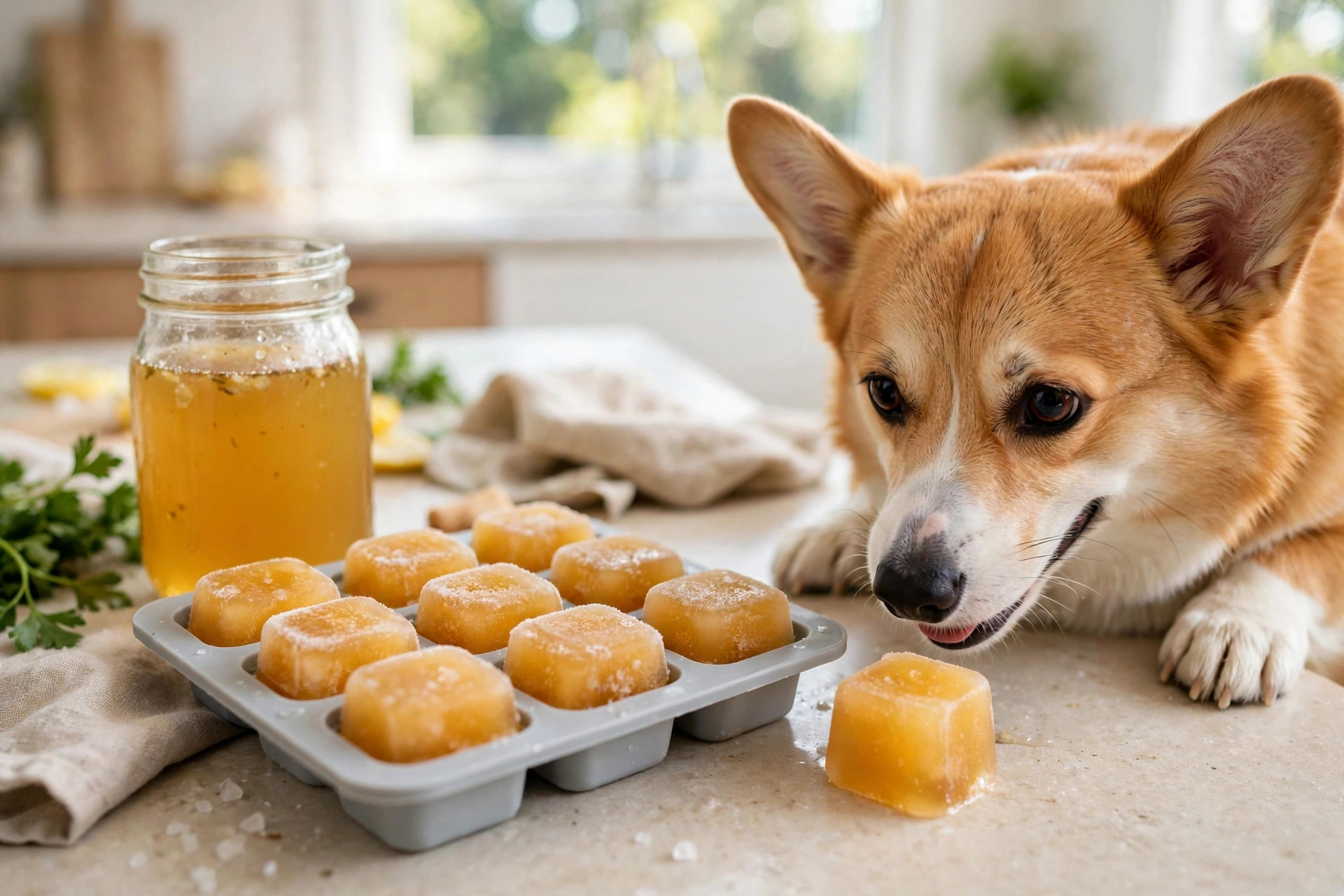
Storage: fridge 4–5 days in sealed jars; freezer 3–4 months (freeze in ice-cube trays for single servings).
The 3 ingredients that must never go in the pot
Regular cooking broth and dog broth look the same — but three common
soup ingredients are genuinely dangerous for dogs: (1) Onion (all
forms) — damages dogs’ red blood cells and can cause haemolytic
anaemia; (2) Garlic — toxic to dogs in meaningful amounts, and
broth concentrates it; (3) Excess salt / stock cubes — far too
salty for dogs and usually contain onion powder too. Also skip leeks,
chives and unidentified soup bases.
How much bone broth can a dog have?
Broth is a topper, not a meal — keep it to roughly 5–10% of daily
calories: small dogs (under 10 kg) 2–4 tablespoons/day; medium dogs
(10–25 kg) ¼–½ cup/day; large dogs (over 25 kg) ½–1 cup/day. Start
small the first few days. Dogs with kidney disease, on sodium-
restricted diets or on medication: check with the vet first.
5 smart ways to serve bone broth
-
The kibble upgrade. Pour a warm quarter-cup over dry food and let it soak 5 minutes.
-
Frozen broth cubes. Freeze in ice-cube trays for a cooling summer chew.
-
The warm-up bowl. A small warm bowl on a cold evening for senior dogs.
-
Post-walk recovery. A few tablespoons after a long hike help rehydration.
-
Medication helper. Soak a pill pocket in broth to make medicine time easier.
Bone broth for puppies, seniors and sick dogs
Puppies: fine in small amounts from ~8 weeks (soften kibble during
weaning). Senior dogs: bone broth’s best audience — collagen for
stiff joints, warmth and extra hydration for ageing kidneys.
Recovering dogs: small, frequent sips of plain broth once vomiting
has stopped — always follow the vet’s timing guidance.
The bottom line
Bone broth earns its superfood reputation honestly: real collagen for
joints, gelatin for the gut, hydration for kibble-fed dogs, and a
flavour dogs find irresistible — all from bones, water, vinegar and
patience. Make it plain, keep onion and garlic far away from the pot,
skim the fat, and serve it as a topper rather than a meal.
FAQs
Is bone broth good for dogs every day? Yes, plain homemade
broth is safe as a daily topper in sensible amounts (5–10% of daily
calories). Dogs with kidney disease or on sodium-restricted diets
should check with their vet first.
Can dogs have store-bought bone broth? Only if pet-formulated
or verified plain: no onion or garlic in any form, low sodium, no
xylitol. Homemade is safer and cheaper.
Why didn’t my bone broth gel? Usually too much water, too
short a simmer, or too few joint-y bones (knuckles, feet, oxtails gel
best). Aim for 12–24 hours at a bare simmer.
Can I give my dog the bones from the broth? No — never.
Cooked bones splinter and can cause choking or intestinal injury.
Strain out and discard every bone; serve only the liquid.
How long does homemade bone broth last? 4–5 days refrigerated
in sealed jars, or 3–4 months frozen. Freeze in ice-cube trays for
single servings.
Is bone broth good for dogs with upset stomachs? Plain,
fat-skimmed broth is a classic gentle recovery food — hydrating and
easy to digest. Offer small amounts once vomiting has stopped, and
follow the vet’s guidance.