
Some dogs bounce off the furniture and sleep anywhere. Others pace at
strange noises, tremble during storms, and won’t settle unless they’re
wedged against you. If you have one of the second kind, you’ve probably
seen the ads: round, fluffy, donut-shaped beds that promise to melt away
anxiety with raised rims and faux-fur centres.
Do calming dog beds actually work — or are they just a very soft place to
nap? The honest answer is somewhere in the middle. Here’s what the design
is really doing, what behaviour science says about it, and how to pick one
that earns its floor space.
What makes a “calming” bed calming?
A calming bed isn’t a medical device — it’s a bed shaped around what anxious
dogs already do when they’re looking for comfort. Three design choices do
most of the work:
1. The raised rim (the den effect)
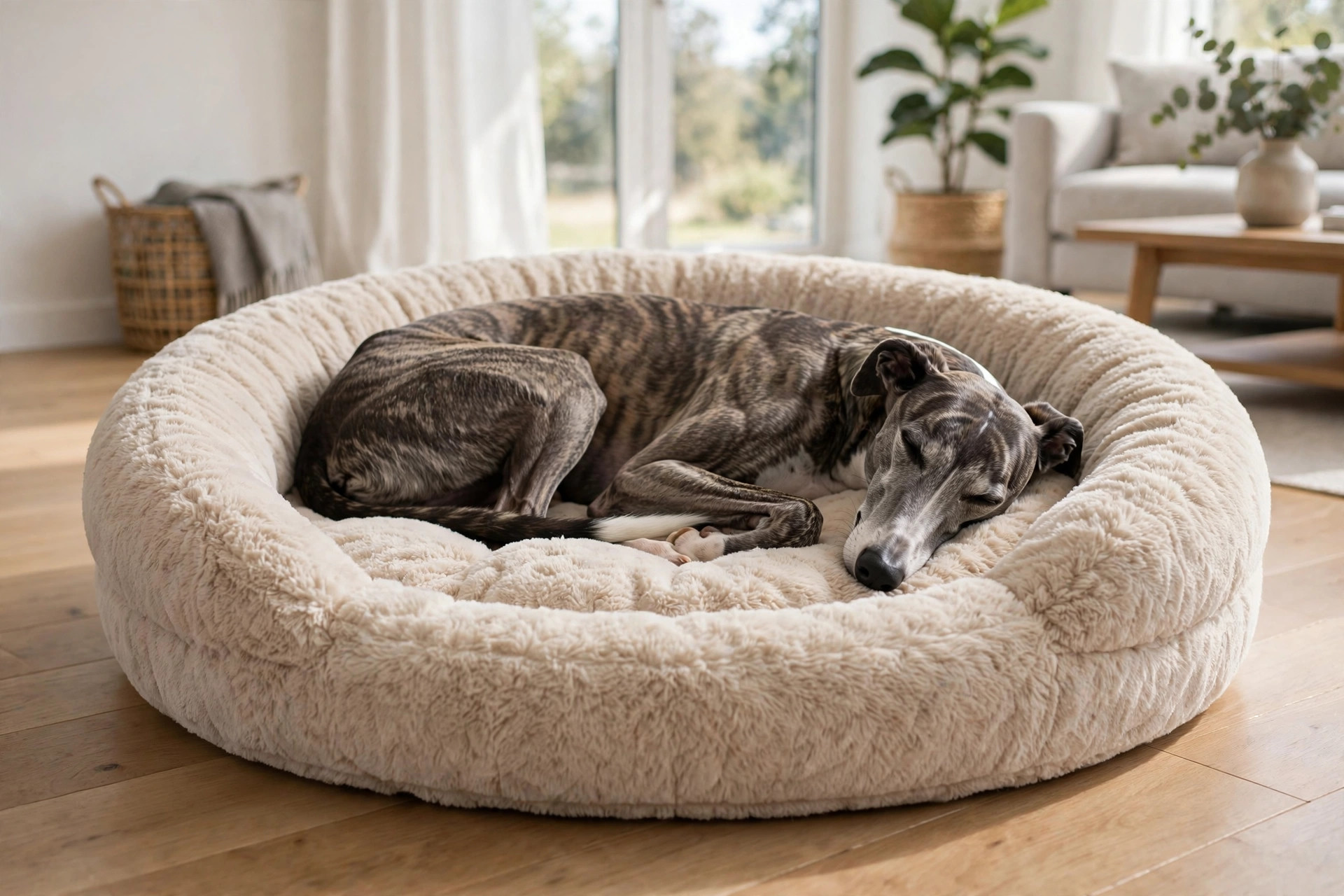
The defining feature is the high, bolstered edge — usually 15 to 25 cm of
plush wall circling most of the bed. Dogs that curl up naturally press their
back against something solid: a sofa arm, your legs, a crate wall. A raised
rim gives them that contact on demand. Behaviourists call this denning
behaviour — dogs are descendants of den animals, and enclosed-feeling
resting spots read as “safe territory” to a nervous brain. For a storm-shy
dog, the rim is a barrier between them and the worrying world.

2. The faux-fur sensory centre
Most calming beds use a long-pile shag or faux-fur cushion in the middle.
This mimics the texture of another dog’s coat — a puppy sleeping against
littermates gets the same sensory input. It’s the same principle behind
heartbeat plush toys for new puppies: warmth + familiar texture lowers
arousal. Dogs that knead, nose-bury, or paw at soft blankets tend to be the
biggest fans.

3. The snug size
Calming beds are deliberately sized closer to the dog’s curled-up body than
general beds are. That gentle all-round pressure resembles a swaddle or a
thunder shirt — and it’s not a coincidence that the same anxious dogs who
love thunder shirts also love donut beds. The hug works both ways: the rim
behind the back and the rim under the chin.
Do they actually work? What the evidence says
Let’s be straight: there are no large clinical trials on donut beds for
canine anxiety. The pet-bed studies that exist are small, often run by the
manufacturers, and mostly measure sleep duration rather than anxiety
scores. So the evidence is soft — but the mechanism is plausible and
consistent with well-studied behaviour principles:
-
Denning preference is real. Shelter and kennel studies consistently
show dogs choose smaller, enclosed resting spaces when stressed. A raised
rim is the home version of that. -
Sustained gentle pressure helps some dogs. The anxiety-wrap literature
(thunder shirts, calming coats) shows modest but real reductions in
heart-rate and stress behaviours for many dogs — and a snug bed applies
the same principle while they sleep. -
Routine sleep itself calms. A dog that naps longer and deeper is simply
less reactive. If a bed gets your dog to settle 20% sooner, that compounds
across every day.
What calming beds do not do: cure separation anxiety, fix noise phobia
on their own, or replace desensitization and vet guidance for genuinely
clinical anxiety. Think of them as one ingredient — an important one —
not the whole recipe. Owners of mildly anxious dogs (the pacers, the
storm-watchers, the velcro sleepers) report the biggest wins. Dogs with
severe, diagnosed anxiety disorders need the bed plus a behaviour plan,
and sometimes medication — that’s a vet conversation.
Calming beds vs orthopedic beds: different jobs
These get confused because both are marketed to “senior” and “anxious”
dogs, but they solve different problems:
-
Calming beds (donut, cuddler, nesting) → designed for anxious,
nest-loving, curl-up sleepers. The priority is the raised rim and the
snuggle factor. They offer some cushioning, but joint support is a
side benefit. -
Orthopedic beds (flat memory-foam rectangles) → designed for joint
support, arthritis, and heavy dogs. The priority is even weight
distribution. They offer comfort, but an anxious curler gets no
“hug” from a flat slab.
An anxious senior is the overlap case: a dog that both curls for comfort
and has stiff hips. For those dogs, the best pick is often a calming bed
with a genuinely supportive (not hollow) base, or a flat orthopedic bed
with a low bolster edge. Buy for the bigger problem first — a dog in pain
won’t calm down no matter how fluffy the rim.
How to pick the right calming bed
Size: snug, not cramped
Measure your dog curled up, then choose a bed whose internal sleeping area
matches that — not the outer diameter. Too big and you lose the hug; too
small and your dog drapes over the rim and gives up. Most brands run
small: when in doubt, size up one from the chart.
Rim height and firmness
The rim should stand up on its own, not flop flat when your dog leans on
it. Squashed-flat rims are the tell-tale sign of a cheap bed — and the
number one complaint in reviews. Look for rims filled with dense, recycled
microfibre or shredded foam rather than thin polyfill.
The centre matters too
Cheap donut beds are all rim and no mattress: a thin disc in the middle
that bottoms out onto the floor. Press the centre in the shop — if you feel
floor through it, keep looking. A decent foam or thick-filled base protects
hips and elbows and makes the bed one a dog returns to.
Cover and washing
Calming beds are fur magnets — long-pile shag traps hair, dander and drool.
A machine-washable bed (whole bed or zip-off cover) is not optional, it’s
the whole maintenance plan. Wash at 30–40°C with unscented detergent; tumble
low or air-dry to keep the faux fur from matting. A spare cover means the
bed is never out of service during laundry day.
For chewers and power diggers
The plush, stuffable construction of donut beds is catnip for determined
chewers. If your dog eats bedding, a calming bed is a supervised-use bed
only — stuffing ingestion is a vet emergency. Nest-diggers are usually fine,
but watch the first week: if your dog is harvesting the fill, this style
isn’t for them.
Getting your dog to actually use it
-
Put it where they already nap. Dogs choose location first, bed
second. The new bed goes in the corner they’ve already claimed —
you’re upgrading their spot, not relocating them. -
Add your scent. A worn t-shirt tucked under the cover bridges the
first few days. Your smell is the fastest trust signal you have. -
Reward the settling. Toss a treat on the bed whenever they step in,
and quietly reward them for lying down. Two to three days of this and
most dogs self-assign. -
Don’t force it. Pushing a nervous dog into the bed teaches them the
bed is where scary handling happens. Patience beats placement.

Safety notes
-
Chewing and ingestion: remove the bed when unsupervised if your dog
pulls stuffing out of anything. Intestinal blockages from swallowed fill
are genuinely dangerous — no calming effect is worth that risk. -
Overheating: long faux-fur beds run warm. Heavy-coated breeds and
flat-faced (brachycephalic) dogs can overheat in summer or heated rooms;
offer a cooler flat bed alongside and let the dog choose. -
Small puppies: very young puppies can struggle to climb in and out of
high rims — choose a lower rim or a cuddler style until they’re bigger. -
Not a treatment: a calming bed supports anxious dogs; it does not
treat clinical anxiety. If your dog panics, injures itself, or can’t
function, see your vet about a proper behaviour plan.
Washing and care tips
-
Shake and vacuum weekly. Long-pile shag hides an astonishing amount
of hair. A weekly shake-outdoors plus a vacuum pass stops it baking in. -
Wash monthly (or sooner). Whole-bed wash at 30–40°C, unscented
detergent, no fabric softener — softener coats the fibres and kills the
plush texture dogs love. -
Dry fully before use. A damp bed smells and mildews fast. Air-dry or
tumble low, and fluff the faux fur with a soft brush once dry to restore
the shag. -
Two covers beat one. If your bed has a zip-off cover, a spare means
laundry day never leaves your dog bedless — anxious dogs notice routine
disruption.
FAQs
How long until my dog calms down in the new bed?
Most dogs investigate within hours and nap in it within a day or two. For
nervous dogs, give it a week of treats and your-scent bedding before
judging — routine matters more than the product.
Are calming beds good for separation anxiety?
They help with settling but they’re not a fix. A dog with real separation
anxiety needs training and often vet input; the bed can be one calm
anchor in a wider plan, not the plan itself.
Can big dogs use donut beds?
Yes, but most “calming” lines top out around medium sizes. Large anxious
dogs need genuinely large donut or cuddler beds — or a low-bolster
orthopedic bed that gives rim contact with proper support. Sizing charts
lie upward; read reviews from owners of your breed.
My dog burrows under the blankets instead. Will a donut bed convert them?
Often yes — hooded cave beds are the burrower’s upgrade. A standard donut
suits curlers; a burrower wants something to get under, so look for the
attached-flap or hood styles.
How often should I replace a calming bed?
When the rim stops standing up or the centre bottoms out — typically 1–2
years of daily use. A flattened donut is just a round rug.