A tired dog is a good dog — but here’s what most owners miss: fifteen
minutes of brain work can tire a dog out more thoroughly than an hour of
fetch. Puzzle games force your dog to think, sniff, plan and problem
solve, and that mental effort burns energy the way no amount of running
in circles quite does. Trainers use puzzle feeding on rainy days, with
under-stimulated teenagers, with reactive dogs that need a calming
focus, and with seniors whose legs have retired but whose brains are
still very much in the game.
The pet industry will happily sell you a £30 plastic puzzle. But the
games dogs love most are the ones you build from your own junk drawer:
a muffin tin, an old towel, a plastic bottle, a cardboard box. They cost
nothing, they take five minutes to set up, and you can retire them the
moment your dog cracks the code — then make a new one.
This guide gives you seven DIY dog puzzle toys from household stuff,
each rated by difficulty so you can start your dog at the right level
and work up.
A note on difficulty levels
Every game below has a rating: Easy, Medium or Tricky. Start
with Easy. A dog that succeeds stays engaged; a dog that fails twice
walks away from puzzle games entirely. Build the wins first, then raise
the stakes.
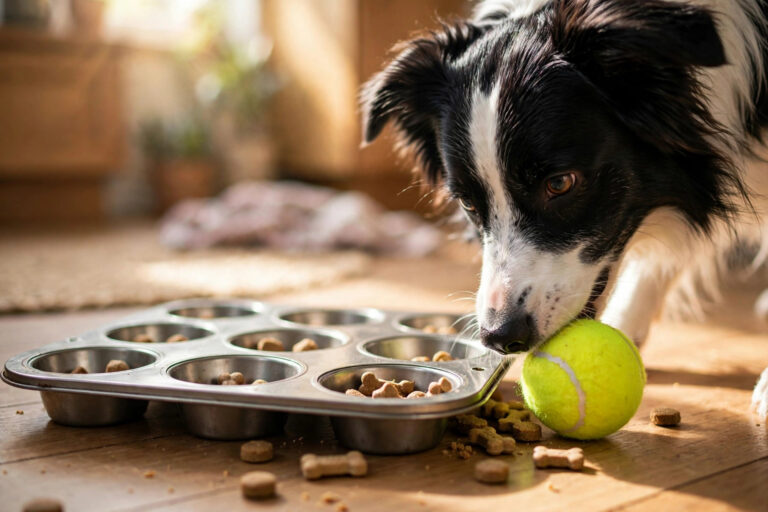
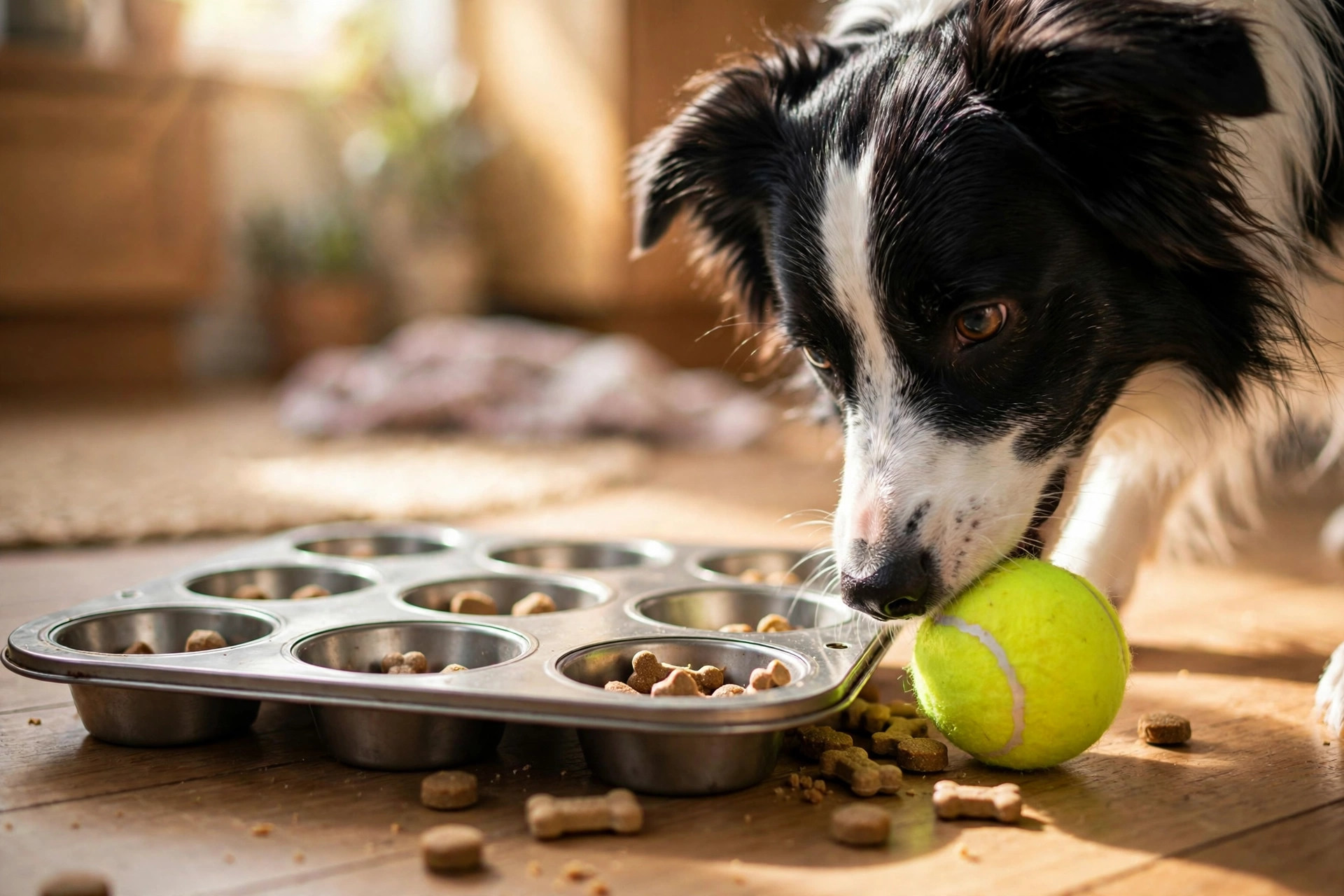
1. The muffin tin treat hunt — Easy
You need: a muffin tin, 6–12 small treats, 6 tennis balls.
Drop a treat into some (or all) of the muffin cups, then set a tennis
ball on top of each cup. Your dog has to nudge or lift the balls to get
the treats. Most dogs get it in under a minute — which makes it the
perfect first puzzle game, not a boring one. Let the first two rounds be
easy wins, then add more balls and cover every cup.
Best for: puppies, seniors, and dogs that have never played a
puzzle game before.
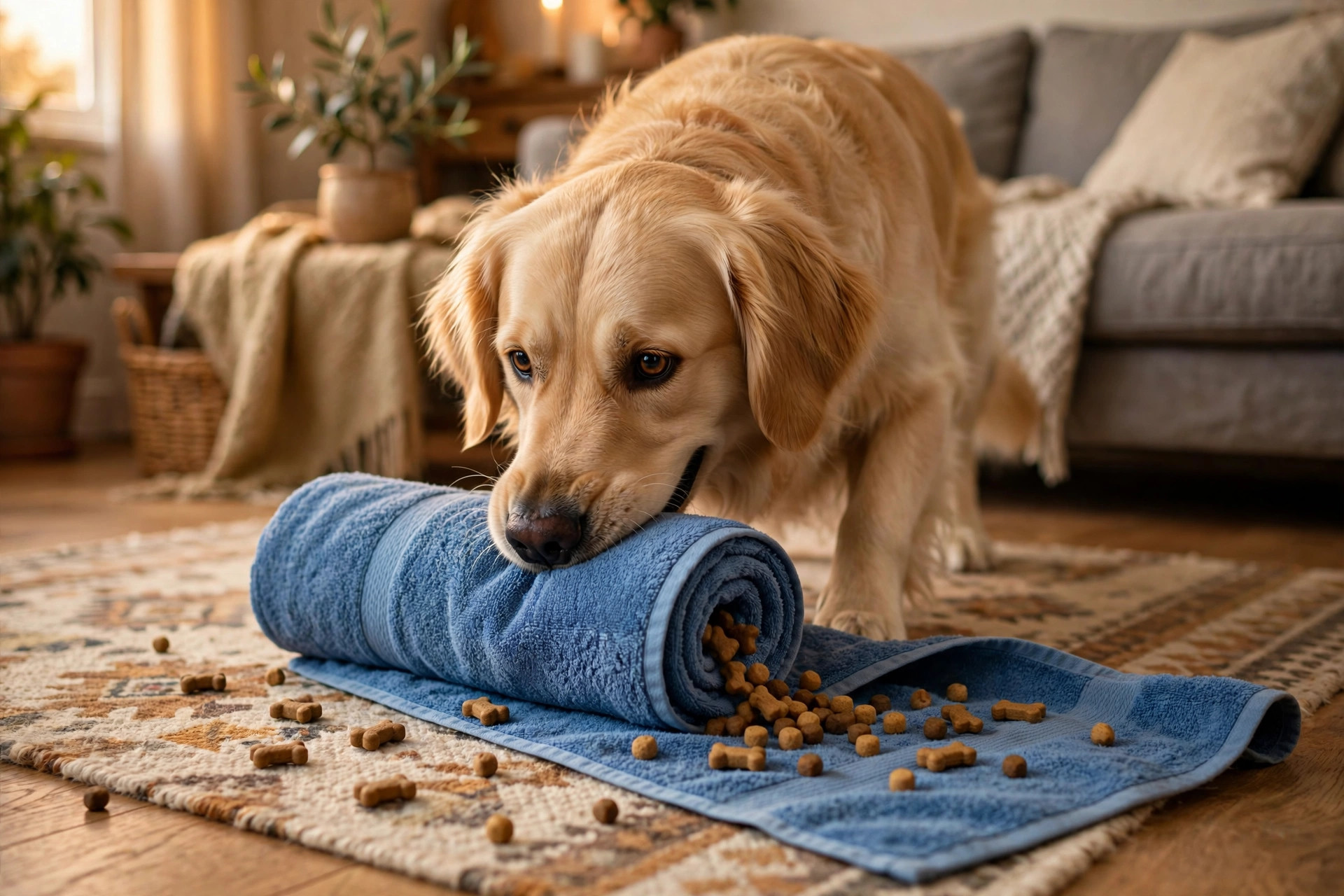
2. The towel roll-up — Easy
You need: an old bath towel, a handful of kibble or treats.
Lay the towel flat, scatter treats across it, and roll it up into a
tight log. Your dog unrolls it nose-first to find the rewards. For a
harder version, fold the towel in half before rolling, or tie a loose
knot in the middle of the rolled log. Towels are ideal because there’s
nothing to chew through and nothing small to swallow — just fabric and
food.
Best for: fast eaters — this turns a 40-second meal into a 10-minute
foraging session.
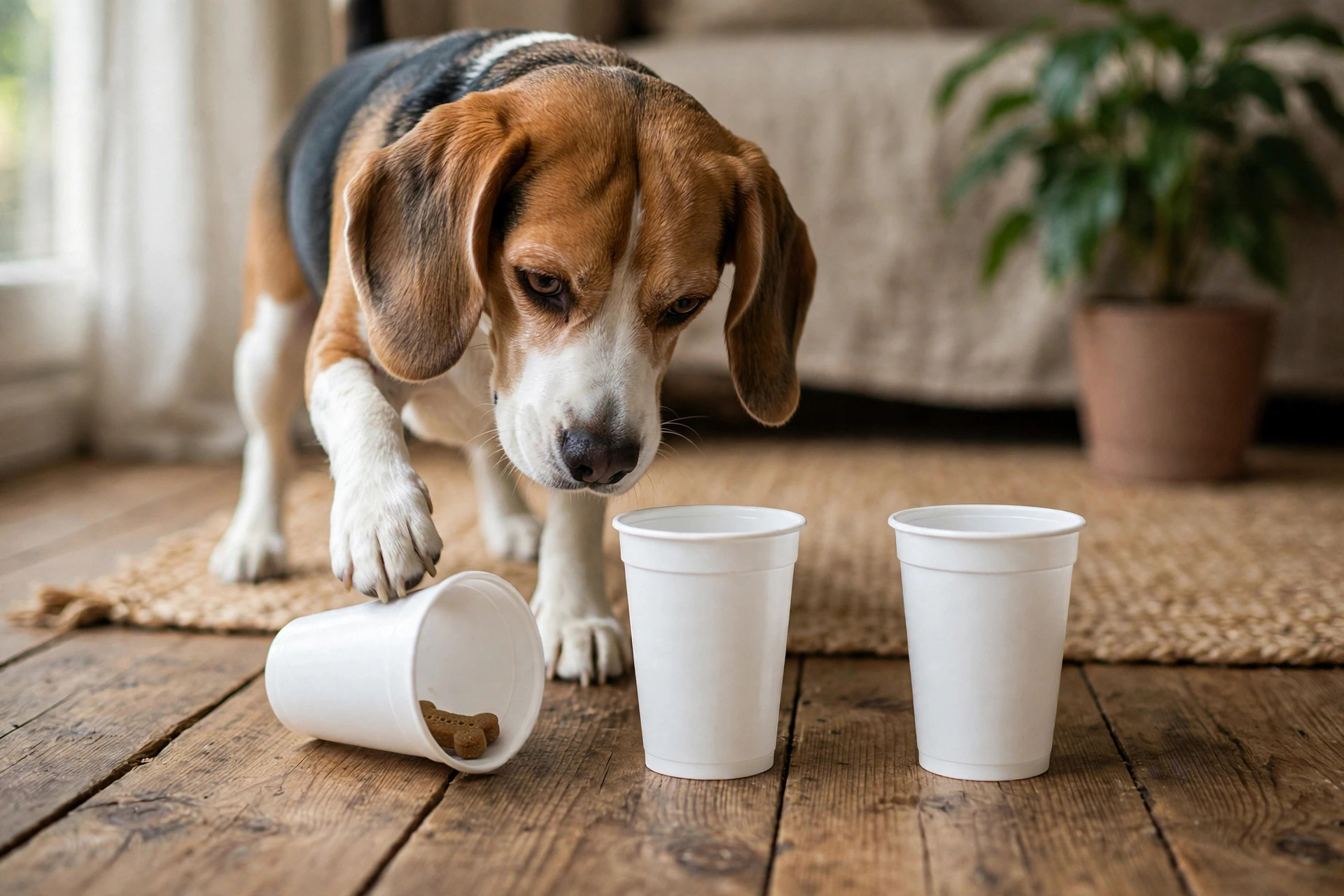
3. The cup shell game — Easy to Medium
You need: 3 identical plastic cups or small bowls, one smelly treat.
This is the classic street game, dog edition. Put a treat under one cup
while your dog watches, shuffle the cups slowly, then let them choose.
Real talk: most dogs will just knock all three over rather than
“deduce” anything, and that’s fine — the nose work is the point. Raise
the difficulty by adding cups, or by hiding the treat under a cup after
a brief “look away” so your dog has to search rather than track.
Best for: nose-driven breeds and rainy-day indoor play.
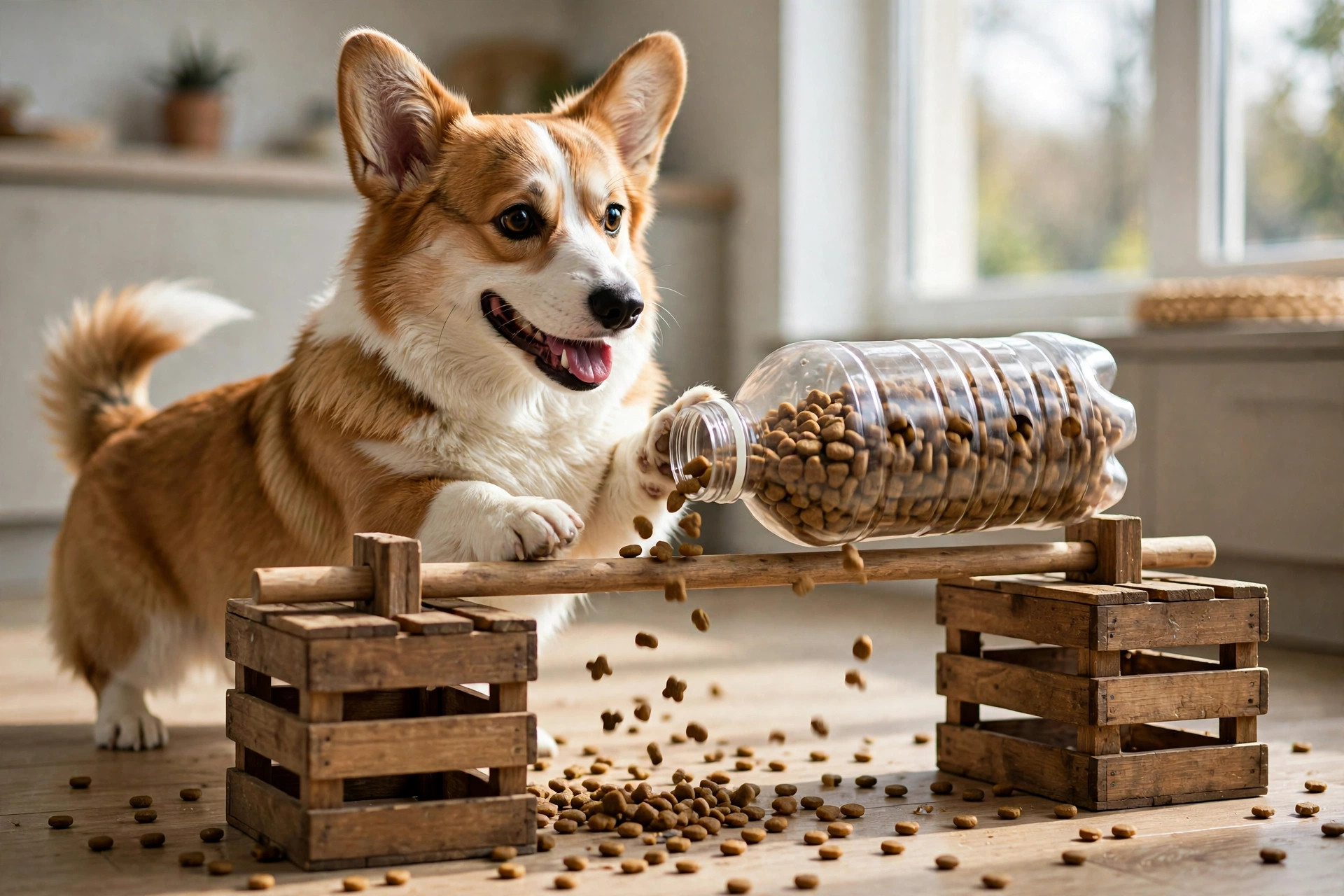
4. The bottle spinner — Medium
You need: an empty plastic bottle (500 ml is ideal), a wooden dowel
or broom handle, two sturdy boxes or chairs to rest the dowel across,
and some kibble.
Cut a couple of small treat-sized holes in the bottle — just big enough
for kibble to fall through. Remove the cap and the label. Thread the
dowel through the bottle’s middle (poke a hole on each side with a
screwdriver), rest the dowel across the two supports, fill the bottle
with kibble, and let your dog spin it with their nose or paw to shake
treats out. It rattles, it moves, it dispenses — dogs go wild for it.
Best for: food-motivated dogs and teenagers with energy to burn.
Supervise closely: retire the bottle the moment it cracks.
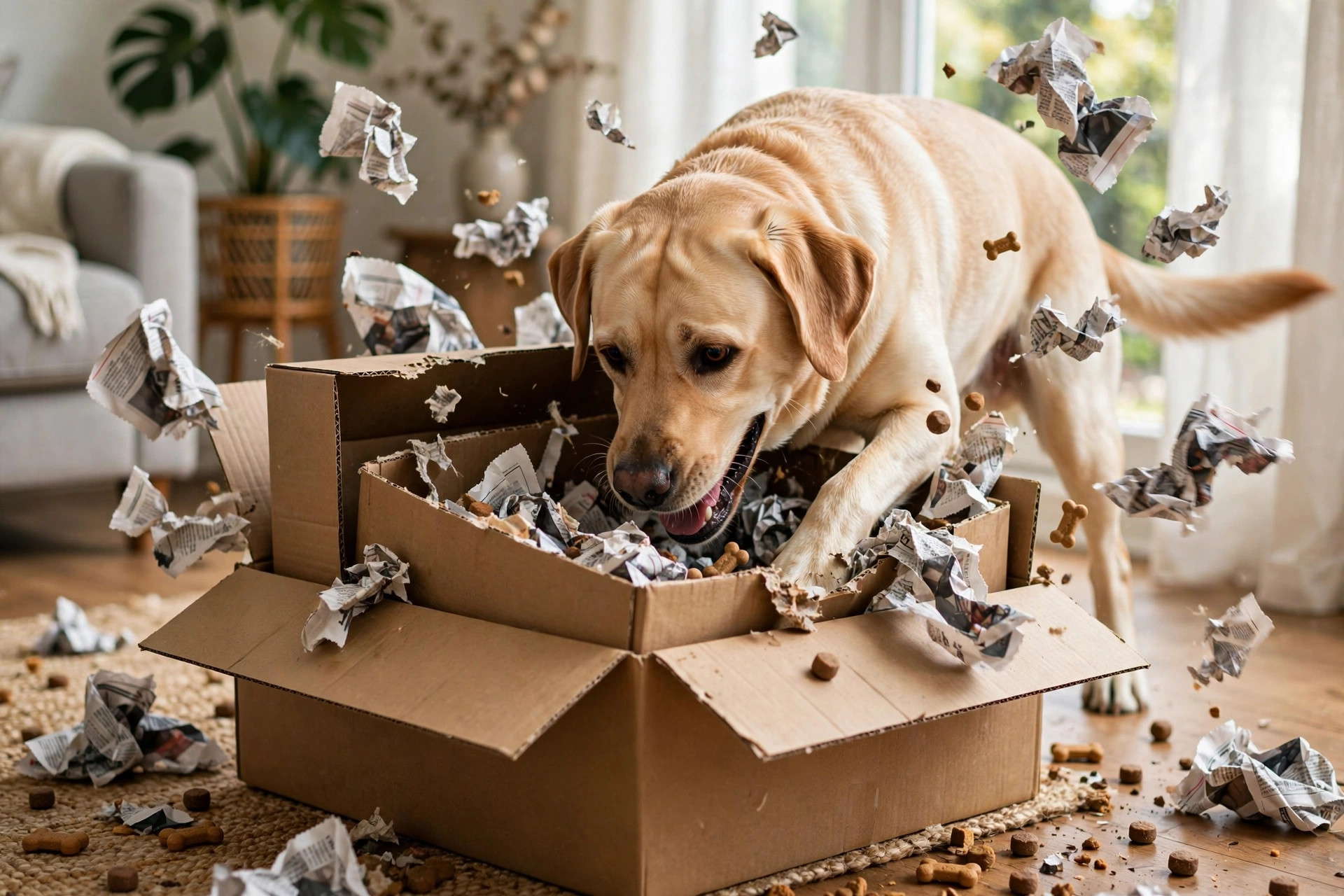
5. The cardboard box nest — Medium
You need: 3–4 cardboard boxes of decreasing size, treats, and some
scrunched newspaper.
Put treats in the smallest box, close its flaps loosely, nest it inside
the next box with more treats tucked in the newspaper around it, and
repeat. Your dog shreds, digs and unpacks their way to the centre like
a furry little archaeologist. Shredding is a natural, satisfying
behaviour — this gives it a legal outlet, and it costs you nothing but
yesterday’s delivery boxes.
Best for: dogs that love to rip things up. Expect confetti; embrace
the confetti.
6. The frozen ice-tray feast — Medium to Tricky
You need: a silicone ice cube tray or muffin mould, kibble or small
treats, and water or low-sodium broth.
Drop a treat into each compartment, fill with water or broth, and freeze
overnight. Pop the cubes out into your dog’s bowl (or a lick mat) and
let them lick, crunch and melt their way through breakfast. On hot days
this doubles as cooling enrichment; on cold days it stretches a meal
into a 20-minute project. Broth cubes smell incredible to dogs, so this
one is a guaranteed hit.
Best for: hot weather, teething puppies, and dogs that need
calming, repetitive licking.
7. The egg carton cracker — Tricky
You need: an empty cardboard egg carton and treats.
Put a treat in each cup of the carton, close the lid, and hand it over.
Simple to us — surprisingly hard for a first-timer, because the dog has
to figure out how to pry the lid open without opposable thumbs. Most
dogs learn to pin it with a paw and nose the lid up within a few tries.
Once they’ve cracked it, make it harder: put the carton inside a paper
bag, or stack a second carton on top.
Best for: confident dogs that have already beaten games 1–6. This
is your graduation puzzle.
Safety rules for homemade puzzle toys
Homemade doesn’t mean unregulated — you’re the safety inspector.
-
Supervise every session. No DIY puzzle toy is a leave-alone toy.
Watch, enjoy the show, and intervene the moment pieces start coming
apart. -
Remove small parts. Bottle caps, pull tabs, rubber bands and
twist ties must go before your dog ever sees the toy. -
Retire damaged toys immediately. A cracked bottle develops sharp
edges; a shredded box is fine, a half-eaten box is not — take it
away before cardboard becomes a meal. -
Size treats sensibly. Puzzle games dispense a lot of small
rewards. Use your dog’s regular kibble for at least half the games,
and cut training treats small, so the games don’t blow the daily
calorie budget. -
Know your chewer. Power chewers should not get the bottle
spinner unsupervised (or at all, if they eat plastic). Gentler dogs
can play with lighter materials safely. -
Wash what you reuse. Towels, silicone trays and bottles that get
regular use should be washed like any other food dish.
How often should dogs play puzzle games?
Once a day is the sweet spot for most dogs — a 10–15 minute session
replaces a chunk of physical exercise and keeps the brain in shape.
Rotate the games so your dog doesn’t memorise them: a puzzle your dog
has fully solved stops being enrichment and becomes a vending machine.
Retire a game for two weeks, then bring it back — it’ll feel new again.
FAQs
Are puzzle toys good for puppies?
Yes — they’re excellent for puppies. Start with Easy games (muffin tin,
towel roll-up) and short sessions. Puzzle play builds frustration
tolerance and teaches a young dog to think before acting, which pays
off in training for years.
My dog gives up when a puzzle is hard. What do I do?
Drop back to a level where they win, and make the first rep of every
session easy — let them see the treat go in. Confidence first, challenge
second. Some dogs also do better with smellier rewards; upgrade the
treats before you upgrade the puzzle.
Can puzzle games replace walks?
They complement walks, not replace them. Physical exercise builds
fitness and provides real-world socialisation; puzzle games burn mental
energy and build calm focus. A dog that gets both is a dog that settles
beautifully in the evening.
What treats work best in puzzle toys?
Small, dry and not too crumbly: regular kibble is ideal. For high-value
motivation, use tiny pieces of freeze-dried meat or cheese. Avoid
sticky treats in fabric games (towels, snuffle mats) — they gum up the
fibres and are a pain to wash out.
My dog destroys puzzle toys instead of solving them. Help?
Destruction is also enrichment — but expensive if it’s a shop-bought
toy. That’s the beauty of DIY: let them shred the box nest (game 5),
because the boxes are free. For the thinking games, redirect: if they
start eating the egg carton instead of opening it, take it away calmly,
reset it easier, and reward the first nose-touch. Shredding has its
place — just give it its own game.