{
“title”: “Dog Kennel Ideas: Outdoor, Indoor & DIY Builds That Work”,
“slug”: “dog-kennel”,
“excerpt”: “Dog kennel ideas for every garden and budget — outdoor 10×10 runs, DIY builds, indoor kennels and designs, with sizing, flooring and safety rules.”,
“meta_description”: “Dog kennel ideas for every garden and budget — outdoor 10×10 runs, DIY builds, indoor kennels and designs, with sizing, flooring and safety rules.”,
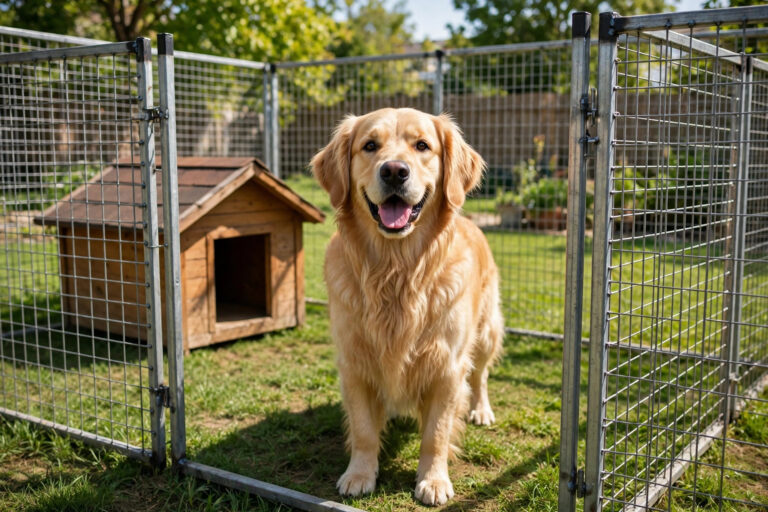
“featured_image_alt”: “Golden retriever standing inside a spacious outdoor dog kennel run with a wooden dog house in a sunny backyard.”,
“content_html”: “
A dog kennel is the one piece of garden kit that does three jobs at once: it gives your dog a safe outdoor space of their own, it keeps them out of the flower beds and off the road, and it gives you somewhere to put the dog when visitors arrive, the gardeners are in, or the fireworks start. Done well, a kennel is not a cage — it is a den with a fence around it, a patch of shade, a dry bed, and room to stretch.
\n
The mistake most people make is buying or building the wrong size, or the wrong type for how their dog actually lives. A kennel for a dog that spends two hours outside a day is a different thing from a kennel for a dog that spends the working day outside. This guide covers both, plus the indoor kennel for flats and small homes: five ideas, real sizes, flooring that survives mud and rain, and the safety rules that matter before your dog moves in.
\n
Kennel, crate, dog house — what is the difference?
\n
People use these words interchangeably, and the confusion costs money. A crate is the small indoor box for sleeping and training — a few hours at a time, always indoors. A dog house is the shelter itself: four walls, a roof, a bed inside — our DIY dog house ideas guide covers nine builds if the house is the part you are planning. A kennel is the whole enclosure: a fenced run plus the shelter inside it, big enough for the dog to walk, stretch, drink, and lie in the sun or the shade as they choose.
\n
That is why kennel sizing is about the run, not just the house. A kennel with a lovely dog house and a run the dog can barely turn around in is a crate with a roof — and a dog kept in one all day will be bored, stiff, and loud about it. Plan the run first, the house second.
\n
The 5 kennel types at a glance
\n
Outdoor run kennel. The classic: a fenced run of welded wire or chain link on posts, with a dog house inside and a roof or shade cloth over part of it. Best for dogs that spend long stretches outside. The standard size everyone sells is 10 x 10 ft (about 3 x 3 m), and it is popular for a reason — it fits most gardens and most dogs.
\n
DIY wooden kennel. Timber panels, a solid roof, and a proper door — built like a small garden room. Warmer, quieter and better looking than a wire run, and the best choice if the neighbours can see your garden. Costs more in time than money if you build it yourself.
\n
Indoor kennel. A pen or gated nook inside the house — under the stairs, in a utility corner, or a section of a room. Same idea as the outdoor run (a defined space that is the dog’s own), just indoors. Best for flats, puppies, and dogs that are only ever outside on a lead.
\n
10 x 10 kennel. Not a type so much as a size — the 10 x 10 ft run is the default panel set sold by every kennel supplier, which means parts, covers and gates are cheap and interchangeable. If you are buying rather than building, start here and adjust up or down.
\n
Budget kennel. Pallets, reclaimed fencing, a second-hand run bought locally, and a roof made from corrugated panels. The cheapest way into a proper kennel, and perfectly safe if the materials are sound — the safety checklist at the end of this guide is the test, whatever you spent.
\n
Size it right — the sizing table
\n
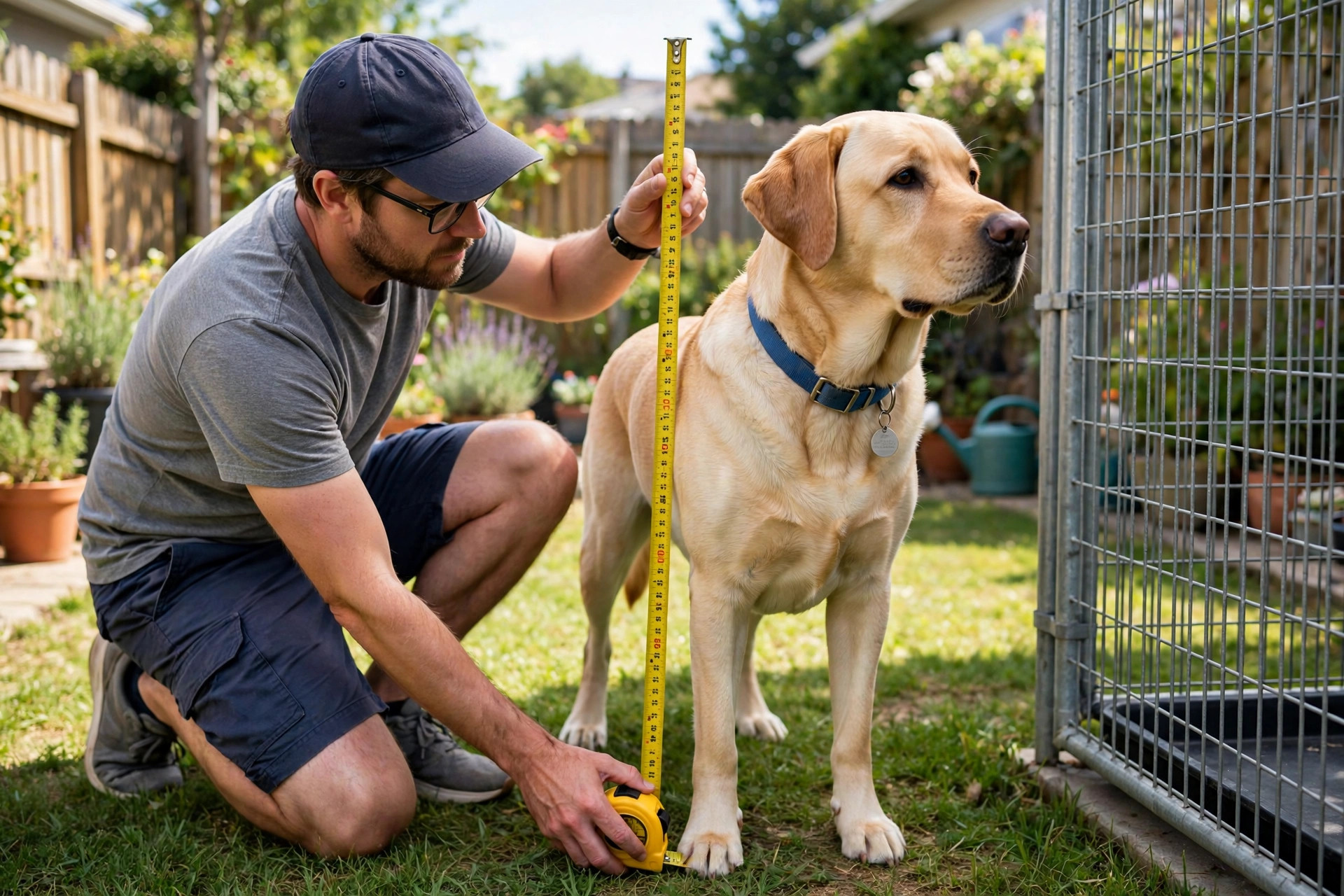
Measure your dog before you buy or build anything. Shoulder height (floor to top of shoulders), body length (chest to base of tail), and weight are the three numbers that decide the run size.
\n
| Dog size | Examples | Minimum run | Comfortable run | Fence height |
|---|---|---|---|---|
| Small (under 10 kg) | Dachshund, pug, french bulldog | 1.5 x 2 m | 2 x 3 m | 1.2 m |
| Medium (10–25 kg) | Beagle, border collie, cocker spaniel | 2 x 3 m | 3 x 3 m | 1.5 m |
| Large (25–40 kg) | Labrador, golden retriever, boxer | 3 x 3 m | 3 x 4 m | 1.8 m |
| Extra large (over 40 kg) | German shepherd, rottweiler | 3 x 4 m | 4 x 4 m | 1.8 m + |
\n
Two rules sit behind the table. First, the run should be at least three times your dog’s body length in its longest direction, so the dog can take a proper walk inside it — a run the dog can only pace in is too small. Second, jumpers and climbers need more height than the table says: a dog that can clear 1.5 m needs a roof or a 1.8 m fence with an inward-leaning top, whatever its weight. And if two dogs share a kennel, add 50% to the floor area rather than doubling it — dogs that share a kennel sleep curled together.
\n
Idea 1 — The classic 10 x 10 outdoor run
\n
The 10 x 10 ft (3 x 3 m) run is the workhorse of the kennel world. A set of four welded-wire panels on steel posts, a gate panel with a latch, a dog house in one corner, and a shade cloth or corrugated roof over half of it. It goes up in an afternoon, it comes apart if you move house, and every part is replaceable.
\n
Set it on level ground, ideally against a fence or wall on the windward side so the dog gets natural shelter. Put the house in the corner furthest from the gate, door facing away from the prevailing wind, and leave the sunny half of the run open so the dog can choose sun or shade. A water bowl that cannot be tipped — a heavy ceramic bowl or a bucket clipped to the fence — is not optional: a kennel dog drinks more than a house dog, and a tipped bowl in the sun is an empty bowl by noon.
\n
The one upgrade worth paying for on a bought run is the roof. A full roof turns the run into an all-weather room; a shade cloth only stops the sun. If your dog is outside in rain, pay for the roof. And check the latch every month — gate latches are the single most common escape route in a bought kennel, and a dog that learns the gate opens will test it daily.
\n
Idea 2 — DIY wooden kennel on a budget
\n
A wooden kennel is warmer, quieter and far better looking than a wire run, and it is a genuine weekend build. The design is simple: a timber frame, plywood or featherboard walls up to about 1 m high, welded wire mesh above that for light and air, a solid pitched roof, and a proper door with a bolt latch.
\n
Build the frame from 5 x 5 cm treated timber and the walls from 18 mm exterior plywood, sealed with pet-safe exterior paint on every surface — including cut edges, which is where rot starts. The mesh panels go in the top half of the walls: the dog can see out, air can move through, and the solid lower half blocks draughts at dog level and stops the dog seeing every passing cat. The roof needs a 5 cm overhang on all sides and roofing felt or corrugated panels; a flat roof ponds water, so give it a slight pitch even if it looks flat from the ground.
\n
The budget version uses reclaimed timber and second-hand fence panels, and it is every bit as good provided you check three things: no old paint flaking off (test anything pre-1970s for lead paint and do not use it), no nails or staples left sticking out, and no pressure-treated timber where the dog can chew it — treated timber is fine for the posts and the base, but interior surfaces the dog can reach should be untreated wood sealed with pet-safe paint. Our DIY dog ramp guide uses the same pet-safe sealing approach for a mobility build, if you want the pair to match.
\n
Idea 3 — The indoor kennel nook
\n
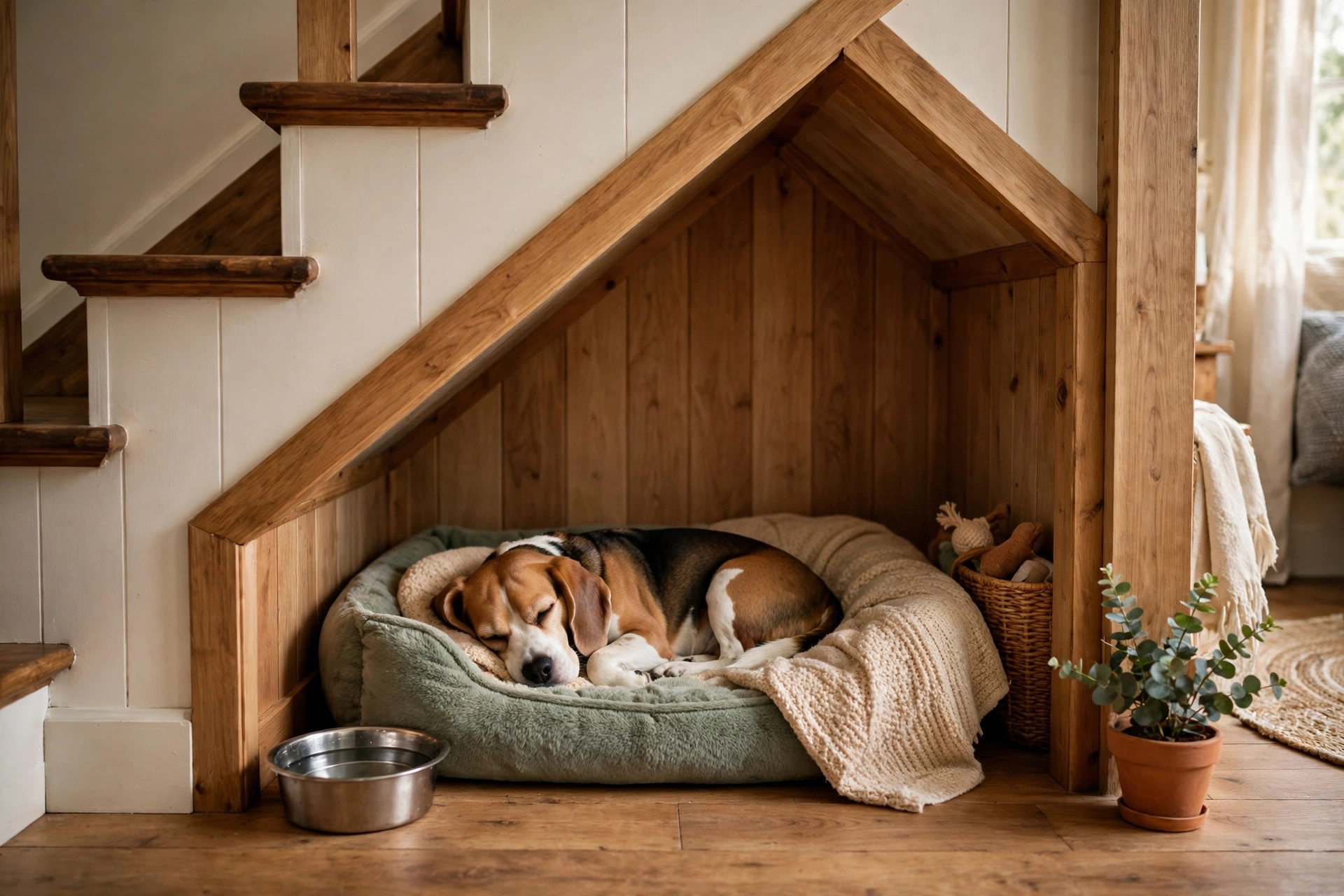
Not every dog has a garden, and not every kennel belongs outside. An indoor kennel is a defined space inside the house — a pen, a gated corner, or the space under the stairs fitted out as a den — and for a puppy, a flat-dwelling dog, or a dog recovering from surgery, it is the most useful kennel of all.
\n
The under-stairs nook is the classic: it is already enclosed on three sides, it is dark and den-like, and it is out of the traffic. Fit a low gate or a half-door across the opening, put a washable bed inside (our dog bed ideas guide covers what survives washing), and add a water bowl that cannot be knocked over. The rules are the same as outdoors, scaled down: the dog must be able to stand, turn and stretch fully; the space must have air moving through it; and the dog must be able to see out, or they will bark at every sound they cannot identify.
\n
An indoor kennel is not a punishment box. If the dog only goes in when they have done something wrong, they will hate it. Feed them in it, put their favourite chew in it, leave the gate open so they can wander in and out — the kennel should be the best spot in the house, not the naughty corner.
\n
Idea 4 — The shaded summer kennel
\n
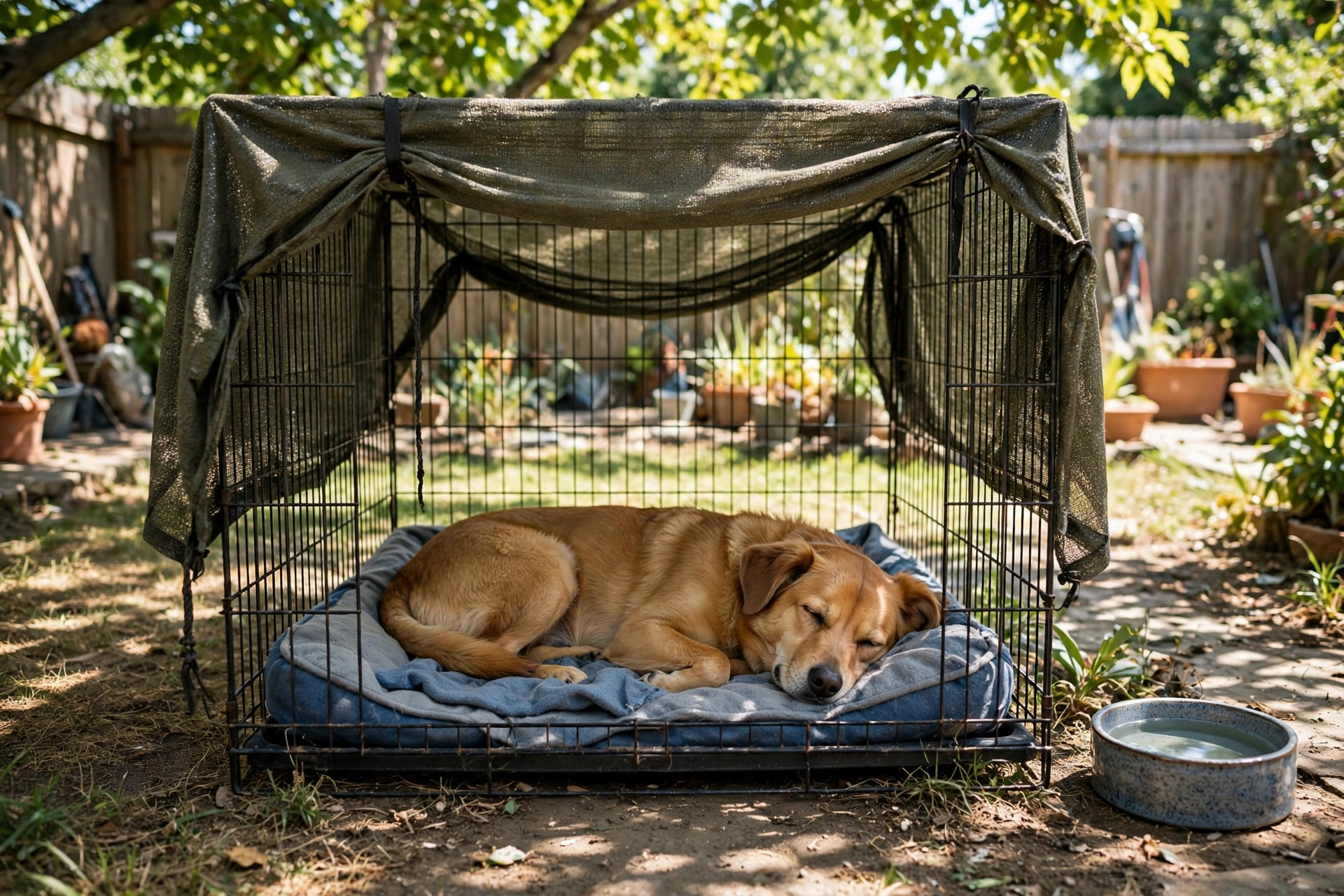
Heat kills more kennel dogs than cold does, and a kennel in full sun is an oven by midday. The shaded summer kennel is a design priority, not an accessory: at least half the run under solid shade at noon, a roof that reflects heat rather than absorbing it, and water in two places, not one.
\n
Shade cloth over the run helps, but a solid roof over half the run is better — shade cloth still lets hot air through, and on a still day the temperature under cloth is barely lower than in the open. A light-coloured roof reflects heat; a dark roof radiates it down onto the dog. If you can, put the kennel where a tree or the house shades it in the afternoon, when the sun is at its worst — morning sun is fine, afternoon sun is the problem.
\n
Add a paddling pool or a damp towel on the floor for hot days, and a ceramic water bowl in the shade, refreshed twice a day. And know the signs of heatstroke — heavy panting that does not ease, drooling, wobbling, glazed eyes — and get the dog into the shade and to a vet fast. No kennel design makes a dog safe in a heatwave without you checking on them.
\n
Idea 5 — Kennel designs that look like they belong
\n
A kennel does not have to look like a compound. The designs that work best in real gardens borrow from the house: matching paint, a pitched roof that echoes the house roof, planting around the outside (never inside — dogs dig up plants and some are toxic), and a path of slabs or gravel from the back door to the gate so you are not wading through mud in winter.
\n
Two designs are worth stealing outright. The first is the kennel-and-store combo: a run with a lockable storage box built into one end for food, leads and toys, so the kennel area stays tidy and you are not carrying kibble across the garden in the rain. The second is the kennel with a viewing window — a low, mesh-covered opening in the wall at dog-head height so the dog can watch the garden without jumping at the fence. Dogs that can see what is happening bark less than dogs that can only hear it.
\n
If your kennel is part of a bigger garden project, our DIY dog wash station guide covers the mudroom and outdoor shower that pair naturally with a kennel — one muddy dog, one wash, straight into the run.
\n
Flooring that actually works
\n
Flooring is the most argued-over part of a kennel, and the most important after size. The wrong floor is a mud pit in winter and a dust bowl in summer, and it is where most kennel smells come from.
\n
Gravel (20 mm pea gravel over a membrane). The best all-rounder: drains well, easy to clean with a hose, comfortable to lie on, and cheap. The downside is that dogs dig in it and it needs topping up once a year. Lay a weed membrane underneath so it does not sink into the mud.
\n
Concrete. The easiest to clean and the hardest wearing, but cold, hard on joints, and slippery when wet. If you use concrete, cover at least half of it with rubber mats or decking boards, and give it a slight fall to a drain so water does not pool.
\n
Decking boards. Warm, dry and good-looking, and the dog’s favourite in our experience — but they need a gap between boards for drainage, and the gaps trap hair and food. Lift and clean underneath twice a year.
\n
Grass. Lovely for a week. A dog in a kennel will wear grass to mud within a month, and mud plus rain plus a dog equals a filthy house and a filthy dog. Keep grass outside the kennel and put hard flooring inside it.
\n
Whatever you choose, raise the kennel floor slightly above the surrounding ground — even 5 cm on a timber base or a gravel bed stops rain running in, and it is the cheapest weatherproofing you will ever buy.
\n
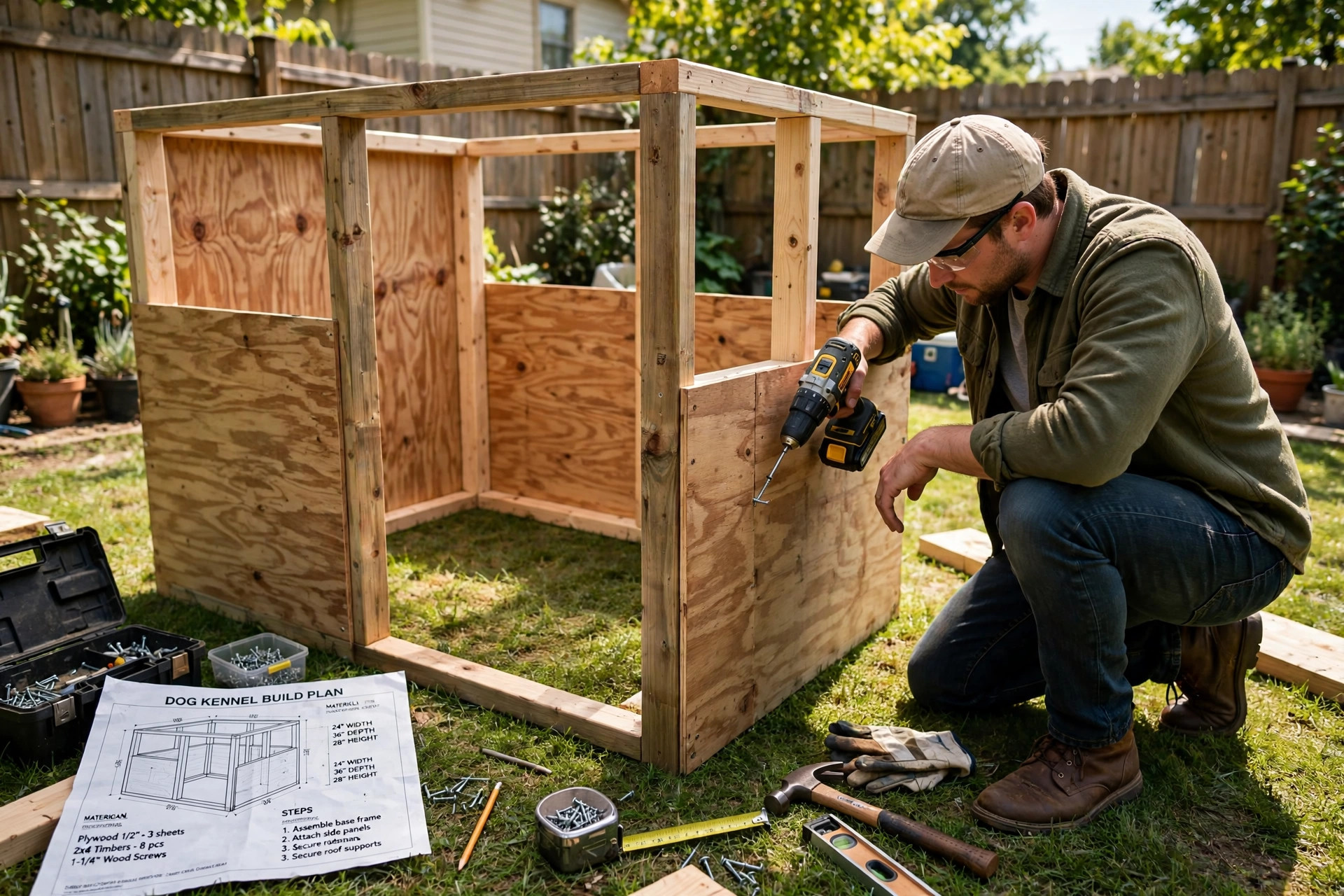
Build it in 3 steps
\n
Whatever kennel you choose, the build order is the same.
\n
Step 1 — Measure and mark. Measure your dog, confirm the run size against the table, and mark the footprint on the ground with string and pegs. Stand in it. Walk the dog through it on a lead. If it feels small with you in it, it is small — a kennel should feel like a small garden, not a large box. Check the ground is level and that water does not pool there after rain.
\n
Step 2 — Base and frame. Lay the base first — gravel bed, concrete slab or decking frame — and let it settle before you build on it. Then the frame: posts set in concrete or bolted to the base, panels fixed square, gate hung last so it can be adjusted to the finished opening. A gate that drags on the ground on day one will drag worse by winter.
\n
Step 3 — Roof, house and finishing. Roof on, house in the dry corner, water bowl clipped to the fence, bed inside the house, and a final check of every edge: run your hand over every panel, post and latch. If you can feel a sharp edge, a proud screw tip or a loose wire, the dog will find it — and fix it before the dog moves in, not after.
\n
Weatherproofing and shade
\n
Three things make a kennel unusable: rain getting in, sun cooking it, and wind funnelling through it. The fixes are simple. Roof overhang of at least 5 cm on every side so rain drips clear of the walls. A windbreak on the windward side — a solid panel, a fence, or the house wall itself — so the dog has a calm corner. And a door flap on the dog house, or the house door turned away from the wind, so the inside stays dry. If you are cutting a door through the garden wall for kennel access, our how to install a dog door guide covers flap sizes and weatherproofing for that job too.
\n
Safety rules before your dog moves in
\n
Run this check before the first night in the kennel, and monthly after that.
\n
- \n
- No gaps the dog can get a head through. A gap that fits a head fits a dog that panics — mesh spacing should be small enough that the dog cannot push a muzzle through, and panel joins should be tight.
- No exposed screw tips, nails or wire ends inside. Run your hand over every interior surface. If you can feel it, the dog can catch on it.
- No treated timber where the dog can chew it. Posts and base can be treated; interior walls, door frames and anything at mouth height should be untreated wood sealed with pet-safe paint.
- The latch works from outside only, and a child or visitor cannot open it by accident. A bolt latch with a carabiner clip is the standard for a reason — a dog that learns to nose a simple latch will be out in the street.
- Diggers get a buried barrier. If your dog digs, bury welded mesh or paving slabs 30 cm down around the inside edge of the run. A dog that digs under a fence once will do it again.
- Water always, in two places, in the shade. One bowl is a single point of failure. Two bowls, one of them clipped to the fence so it cannot be tipped, and both refreshed daily.
- Never use a kennel as a punishment. A dog that is shut in the kennel when they have done something wrong will learn to hate it — and a dog that hates its kennel barks, digs and escapes.
\n
\n
\n
\n
\n
\n
\n
\n
FAQs
\n
How big should a dog kennel be?\nAt least three times your dog’s body length in its longest direction, and tall enough for the dog to stand fully upright. For most medium dogs that means a 3 x 3 m run; large dogs need 3 x 4 m. The table above gives the minimum and the comfortable size for each weight band.
\n
Is a 10 x 10 kennel big enough for a large dog?\nA 10 x 10 ft (3 x 3 m) run is the comfortable minimum for a large dog like a labrador, and it is fine if the dog also gets daily walks and time in the house. If the dog spends the whole working day in the kennel, go bigger — 3 x 4 m — or add an attached exercise area. For extra-large dogs, 3 x 4 m is the minimum.
\n
Can a dog live in a kennel full time?\nA kennel is a daytime space, not a life. A dog that lives in a kennel 24 hours a day with no walks, no play and no time with people will be bored, stiff and unhappy whatever the kennel looks like. The kennel works when it is the dog’s safe base between walks, play and family time — not a replacement for them.
\n
What is the best flooring for a dog kennel?\nPea gravel over a weed membrane is the best all-rounder: it drains, it is easy to hose down, and it is comfortable to lie on. Concrete is the easiest to clean but needs rubber mats for comfort. Avoid bare grass inside the run — it turns to mud within weeks.
\n
How do I stop my dog digging out of the kennel?\nBury welded mesh or paving slabs 30 cm down around the inside edge of the run, and give the dog something to dig in instead — a sandpit corner inside the kennel satisfies most diggers. A bored dog digs; a tired dog does not, so more exercise helps more than more fencing.
\n
Do I need planning permission for a dog kennel?\nIn most places a small kennel in your own garden does not need permission, but rules vary by area and by size — a large permanent structure, or one close to a neighbour’s boundary, can need approval. Check with your local council before building anything bigger than a 10 x 10 run, and talk to the neighbours first either way.
\n
The bottom line
\n
A good kennel starts with the dog, not the catalogue: measure your dog, pick the run size from the table, and choose the type that matches how your dog actually lives — a 10 x 10 run for the garden dog, a DIY wooden build if you want it warmer and better looking, an indoor nook if there is no garden at all. Get the flooring right, shade half of it, keep water in two places, and run the safety check before the first night. Done well, the kennel is the place your dog chooses to lie in, not the place they are shut in — and if you want the full set, our DIY dog agility course guide gives them something to do when they come out of it.
\n
Pin this for later 📌 — and if the house is the part you are still planning, our DIY dog house ideas guide shows nine builds, from pallet houses to indoor nooks, to compare before you buy or build.
“,
“source_draft”: “/home/hatch/workspace/goals/pinterest-pin-automation-for-petsmush-com/files/dog-kennel-post-draft.md”,
“status”: “publish”
}