
Walk down any pet-supply aisle and you’ll see them: colourful tubs of dog multivitamins promising shinier coats, stronger joints and more energy. Search interest in dog vitamins has climbed steeply over the past two years, and plenty of owners are reaching for the bottle. But here’s the question worth asking first — does your dog actually need one?
For many healthy dogs eating a complete, balanced food, the honest answer is no. A daily multivitamin can make a real difference for the right dogs, but it can also be a waste of money — or, in a few cases, genuinely risky. This guide explains which dogs benefit, which nutrients matter, how to read a label like a sceptic, and when supplements can do more harm than good.

Does my dog need a multivitamin?
A dog eating a quality complete and balanced food — one that meets AAFCO nutrient profiles or equivalent standards — already gets all the vitamins and minerals it needs. Adding a multivitamin on top of that is like watering an already-soaked plant: the excess usually just passes through, and you pay for the privilege.
The dogs who genuinely benefit are the ones with a gap — in their diet, their health, or their life stage:
-
Dogs on homemade or raw diets. Home-cooked meals are wonderful, but almost none are nutritionally complete without careful formulation. A multivitamin formulated for dogs is often the safety net a vet recommends for homemade feeders.
-
Senior dogs. Ageing dogs absorb some nutrients less efficiently, and senior formulas often add joint and antioxidant support.
-
Dogs with digestive or liver issues. Poor absorption means deficiencies even on good food — but this should be vet-guided, with bloodwork.
-
Picky eaters. Dogs that self-restrict to a few foods may miss key nutrients over time.
-
Pregnant or nursing dogs. Nutritional demands skyrocket; most need a purpose-built prenatal supplement, not an off-the-shelf multivitamin.
Safety note: if your dog is on a balanced commercial diet and is healthy, ask your vet before adding any supplement. More is not better — fat-soluble vitamins (A, D, E, K) accumulate in the body and can reach toxic levels, unlike water-soluble ones that are mostly excreted.

Which nutrients actually matter for dogs
A good dog multivitamin isn’t a random alphabet soup. These are the nutrients with real jobs behind them:
-
Vitamin A — vision, skin, coat and immune function. Important, but toxic in excess — don’t stack multiple sources.
-
B vitamins (complex) — energy metabolism, nervous system health and appetite. Water-soluble, so deficiency is a bigger risk than overdose for healthy dogs.
-
Vitamin D — calcium absorption and bone strength. Dogs can’t make it from sunlight the way people do, so diet matters; too much causes dangerous calcium build-up.
-
Vitamin E — antioxidant protection for cells, skin and coat.
-
Vitamin C — dogs make their own, so it’s not essential, but extra antioxidant support can help senior or stressed dogs.
-
Calcium & phosphorus — bone strength in the right ratio (roughly 1.2:1 calcium to phosphorus); the ratio matters as much as the amount, especially in growing large breeds.
-
Zinc — skin, coat, immune function and wound healing. Zinc deficiency shows as skin and coat problems.
-
Iron — red blood cell production; anaemia is rare on good food but matters for some dogs.
-
Omega-3 fatty acids (EPA/DHA) — brain, joint and skin support. Not always in a “multivitamin”, but often bundled in and worth having.
-
Glucosamine & chondroitin — joint support common in senior multivitamins; evidence is moderate but consistent for mild joint stiffness.
When vitamins can be harmful
This is the part the colourful tubs don’t advertise. Supplements can hurt in a few well-documented ways:
-
Fat-soluble vitamin toxicity. Vitamins A and D build up in the liver and body fat. Excess vitamin A causes joint pain, bone issues and liver damage; excess vitamin D causes dangerous calcium deposits in organs and kidneys. This is the biggest risk of stacking a multivitamin on top of an already-complete food.
-
Calcium imbalance in puppies. Large-breed puppies given extra calcium can develop skeletal deformities. Never supplement a growing large-breed puppy’s calcium without vet guidance.
-
Iron overdose. Iron is one of the more toxic nutrients in overdose — keep all supplements, human and dog, where your dog can’t chew the bottle.
-
Xylitol and other nasties. Some products — especially flavoured chews — contain xylitol (also labelled birch sugar), which is extremely toxic to dogs. Check every label, every time you buy.
-
Masking a real problem. A dull coat or low energy that “needs vitamins” might be hypothyroidism, kidney disease or a diet problem. Supplements can delay the diagnosis that actually fixes things.
How to read a dog vitamin label like a sceptic
The supplement shelf is full of confident claims. Run every product through this checklist:
-
Formulated for dogs, not humans. Dog products use appropriate doses and dog-safe ingredients; human gummies often contain xylitol.
-
Specific nutrient amounts, not fairy dust. The label should list actual amounts per chew/scoop — not just “a proprietary blend of vitamins”. Vague blends hide tiny doses.
-
AAFCO-style balance. Look for products designed to complement a complete diet, with nutrient levels in sensible ranges — not mega-doses.
-
No xylitol / birch sugar. This is non-negotiable. Check the inactive ingredients too.
-
Quality markers. Third-party testing seals (NASC certification is the pet industry’s own quality mark) and a manufacturer with a real address and customer line.
-
Realistic claims. “Supports skin health” is fine. “Cures arthritis” or “guaranteed energy boost” is marketing noise — walk away.
And remember the simplest test: if the product can’t tell you exactly what’s in each dose, you don’t want it in your dog.
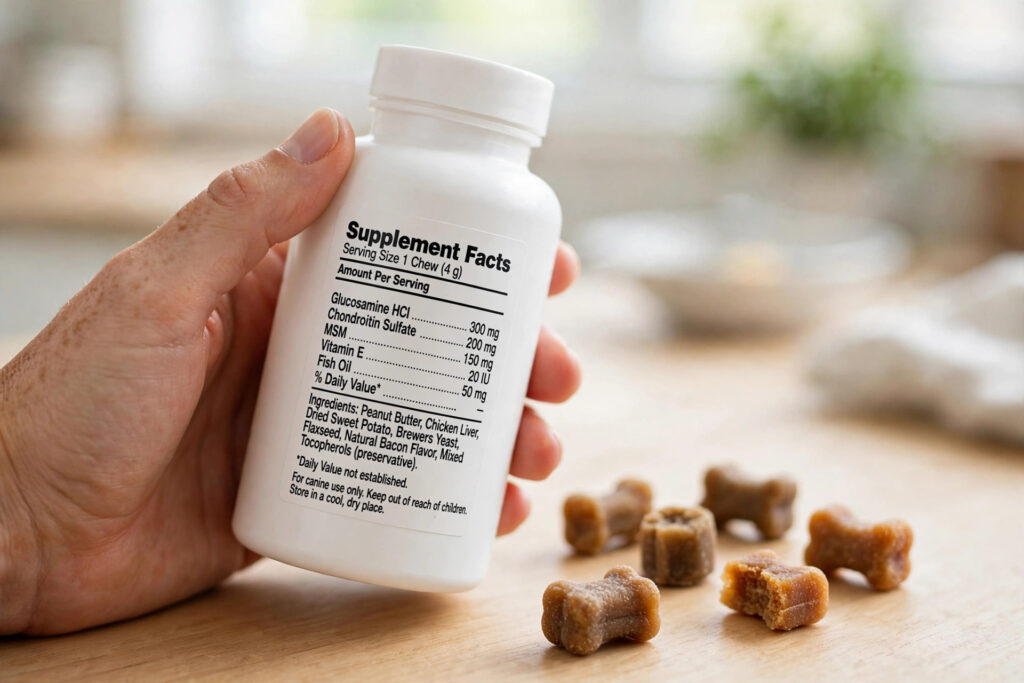
Choosing the right form: chews, powders, liquids
The best supplement is the one your dog will actually take every day:
-
Soft chews — easiest for most dogs and the most popular form; check for fillers and flavourings, and confirm no xylitol.
-
Powders — sprinkled over food; easy to adjust the dose, good value, but fussy dogs may notice the taste.
-
Liquids — precise dosing with a syringe, ideal for tiny dogs or dogs that won’t chew; can be mixed into food.
-
Tablets — precise and cheap, but pilling a reluctant dog gets old fast.
Whatever you choose, introduce it gradually — start with half the dose for a few days to make sure it agrees with their stomach — and give it consistently. Like probiotics, vitamins need weeks of steady use before you judge the results.
What about natural food sources?
Before reaching for a bottle, know that several whole foods are naturally rich in the nutrients dogs need:
- Blueberries and leafy greens — antioxidant vitamins (A, C, K).
- Pumpkin puree — vitamin A, fibre, and a gentle gut helper.
- Eggs — B vitamins, vitamin D, and complete protein.
-
Oily fish (sardines, salmon) — omega-3s EPA and DHA for skin, coat and joints.
-
Liver (small amounts) — vitamin A and iron — but go easy, since excess vitamin A is exactly what we’re avoiding.
Whole foods are a lovely daily topper and great maintenance nutrition, but they’re not a substitute for a vet-guided supplement when a real deficiency exists. And keep portions sensible: even good foods are extras on top of a balanced diet — treats and toppers should stay under 10% of daily calories.

The bottom line
Multivitamins are a tool, not a ritual. For a healthy dog on complete food, they’re unnecessary. For homemade feeders, seniors, picky eaters and dogs with absorption issues, they’re one of the simplest, highest-value things you can add — with your vet’s blessing.
Buy the boring, well-labelled product from a reputable maker, skip the miracle claims, keep xylitol off the ingredient list, and never stack supplements on top of each other without checking the total dose. Your dog’s nutrition is mostly decided by the food bowl — the vitamin bottle is the fine print.
FAQs
Do dogs need multivitamins every day?
Most healthy dogs on a complete, balanced commercial food do not need a daily multivitamin. Dogs on homemade diets, seniors, picky eaters, and dogs with certain health conditions often benefit — but check with your vet first.
Are dog multivitamins safe?
Quality dog-formulated multivitamins are safe when used as directed. The risks come from excess fat-soluble vitamins (A, D), calcium imbalance in growing puppies, and xylitol in flavoured chews. Never give human vitamins without vet approval.
What is the best vitamin for a senior dog?
There is no single best one — senior dogs benefit most from products combining antioxidants (vitamins E and C), omega-3s, and joint support (glucosamine). Choose a senior-specific formula and ask your vet to match it to your dog’s bloodwork.
Can I give my dog human multivitamins?
Not without vet guidance. Human products are dosed for people, may contain xylitol or other dog-unsafe ingredients, and can deliver dangerous excesses of vitamins A and D at dog body weights.
How long before I see results from dog vitamins?
For coat and skin improvements, most owners notice a difference in 4–8 weeks of consistent daily use. Joint and energy changes can take longer. If nothing changes after 2–3 months, talk to your vet — supplements may not be the answer.