{
“title”: “Dog Vest Pattern: How to Sew a Cosy Dog Vest at Home”,
“slug”: “dog-vest-pattern”,
“excerpt”: “Sew a dog vest at home with this simple pattern: measure your dog, draft the pattern, cut and sew a warm fleece vest — plus a 10-minute no-sew version.”,
“meta_description”: “Sew a dog vest at home with this simple pattern: measure your dog, draft the pattern, cut and sew a warm fleece vest — plus a 10-minute no-sew version.”,
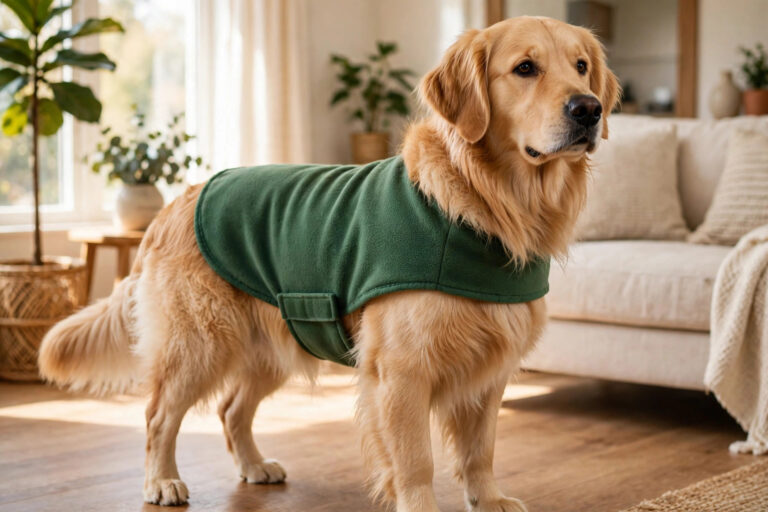
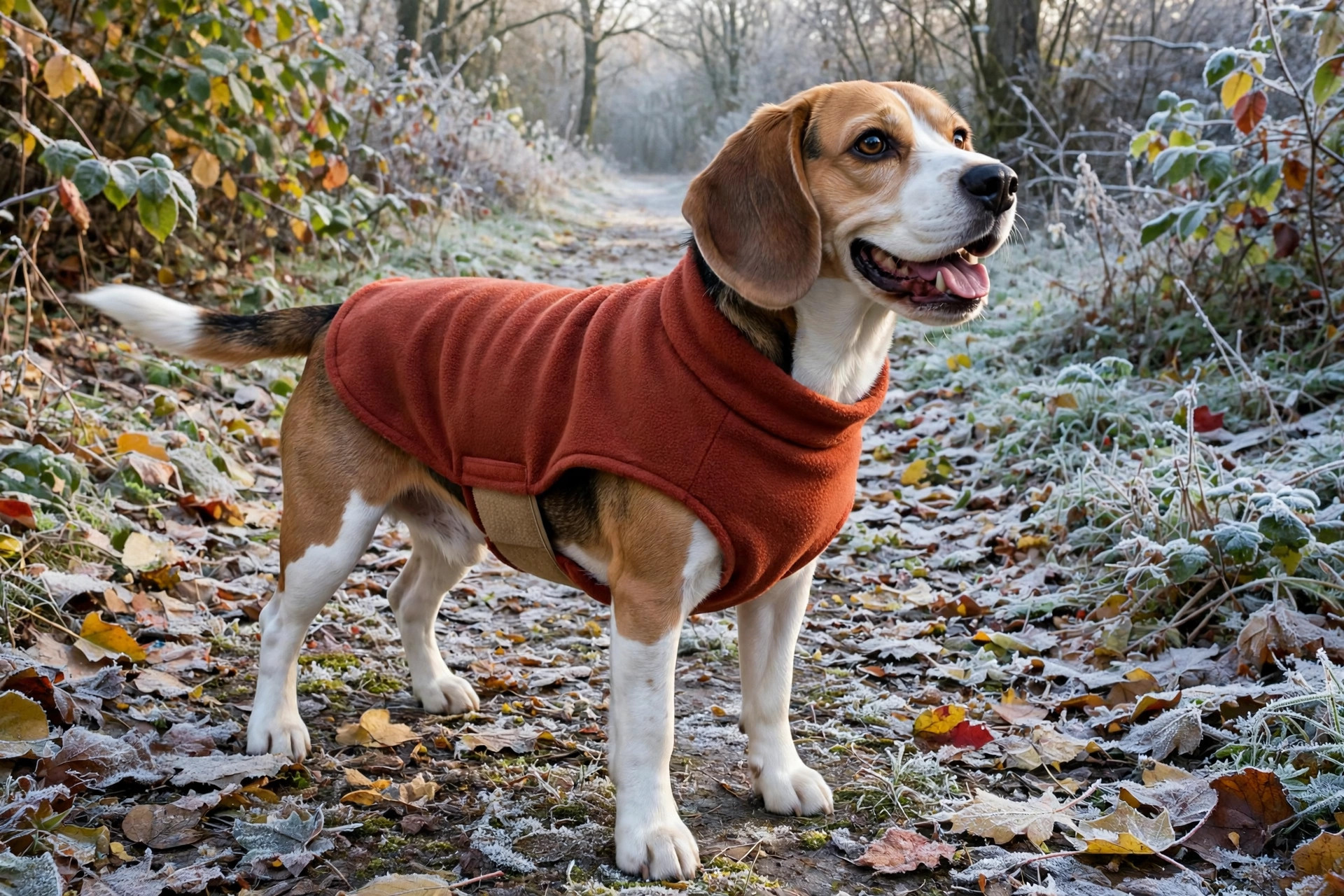
“featured_image_alt”: “Golden retriever wearing a handmade green fleece dog vest at home.”,
“content_html”: “
A shop-bought dog coat is either too long, too tight, or made for a dog shaped nothing like yours. A vest you sew yourself fits the dog in front of you — and it costs a fraction of the price. This guide gives you a simple dog vest pattern you can draft from three measurements, cut from a single piece of fleece, and sew in an evening. No shop pattern to buy, no complicated tailoring, and a no-sew version at the end if you would rather skip the machine altogether.
\n
A vest is the most useful piece of dog clothing there is. It warms the chest and back — the parts that lose heat fastest — without covering the legs or restricting movement the way a full coat can. Short-haired dogs, seniors, puppies, and any dog that shivers on a winter walk will feel the difference on the first wear. And because the pattern is yours, you can make a second one in a different fabric in half the time.
\n
Do dogs actually need a vest?
\n
Not every dog does. A healthy adult dog with a thick double coat — a husky, a malamute, a Bernese — is already wearing a better vest than you can sew. But plenty of dogs genuinely benefit from one:
\n
- \n
- Short-haired and single-coated breeds — greyhounds, whippets, boxers, dachshunds, French bulldogs, and most terriers lose heat fast and shiver in cold weather.
- Seniors and puppies. Older dogs struggle to regulate temperature, and puppies have not grown their adult coat yet. Both get cold sooner and warm up slower.
- Lean or unwell dogs. A dog that has lost weight, or one recovering from illness, has less insulation and less energy to spare on staying warm.
- Wet-weather walks. A waterproof vest keeps the chest and belly dry on rainy days, which means a drier dog and a shorter towel-drying session when you get home.
\n
\n
\n
\n
\n
If your dog shivers, hunches, lifts its paws, or begs to go back inside after five minutes, it is cold — a vest is worth trying. If your dog runs hot, pants on winter walks, or tries to wriggle out of every layer you put on, it probably does not need one. Our winter dog paw care guide covers the other half of cold-weather care — paws, salt, and ice — and our guide to do German Shepherds get cold explains how coat type changes what a dog needs.
\n
Step 1 — Measure your dog (three numbers, one minute)
\n
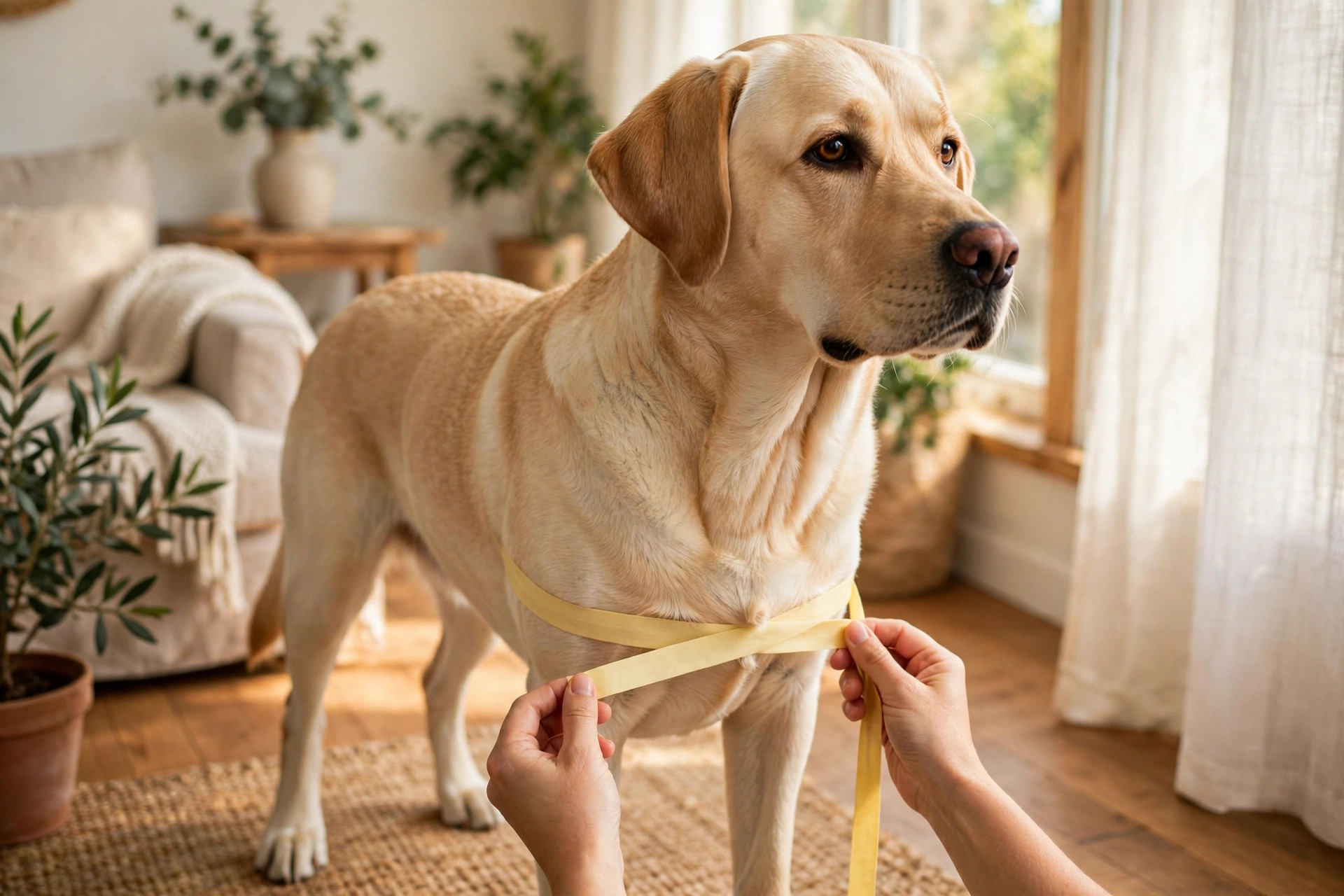
A vest pattern only works if the measurements are right, so take them properly. You need a soft measuring tape, your dog standing square on all four feet, and a helper or a pocketful of treats to keep the dog still.
\n
- \n
- Neck: around the base of the neck, where a collar sits. Snug, not tight — two fingers should fit under the tape.
- Chest: around the widest part of the ribcage, just behind the front legs. This is the number that matters most.
- Back length: from the base of the neck (where the collar sits) to the base of the tail. Do not include the tail.
\n
\n
\n
\n
Write the numbers down and add 2 cm of ease to the chest and 1 cm to the neck — a vest should sit close without squeezing. If your dog is between sizes, size up: a slightly loose vest is comfortable, a tight one chafes. A quick sizing guide for common weights:
\n
| Dog size | Chest | Back length | Fabric needed |
|---|---|---|---|
| Small (5–10 kg) | 40–50 cm | 28–35 cm | 0.5 m |
| Medium (10–25 kg) | 50–65 cm | 35–50 cm | 0.7 m |
| Large (25–40 kg) | 65–80 cm | 50–65 cm | 1 m |
| Extra large (40 kg+) | 80–95 cm | 65–80 cm | 1.2 m |
\n
Measure twice. Every badly fitting vest I have ever seen started with a guessed chest measurement.
\n
Step 2 — Choose your fabric
\n
The fabric decides whether the vest gets worn or sits in a drawer. Pick for the job, not the colour.
\n
- \n
- Fleece (best all-rounder). Warm, light, stretchy, and forgiving to sew — it does not fray, so raw edges are fine. Anti-pill fleece is worth the small extra cost; cheap fleece pills after two washes. One layer is enough for most dogs; two layers (fleece outside, soft lining inside) for very cold weather.
- Waterproof shell + fleece lining. For rainy walks: a water-resistant outer (ripstop nylon or a shower-proof cotton) with a fleece lining. Slightly harder to sew — use a walking foot or a denim needle — but it is the only version that keeps a dog dry.
- Old jumpers and blankets. The cheapest option, and a good one. An old fleece jumper has already been washed and shrunk, and its cuffs and hems can become the vest’s edges. Our DIY dog toys from old clothes guide uses the same idea for toys — the same pile of old clothes works for vests.
- What to avoid. Anything stiff or noisy (dogs hate rustly fabric), anything that sheds fibres a dog can chew off, and anything with buttons, beads, or drawstrings anywhere near the dog. Furry or fluffy fabrics look cosy but trap mud and mat after one wet walk.
\n
\n
\n
\n
\n
Buy a little more fabric than the table says — 10 cm extra in each direction covers a cutting mistake and leaves enough for a matching belly strap.
\n
Step 3 — Draft the pattern (no shop pattern needed)
\n
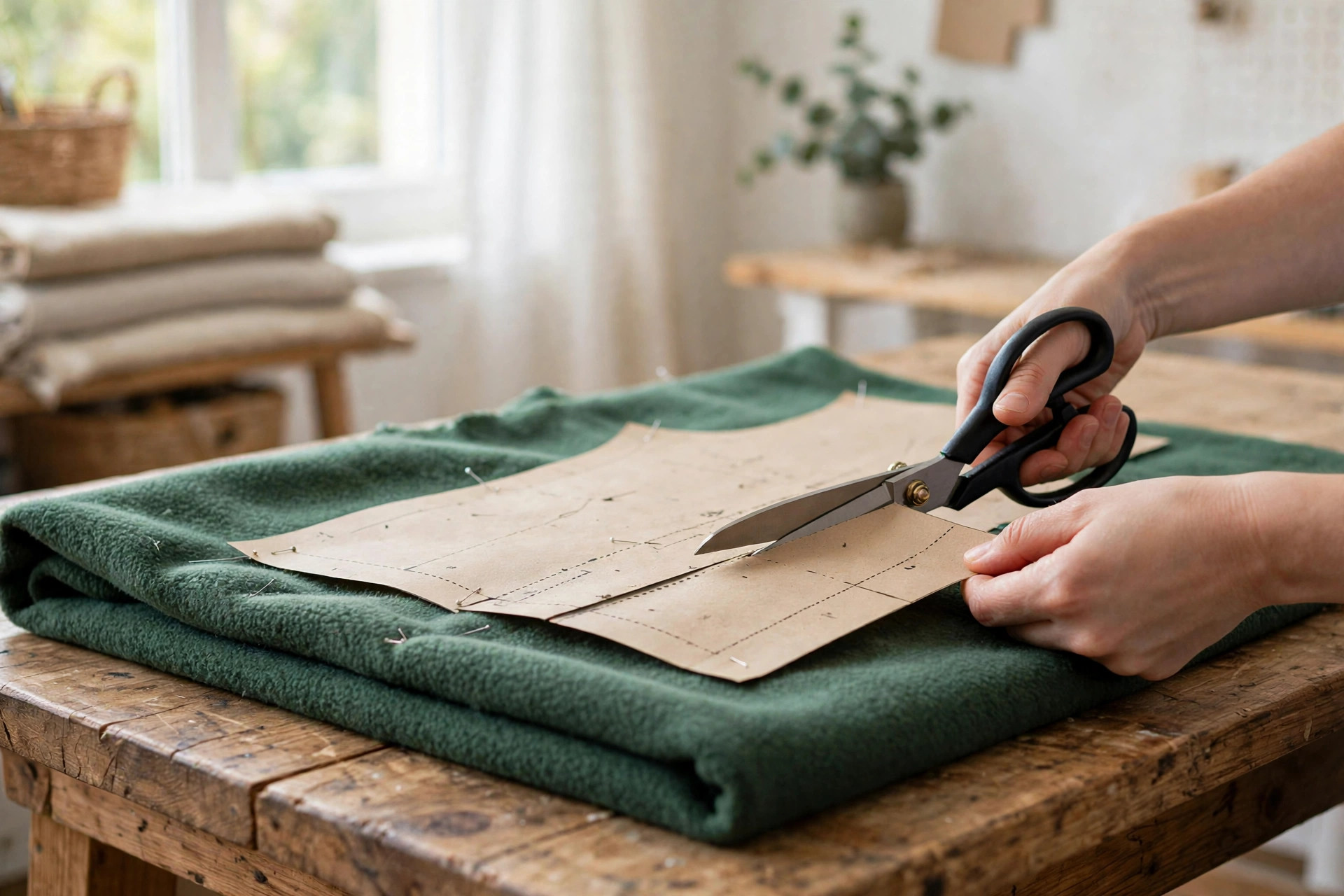
You will draw the pattern on paper — old wrapping paper, newspaper taped together, or a paper grocery bag cut flat all work. Fold the paper in half lengthways; you draw half the vest and cut both sides at once, so it comes out symmetrical.
\n
- \n
- Draw the back line. Along the fold, mark the back length (neck to tail base). This is the top edge of the vest.
- Draw the neck curve. At the front end of the back line, draw a shallow curve down about 6 cm for the neck opening — deeper for broad-chested dogs, shallower for narrow ones.
- Draw the chest line. Halfway along the back line, measure out from the fold half the chest measurement plus ease, and mark it. This is the widest point of the vest.
- Draw the belly curve. From the chest point, curve the line back toward the fold, ending about two-thirds of the way along the back line — the vest should end well in front of the back legs, never over them.
- Add seam allowance. Draw a second line 1 cm outside the whole shape. Cut along the outer line.
\n
\n
\n
\n
\n
\n
That is the whole pattern: one body piece, cut on the fold. If you want a two-tone vest, cut the same piece twice — once in the outer fabric, once in the lining — and sew them together later. For the belly strap, cut a rectangle 8 cm wide and as long as the chest measurement minus 10 cm; it will fasten under the belly with velcro.
\n
Pin the paper pattern to your dog (gently, with the dog standing) before you cut the fabric. Check the chest width, the back length, and that the belly curve clears the back legs. Adjusting paper is free; adjusting cut fleece is not.
\n
Step 4 — Cut and sew the vest
\n
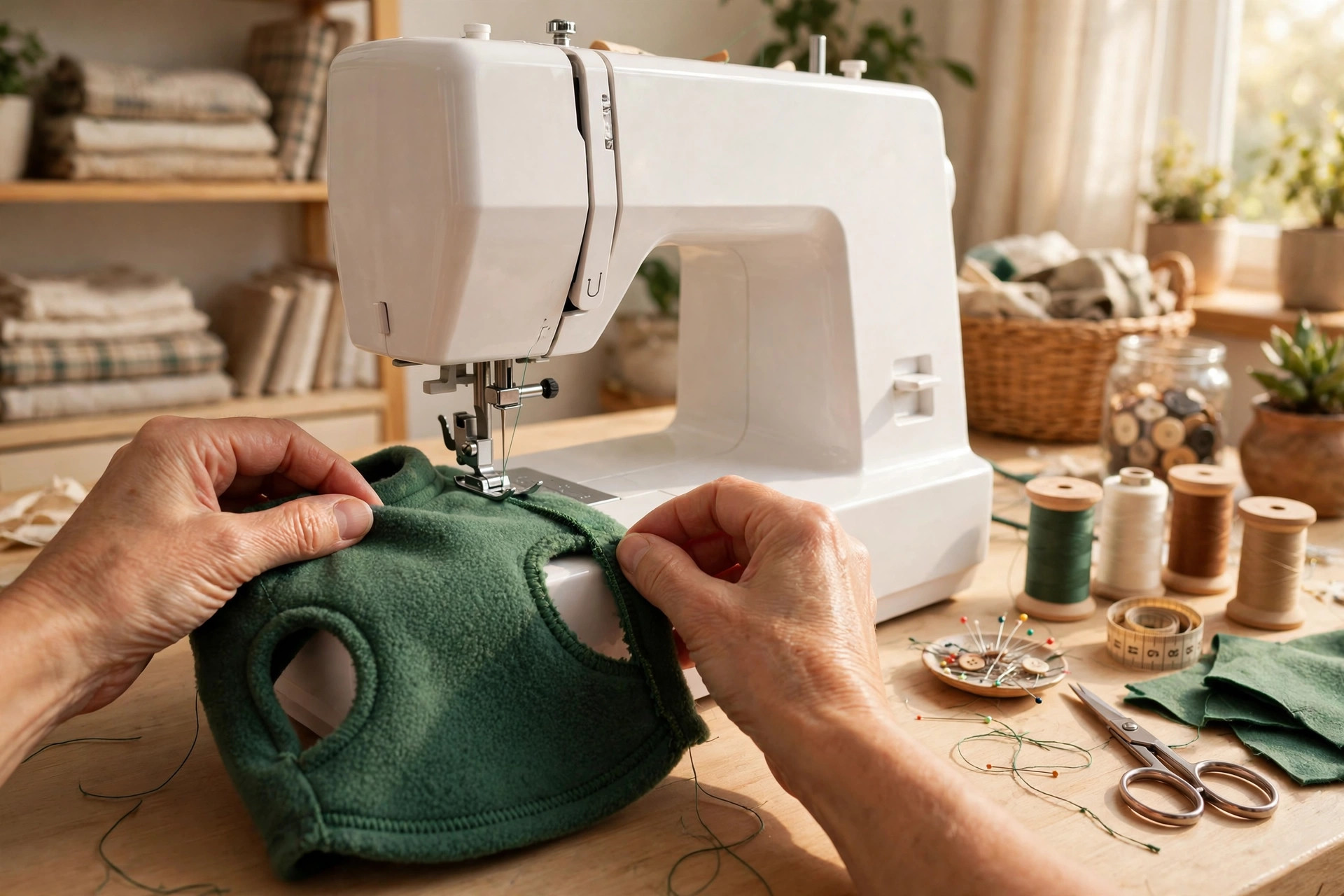
You need: the fabric, the paper pattern, sharp scissors, pins, a sewing machine (or a needle and a free evening), thread to match, and 5 cm of sew-on velcro for the belly strap and the neck.
\n
- \n
- Cut. Lay the fabric flat, fold it in half, pin the paper pattern to the fold, and cut along the outer line. Cut the belly strap rectangle too. If you are making a lined vest, cut the body piece twice — once in each fabric.
- Sew the lining (if using one). Place the outer and lining pieces right sides together, pin around the edge, and sew all the way around, leaving a 10 cm gap on one side. Turn the vest right side out through the gap, push the corners out, and topstitch the gap closed. The vest now has clean edges and no raw seams.
- Attach the belly strap. Sew one half of the velcro to the end of the strap and the matching half to the vest body where the strap will meet it under the belly. Sew the strap to one side of the vest with a box stitch — a square of stitching with an X through it — so it cannot pull off.
- Finish the neck. If the vest has no lining, fold the neck edge under by 1 cm and topstitch it, or bind it with a strip of the same fleece. A raw neck edge will stretch and sag after a few washes.
- Try it on. Put the vest on the dog, fasten the belly strap, and check the fit: two fingers under the chest strap, the back length ending before the hips, no pulling across the shoulders, and the dog able to sit, lie down, and trot without the vest shifting. Adjust the strap position if it rides forward.
\n
\n
\n
\n
\n
\n
Total sewing time for a single-layer fleece vest is about 45 minutes once the pattern is drafted. The second vest from the same pattern takes half that.
\n
The 10-minute no-sew version
\n
No machine, no problem. Take an old fleece jumper in roughly your dog’s size, lay it flat, and cut straight across just below the armpits — the bottom half of the jumper becomes the vest body. Cut two slits for the front legs about 5 cm from the top edge, spaced to match your dog’s chest width, and trim the bottom edge into a gentle curve. That is it. The jumper’s hem becomes the vest’s finished edge, the cuffs become the leg openings, and the whole thing took ten minutes. It will not look as neat as the sewn version and it will not last as long, but it is a perfectly good first vest — and the fastest way to find out whether your dog will actually wear one before you invest in fabric. Our no-sew DIY dog bed guide uses the same no-sew thinking for a different project.
\n
Fitting and safety — read this before the first walk
\n
- \n
- The two-finger rule. You should be able to slide two fingers flat under the chest strap and the neck. Any tighter and the vest can rub raw spots behind the front legs; any looser and it slides around and annoys the dog.
- Check for chafing after the first three wears. Look under the front legs and around the belly strap for red or bald patches. Fleece rarely chafes, but a seam sitting in the wrong place will — move the seam or add a soft binding.
- No dangling straps, ever. Trim every strap end and sew down any loose velcro. A loose strap is a chewing target and a catching hazard on fences and branches.
- Supervise the first wear. Most dogs accept a vest in minutes; a few freeze, flop, or try to chew it off. If your dog freezes, do not laugh and film it — take the vest off, give a treat, and try again for five minutes tomorrow with a treat in your hand. Patience beats force.
- Never leave a vest on indoors all day. A vest is for cold and wet walks, not for the sofa. Leaving one on indoors overheats the dog and mats the coat underneath.
- Wash it. A vest that smells of wet dog is a vest the dog will not want to wear. Machine wash cold on a gentle cycle, air dry — tumble drying shrinks fleece and melts velcro.
\n
\n
\n
\n
\n
\n
\n
Mistakes to avoid
\n
- \n
- Guessing the measurements. A vest made from a guessed chest measurement fits nobody. Measure, write it down, measure again.
- Making it too long. A vest that covers the hips restricts the back legs and rides up when the dog sits. End it well in front of the hind legs.
- Using slippery fabric. Satin, silky nylon, and shiny polyester slide around and twist. If the vest will not stay put, the fabric is the problem, not the pattern.
- Sewing the belly strap too tight. The strap should hold the vest in place, not squeeze the ribs. If the dog’s breathing changes when the strap is fastened, it is too tight.
- Forgetting the dog will grow. A puppy vest made in October will not fit in January. Make puppy vests from cheap fabric or old jumpers, and save the good fabric for the adult size.
- Adding buttons or toggles. Anything small and hard near a dog’s mouth will be chewed off and swallowed. Velcro and sewn-on straps only.
\n
\n
\n
\n
\n
\n
\n
FAQs
\n
Do all dogs need a vest?\nNo. Thick-coated, healthy adult dogs usually do not, and a vest can make them overheat. Vests are for short-haired, lean, senior, puppy, and unwell dogs — and for any dog on a cold, wet walk. Watch your own dog: shivering, hunching, and begging to go home are the signs.
\n
Can I make a vest without a sewing machine?\nYes — two ways. Hand-sew the simple pattern with a backstitch; fleece is forgiving and a hand-sewn vest is perfectly strong enough. Or use the 10-minute no-sew version from an old jumper, which needs only scissors.
\n
What is the best fabric for a dog vest?\nAnti-pill fleece for most dogs — warm, light, stretchy, and easy to sew. For rainy walks, a waterproof outer with a fleece lining. Avoid stiff, noisy, or shedding fabrics, and never use anything with buttons or drawstrings.
\n
How tight should a dog vest be?\nClose but not tight: two fingers flat under the chest strap and the neck, no pulling across the shoulders, and the dog able to sit, lie down, and trot freely. If the vest leaves marks on the coat or the dog’s breathing changes, it is too tight.
\n
Can I use an old jumper to make a dog vest?\nYes — it is the fastest route. Cut the bottom half of a fleece jumper, add two leg slits, trim the edge, and you have a vest in ten minutes. It is also the best way to test whether your dog will wear a vest before you buy fabric.
\n
How do I wash a handmade dog vest?\nMachine wash cold on a gentle cycle and air dry. Do not tumble dry — heat shrinks fleece and melts velcro. Wash it whenever it smells of wet dog or mud; a clean vest is a vest the dog will wear.
\n
My dog freezes when I put the vest on — what do I do?\nTake it off, give a treat, and try again tomorrow for five minutes with treats in your hand. Most dogs accept a vest within a few short sessions. If your dog still freezes after a week, the vest may be the wrong size or the wrong fabric — check the fit and try a lighter fleece.
\n
The bottom line
\n
A dog vest is three measurements, one paper pattern, and an evening of sewing — and it is the most useful thing you can make for a cold dog. Measure properly, pick fleece (or an old jumper for the first try), keep the fit close but never tight, and check for chafing after the first few wears. If your dog shivers on winter walks, this vest will change them. If you want more homemade gear for your dog, our DIY dog clothes guide covers seven easy outfits to make at home, from no-sew bandanas to a fleece jacket.
\n
Pin this for later 📌 — and if your dog hates the cold as much as the rain, our winter dog paw care guide covers the paws, the salt, and the ice too.
“,
“source_draft”: “/home/hatch/workspace/goals/pinterest-pin-automation-for-petsmush-com/files/dog-vest-pattern-post-draft.md”,
“status”: “publish”
}