{
“title”: “Homemade Dog Toys: 25 Easy DIY Toys Your Dog Will Love”,
“slug”: “homemade-dog-toys”,
“excerpt”: “Homemade dog toys your dog will actually love — 25 easy DIY ideas from old clothes, socks, bottles and towels, with safety rules for every chew style.”,
“meta_description”: “Homemade dog toys your dog will actually love — 25 easy DIY ideas from old clothes, socks, bottles and towels, with safety rules for every chew style.”,
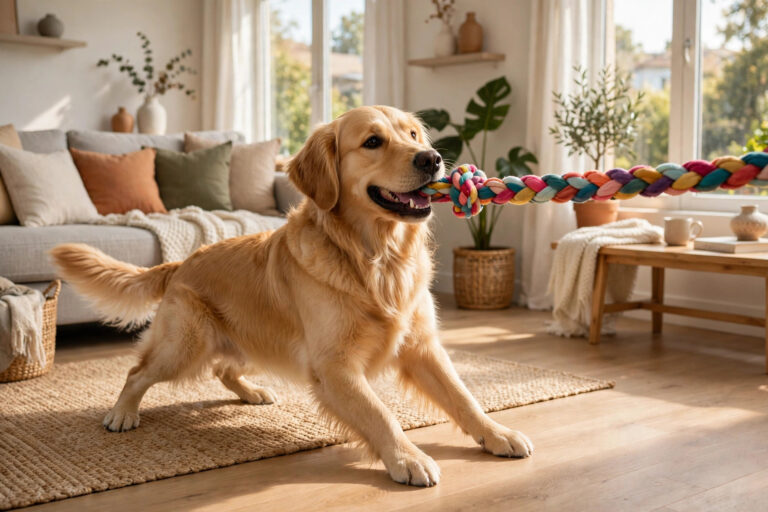
“featured_image_alt”: “Golden retriever playing tug with a homemade braided t-shirt dog toy.”,
“content_html”: “
Your dog does not care what a toy costs. A knotted old t-shirt can beat a shop-bought toy costing twenty pounds — because what dogs actually love is not the toy itself, it is the smell of you on it, the game attached to it, and the fact that it moves, squeaks, or hides a treat.
\n
Homemade dog toys are also the cheapest enrichment you will ever buy. Most of the ideas below cost nothing at all: they are made from things already in your house — old t-shirts, socks, towels, cardboard boxes, plastic bottles, and tennis balls. This guide collects 25 of them, organised by play style, with the safety rules that keep a fun toy from becoming a vet visit.
\n
Before you start: the 5 safety rules
\n
Every toy in this guide follows the same five rules. They take a minute to learn and they prevent almost every homemade-toy accident.
\n
1. Match the toy to the chewer. A gentle mouth can play with almost anything. A power chewer who shreds a tennis ball in five minutes needs rope and fleece only, and only under supervision. If your dog destroys toys, homemade toys are play-session toys, not leave-alone toys.
\n
2. Supervise the first few plays. Watch how your dog plays with a new toy before leaving it with them. Some dogs chew, some tug, some dissect. The way your dog plays tells you whether the toy is safe for them.
\n
3. No small parts. No buttons, zips, beads, googly eyes, or sewn-on decorations. Anything smaller than your dog’s mouth that can be bitten off will be bitten off — and swallowed. If a toy has a part you can pull off with two fingers, your dog can pull it off too.
\n
4. Check the toy every time. Homemade toys wear out, and that is normal. Before each play session, give the toy a quick pull and a look: frayed rope, a hole in a sock, a cracked bottle, a loose knot. Retire it the moment it starts falling apart.
\n
5. Size it right. A toy should be too big to fit entirely in your dog’s mouth. A ball that disappears behind the teeth is a choking risk. For small dogs, a tennis ball is fine; for a large dog, use a ball at least the size of a grapefruit.
\n
Tug toys (5 ideas)
\n
Tug is the easiest game to make for, and it is also the best bonding game you can play with your dog. Keep tug sessions short, let your dog win sometimes, and teach a \”drop it\” cue — then reward the release with a treat so the game can start again.
\n
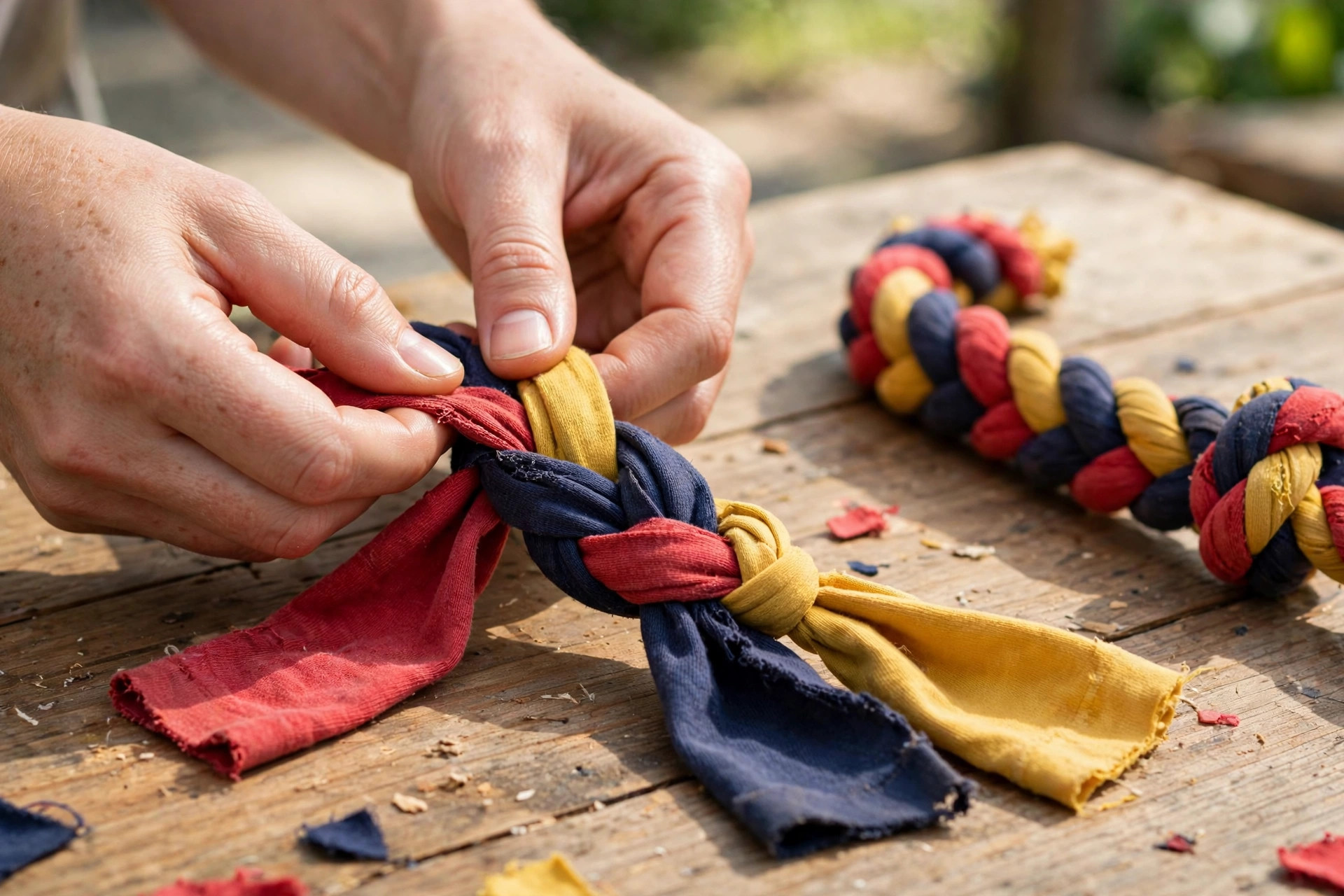
1. The classic t-shirt tug rope. Cut an old t-shirt into three long strips, knot them together at one end, braid tightly, and knot the other end. That is the whole project — five minutes, no sewing. Our full guide to DIY dog toys from old clothes has seven variations, including the denim knot for strong chewers.
\n
2. Braided fleece tug. Fleece does not fray the way cotton does, which makes it the best fabric for power chewers. Cut three fleece strips, braid, and finish with a tight double knot at each end. A fleece tug survives far longer than a cotton one.
\n
3. The denim knot. Cut the leg off an old pair of jeans, knot it in the middle, then knot each end. Denim is tough, it washes well, and it is the closest thing to a shop-bought rope toy you can make for free.
\n
4. Towel tug with handles. Roll an old bath towel lengthways, tie a knot in the middle, and you have a tug toy with two handles — one for you, one for the dog. It is also the softest tug toy here, which suits older dogs and puppies.
\n
5. The sock snake. Stuff three old socks inside each other, knot the end, and you have a floppy tug toy that is perfect for small dogs and puppies. Add a squeaker from a dead shop toy inside the middle sock if you have one — just make sure it is too big to swallow.
\n
Fetch toys (5 ideas)
\n
Fetch toys do not need to be fancy. They need to be visible, throwable, and easy for your dog to find in long grass.
\n
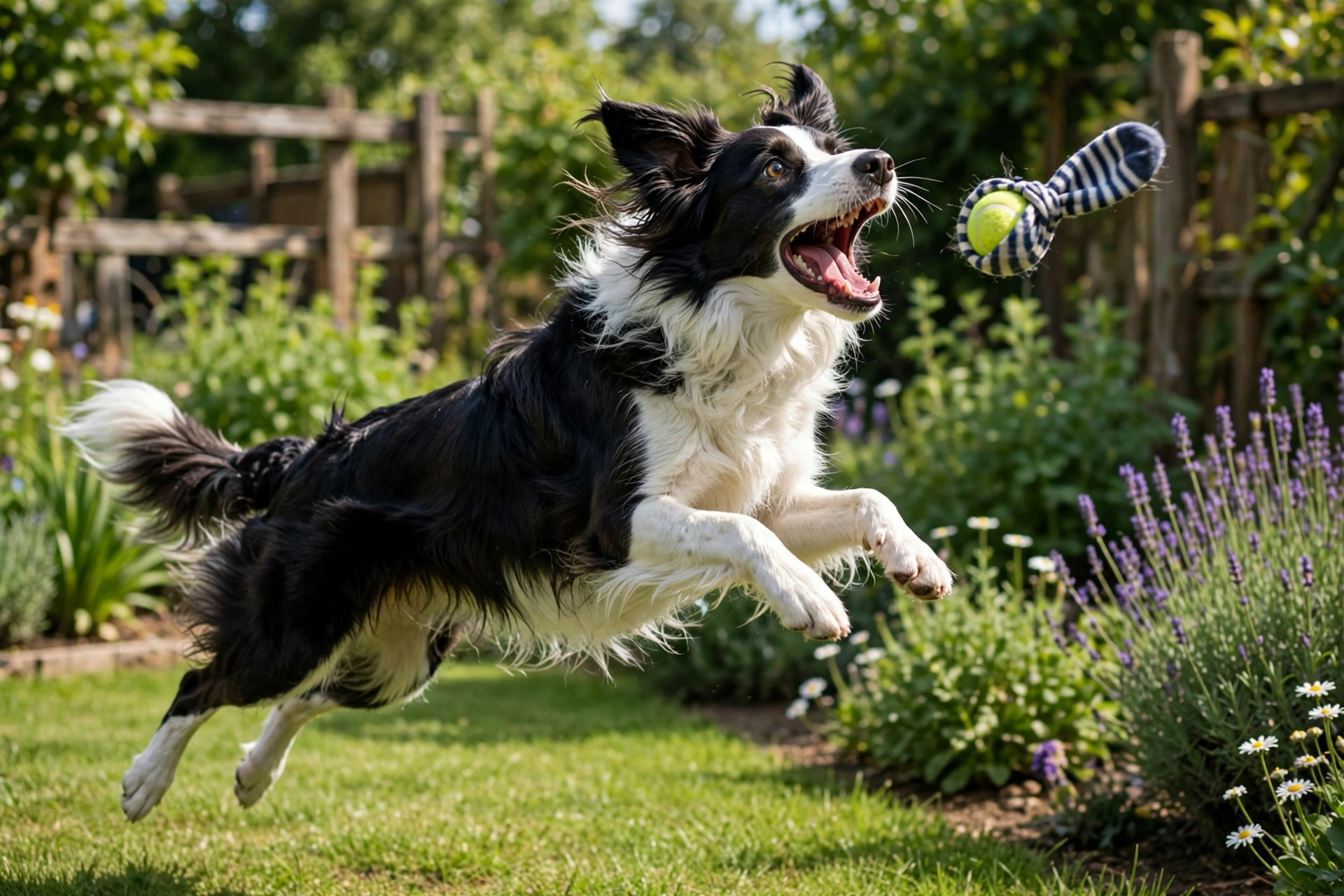
6. Sock ball. Roll a tennis ball inside an old sock and knot the end. The sock gives your dog something to grip, it is gentler on teeth than a bare ball, and it is much easier to spot in the grass.
\n
7. The bottle fetch. Put a few dry treats or a handful of kibble inside a clean, empty plastic bottle, screw the lid on tight, and throw it. It rattles, it rolls unpredictably, and it is free. Retire it the moment the plastic cracks or your dog starts chewing through it.
\n
8. Tennis ball in a sock sling. Knot a tennis ball into the toe of a long sock, leaving the rest of the sock as a handle. You can throw it further than a bare ball, and your dog gets a handle to carry it home with.
\n
9. The towel frisbee. Fold an old towel into a flat disc and stitch or knot the edges so it holds its shape. It flies badly compared to a real frisbee — which is the point: it floats, it is soft on the catch, and it will not hurt your dog’s teeth or gums the way hard plastic can.
\n
10. Rope-and-ball thrower. Tie a tennis ball into the end of a length of rope with a big knot. The rope lets you throw further and gives your dog something to carry the ball by. Use a rope at least a metre long so your fingers stay clear of the teeth on the grab.
\n
Puzzle and brain games (6 ideas)
\n
Mental work tires a dog out faster than physical work. Ten minutes with a puzzle toy is worth half an hour of fetch, and puzzle toys are where homemade beats shop-bought most clearly — because the best puzzles are just household objects with treats hidden in them.
\n
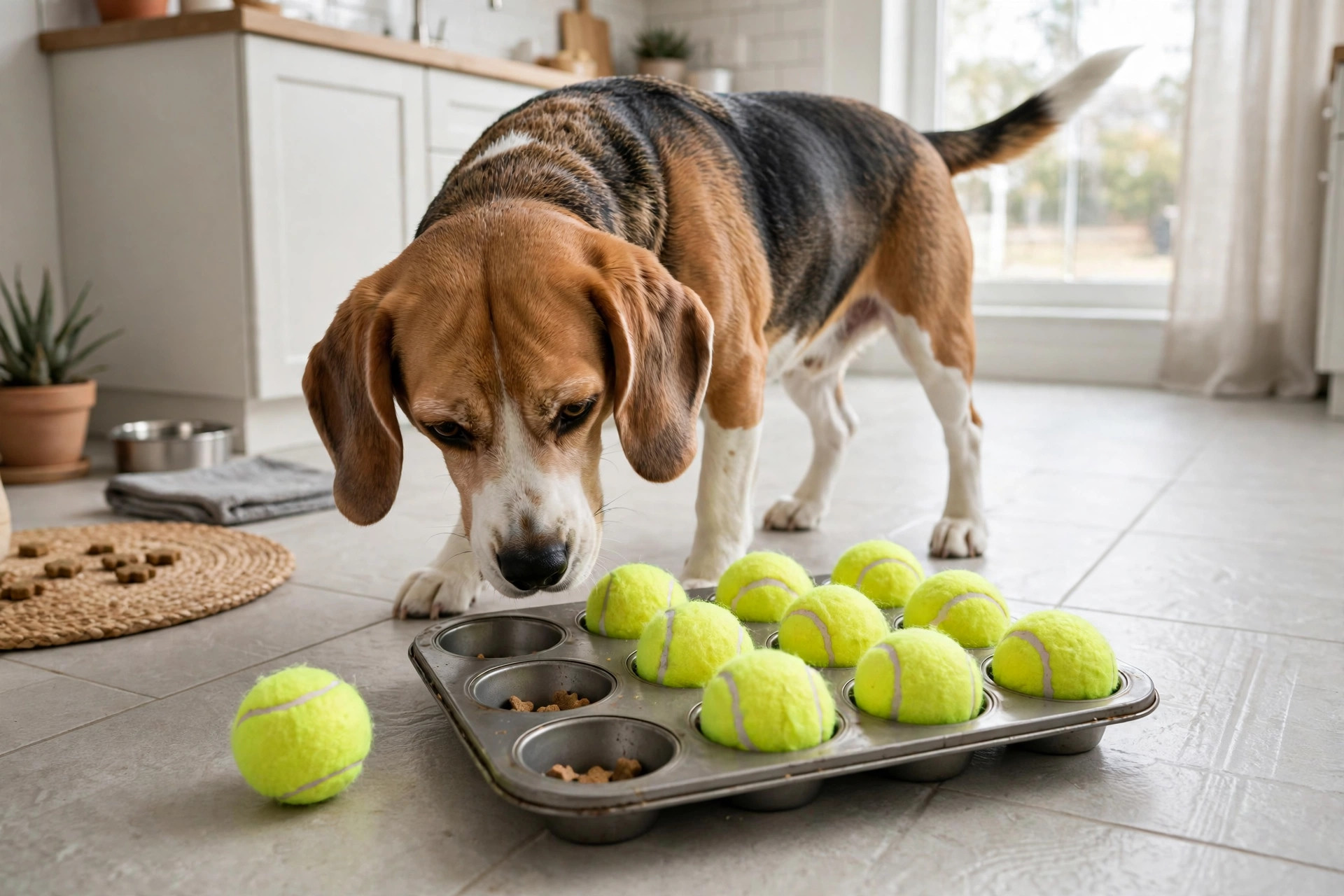
11. The muffin tin game. Put a treat in each cup of a muffin tin and cover the cups with tennis balls. Your dog has to work out how to lift each ball to get the treat underneath. Our DIY dog puzzle toys guide has the full version plus six more brain games, with difficulty levels.
\n
12. Towel roll-up. Lay a towel flat, scatter treats across it, roll it up tightly, and let your dog unroll it. It is the simplest puzzle there is, and it works for every dog from puppy to senior.
\n
13. The cup shell game. Hide a treat under one of three cups, shuffle them, and let your dog nose the right one. Start with the treat visible under a clear cup, then move to opaque cups once your dog understands the game.
\n
14. Cardboard box puzzle. Put treats inside a small cardboard box, close the flaps loosely, and let your dog tear it open. For a harder version, put a small box inside a bigger box. Cardboard is free, and tearing it up is half the fun for the dog.
\n
15. The bottle spinner. Thread a clean plastic bottle onto a wooden dowel or broom handle suspended between two chairs, cut a small hole in the bottle, and fill it with kibble. Your dog has to spin the bottle to release the food, one piece at a time.
\n
16. Treat treasure hunt. Hide treats around one room — under cushions, behind chair legs, on low shelves — and send your dog to find them. It is not a toy at all, but it uses the same nose-work instinct as every puzzle toy, and it costs nothing. For a full foraging setup, our DIY snuffle mat for dogs guide shows how to build a no-sew mat in under an hour.
\n
Chew and comfort toys (5 ideas)
\n
Chewing is a need, not a bad habit — especially for puppies and anxious dogs. The right chew toy gives that energy somewhere safe to go.
\n
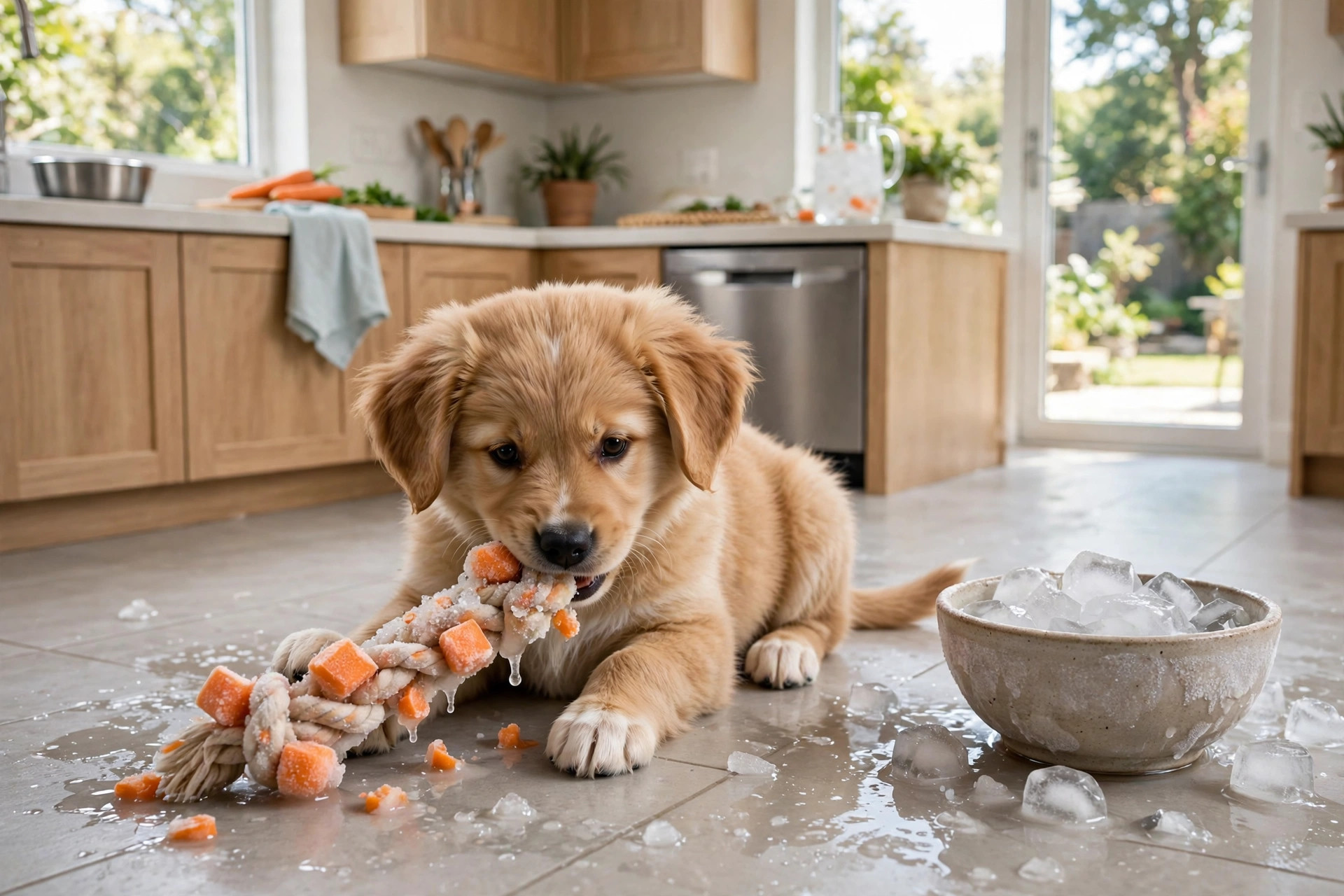
17. Frozen carrot rope. Soak a cotton rope toy in water, freeze it overnight, and hand it over. The cold soothes sore gums, and the rope gives a puppy something to work on. Replace it once it thaws and softens.
\n
18. The ice lick toy. Freeze a bowl of water with a few treats and a smear of peanut butter inside, then pop the ice block out and give it to your dog outside or on a towel. It is a chew toy, a puzzle, and a cooling treat in one — our puppy popsicles guide has the full frozen-treat method.
\n
19. Knotted fleece chew. Cut a fleece blanket into strips, tie a series of tight knots along one strip, and you have a soft chew toy that is gentle on puppy teeth. Fleece is the safest fabric here because it does not unravel into long threads the way cotton does.
\n
20. The old jumper snuggle toy. Stuff the sleeve of an old jumper with other old clothes, knot the end, and you have a soft comfort toy that smells like you. It is the homemade version of the comfort toys anxious dogs love — and it costs nothing.
\n
21. Lick mat upgrade. A silicone lick mat smeared with mashed banana or plain yoghurt is the cheapest calming toy there is, and it pairs perfectly with a chew session. Our lick mat recipes for dogs has ten spreads, including the frozen ones that last longest.
\n
Water and outdoor toys (4 ideas)
\n
22. The splash bottle. Fill a clean plastic bottle halfway with water, freeze it, and float it in a paddling pool. Dogs push it around, chase it, and try to fish it out — a whole game from one bottle.
\n
23. Sponge fetch. Cut a kitchen sponge into a ball shape and soak it in water. It is soft, it flies well when wet, and it will not hurt anyone if it lands on a person. Only for supervised play — a sponge is not a chew toy.
\n
24. The garden hose game. A gentle spray from a hose is the best free toy for water-loving dogs. Keep the pressure low, let the dog chase the stream, and stop before they get overexcited — some dogs get obsessive about water, and that is a habit you do not want to build.
\n
25. Digging box. Fill a shallow box or old paddling pool with sand or soil, bury a few treats and toys in it, and let your dog dig. It gives diggers a legal place to dig, and it keeps the rest of the garden intact.
\n
How to pick the right homemade toy for your dog
\n
Not every toy suits every dog. Use this quick guide:
\n
- \n
- Power chewers (destroy a toy in minutes): fleece and denim tugs, knotted rope, frozen toys. Avoid bottles, cardboard, and anything with stuffing. Always supervise.
- Gentle mouths (carry toys around, rarely destroy them): almost everything here works, including sock toys, cardboard puzzles, and sponge fetch.
- Puppies: soft fleece, frozen carrot rope, sock snake, towel roll-up. Nothing hard, nothing with small parts, and everything supervised.
- Seniors: towel tug, lick mat, snuffle mat, gentle puzzle games. Avoid anything that needs jumping or hard chewing.
- Bored dogs: puzzle games first — muffin tin, bottle spinner, treat treasure hunt. Ten minutes of thinking beats an hour of pacing.
- Anxious dogs: lick mats, snuffle mats, and the old jumper snuggle toy. Calm, repetitive, scent-based play settles a nervous dog faster than anything energetic.
\n
\n
\n
\n
\n
\n
\n
If you are not sure which type your dog is, start with a fleece tug and a towel roll-up. Both are safe for almost every dog, both cost nothing, and how your dog plays with them will tell you everything you need to know.
\n
Make any toy in 3 steps
\n
Every toy in this guide follows the same three steps — once you know them, you can invent your own.
\n
Step 1 — Pick a safe material. Old clothes, towels, fleece, socks, cardboard, clean bottles, tennis balls. No buttons, no zips, no small parts, nothing painted or treated.
\n
Step 2 — Build it tight. Knots should be tight enough that you cannot pull them apart with both hands. Seams should be double-knotted. If you can pull a piece off, your dog can too.
\n
Step 3 — Test it supervised. Play with the new toy together for ten minutes before leaving your dog with it. Watch how they chew, tug, and carry it. If it survives the test, it is a keeper.
\n
Materials to never use
\n
Some household things look like toy material but are not safe for dogs:
\n
- \n
- Cooked bones and rawhide scraps — they splinter and cause blockages.
- Anything with stuffing from old cushions or soft toys — the filling is a blockage risk if swallowed, and old foam can contain flame retardants.
- Tennis balls for power chewers — the felt wears down teeth over time, and a determined chewer can compress a ball small enough to swallow. Use them for fetch, not for chewing.
- Plastic bags, cling film, and elastic bands — all choking and blockage risks.
- Old socks with holes — a dog can swallow a sock whole, and that is one of the most common foreign-body surgeries vets perform. Use intact socks, knotted tightly, and retire them the moment they tear.
- Anything treated with chemicals — painted wood, varnished furniture offcuts, fabric softener-soaked cloths, and mothballed clothes.
\n
\n
\n
\n
\n
\n
\n
When in doubt, leave it out. A toy made from one safe material is better than a clever toy made from three questionable ones.
\n
Washing and looking after homemade toys
\n
Homemade toys get dirty fast — that is the price of being loved. The good news is that they are all washable:
\n
- \n
- Fabric toys (t-shirt, fleece, denim, towel, sock): machine wash at 40°C with plain detergent, no fabric softener, and air-dry. Wash weekly, or sooner if the toy smells.
- Rope toys: soak in warm soapy water, rinse well, and dry completely before the next play — damp rope grows bacteria fast.
- Bottles and plastic: wash with warm soapy water, rinse, and replace the moment the plastic cracks or clouds.
- Cardboard puzzles: these are single-use by design. Recycle after each session and make a fresh one.
- Frozen toys: wash after every use and refreeze clean.
\n
\n
\n
\n
\n
\n
Keep a small rotation: two or three toys out, the rest in the wash or in a toy box. Dogs get bored of the same toy, and a toy that disappears for a week comes back feeling brand new. Our slow feeder dog bowls guide uses the same rotation idea for feeding — variety keeps a dog interested.
\n
Mistakes to avoid
\n
- \n
- Leaving a new toy unsupervised on day one. Always test it first. The first ten minutes tell you everything.
- Making toys too small. If it fits entirely in your dog’s mouth, it is too small. Size up.
- Using your dog’s bedding as toy material. A dog that learns to shred an old jumper will happily shred the new one too.
- Letting tug get rough. Tug is a great game, but it has rules: the game stops the moment teeth touch skin, and \”drop it\” ends the game every time. Rough tug teaches rough mouthing.
- Forgetting to retire worn toys. A toy that is falling apart is not a toy any more — it is a pile of swallowable pieces. Retire it.
- Making one toy and stopping. Dogs need variety. Rotate between tug, fetch, puzzle, and chew toys across the week, and your dog will stay interested far longer than with any single toy.
\n
\n
\n
\n
\n
\n
\n
FAQs
\n
Are homemade dog toys safe?\nYes, when they follow the five rules: match the toy to the chewer, supervise new toys, use no small parts, check the toy before each play, and size it right. The most dangerous homemade toy is one made from the wrong material or left unsupervised with a power chewer.
\n
What is the easiest homemade dog toy to make?\nThe towel roll-up: scatter treats on a towel, roll it up, and hand it over. Thirty seconds, no tools, no sewing, and it works for every dog. The t-shirt tug rope is the easiest tug toy — three strips, two knots, five minutes.
\n
What household items are safe for dogs to play with?\nOld t-shirts, fleece, denim, towels, socks, cardboard boxes, clean plastic bottles, tennis balls, and muffin tins. Avoid anything with buttons, zips, stuffing, small parts, or chemical treatments.
\n
Can puppies play with homemade toys?\nYes — puppies are the dogs that benefit most, because they need to chew and they need novelty. Stick to soft materials (fleece, towel, sock), freeze toys for sore gums, and always supervise. Nothing hard, nothing small enough to swallow.
\n
How often should I replace homemade dog toys?\nCheck before every play session and replace the moment a toy frays, tears, or cracks. Fabric toys usually last a few weeks of regular play; cardboard and bottle toys are often single-session. Wash fabric toys weekly.
\n
My dog destroys every toy in minutes. Are homemade toys still worth it?\nYes — but only as supervised play-session toys, not as leave-alone toys. Use fleece and denim, keep sessions short, and take the toy away when the session ends. A destroyed homemade toy costs you nothing; a destroyed shop toy costs you money and the same vet risk.
\n
Can homemade toys help a bored dog?\nMore than almost anything else. Puzzle toys — the muffin tin, the bottle spinner, the towel roll-up — make a dog think, and thinking tires a dog out faster than running. Ten minutes of puzzle play is worth half an hour of fetch for a bored dog.
\n
The bottom line
\n
Homemade dog toys are not a compromise — for most dogs, they are better than shop-bought toys. They smell like you, they cost nothing, they can be replaced in five minutes when they wear out, and they turn things you were about to throw away into the best part of your dog’s day. Start with the t-shirt tug rope and the towel roll-up tonight, and see which one your dog picks. Then work through the rest of the list, one play style at a time — and if your dog loves the puzzle games, our DIY dog puzzle toys guide has seven more, and our DIY dog agility course turns the garden into a whole playground. For the full enrichment picture, pair these toys with a DIY snuffle mat for dogs and a few no-bake dog treats hidden inside them.
\n
Pin this for later 📌 — and if your dog demolishes every toy you give them, our DIY dog toys from old clothes guide has the denim knot and six more tough makes for strong chewers.
“,
“source_draft”: “/home/hatch/workspace/goals/pinterest-pin-automation-for-petsmush-com/files/homemade-dog-toys-post-draft.md”,
“status”: “publish”
}