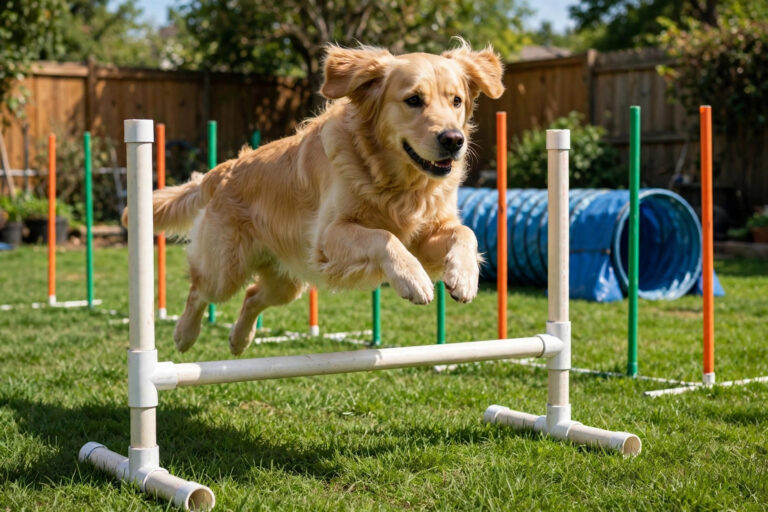
A backyard agility course used to mean spending hundreds on competition-grade equipment — or driving to a club twice a week. It doesn’t anymore. With some PVC pipe, garden stakes, a blanket and a hula hoop, you can build a proper DIY dog agility course in an afternoon, for less than the cost of one club session.
Agility is one of the best things you can do with a busy dog. It burns off physical energy, but the real magic is the mental workout: your dog has to listen, think, and trust your direction at speed. Ten minutes on a course tires out many dogs the way an hour-long walk never quite does. And if your dog already loves the enrichment games in our DIY dog toys and DIY snuffle mat guides, agility is the natural next level — it takes that brain work outside.
You don’t need a big garden, either. A course of just three or four obstacles in a small yard is plenty for a beginner dog. Here are seven household builds, in the order most trainers would introduce them.
Before you build: the ground rules
- Soft ground only. Grass, packed dirt or rubber mulch is ideal. Skip concrete and hard-packed gravel — a bad landing on a hard surface is how injuries happen.
- No high jumps for puppies. Dogs under 12–18 months (check with your vet for your breed) shouldn’t jump full height — their growth plates are still open. Keep bars at paw height or on the ground while they’re young.
- Short sessions. Ten to fifteen minutes, once a day, is perfect. End while your dog is still having fun, not when they’re exhausted.
- Always warm up. A five-minute loose-lead walk and a few minutes of play before the course, and a gentle cool-down walk after.
1. The PVC Jump
The signature agility obstacle, and the easiest to build. You’ll need two PVC pipes (about 1.5 m each) for the uprights, two T-joints, four short feet pieces, and one longer pipe or a wooden dowel for the bar. Stand the uprights in the T-joints, attach the feet, and rest the jump bar across two shorter stubs at your chosen height.
The clever bit: use cups or clamps so the bar falls freely if your dog clips it. A bar that knocks down safely is a safety feature, not a flaw. Start with the bar on the ground (just a pole between the uprights), then raise it to wrist height, then — for adult dogs — to roughly their shoulder height. Never higher than their shoulder.
2. Weave Poles from Garden Stakes
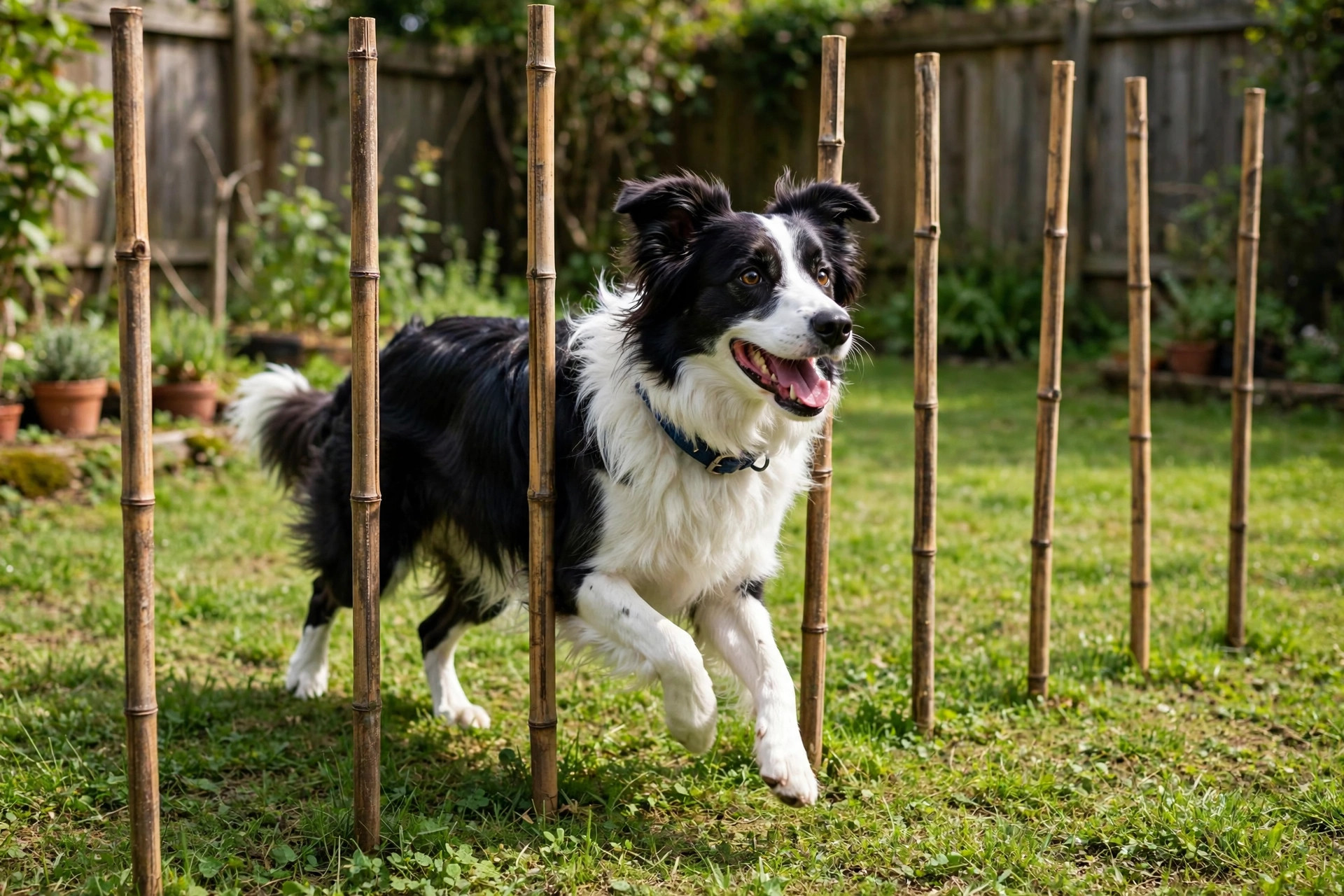
Push six to twelve bamboo garden stakes or tomato stakes into soft ground in a straight line, spaced about 60 cm apart. That’s it — you have weave poles. Dogs learn to snake through them left-right-left, and it’s one of the most satisfying obstacles to watch a dog master.
Teach it with a lure: walk your dog through the first two poles in a straight line with a treat at their nose, rewarding at each gap. Add one pole at a time. Most dogs pick this up in a week of short daily sessions.
3. The Blanket Tunnel
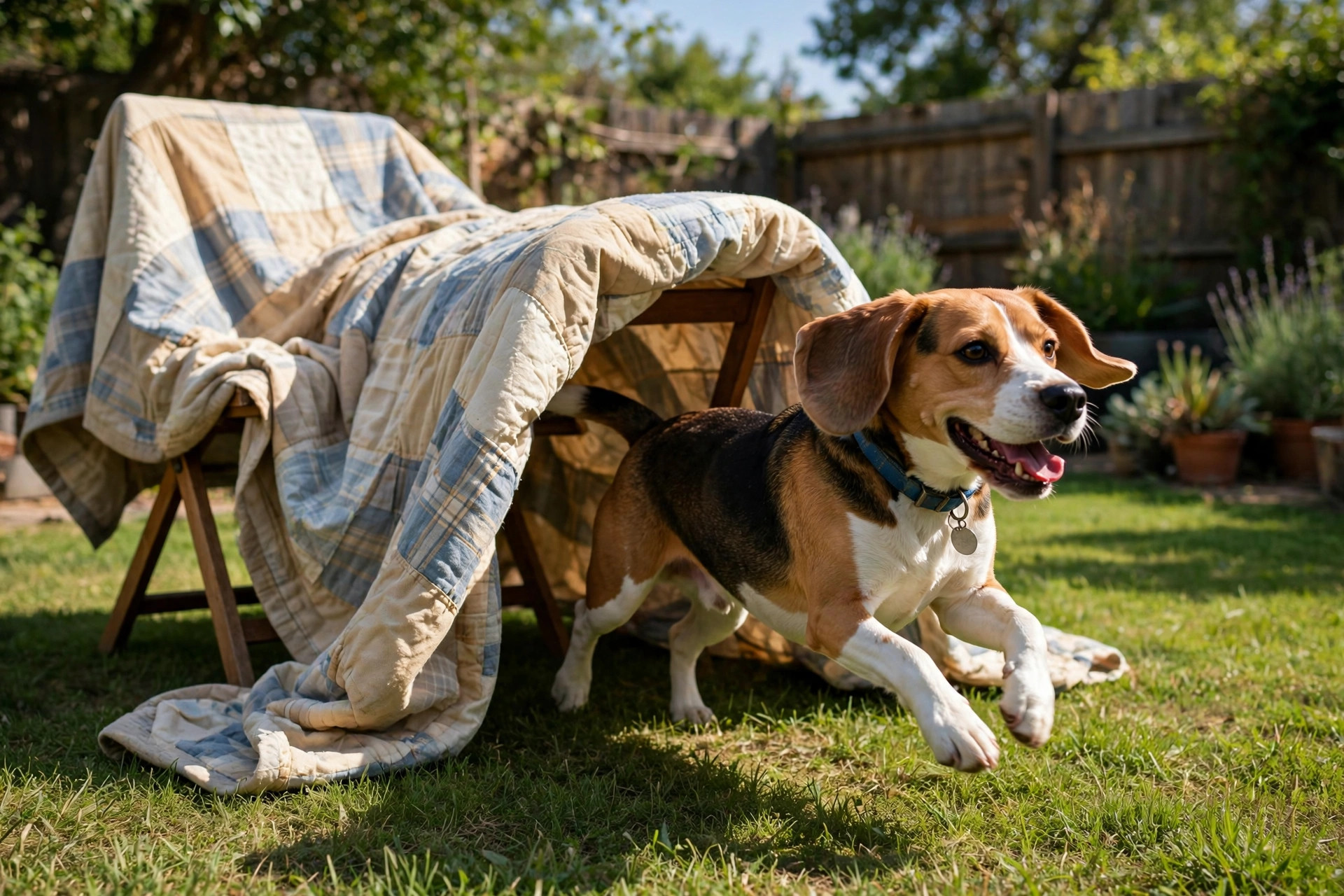
Drape a blanket or duvet cover over two chairs or sawhorses, leaving both ends open. For a longer tunnel, drape it over a row of three chairs. Weight the edges with shoes or books so it doesn’t slide.
Tunnels are brilliant confidence-builders because dogs can’t see through them — the first time your dog pops out the far end expecting you and gets a jackpot treat, you’ve got a tunnel fan for life. Start with the tunnel short and straight, then make it longer and curved as your dog gains confidence.
4. The Pause Table from a Pallet
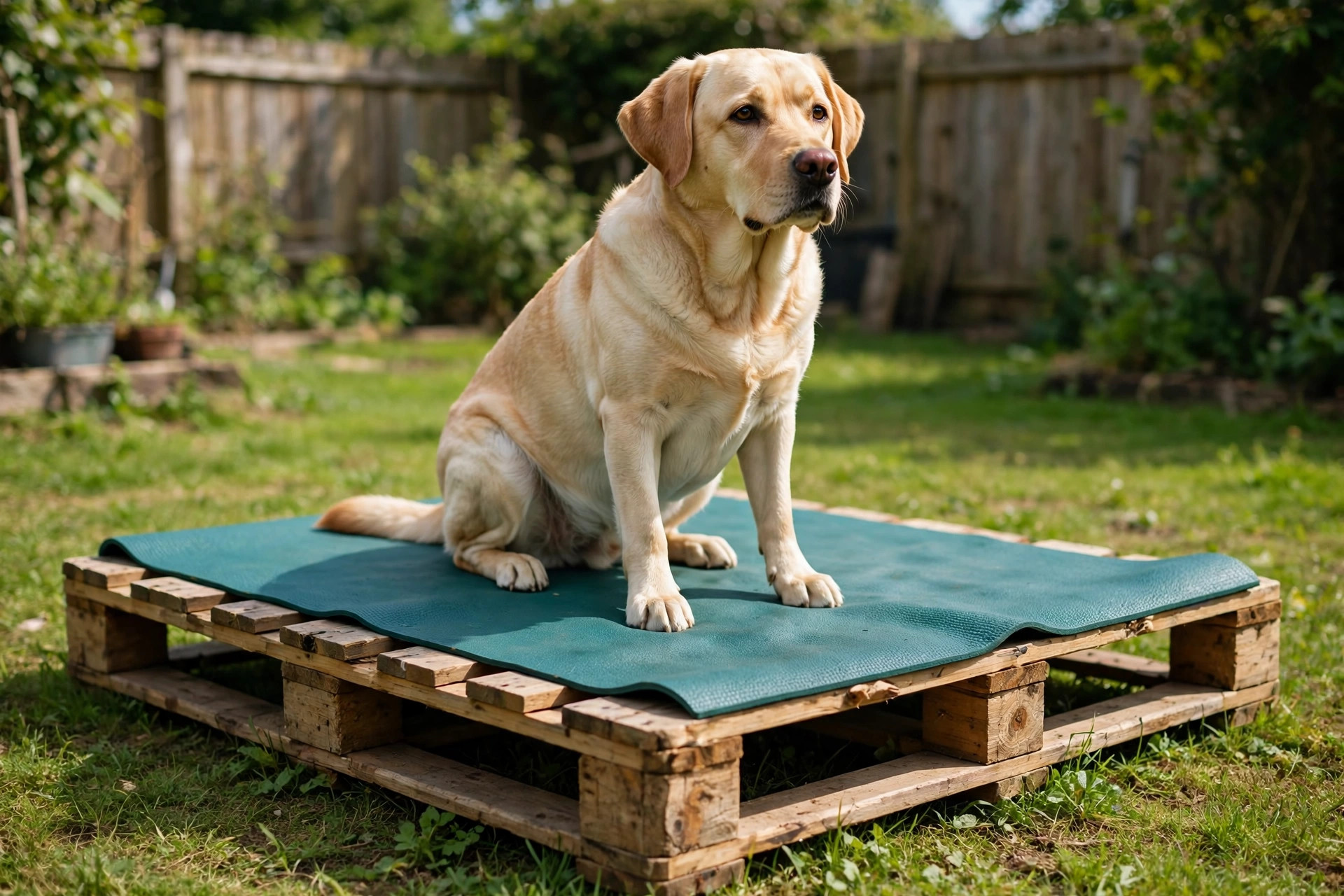
A pause table is a low platform where the dog jumps up and holds a sit or down for five seconds. A wooden pallet on four short blocks (about 25–30 cm high) does the job. Lay an old yoga mat, carpet offcut or rubber doormat on top for grip.
The pause table is where your dog learns the most valuable agility skill: listening at speed. Running full tilt and then stopping on the table on cue is hard for excitable dogs — and incredibly useful everywhere else in life, too.
5. The Hula-Hoop Tire Jump
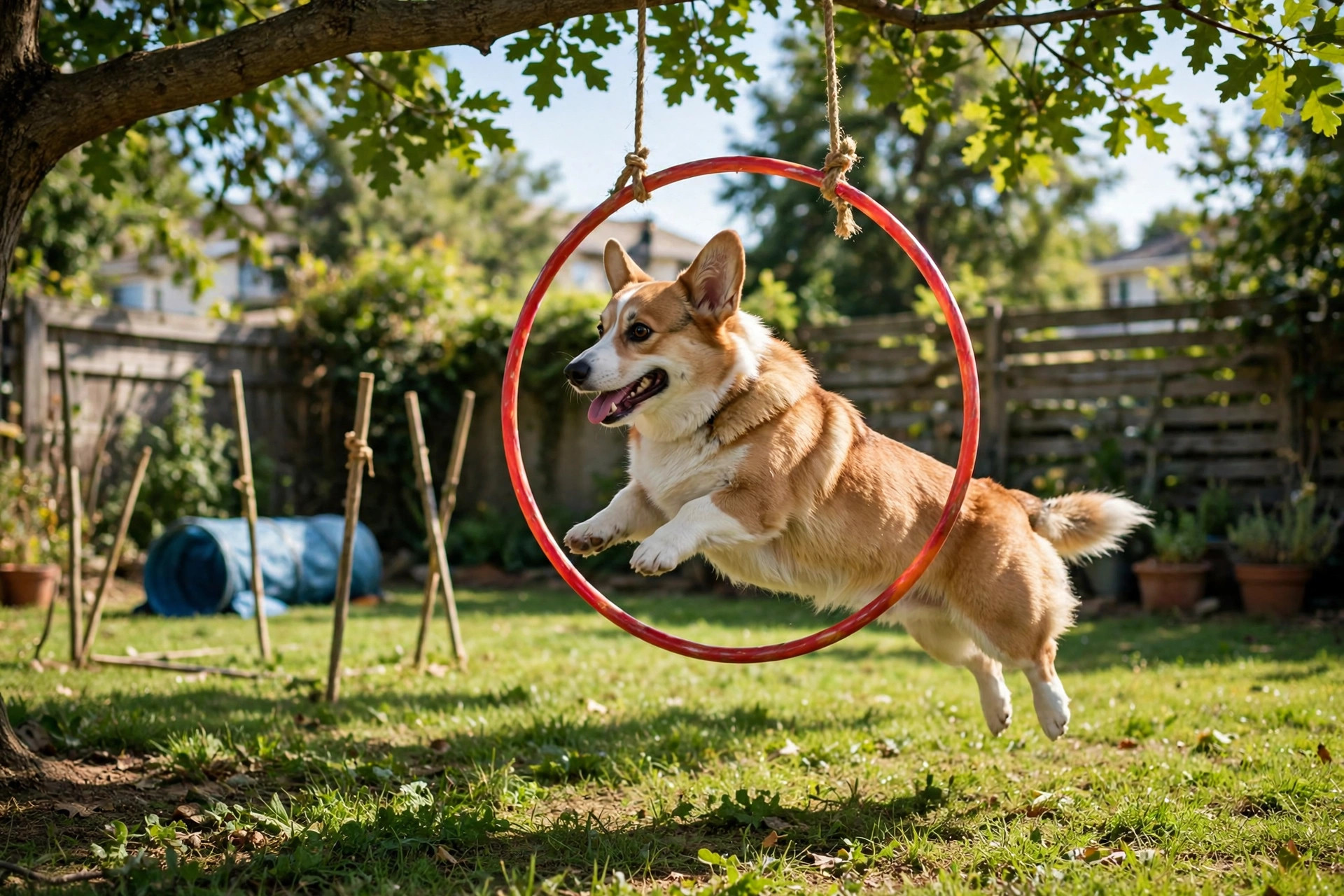
Hang a hula hoop from a tree branch with rope, or mount it between two PVC uprights like the jump in build 1. Start it touching the ground so your dog simply walks through it, then raise it slowly — to chest height for adult dogs, no higher.
This is the crowd-pleaser: dogs seem to find jumping through a hoop inherently fun. It’s also a great starter obstacle for cautious dogs, because there’s nothing to knock over and the target is obvious.
6. The Cardboard-Box Contact Zone
Competition courses have a “contact zone” — a painted area on the seesaw and ramp that the dog must touch, teaching controlled movement. You can train the idea with a flat cardboard box or a low wooden board. Teach your dog to walk across it and stop with two paws on, two paws off, then treat.
This build costs nothing and pays off in every other obstacle: a dog that understands “slow down and touch” is a dog that stays in control on the course.
7. The Slalom of Pool Noodles
Push pool noodles (or rolled towels) upright into soft ground, or stand them in buckets of sand. Dogs weave through them just like weave poles, but the soft noodles forgive every bump — perfect for puppies, seniors, or dogs that are still learning where their feet are.
Safety note — puppies and seniors: skip the full-height jumps and hard weaving for puppies under 12 months entirely — stick to ground poles, the tunnel, the pause table and the noodle slalom. For seniors, keep bars at elbow height, sessions to ten minutes, and check with your vet first if your dog has arthritis or hip issues. One bad landing matters more than one great run.
The beginner training order
Don’t just let your dog loose on all seven at once. Most trainers introduce obstacles in this order:
- Tunnel and pause table — confidence and listening, zero risk.
- Ground-level jumps (bar on the ground) and hula hoop at ground level — straight lines at walking pace.
- Weave poles and noodle slalom — add the weaving pattern.
- Raised jumps and contact work — only for adult dogs, raised gradually.
Work on one obstacle until your dog offers it happily and reliably, then add the next. A course of three mastered obstacles beats seven half-learned ones every time.
How much does it cost?
A full seven-obstacle course from household stuff typically runs under $30–$50: a few PVC pipes and fittings (the only thing most people buy), garden stakes you probably own, a blanket, a hula hoop, a pallet. Compare that to $150+ for a single commercial jump, and DIY wins by a mile. The most expensive part of agility was always the dog’s enthusiasm — and that’s free.
The bottom line
A DIY dog agility course turns an ordinary backyard into the best fifteen minutes of your dog’s day. Start with the tunnel and pause table, keep sessions short, keep the ground soft, and let your dog’s confidence set the pace. You’ll be amazed how quickly a dog that once dragged you to the park starts dragging you toward the course instead.
FAQs
Is agility safe for my dog?
For healthy adult dogs on soft ground with appropriate jump heights, yes. Puppies and seniors need the modified version above, and dogs with joint problems should get a vet’s clearance first.
What age can a dog start agility?
Puppies can start foundation work (tunnels, targets, flatwork) as young as 8–10 weeks with a trainer’s guidance. Full-height jumping and tight weaving should wait until growth plates close — 12–18 months depending on breed and size.
Do I need to compete to do agility?
Not at all. Most backyard agility dogs never enter a competition. The course is enrichment, exercise and bonding — competition is optional.
How big a yard do I need?
A 10 × 10 m patch of grass fits three or four obstacles comfortably, which is plenty for a beginner course. Small yards work fine if you keep the course compact.
My dog is scared of the tunnel. What now?
Shorten it, bunch the fabric up so they can see through, and toss treats through the middle. Never push a scared dog through — let curiosity do the work over a few days.