
Watch a senior dog get up in the morning and you’ll understand what an orthopedic dog bed is for. The stiff pause before the first step. The careful way they lower themselves down, joint by joint, at night. Around half of all dogs over the age of seven show some degree of arthritis — and a bed that supports their joints instead of fighting them is one of the simplest, kindest upgrades you can make.
But “orthopedic” is one of the most abused words in pet marketing. Thin egg-crate foam pads, polyester-filled “support” cushions and flat mats all wear the label without earning it. A genuinely orthopedic bed is a piece of furniture with a job: distribute the dog’s weight evenly, keep pressure off sore hips, elbows and shoulders, and make getting up and lying down as easy as possible.
Here is how to tell the real thing from the marketing — and how to pick the right one for your dog.
What makes a bed genuinely orthopedic
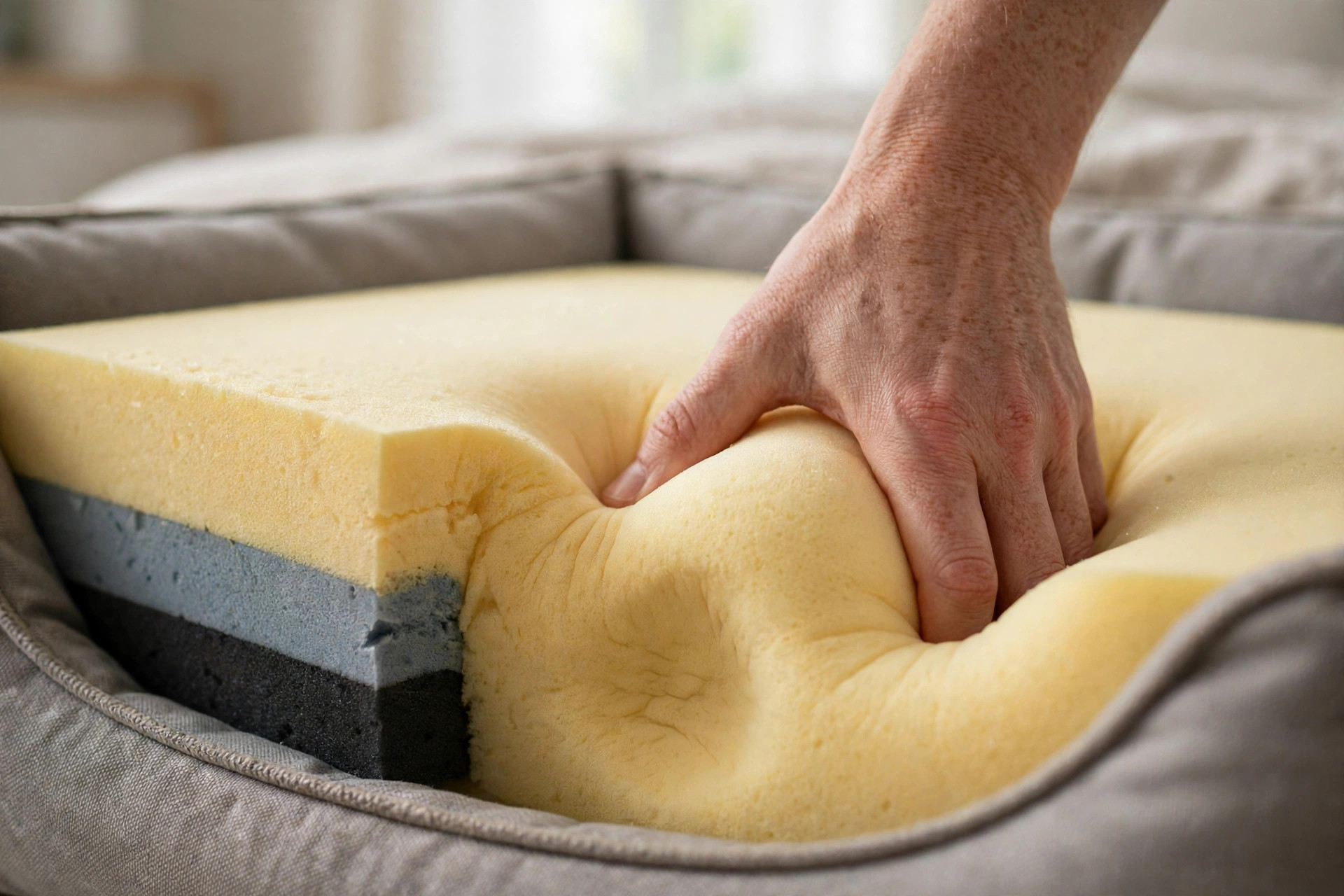
The heart of an orthopedic bed is a thick slab of high-density memory foam. Not a layer of memory foam over cheap poly-fill. Not shredded-foam stuffing. A solid slab — usually at least 10 cm (4 inches) thick for large breeds — that compresses under your dog’s weight and cradles the joints instead of letting them sink through to the floor.
Do the hand test before you buy (or when the bed arrives): press your knee hard into the middle. On a real orthopedic bed you feel firm, slow resistance and you can’t feel the floor through it. On a fake, your knee goes straight through to the other side. If your knee can bottom it out, so can your arthritic dog’s elbow.
Under the memory foam, the best beds add a denser support-foam base — the same layered construction as a human mattress. This keeps the bed from flattening over time and gives the surface a stable platform to rebound from.
The memory foam density guide — the one spec that matters
Foam density is measured in pounds per cubic foot, and it is the single most honest number on the label. Here is what the numbers mean for your dog:
- 2–3 lb density: soft comfort foam. Fine as a topper, not orthopedic on its own. Most “orthopedic” impostors live here.
- 4 lb density: the sweet spot for most dogs. Genuinely supportive, sleeps a little warmer than lower-density foam.
- 5 lb density: maximum support for very large or giant breeds, and for dogs with severe arthritis. Very firm at first — it softens slightly with body heat.
A word on thickness too: a 10 cm (4 inch) slab of 4 lb foam beats a 18 cm (7 inch) slab of 2 lb foam every time. Thickness without density is just height. Look for both numbers on the label, and be suspicious of any “orthopedic” bed that lists neither.
Bolster vs flat: which suits an arthritic dog?
Flat orthopedic beds win for most senior dogs with joint problems. Nothing to climb over, no raised edges pressing into sore ribs when the dog sprawls — and many arthritic dogs sprawl flat out because curling up hurts. If your dog sleeps stretched on their side, go flat.
Bolster beds (raised edges on two or more sides) suit dogs who like to rest their chin or brace their back against something. The bolster has to be genuinely low and soft for a senior, though — a tall, firm bolster becomes a wall they have to heave themselves over, which defeats the purpose. For dogs who love the den feeling but have stiff joints, a low bolster on just the back edge is the best compromise. (If anxiety rather than arthritis is your dog’s main issue, our guide to calming dog beds covers the raised-rim designs built for that.)
Low-entry designs: the feature seniors actually feel
The most underrated orthopedic feature is how the dog gets on and off. Arthritis makes every small step up a negotiation. Look for:
- A low profile overall — the sleeping surface should sit no more than a few inches off the floor, so there is no “step” to climb.
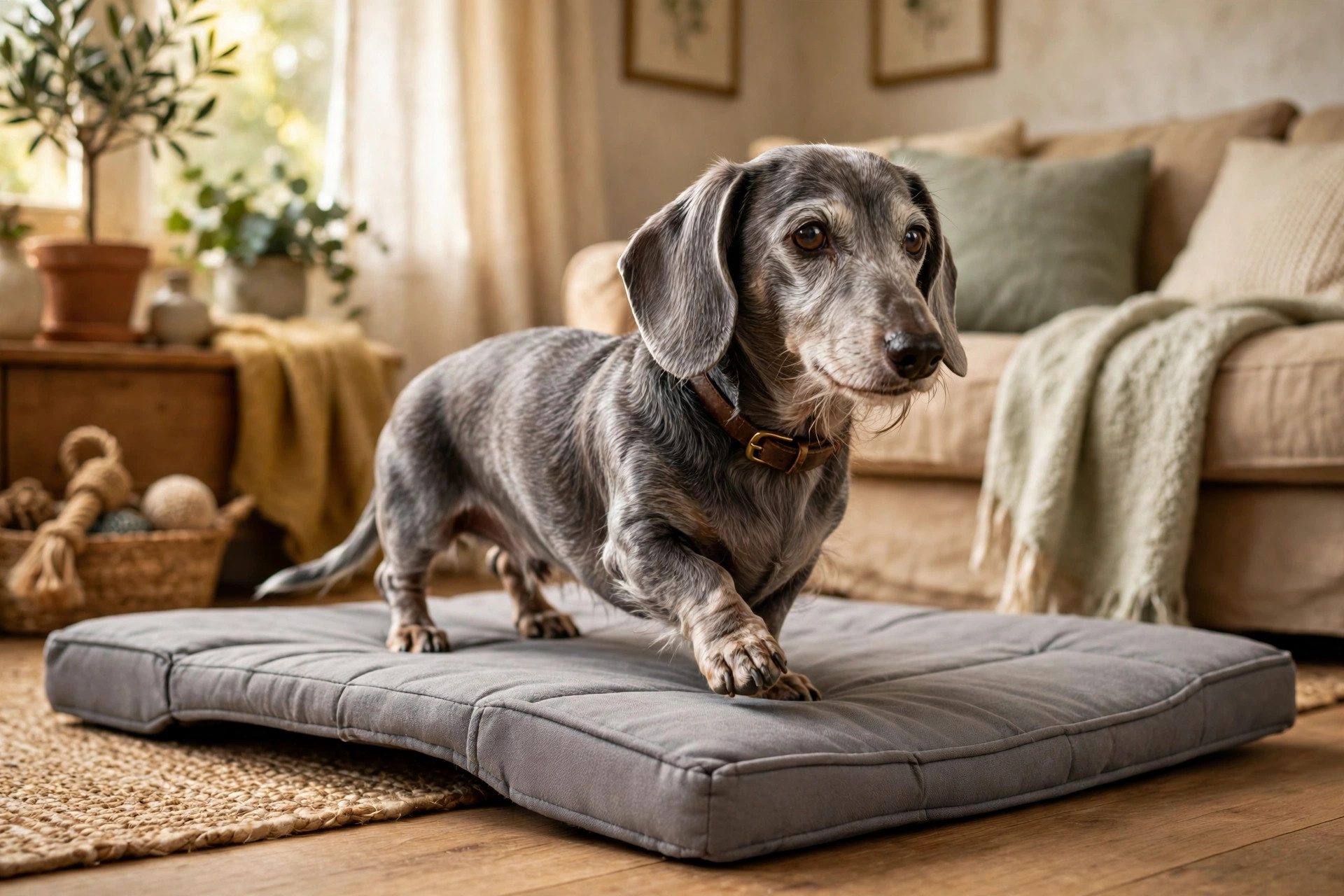
- Dipped or ramped front edges on at least one side, letting a stiff dog walk on rather than haul themselves up.
- No surrounding frame or lip the dog has to clear. Wooden-frame beds look great but add a barrier; for a genuinely creaky dog, a simple low slab beats a stylish frame.
If your dog struggles with the couch or the car too, a ramp can change their daily life — the same senior-mobility logic that applies to beds applies everywhere.
Sizing for large and giant breeds
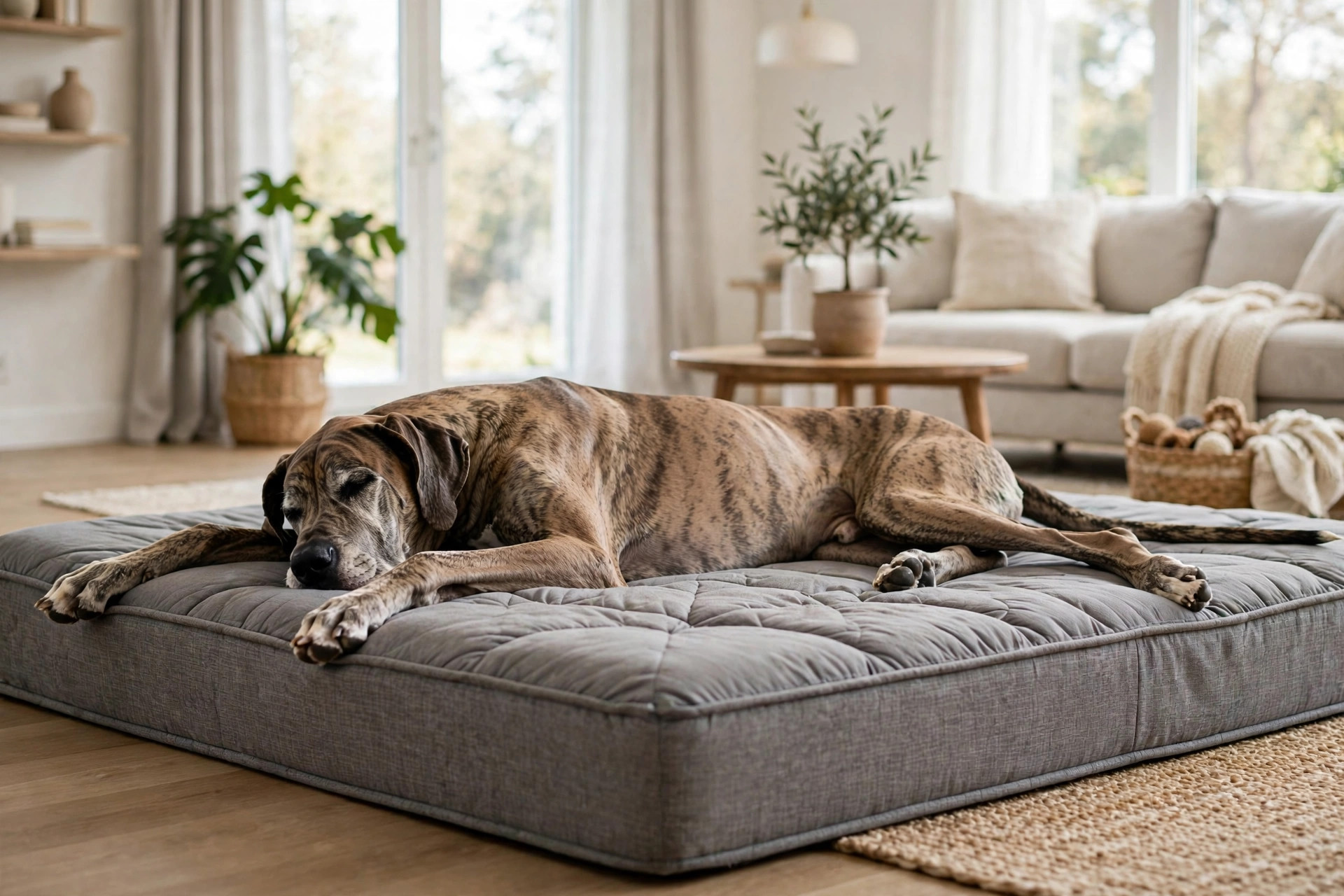
Orthopedic support scales with the dog, and this is where most buyers under-buy. A bed is too small if any part of the dog hangs off the edge while they sleep — joints dangling off the rim get zero support, and the dog will quietly migrate to the floor (or your sofa) instead.
Measure your dog from nose to tail base while they sleep in their favourite position, then add 15–20 cm (6–8 inches). For large breeds like Labradors and German Shepherds that means a bed around 100–110 cm long; for giant breeds like Great Danes, look for true XL/XXL beds — a standard “large” is built for a 30 kg dog, not a 60 kg one.
Bigger beds also need thicker foam. A 4-inch slab that supports a terrier will bottom out under a mastiff. For dogs over 40 kg, insist on 5 lb density foam, 12 cm (5 inches) or thicker.
Washable covers that survive real life
An orthopedic bed is an investment — senior dogs drool, shed, and have the occasional accident — so the cover matters as much as the foam:
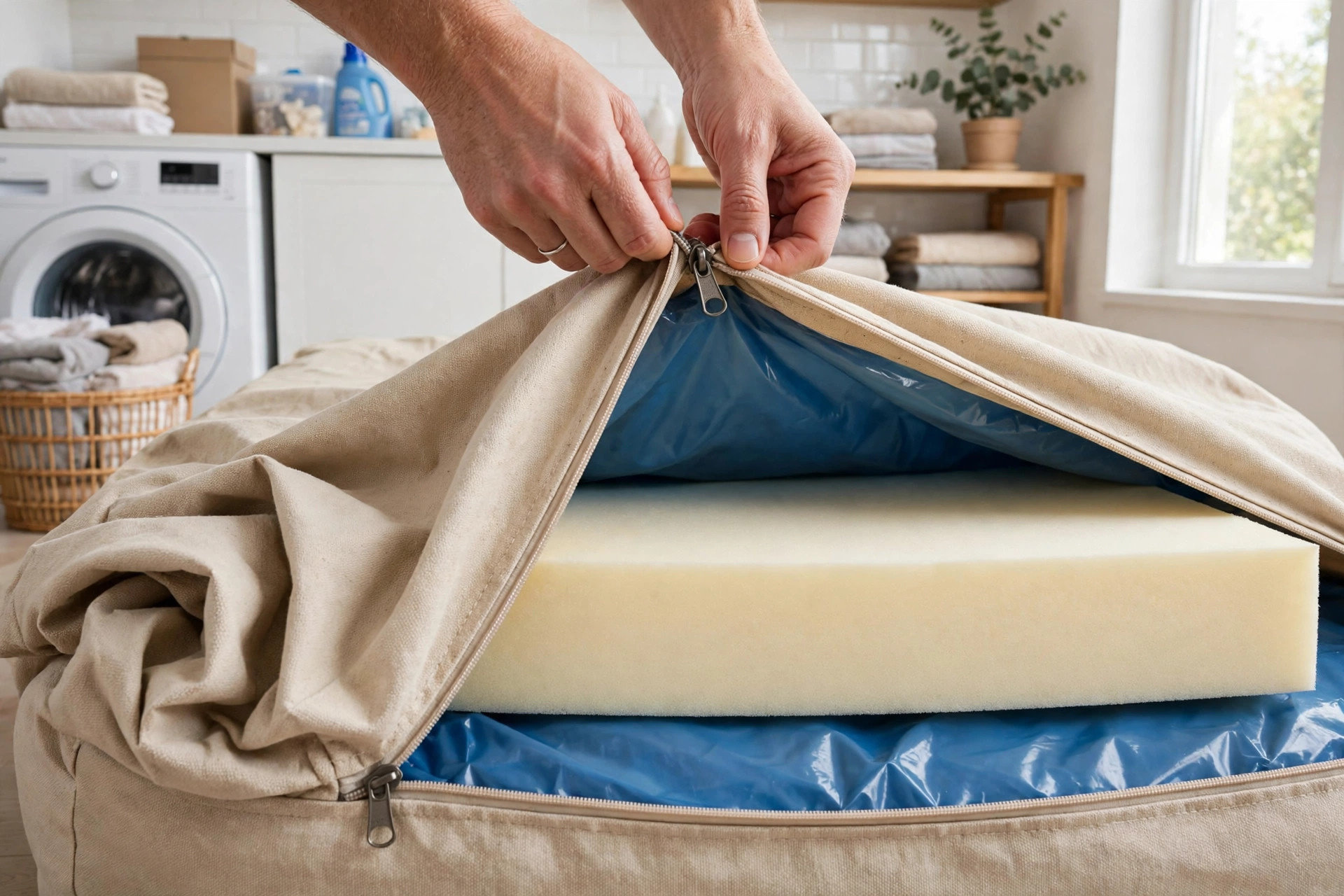
- Removable, machine-washable covers are non-negotiable. The cover should come off easily (a full-length zip, not a tiny slot) and go back on without a wrestling match.
- A waterproof liner between the cover and the foam is the difference between a washable cover and a ruined bed. One accident soaking into memory foam is the end of that foam — it can’t be washed and it won’t dry properly.
- Durable fabrics like canvas or microfibre outlast plush fleece, which pills and mats within months. If your dog likes to “dig” before lying down, avoid anything with a loose weave.
Plan to wash your dog’s bed every 2–4 weeks; a good orthopedic bed is built to survive years of that routine.
What to avoid
- Egg-crate “orthopedic” toppers. The bumpy foam looks medical and does almost nothing. It compresses flat within weeks.
- Beds filled with shredded foam or poly-fill. They develop lumps and dead spots exactly where your dog lies, creating pressure points — the opposite of what you paid for.
- Beds that sleep hot with no remedy. Dense memory foam retains body heat. That’s a bonus in a draughty house and a problem for a hot-sleeping senior — if your dog pants on foam beds, pair the orthopedic bed with a cooling setup or consider one of our elevated dog beds for summer.
- No listed foam density. A manufacturer that won’t tell you the density is telling you everything.
Safety notes
- A new orthopedic bed can take a few nights — some dogs distrust the different feel. Put a worn t-shirt of yours on it; familiar scent does more than any “calming” marketing.
- Dogs with severe arthritis should see the vet before you shop: pain management and the bed work together, and neither replaces the other.
- Keep the bed on a non-slip surface. A low, heavy foam slab sliding on a hard floor turns getting up into a skating accident for a stiff dog — a rug or rubber mat underneath fixes it.
- Check the bed every few months with the knee test. All foam eventually softens; when your knee bottoms out, the bed has retired.
How to choose in 3 steps
Step 1 — Measure. Measure your sleeping dog nose-to-tail and add 15–20 cm. Write it down; this is your minimum bed length.
Step 2 — Match the foam. 4 lb density for most dogs, 5 lb for dogs over 40 kg or with severe arthritis. Demand the number on the label — no number, no sale.
Step 3 — Check the entry. Low profile, dipped or ramped front edge, waterproof liner, removable washable cover. If it ticks all four, buy it.
The bottom line
An orthopedic bed won’t cure arthritis, but it changes the hours your dog spends on it — which, for a senior, is most of the day. Buy for foam density, low entry and a washable waterproof-covered build, size it honestly for your dog’s weight, and expect to pay for real foam rather than the word “orthopedic” on a poly-fill cushion. Your stiff old friend will tell you the difference the first morning they get up without the pause.
If you’re still browsing styles, our roundup of dog bed ideas covers the full range — orthopedic is one strong option among several worth knowing about.
FAQs
Are orthopedic dog beds worth it for a young dog?
For a healthy young dog, a good-quality standard bed is fine — but for large and giant breeds, starting on supportive foam early can be a smart investment, since these breeds are far more prone to joint problems later.
How long do orthopedic dog beds last?
A quality 4–5 lb density foam bed typically keeps its support for 3–5 years of daily use. When the knee test shows your knee reaching the floor through the foam, it’s done.
Can arthritic dogs sleep on elevated beds?
Some can, and the airflow helps hot sleepers — but most arthritic dogs do better on a low, thick orthopedic slab because there’s nothing to climb and no edge pressing into sore joints. If in doubt, orthopedic first.
Do orthopedic beds help with hip dysplasia?
They relieve the symptoms — even weight distribution means less pressure on the hips — but they don’t treat the condition. Pair the bed with your vet’s management plan: weight control, appropriate exercise and any prescribed medication.
What is the best foam density for a senior dog with arthritis?
4 lb density memory foam, at least 10 cm (4 inches) thick, is the right call for most senior dogs. Go to 5 lb density if your dog weighs over 40 kg or their arthritis is advanced.