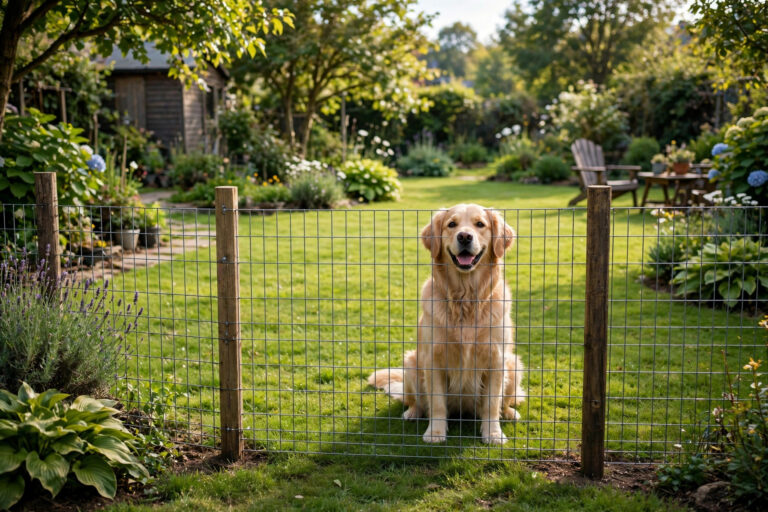
A proper garden fence can cost thousands — and for a lot of dog owners, that is the whole problem. The dog needs a safe yard to run in, the budget says otherwise, and the “cheap” options online are either flimsy garden edging or a project that needs a contractor.
Here is the good news: a DIY dog fence does not have to be expensive to work. A welded-wire fence on steel T-posts, a pallet fence built from free wood, or a no-dig panel run can keep a dog safely in the yard for a fraction of a contractor’s quote — often under $100 for a small run, and a few hundred for a full backyard. The trick is picking the right build for your dog’s size and habits, and getting the gate and the ground line right, because that is where cheap fences fail.
This guide covers 7 cheap DIY dog fence builds for outdoors, with honest costs, the right height for your dog, and the mistakes that send dogs straight over, under or through.
Before you start — the 3 rules
1. Check the rules first. Many neighbourhoods, HOAs and councils limit fence height, materials and placement — some ban wire mesh at the front of the house, others need a permit over a certain height. A five-minute check beats rebuilding the whole fence.
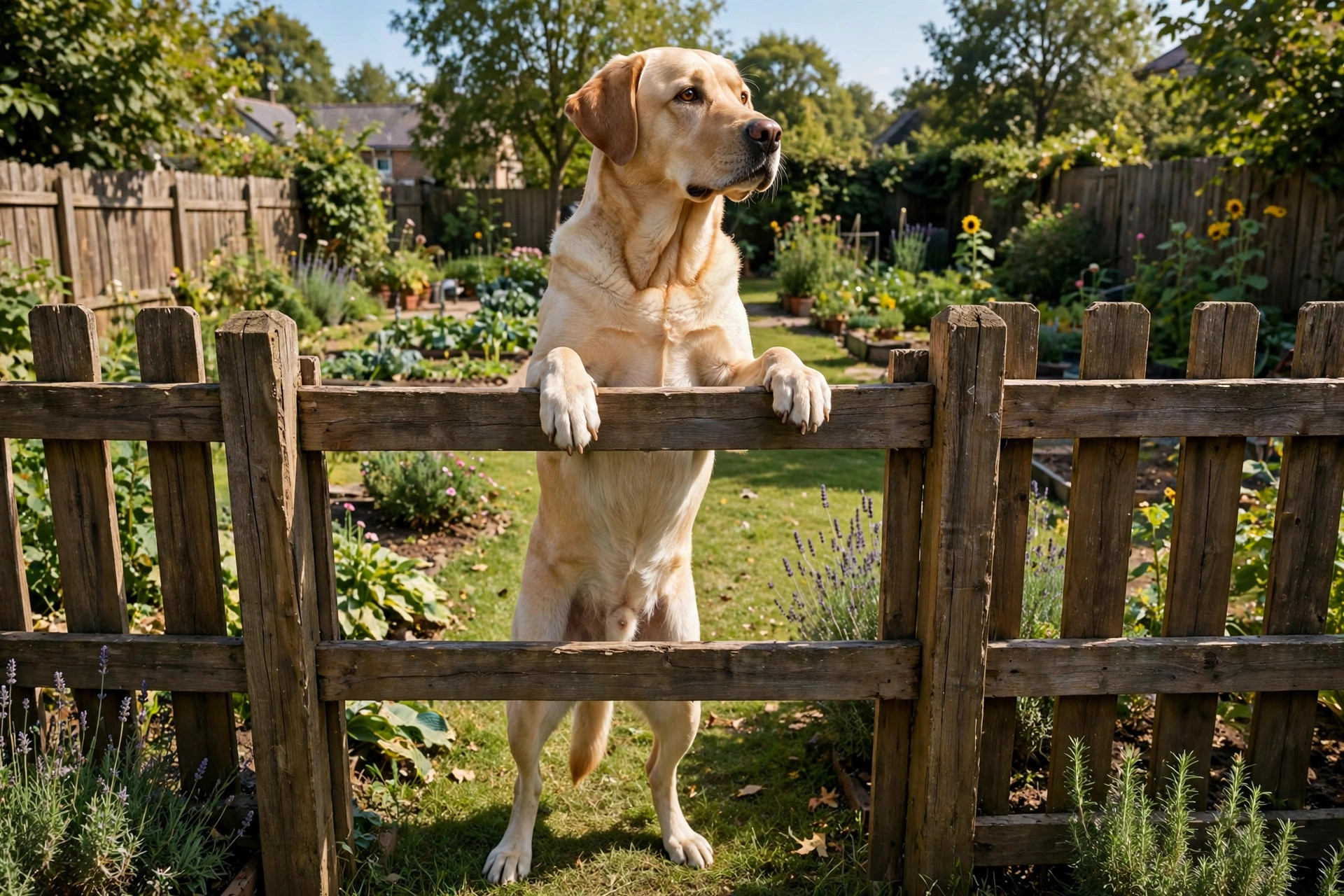
2. Measure your dog, not the catalogue. Fence height is decided by your dog’s jump, not by what looks tidy. Measure your dog standing on its hind legs with its paws up — the fence must be comfortably taller than that, with margin.
3. Plan the gate before you buy anything. Gates are where cheap fences fail: they sag, the latch slips, and the dog learns the gap in a day. Decide where the gate goes and how it closes before you order a single post.
How much does a cheap DIY dog fence cost?
It depends on the length you need and the material you choose, but a rough guide for a 30-metre (100-foot) run:
| Build | Approx. cost per 30 m | Best for |
|---|---|---|
| T-posts + welded wire mesh | $80–$150 | Most dogs, best value |
| Pallet fence | $0–$60 | Small–medium dogs, free wood |
| Chicken wire garden fence | $40–$80 | Small dogs, garden zones |
| No-dig fence panels | $150–$300 | Renters, small yards |
| Bamboo / reed screening | $60–$120 | Privacy over an old fence |
| PVC pipe fence | $120–$250 | Small dogs, clean look |
| Rope + post boundary | $30–$60 | Calm dogs, visual boundary only |
Measure your boundary before you shop: walk it with a tape or a long rope, add 10% extra for mistakes and corners, and count your posts — one every 2–2.5 metres for wire fences, closer together on soft ground.
How tall should a dog fence be?
Height is the single most important decision. Too low and your dog is over it; too high and you have paid for fence you did not need.
| Dog size | Minimum height | Notes |
|---|---|---|
| Small (under 10 kg) | 90 cm (3 ft) | Watch for squeezing through gaps, not jumping |
| Medium (10–25 kg) | 120 cm (4 ft) | Most spaniels, beagles and border collies |
| Large (25–45 kg) | 150 cm (5 ft) | Labradors, boxers, German Shepherds |
| Giant / athletic jumpers | 180 cm (6 ft) | Huskies, Malinois, any dog that clears 5 ft |
If your dog has ever cleared a fence, go one step taller than the table says. And remember: a dog that cannot jump over will try to dig under, so height alone is never the whole answer — the ground line matters just as much, and we cover that below.
1. T-posts + welded wire mesh (the cheapest real fence)
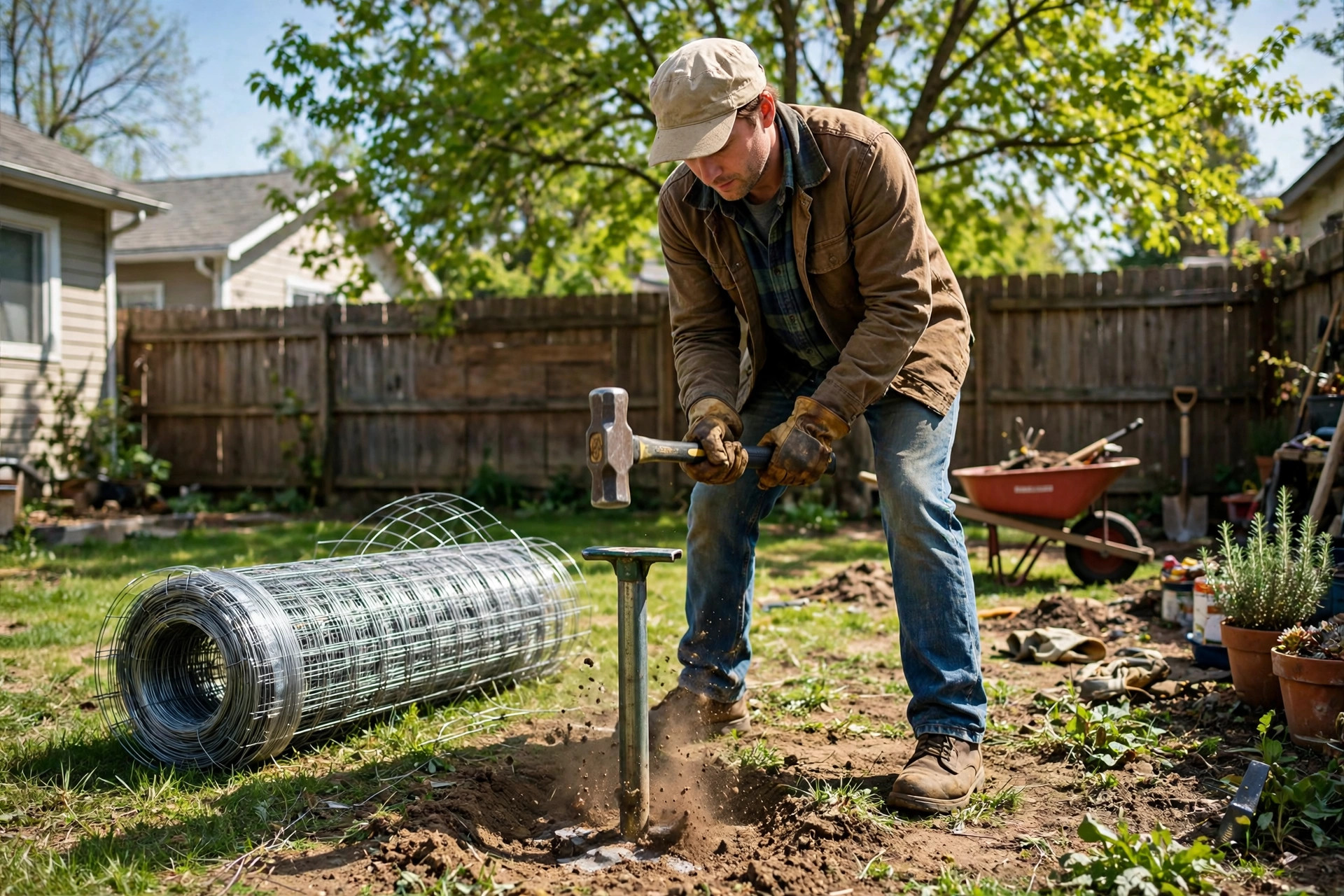
This is the build most people should start with: steel T-posts driven into the ground every 2–2.5 metres, with a roll of welded wire mesh unrolled along them and fixed with wire clips or zip ties. It is the cheapest proper fence you can build, it goes up in a day, and it holds up for years.
Buy 1.2 m or 1.5 m T-posts to match your dog’s height, and welded wire with 5 cm × 5 cm (2 in × 2 in) openings — smaller openings for puppies and small dogs so they cannot push their heads through. Drive each post 30–40 cm into the ground with a post driver or a heavy hammer, keeping them straight and evenly spaced. Unroll the mesh along the line, pull it tight, and clip it to every post at the top, middle and bottom. Leave no slack: a loose mesh sags, and a sagging mesh is a climbing ladder.
Cost: about $80–$150 for a 30-metre run. Time: half a day for two people. It will not win a design award, but it is the best value fence in this guide — and it is easy to extend later if you fence more of the yard.
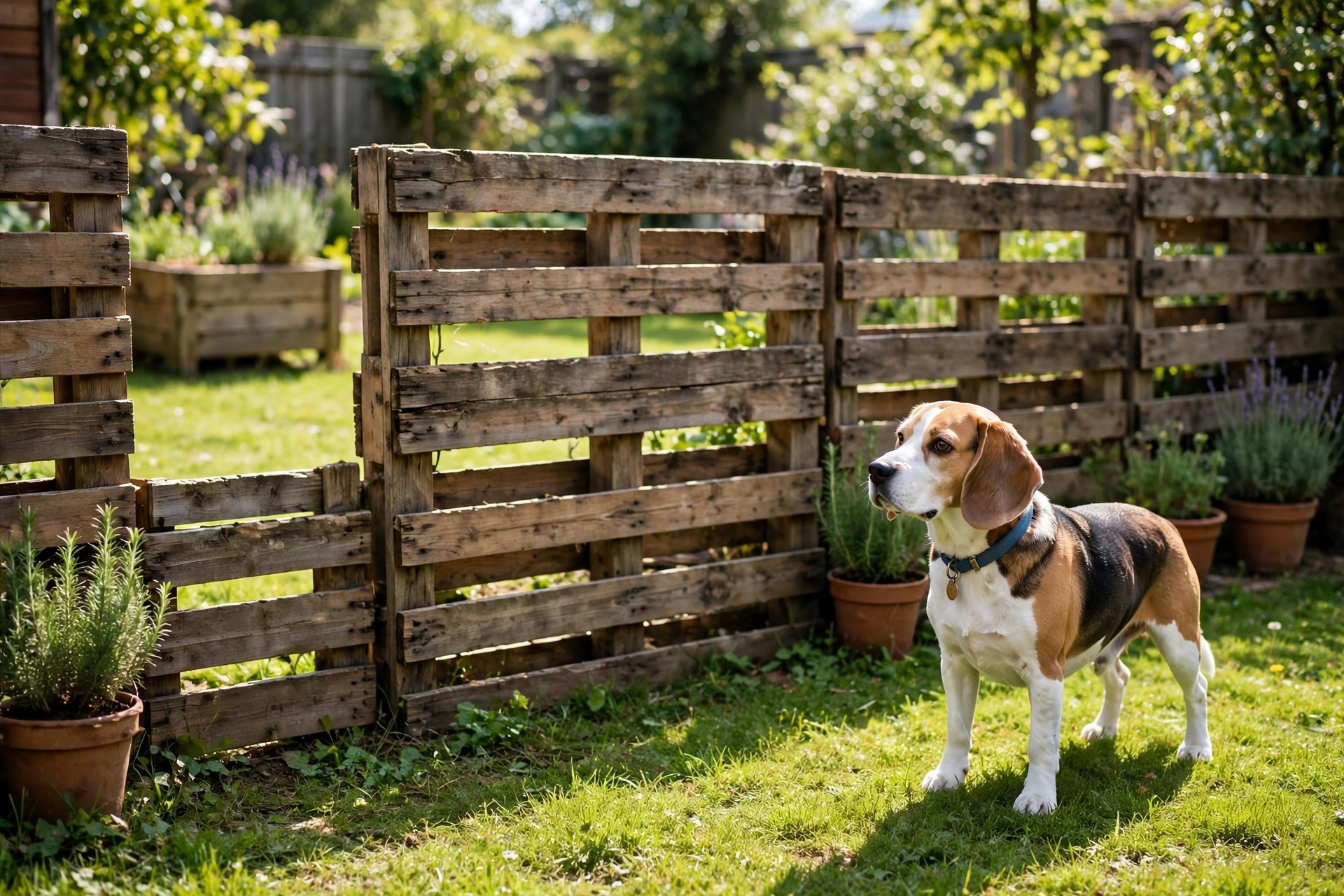
2. Pallet fence (free wood, real fence)
If you can get free pallets — check local listings, warehouses and building sites, and always ask first — a pallet fence costs almost nothing but your time. Stand the pallets upright in a line, screw them together, and brace them with posts every second pallet.
Choose pallets in decent condition: no broken slats, no spills or chemical stains, and look for the “HT” (heat-treated) stamp rather than “MB” (chemically treated) — you do not want your dog chewing treated wood. Two pallets stacked gives roughly 1.8 m of height; one pallet gives about 1.2 m, enough for small and medium dogs. Sink a wooden post at each joint and screw the pallets to it, top and bottom, so the run cannot lean or blow over. A coat of exterior wood stain makes it last twice as long and look far better.
Cost: $0–$60 (screws, posts and stain). Time: a weekend. Watch for gaps between slats that a small dog can squeeze through, and add a horizontal board across the back if your dog is a chewer.
3. Chicken wire garden fence (small dogs & garden zones)
Chicken wire — hexagonal wire mesh — is the lightest and cheapest mesh you can buy, and it is ideal for fencing off a vegetable patch or a small side yard for a small dog. It is not a full-boundary fence for a large or determined dog: a big dog can push through it, and a chewer can tear it.
Use it where it suits: a 90 cm roll on short wooden stakes around a flower bed, or a small run for a puppy or a toy breed. Fix it to the stakes with a staple gun, keep the bottom edge tight to the ground, and fold the sharp cut ends inward so your dog cannot catch a paw. For anything bigger than a beagle, use welded wire instead — the price difference is small and the strength difference is huge.
Cost: about $40–$80 for a 30-metre run. Time: a couple of hours.
4. No-dig fence panels (best for renters)
No-dig panels are pre-made metal or plastic fence sections that push into the ground with pointed feet — no post holes, no concrete, no digging. They are the best cheap option if you rent, because you can pull them up and take them with you when you move.
Most panels are 60–90 cm tall, so they suit small and calm medium dogs, not jumpers or climbers. Link the panels together with the clips supplied, check they sit level, and add a rubber mallet tap on each foot so they do not wobble. They work best on flat, firm ground; on a slope, step the panels down rather than forcing them level. For a taller run, stack two rows — it costs more, but it is still cheaper than a contractor-built fence.
Cost: about $150–$300 for a 30-metre run. Time: an afternoon, and you can do it alone.
5. Bamboo / reed screening on existing posts
If you already have a chain-link fence, an old post-and-rail fence, or a neighbour’s fence you are allowed to use, bamboo or reed screening turns it into a solid, private dog fence for very little money. Unroll the screening along the existing fence and tie it on with wire or zip ties every 30 cm.
It adds privacy, blocks the sightlines that set some dogs barking, and closes the gaps a small dog could slip through. It is not a fence on its own — it needs a structure behind it — and it will need replacing every couple of years as it weathers. But for a tired old fence that needs a second life, it is the cheapest upgrade there is.
Cost: about $60–$120 for a 30-metre run. Time: a few hours.
6. PVC pipe fence (lightweight, clean look)
A PVC pipe fence — white plastic pipes as rails between posts, with mesh or vertical pickets — looks tidy, never rusts, and is light enough for one person to build. It suits small and medium dogs in a front yard where a wire fence would look out of place.
Use thick-walled PVC (schedule 40) for the posts and rails, and set the posts in the ground or in small concrete footings — PVC on its own is too flexible to hold a fence line without proper posts. Space the pickets or mesh tightly enough that a small dog cannot push through, and keep the bottom rail close to the ground so there is no gap to crawl under.
Cost: about $120–$250 for a 30-metre run. Time: a day. It will not hold a large dog that throws itself at a fence, so be honest about your dog before choosing this one.
7. Rope + post boundary (visual boundary for calm dogs only)
A rope fence — wooden posts with two or three strands of thick rope between them — is the cheapest “fence” of all, and it looks lovely around a cottage garden. But let us be honest: it is a boundary marker, not a fence. It will not stop a dog that wants out.
It works for calm, older dogs that already respect boundaries, and for marking a garden zone you would rather the dog avoided. It does not work for puppies, escape artists, or any dog with a squirrel habit. If you use it, keep the ropes taut and the posts close together (1.5 m apart), and never rely on it as your only containment.
Cost: about $30–$60 for a 30-metre run. Time: a few hours.
The gate — the part everyone gets wrong
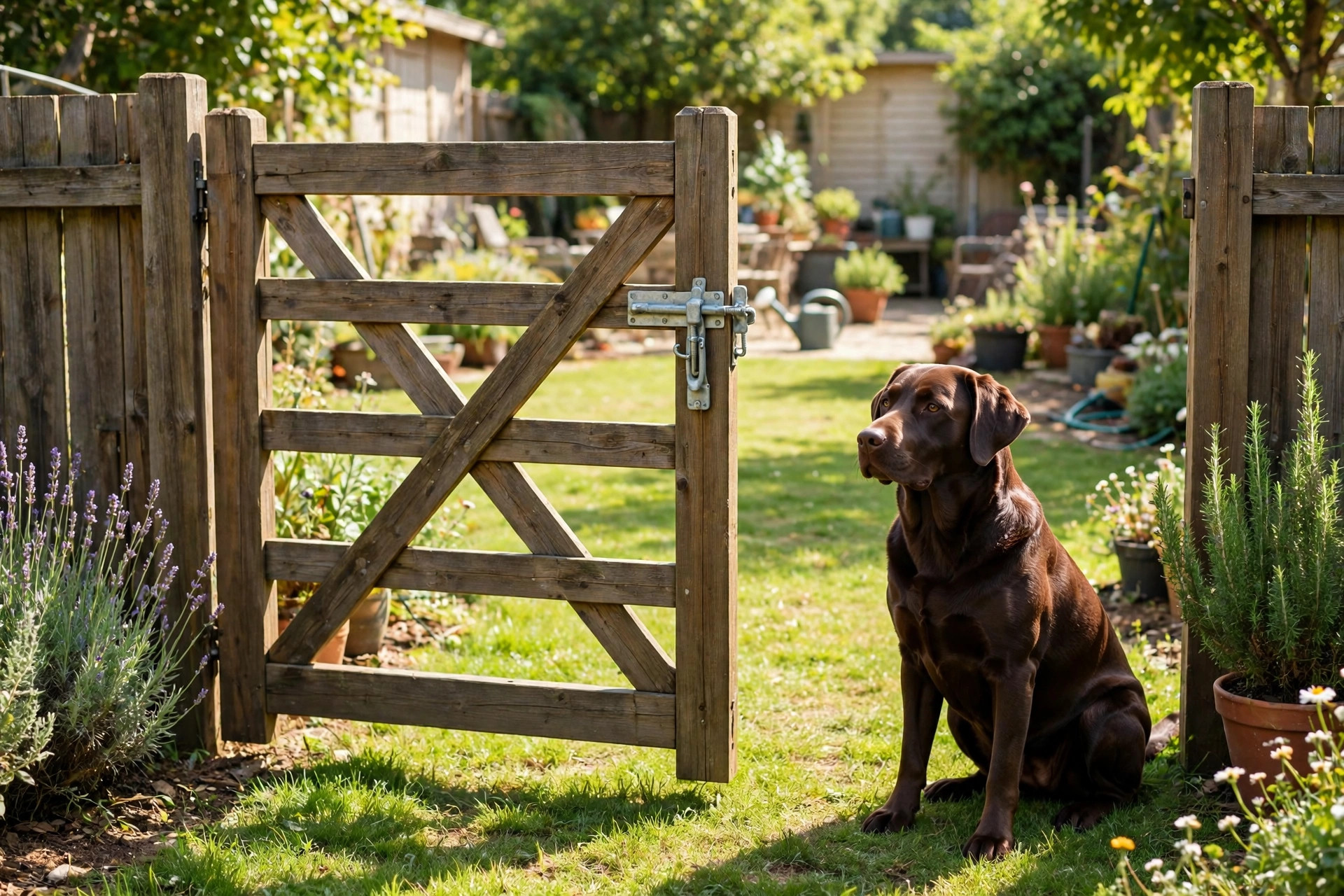
Every cheap fence fails at the gate first. Build the gate from the same material as the fence, hang it on proper hinges (not a loop of wire), and fit a latch that closes by itself — a gravity latch or a spring latch — because a gate that needs remembering to close is a gate that gets left open.
Make the gate swing inward, into the yard, so a dog pushing against it only pushes it shut. Leave a gap of no more than 2–3 cm under the gate, or add a board along the bottom: a surprising number of escapes happen under the gate, not over the fence. And test it properly — push it, pull it, lean on it, and get a child to try the latch. If a child can open it, so can a clever dog.
Stop diggers and jumpers
A fence is only as good as its ground line. Dogs dig where the fence meets the soil, usually at corners and near the gate. The fix is cheap: an L-footer. Lay a 30–40 cm strip of welded wire flat on the ground along the inside of the fence, bent up against the fence itself in an L shape, and peg it down. A digging dog hits wire within a few centimetres and gives up. Bury it under a thin layer of soil or gravel so it is not a trip hazard.
For jumpers, add height the cheap way: a 30 cm extension of wire above the top rail, angled slightly inward, makes a surprising difference — most dogs will not jump a fence they cannot see the top of clearly. Never use barbed wire or anything sharp on top: it injures dogs, and in many places it is not legal on a garden fence. If your dog is a serious climber, a coyote roller (a spinning tube on the top rail) is a humane option that stops the paws finding purchase.
What NOT to use
A few cheap options are cheap for a reason, and should be avoided:
- Barbed wire: injures dogs and people, and is restricted or banned for garden fences in many areas. Never use it.
- Electric shock fences as the only containment: they do not stop other dogs or people coming in, they fail in a power cut, and many owners and vets consider them inhumane. A physical fence is better.
- Chicken wire for big dogs: too weak — a large dog can push straight through it.
- Treated timber your dog can chew: avoid “MB” stamped pallets and freshly treated wood; let treated posts weather before the dog has access, or cover the chewable parts.
- A fence with gaps at the bottom: if you can fit your fist under it, a small dog can get under it. Close every gap before the dog finds it.
Maintenance checklist (10 minutes, twice a year)
A cheap fence stays a good fence if you check it. Twice a year — spring and autumn — walk the whole line and check: posts still upright and firm; mesh still tight with no sagging; no rust or broken wires; gate hinges oiled and latch closing by itself; ground line still buried with no new digging; no gaps under the gate. Fix small problems when they are small: a loose clip today is a hole in the fence tomorrow.
FAQs
What is the cheapest dog fence I can build myself?
T-posts with welded wire mesh — about $80–$150 for a 30-metre run, and it goes up in half a day. If you can get free pallets, a pallet fence costs almost nothing but screws and posts.
How tall should a DIY dog fence be?
At least 120 cm (4 ft) for a medium dog, 150 cm (5 ft) for a large dog, and 180 cm (6 ft) for giant breeds or known jumpers. Measure your dog standing on its hind legs — the fence must be comfortably taller than that.
Can I build a dog fence without digging?
Yes — no-dig fence panels push straight into the ground, and a T-post fence only needs the posts driven in, not holes dug. Both are renter-friendly, and the panels can be taken with you when you move.
How do I stop my dog digging under the fence?
Lay an L-footer: a 30–40 cm strip of welded wire flat on the ground along the inside of the fence, bent up against it, and pegged down. A digging dog hits wire within a few centimetres and gives up.
Do I need a permit to build a dog fence?
It depends on where you live. Many areas limit fence height (often 1.8–2 m) and ban certain materials at the front of the house. Check your local rules and any HOA before you buy materials.
Will a cheap fence keep a husky in?
Only if it is tall enough (180 cm minimum), has an L-footer against digging, and a gate that latches by itself. Huskies are famous escape artists — if your dog is a climber or a jumper, spend the extra on height and a coyote roller rather than on looks.
The bottom line
A cheap DIY dog fence is not a compromise — it is a sensible build, as long as you match it to your dog. T-posts and welded wire will contain most dogs for the least money; pallets will do it for free if you have the time; no-dig panels will do it if you rent. Spend your effort on the three things that actually decide whether a fence works: the right height, a tight ground line, and a gate that closes itself. Get those right and the cheapest fence on this list will keep your dog safe for years.
Pin this for later 📌 — and once the yard is fenced, give your dog somewhere to enjoy it: our DIY dog house ideas and dog run ideas turn a fenced yard into a proper dog space, and our dog backyard ideas cover the whole garden.