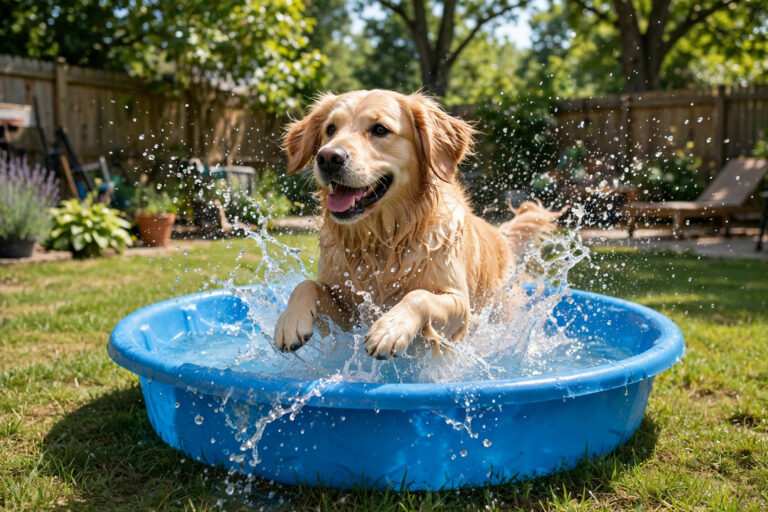
Some dogs were born for water. Others treat a puddle like a personal insult. Either way, on a hot day a dog pool is one of the simplest things you can build for your dog — a shallow splash to cool off in, a game to play, and a reason to spend the afternoon in the garden instead of panting indoors.
The good news is that a DIY dog pool does not need a contractor, a pond liner, or a big budget. A hard plastic kiddie pool, a stock tank, or even a splash pad from the garden centre can be a proper dog pool in under an hour — often for less than the cost of a bag of kibble. The trick is matching the pool to your dog’s size and confidence, keeping the water clean, and never treating a pool as a babysitter.
This guide covers 7 easy DIY dog pool ideas, the right water depth for your dog, how to keep the water fresh without chemicals, and the safety rules that matter most.
Before you start — the 3 rules
1. Never leave a dog alone in water. Even a shallow pool. Dogs slip, panic, or tire faster than they look, and a dog that cannot climb out of a steep-sided pool is in trouble within minutes. Somebody stays outside with the dog, every time.
2. Shallow first, always. A dog should be able to stand in the pool with its head well above the water. Start ankle-deep and let a nervous dog walk in on its own — never lift a reluctant dog into deep water.
3. Fresh water, no chemicals. Pool chlorine, algaecides and garden chemicals are not made for dogs that drink what they swim in. Keep the water clean by changing it often, not by dosing it.
How deep should a dog pool be?
Depth is the single most important decision. Too deep and a small or nervous dog will not use it — or worse, will panic. Too shallow and it is a puddle, not a pool.
| Dog size | Water depth | Notes |
|---|---|---|
| Small (under 10 kg) | 10–15 cm (4–6 in) | Belly-deep at most; a kiddie pool with a low wall they can step over |
| Medium (10–25 kg) | 15–25 cm (6–10 in) | Chest-deep is plenty for cooling off and splashing |
| Large (25–45 kg) | 20–30 cm (8–12 in) | Enough to lie down in and soak the belly and paws |
| Giant / confident swimmers | 30–45 cm (12–18 in) | Only for dogs that already swim happily and can climb out easily |
If your dog has never been in water, start at the shallow end of the range no matter its size. A dog that loves its first paddle will happily go deeper next time; a dog that gets a fright the first time may never go near the pool again. And remember: the pool also needs a way out — a low wall, a ramp, or a step — because a dog that cannot climb out will panic.
1. Hard plastic kiddie pool (the classic)
This is the build most people should start with: a rigid plastic kiddie pool from a garden centre or toy shop, set on flat ground in the shade. It is the cheapest proper dog pool you can buy, it takes five minutes to set up, and if your dog does not like it, you have lost almost nothing.
Pick a hard plastic pool, not an inflatable one — a dog’s claws will puncture an inflatable ring in seconds, and a collapsing wall is a bad first experience. Look for a pool with a low, gently sloping wall (10–15 cm high) so small dogs can step in and out on their own, and a flat bottom so it does not tip. Put it on level ground, ideally on grass or a non-slip mat rather than bare concrete, which gets slippery when wet.
Cost: about $10–$30. Time: five minutes. Fill it ankle-deep to start, toss in a floating toy, and let your dog investigate at its own pace.
2. Stock tank pool (big dogs, serious splashing)
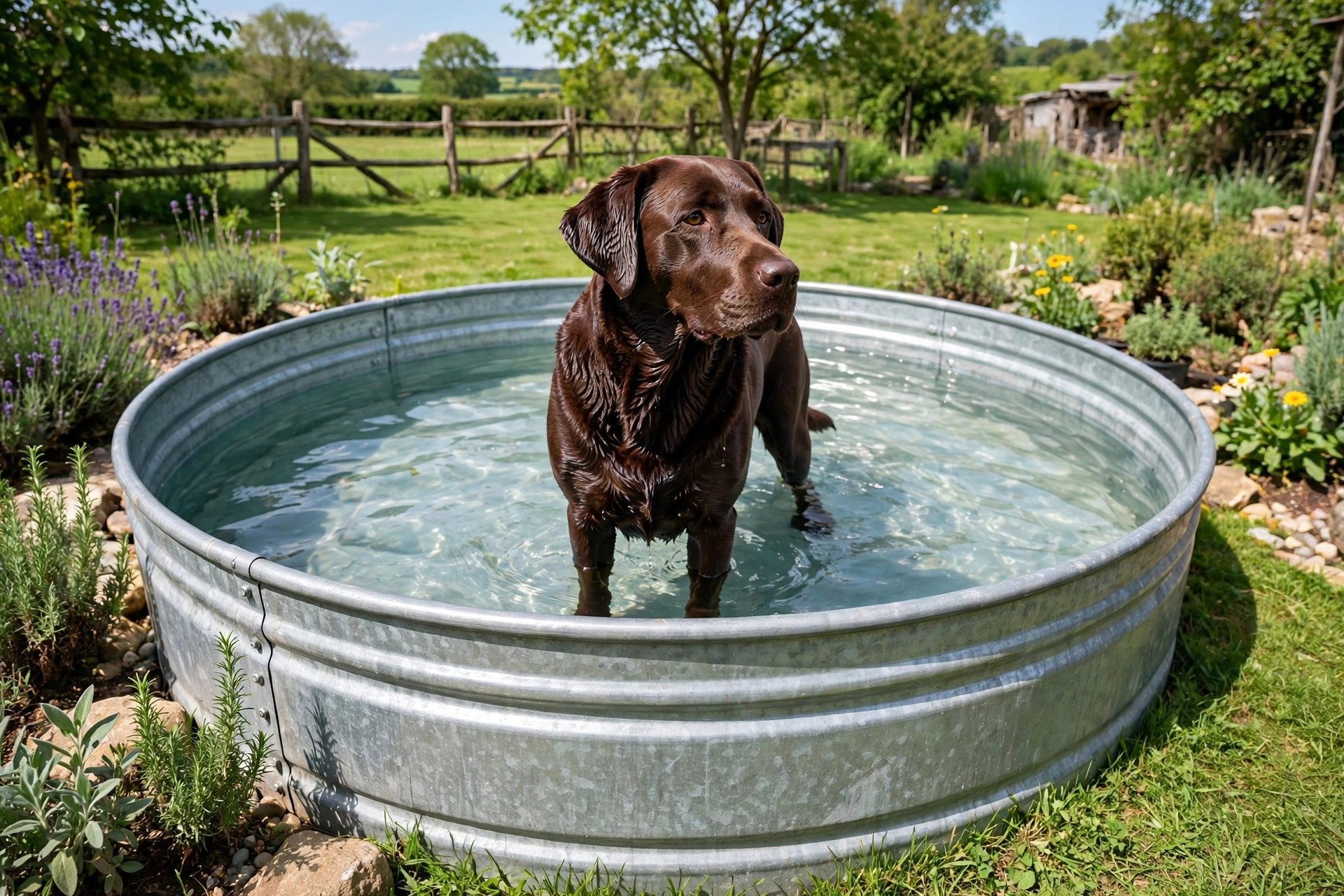
For large dogs that flatten a kiddie pool in a week, a galvanised or plastic stock tank — the kind farmers use for livestock water — is the upgrade. They come in sizes from 100 to 400 litres, they are rigid enough for a 40 kg dog to climb in and out of, and they last for years.
Choose a tank with a low profile (around 60 cm tall) and a wide base so it cannot tip. The taller ones need a step or a ramp, or a dog that is happy to be lifted in — and a wet 40 kg dog is not something you want to lift. A plastic stock tank is lighter and stays cooler in the sun than a metal one, which can get hot to the touch. Put a non-slip mat on the bottom — wet plastic is slippery — and place the tank where the water can drain away when you empty it.
Cost: about $60–$150 depending on size. Time: half an hour to position and fill. It will not win a design award, but it is the toughest dog pool in this guide — and it doubles as a bath for a muddy dog.
3. Splash pad / sprinkler mat (dogs that will not sit still)
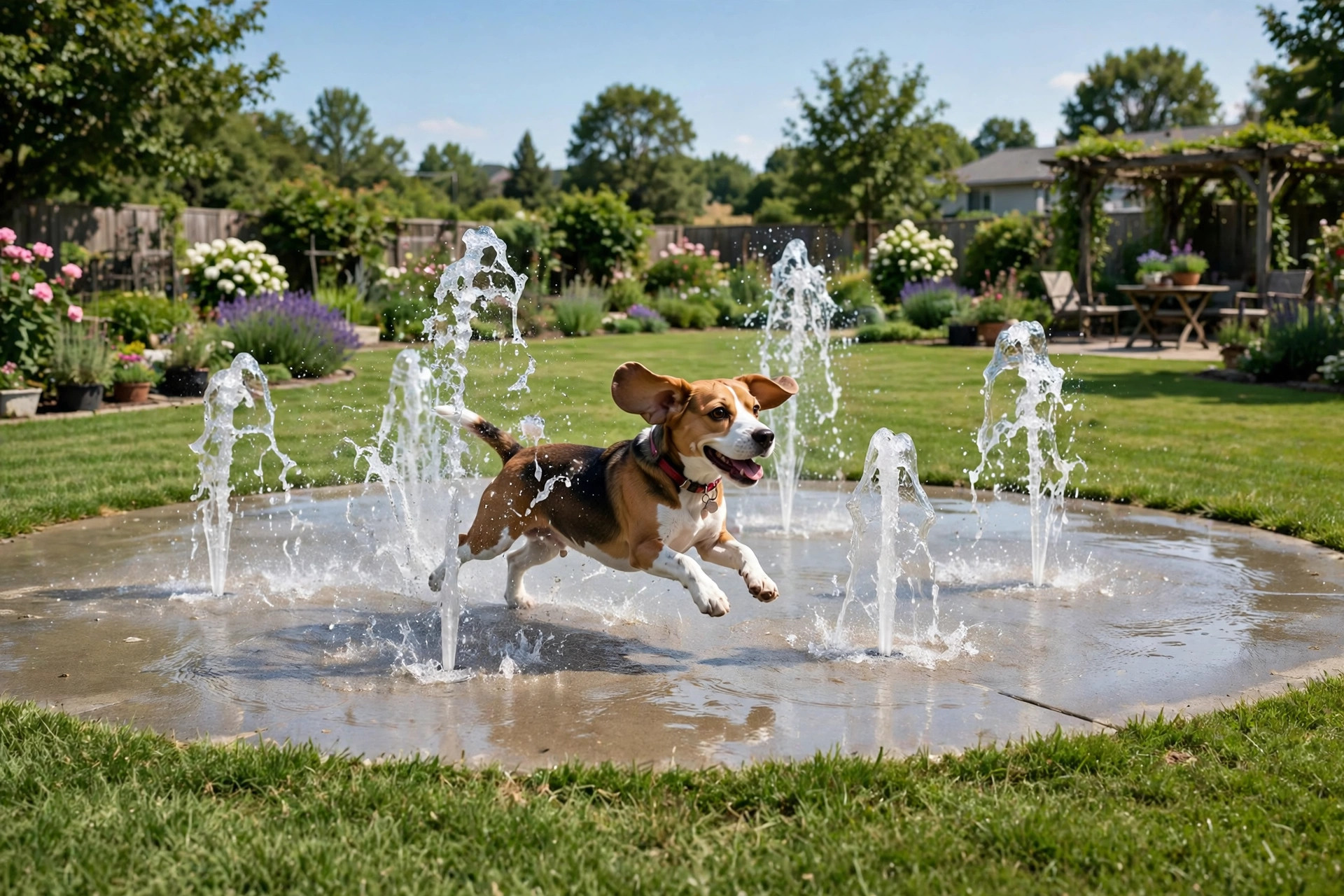
Some dogs will not lie in a pool but will chase a sprinkler for an hour. A splash pad — a flat mat with little water jets around the edge — is the answer for those dogs. It connects to a garden hose, sprays a gentle ring of water, and has no sides at all, so there is nothing to climb into and nothing to be nervous about.
It suits puppies, small dogs, and dogs that are wary of standing water, because the dog controls how wet it gets — it can run through the spray or stand at the edge and watch. Keep the water pressure low: a fierce jet can sting a small dog’s eyes and ears, and a dog that gets blasted in the face once may never come back. A gentle, low spray is the whole point.
Cost: about $15–$40. Time: ten minutes to connect the hose. Best on a warm day on grass, where the water drains away instead of pooling.
4. Frozen treat pool games (cooling + enrichment in one)
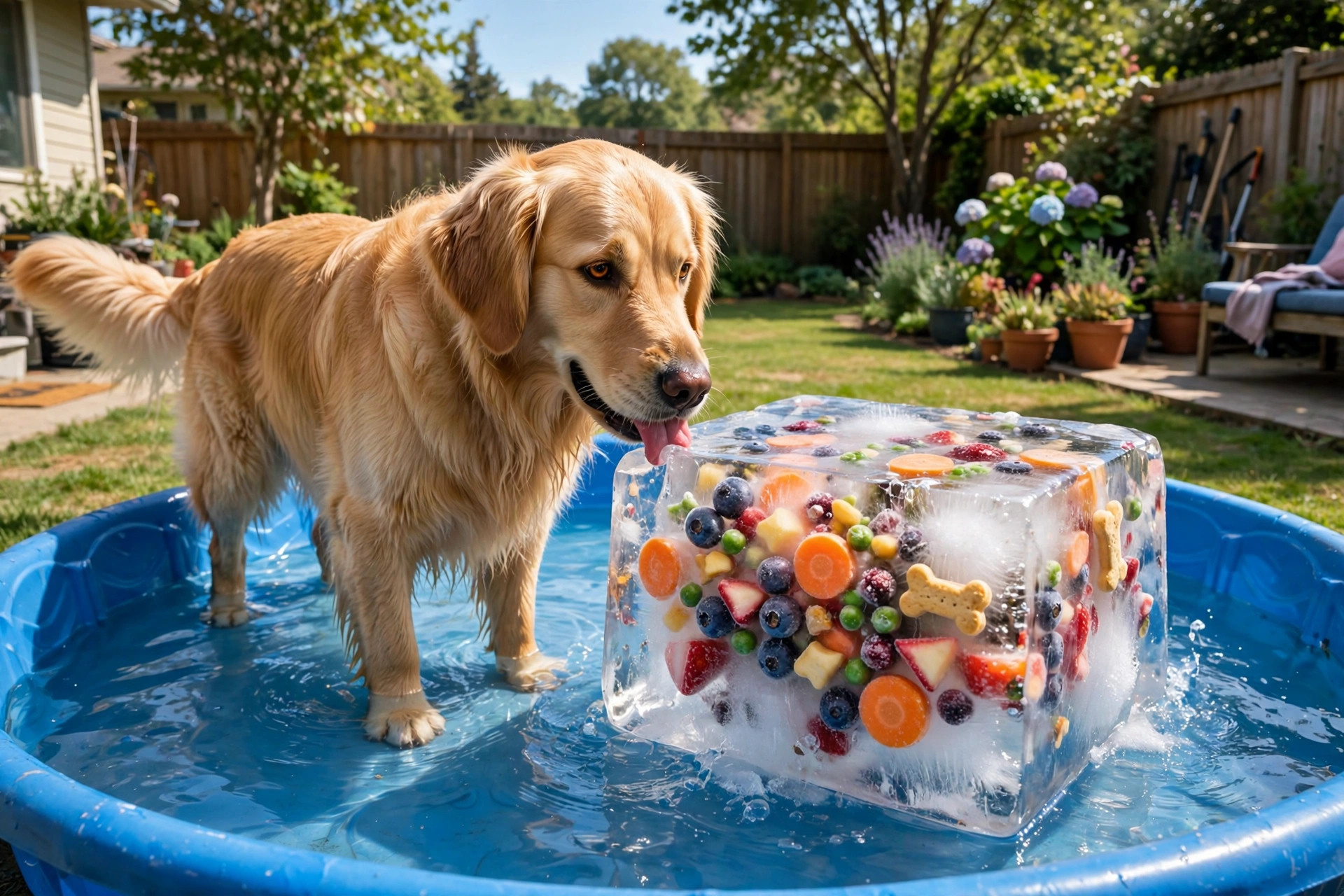
On the hottest days, the pool is not just for splashing — it is a game. Freeze treats into a block of ice, drop the block into a shallow pool, and let your dog work at it. It cools them down from the outside and the inside at the same time, and it keeps a bored dog busy for half an hour.
Make a treat block by filling a container with water, dropping in a few dog-safe treats — blueberries, carrot pieces, apple slices, a smear of peanut butter (xylitol-free, always) — and freezing it overnight. Float the block in the pool, or put it in an empty pool with a little water around it. As it melts, the treats appear one by one. It is the simplest enrichment game there is, and it costs almost nothing.
Cost: about $0–$5 (treats you already have). Time: overnight in the freezer, five minutes to set up. Supervise as always — and skip this one if your dog is a gulper that tries to swallow large ice chunks whole.
5. Shade + pool station (the setup that actually gets used)
A pool in full sun is a hot bath by midday. The pool that gets used every day is the one in the shade, with a towel and a drink nearby. A shade station is the cheapest upgrade you can make to any pool on this list.
A pop-up canopy, a large garden umbrella, or a shade sail over the pool keeps the water cool and gives your dog somewhere to lie in the shade afterwards. Put a non-slip mat or an old towel beside the pool as a drying spot, and keep a bowl of fresh drinking water next to it — a dog that has been splashing for half an hour will be thirsty, and you do not want it drinking pool water. If your garden has no natural shade, a $30 pop-up canopy is money well spent.
Cost: about $0–$40 (an umbrella you already own, or a cheap canopy). Time: ten minutes. This is the difference between a pool your dog uses once and a pool your dog lives in all summer.
6. Portable foldable pool (small spaces, travel, renters)
A foldable dog pool — the kind that pops open like a laundry basket and folds flat for storage — is the best option if you are short on space, you rent, or you want a pool to take to the park or on holiday. They are made of tough PVC with a rigid rim, they hold their shape when full, and they pack away into a cupboard when the weather turns.
They suit small and medium dogs best; a big dog can still use one, but check the weight limit and the wall height before you buy — a 45 kg dog leaning on a foldable wall will fold it. The big advantage is storage: a rigid kiddie pool takes up garden space all year, a foldable one does not. Rinse it, dry it, fold it, and it is gone until the next hot day.
Cost: about $20–$50. Time: two minutes to pop open and fill. A good choice for balconies and small patios, too — just make sure the surface underneath can take the weight of the water and that the drain-off goes somewhere sensible.
7. Digging pit + pool combo (for dogs that dig)
Some dogs do not want a pool — they want a hole. If your dog digs every flower bed in the garden, give the digging a legal outlet: a shallow digging pit next to the pool. A low wooden frame filled with damp sand or soil, with the pool beside it, turns a destructive habit into a game.
Wet the sand down and bury a few treats in it, and most diggers will choose the pit over the petunias within a week. The pool beside it lets them cool off between digging sessions, and the two together keep a high-energy dog busy for an afternoon. Keep the pit shallow (15–20 cm of sand is plenty) and in the shade, and cover it with a board or tarp when it is not in use so cats do not adopt it.
Cost: about $20–$60 (frame timber, sand, a few treats). Time: an afternoon. It will not stop every digger, but for a dog that digs for fun rather than escape, it works surprisingly well.
Keeping the water clean (without chemicals)
A dog pool goes green fast in the sun. The fix is simple and chemical-free: change the water often. A small kiddie pool should be emptied and refilled every day or two in hot weather; a stock tank every two or three days. Tip the pool over onto the lawn — the water is good for the grass — scrub the bottom with a brush, and refill.
A few habits help: keep the pool in the shade, which slows algae; skim leaves out with a small net; and put the pool where the dog does not track mud straight into it. Never add chlorine, bleach, or algaecide — dogs drink pool water, lick their paws, and groom themselves afterwards, so anything in the water ends up inside the dog. If the water smells or looks cloudy, empty it. Fresh water is cheaper than a vet visit.
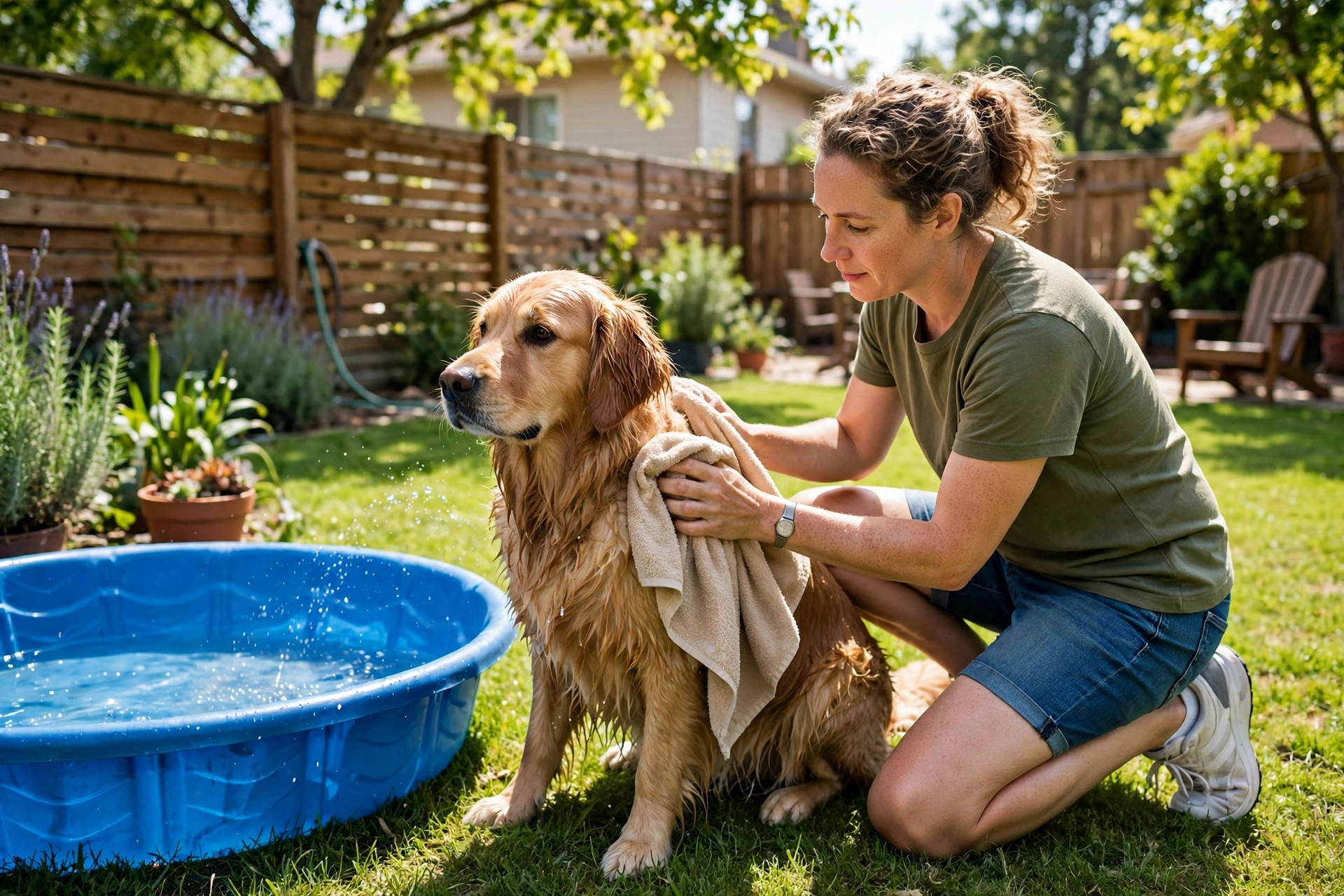
Drying off after the pool
A wet dog in the house is a wet sofa, a wet floor, and a dog that smells like a pond by evening. Keep a towel by the pool and dry the belly, paws and ears before the dog comes inside — ears especially, because damp ears are where ear infections start. A quick towel-dry takes two minutes and saves a lot of mopping.
If your dog will tolerate it, a gentle rinse with fresh water after a pool session washes off the worst of the mud and algae. And on a cool evening, bring the dog in promptly: a wet dog loses heat fast once the sun goes down, and a small or older dog can get chilled even on a warm day.
When NOT to use a dog pool
A pool is not right for every dog, every day. Skip it — or keep the water very shallow — for brachycephalic breeds (bulldogs, pugs, French bulldogs), which struggle to keep their heads above water and overheat fast; for puppies under 12 weeks, which chill quickly; for dogs with ear infections or skin wounds, which water can make worse; and for any dog that is frightened of water. A frightened dog forced into a pool learns to fear water, not to love it.
Watch for the signs of overheating even in the pool: heavy panting that does not ease, drooling, wobbling, or a dog that suddenly goes quiet and still. If you see them, get the dog out of the sun, offer cool (not ice-cold) water to drink, wet the belly and paws with a damp towel, and call your vet if the panting does not settle within a few minutes. A pool helps a dog cool down — it is not a cure for heatstroke.
FAQs
What is the best DIY dog pool for a large dog?
A plastic stock tank. It is rigid, it holds its shape under a heavy dog, it lasts for years, and it is deep enough for a large dog to lie down in. Add a non-slip mat on the bottom and a step or ramp if the wall is high.
How deep should the water be in a dog pool?
Belly-deep at most for most dogs — 10–15 cm for a small dog, 15–25 cm for a medium dog, 20–30 cm for a large dog. A dog should always be able to stand with its head well above the water.
Can dogs swim in a kiddie pool?
Most dogs do not really swim in a kiddie pool — they stand, splash and lie down in it, which is exactly what cools them off. A kiddie pool is for cooling and playing, not for swimming practice.
How often should I change the water in a dog pool?
Every day or two in hot weather for a small pool, every two or three days for a stock tank. If the water smells, looks cloudy, or has leaves and mud in it, empty it and refill — never add chlorine or algaecide.
Do dogs need a pool in summer?
Not every dog does — some dogs hate water and are perfectly happy in the shade with a bowl of cold water. But for a dog that loves splashing, a shallow pool is one of the cheapest ways to keep them cool, and it is a lot of fun to watch.
Is it safe to leave my dog alone in a pool?
No. Never leave a dog unsupervised in water, even a shallow pool. Dogs slip, panic or tire faster than they look, and a dog that cannot climb out is in trouble quickly. Somebody stays outside with the dog, every time.
The bottom line
A DIY dog pool is one of the simplest things you can build for your dog: a kiddie pool for most dogs, a stock tank for big ones, a splash pad for the ones that will not sit still, and a frozen treat block when the heat is really on. Keep the water shallow, keep it fresh, put the pool in the shade, and never leave your dog alone in it. Get those right and the cheapest pool on this list will keep your dog cool and happy all summer.
Pin this for later 📌 — and once the pool is in, make the rest of the garden dog-friendly too: our DIY dog house ideas and dog run ideas turn a fenced yard into a proper dog space, our dog backyard ideas cover the whole garden, and our DIY dog wash station is the perfect spot to rinse off after a swim.