A bored dog is a busy dog — just not in the way you want. Chewed shoes, shredded cushions, barking at the window, digging up the garden: most of it is not naughtiness, it is a dog with a brain that has nothing to do. Dogs were bred to work, sniff, hunt and solve problems. A walk and a bowl of kibble do not use up that wiring. Enrichment does.
DIY dog enrichment is simply giving your dog something interesting to do with things you already own. No expensive puzzle feeders, no special equipment — a muffin tin, an old towel, a plastic bottle and a handful of treats will keep most dogs happily occupied for ten minutes. And ten minutes of sniffing and thinking tires a dog out more than a half-hour walk.
This guide covers 10 easy DIY dog enrichment ideas, from five-minute games to frozen treats that last half an hour. Every one is cheap, quick to set up, and tested on real dogs. Pick two or three, rotate them through the week, and watch the chewing and the barking fade.
Before you start — the 3 rules
1. Supervise, especially the first time. Enrichment should be fun, not a choking hazard. Watch your dog with any new game until you know how they play with it — some dogs shred cardboard, some try to eat the bottle.
2. Match the difficulty to the dog. Start easy so your dog wins. A game that is too hard frustrates them; a game that is too easy bores them. Make it slightly harder each time they master it.
3. Use their food, not extra food. Enrichment treats should come out of your dog’s daily food allowance, not on top of it. Use kibble, small training treats, or a few bits of carrot and apple — not handfuls of high-calorie biscuits.
What is dog enrichment, and why does it matter?
Enrichment is anything that lets a dog use its natural behaviours — sniffing, foraging, chewing, problem-solving, playing. In the wild, a dog’s ancestors spent most of the day searching for food. A pet dog gets dinner in a bowl in thirty seconds, and then has nothing to do until the next walk. That gap is where boredom lives.
The signs are easy to spot: destructive chewing, excessive barking, pacing, digging, attention-seeking, and that restless look dogs get at 7pm when the house is quiet. Vets and behaviourists agree that mental stimulation is as important as exercise — a dog that has sniffed, searched and solved something is a calmer, happier dog. Studies on working dogs show that just ten minutes of nose work can be as tiring as a much longer walk, because sniffing uses a huge part of a dog’s brain.
The good news is that enrichment does not need to cost anything. The ideas below use a muffin tin, towels, cardboard, plastic bottles and old socks — things that would otherwise go in the bin or the recycling.
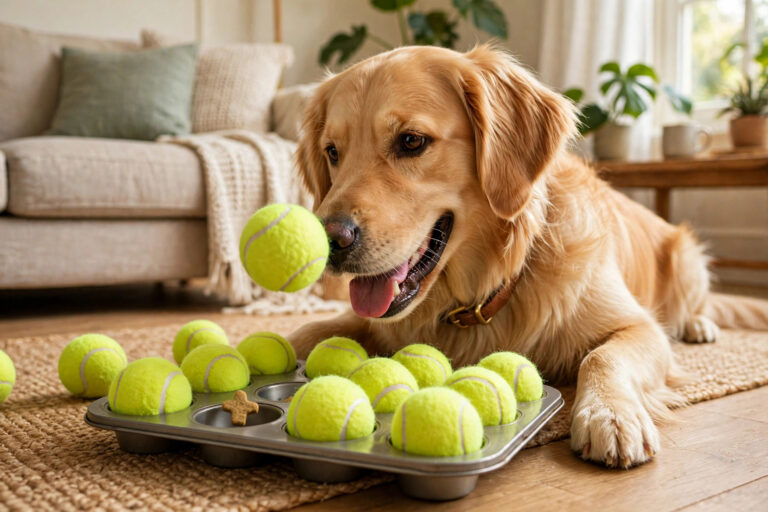
1. The muffin-tin treat game (2 minutes to set up)
The classic, and the easiest place to start. Put a few treats in the cups of a muffin tin, then cover each cup with a tennis ball (or a rolled-up sock if you do not have tennis balls). Your dog has to work out how to lift the balls to get the treats.
Start with only two or three cups covered and the rest open, so your dog learns the game. Once they have the idea, cover them all. For a harder version, use a mini muffin tin with smaller cups, or hide the treats under the balls and let your dog nudge them off with their nose.
This is the game we use as our featured photo — a golden retriever working a muffin tin is the picture of a happy, busy dog. If you want more brain games like this one, our guide to DIY dog puzzle toys has seven more, all made from household stuff.
2. The towel roll-up (1 minute to set up)
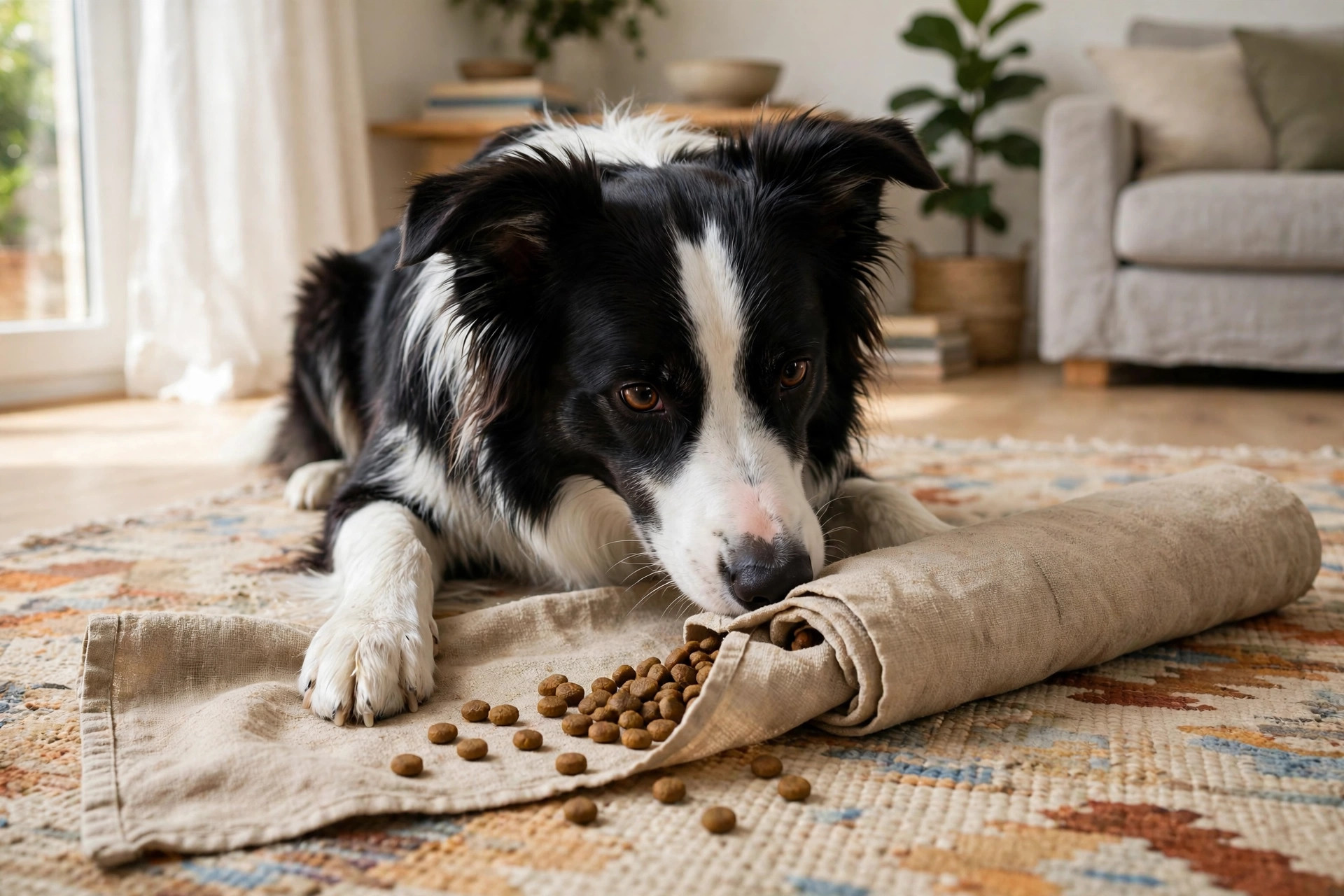
Lay an old towel flat, scatter a handful of kibble across it, then roll it up tightly. Your dog has to unroll the towel with their nose and paws to find the food. It sounds too simple to work, and it works brilliantly — most dogs spend five to ten minutes on a single roll-up.
Make it harder by folding the towel in half before rolling, tying a loose knot in the middle, or hiding the towel under a cushion. For puppies and seniors, keep the roll loose so they succeed quickly; for clever dogs, roll it tighter and add a second towel.
3. The bottle spinner (5 minutes to make)
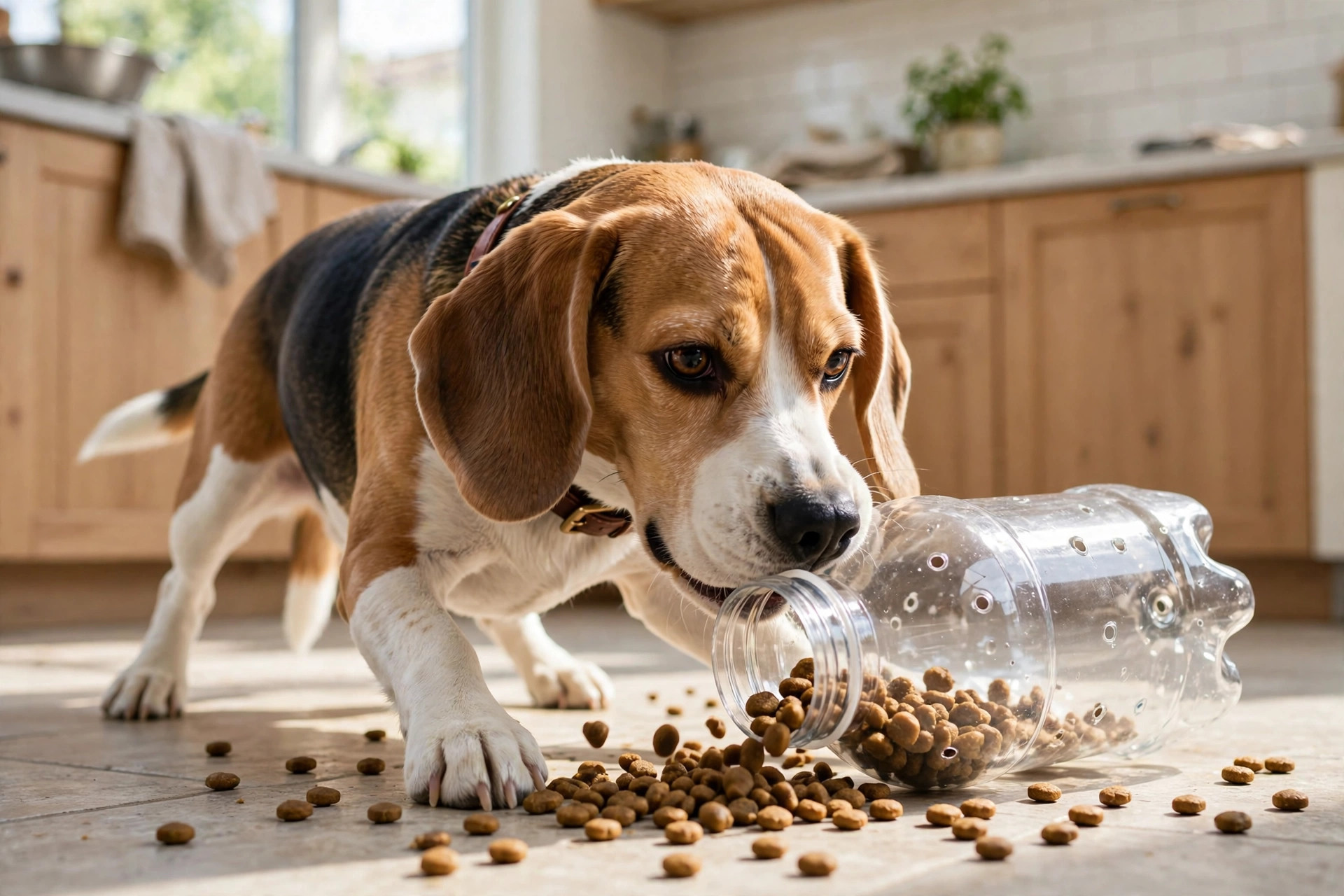
Take a clean plastic bottle, cut two or three small holes in the sides (big enough for kibble to fall out, small enough that it does not pour out), fill it with kibble, and screw the lid on tight. Your dog rolls the bottle around the floor and kibble drops out as it spins.
Start with big holes and only a few pieces of kibble, so your dog gets rewarded fast. As they learn, use smaller holes or a bottle with a narrower neck. Always remove the cap and the plastic ring first — those are the parts a dog will chew off and swallow — and throw the bottle away as soon as it starts to crack or split.
4. The frozen lick mat (10 minutes, lasts 20–30)
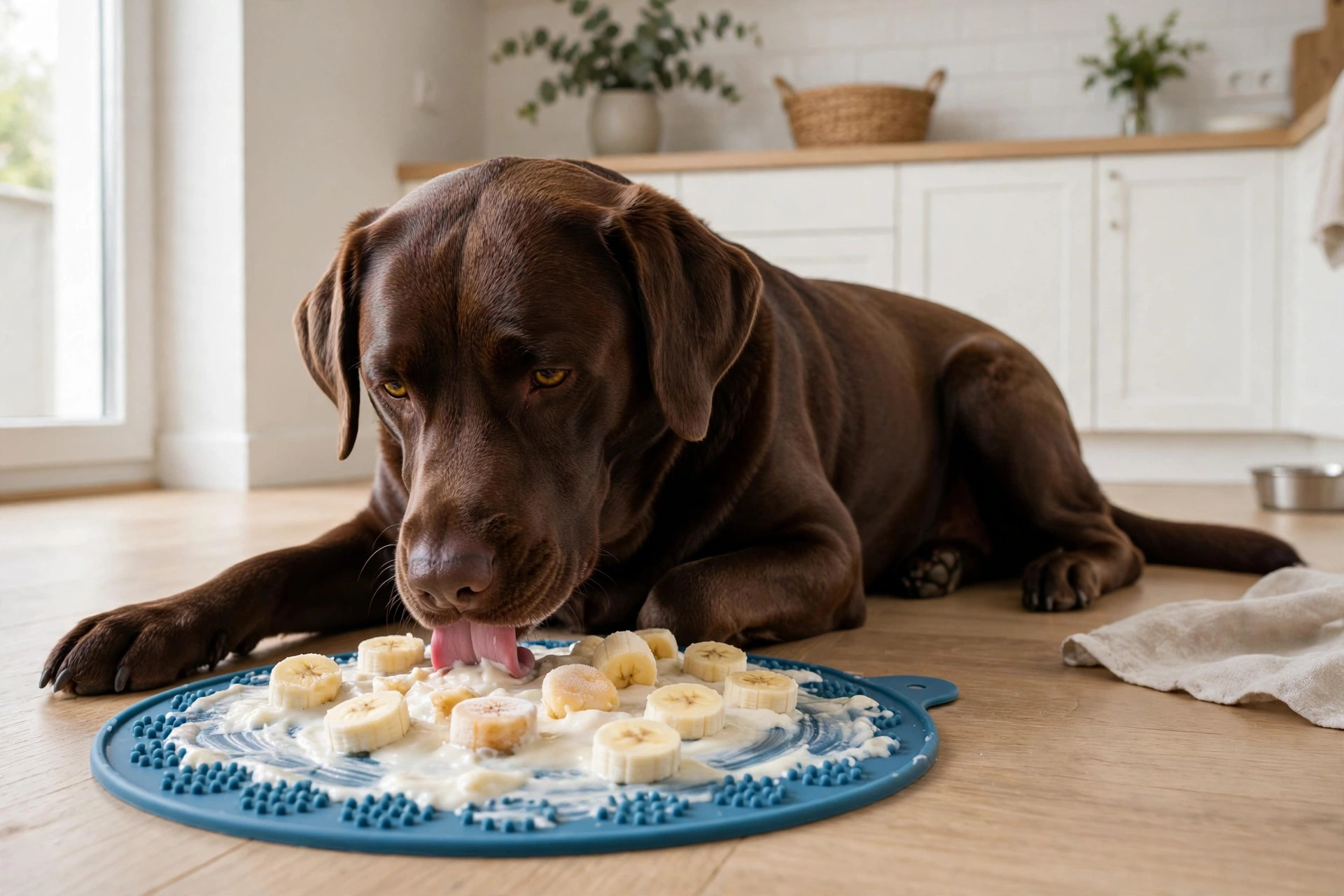
Spread a thin layer of dog-safe food on a lick mat — mashed banana, plain yoghurt, peanut butter (xylitol-free), or pumpkin purée — then freeze it for two to three hours. The frozen layer makes your dog work slowly, licking instead of gulping, and the repetitive licking is genuinely calming: it releases endorphins and settles anxious dogs.
This is the best enrichment for dogs that need to settle — after a walk, during fireworks season, or while you eat dinner in peace. Our lick mat recipes have ten freezable combinations, including a chamomile-and-banana one that works well for nervous dogs. If you do not own a lick mat, a silicone baking tray or a clean ice-cube tray works just as well.
5. The cup shell game (1 minute to set up)
The oldest trick in the book, and dogs love it. Put a treat under one of three cups (or small bowls) while your dog watches, shuffle them slowly, and let your dog nose the right one. Start with one cup and a visible treat, then build up to three cups and a proper shuffle.
This game is pure nose work — your dog is using scent, not sight, to find the food. It is also the easiest game to play with children, who love being the dealer. Keep the sessions short (five minutes) and always let your dog win most of the time: the point is the search, not the test.
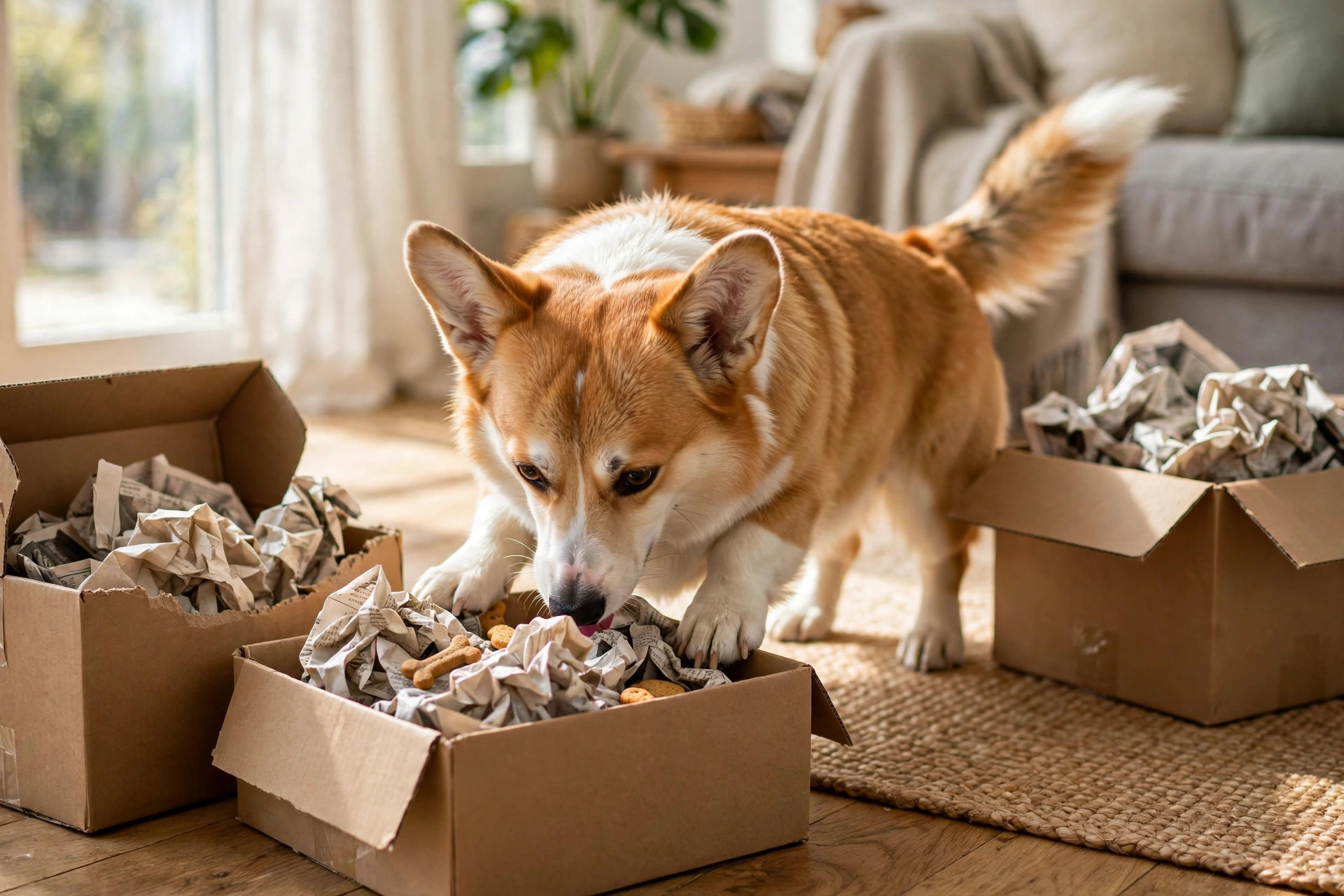
6. Cardboard box foraging (2 minutes to set up)
Save your delivery boxes. Put a few treats in the bottom of a box, scrunch up some newspaper or old fabric on top, and let your dog dig through it. For a harder version, put a small box inside a bigger box, or tape the flaps half-closed so your dog has to push them open.
Cardboard is free, recyclable, and dogs love shredding it — which is the point. Set this one up on a hard floor or outside, because there will be cardboard everywhere afterwards. Remove any tape, staples or labels first, and take the box away if your dog starts eating the cardboard instead of searching through it.
7. The snuffle ball (10 minutes to make)
A snuffle ball is a ball of fleece strips tied into a rubber ball or a whiffle ball, with treats hidden in the folds. If you do not have fleece, cut up an old t-shirt or a pair of socks. Stuff the strips into the holes of the ball, tuck treats between them, and let your dog nose the food out.
It is the portable version of a snuffle mat — easier to carry, harder for the dog to flip over, and good for small spaces. Our full snuffle mat guide shows the no-sew fleece method step by step, and the same technique makes a ball in about ten minutes.
8. Scent games — “find it” (no equipment at all)
Hide treats around a room while your dog waits in another room, then let them in with a cheerful “find it!”. Start with the treats in plain sight, then hide them behind chair legs, under cushions and on low shelves. Dogs that have never played this will find the first few in seconds; within a week, most dogs will search a room methodically, nose down, tail wagging.
Scent work is the most tiring enrichment there is — a ten-minute “find it” session leaves most dogs ready for a nap. It is also the best enrichment for rainy days, bad weather and dogs on restricted exercise after surgery, because it needs almost no movement at all.
9. The blanket tunnel (3 minutes to set up)
Drape a blanket over two chairs to make a tunnel, scatter treats through it, and let your dog walk through. For nervous dogs, keep the tunnel short and the sides open at first; for confident dogs, add a second blanket to make it darker, or put a treat at the far end so they have to go all the way through.
This is also a good confidence-builder for puppies and rescue dogs that are wary of new spaces. Pair it with a treat at each end and never push a dog through — let them choose to go in, and praise them when they do.
10. The frozen treasure block (5 minutes, lasts 30+)
Fill a bowl or a plastic container with water, drop in treats, carrot slices, blueberries and a few pieces of kibble, then freeze it overnight. Tip the frozen block out onto a tray or outside on the grass, and let your dog lick and chew their way to the treasure inside.
This is the longest-lasting enrichment on the list and the best one for hot days — it cools your dog down while it keeps them busy. Use a shallow container for small dogs and puppies so they can reach the treats, and always supervise: a very determined chewer can break off chunks of ice, so take the block away once it gets small enough to swallow whole.
Feeding enrichment — use dinner as the game
The easiest enrichment upgrade costs nothing and takes no extra time: stop feeding from a bowl. Scatter your dog’s kibble across the garden, hide it in a snuffle mat, put it in a bottle spinner, or freeze it into a lick mat. The same food, eaten slowly through searching and solving, turns a thirty-second meal into ten minutes of work.
Dogs that eat too fast benefit most — slow feeders and foraging cut down gulping, reduce the risk of bloat, and make a meal feel like an event. If your dog is a fast eater, start with the towel roll-up or the muffin tin, which slow them down without frustrating them.
Enrichment by age — puppies, adults and seniors
Puppies (8 weeks – 6 months): Keep it easy and short. A loose towel roll-up, a cup game with one cup, a snuffle mat with treats on top. Puppies tire fast and frustrate faster — two or three minutes is plenty, and always end while they are still having fun. Never leave a puppy alone with cardboard, bottles or fabric they can chew and swallow.
Adult dogs: This is the age for the full range. Rotate the harder versions — tight towel knots, small-hole bottle spinners, multi-box foraging — and combine games: a scent game followed by a frozen lick mat is a perfect evening routine.
Seniors: Enrichment matters even more for older dogs, because their world shrinks as their mobility drops. Keep games low-impact and nose-led: scent games, lick mats, snuffle mats and easy muffin-tin games. Avoid anything that needs jumping, climbing or rough play, and keep sessions short — five minutes of sniffing beats twenty minutes of frustration.
The 10-minute daily routine
You do not need an hour. Ten minutes a day, split across the day, is enough to change a dog’s behaviour:
Morning: scatter breakfast across the garden or in a snuffle mat instead of a bowl (2 minutes of your time, 10 minutes of theirs).
Midday: one quick game — the muffin tin, the towel roll-up or the cup game (5 minutes).
Evening: a frozen lick mat or a scent game while you eat dinner (2 minutes to set up, 20 minutes of calm for them).
Rotate the games so your dog does not get bored: the same game every day stops being enrichment and becomes routine. Keep a simple weekly rotation — Monday muffin tin, Tuesday towel roll-up, Wednesday scent game, Thursday bottle spinner, Friday frozen lick mat — and swap in the box foraging or the blanket tunnel at the weekend.
Safety notes — read this before you start
Most enrichment is very safe, but a few rules keep it that way. Always supervise new games until you know how your dog plays. Remove anything your dog can chew off and swallow: bottle caps, plastic rings, tape, staples, buttons, small parts. Throw away cracked bottles, torn fabric and chewed cardboard straight away.
Use dog-safe foods only. No chocolate, grapes, raisins, onions, garlic, xylitol (found in some peanut butters — check the label), cooked bones, or anything with artificial sweetener. If you are not sure a food is safe, leave it out.
Size everything to your dog. A muffin tin that works for a labrador is a choking hazard for a chihuahua; a bottle spinner that challenges a border collie will frustrate a pug. When in doubt, go bigger and easier, and watch your dog’s first attempt closely.
And never use enrichment as a substitute for exercise, training or company. A bored dog that also never walks, never plays and never sees anyone is not an enrichment problem — it is a lifestyle problem. Enrichment works best alongside walks, play and time with you.
FAQs
How much enrichment does a dog need every day?
About 10–20 minutes of mental stimulation a day is enough for most dogs, split into two or three short sessions. High-energy breeds (border collies, malinois, spaniels) may need more, and will tell you — if the chewing and barking continue, add another session rather than a longer walk.
Is enrichment a substitute for walks?
No. Enrichment and exercise do different jobs: walks give physical exercise, social contact and new smells; enrichment gives problem-solving and calm focus. A dog needs both. On days when a long walk is not possible (bad weather, illness, injury), enrichment can fill the gap — but it should not replace walks permanently.
My dog solves every puzzle in seconds. What now?
Make it harder, not bigger. Tighter towel rolls, smaller bottle holes, treats hidden inside boxes inside boxes, scent games with the treats higher up or further apart. And combine games: a scent game that ends at a frozen lick mat keeps even clever dogs busy for half an hour.
Can enrichment help with separation anxiety?
It helps, but it is not a cure. A frozen lick mat or a stuffed Kong given as you leave can settle a dog and create a positive association with your departure. For real separation anxiety — destruction, howling, toileting when left alone — enrichment is one part of a proper behaviour plan, and a vet or behaviourist should be involved.
What is the cheapest enrichment to start with?
The towel roll-up. One old towel, a handful of kibble, one minute to set up, and most dogs love it. The muffin-tin game is a close second if you already own a muffin tin and some tennis balls. Both cost nothing and work on the first try.
The bottom line
DIY dog enrichment is not about buying puzzle feeders or building elaborate setups. It is about giving your dog’s brain a job, using things you already own. A muffin tin, an old towel, a plastic bottle and a frozen lick mat will keep most dogs happier, calmer and quieter than any new toy you could buy. Start with one game today — the towel roll-up takes a minute — and build a simple rotation from there. Your dog will tell you which ones they love, and your shoes will thank you.
Pin this for later 📌 — and if your dog also needs new toys to play with, our guide to DIY dog toys from old clothes turns the rest of the wardrobe into tug toys and sock balls.