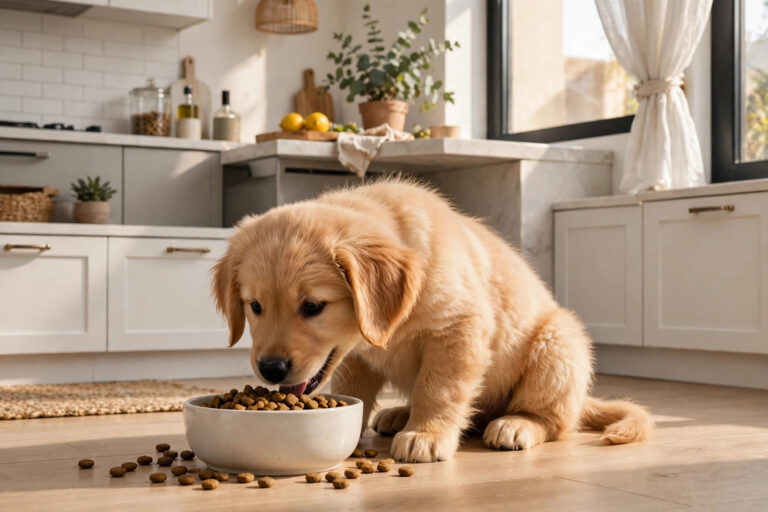
Bringing home a puppy means one urgent question: what should this
tiny, fast-growing creature actually eat? Puppy food isn’t a marketing
gimmick — puppies burn through calories at a rate adult dogs never
touch, and they’re building bones, brains and muscles from every meal.
Feed the wrong food, or the wrong amount, and you can genuinely change
how your puppy grows.
This guide covers why puppies need purpose-made food, what to look
for on the label, exactly how much to feed at each age, the special
rules for large-breed puppies, the five feeding mistakes owners make
most often, and when to switch to adult food. Pair it with our
slow feeder guide if your puppy inhales
meals in forty seconds flat.
Why puppies can’t just eat adult dog food
Puppies are not small adults. A growing puppy needs roughly twice
the calories per pound of body weight that an adult dog needs, plus
more protein for muscle development and more fat for energy and brain
growth. Adult dog food is formulated for maintenance — steady weight,
moderate energy — so it simply doesn’t deliver the density a growing
puppy burns through.
The ingredient that matters most is DHA, an omega-3 fatty acid
that supports brain and vision development. Quality puppy foods
include it (often from fish oil); standard adult foods often don’t.
Puppy formulas also carry higher levels of the minerals bones are
built from — but in carefully controlled ratios, because for
large-breed puppies, too much of a good mineral can be a real problem
(more on that below).
One caveat: “puppy food” on the bag isn’t a legal guarantee of
quality. The phrase that actually matters is the AAFCO statement —
more on that in the label section.
What to look for on the puppy food label
You don’t need a nutrition degree. You need four checks:
-
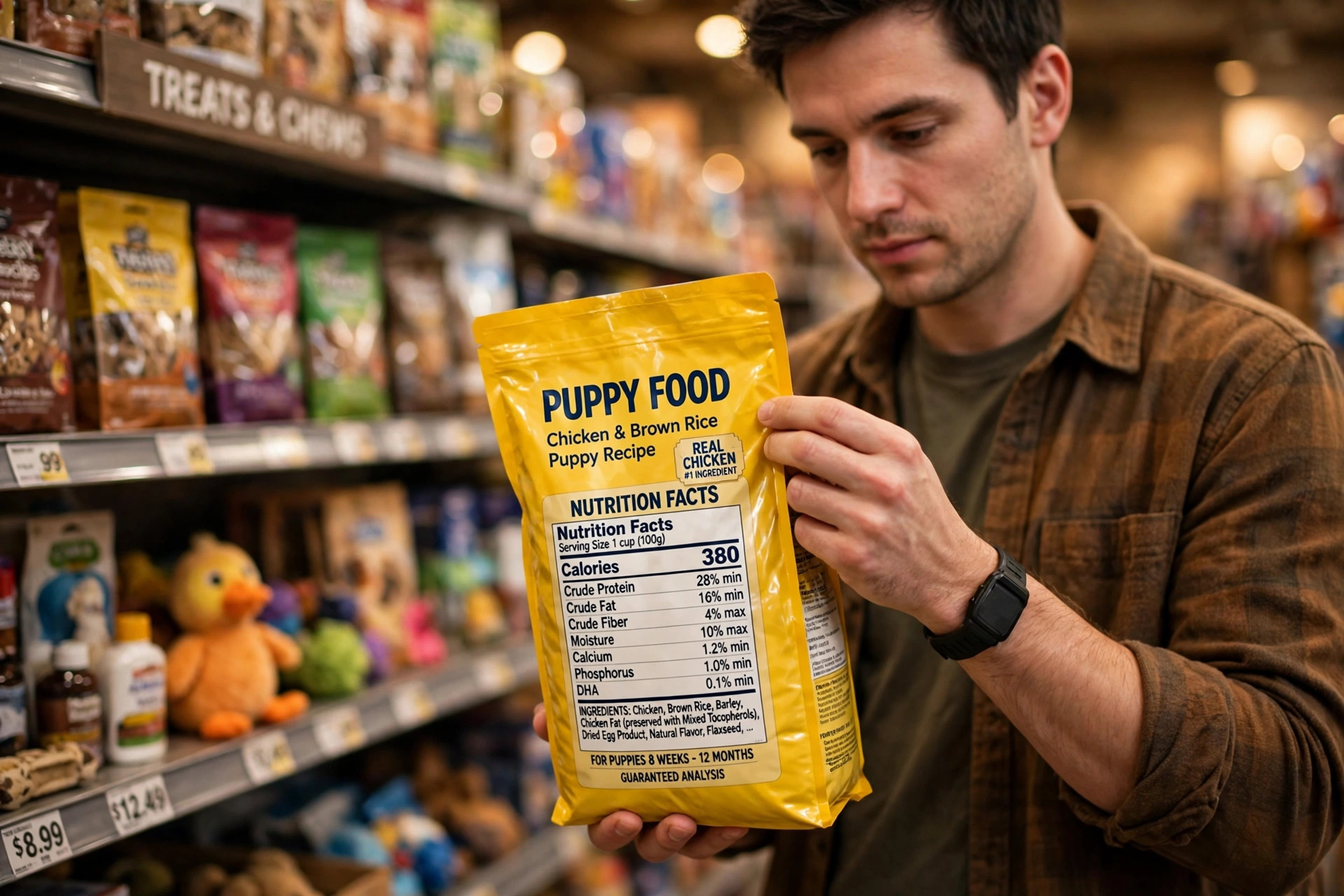
The AAFCO statement. Look for “formulated to meet the
nutritional levels established by the AAFCO Dog Food Nutrient
Profiles for growth” (or “for all life stages”, which includes
growth). This is the one line that means the food is actually
complete for a growing puppy. No statement, no buy. -
A named animal protein first. “Chicken”, “salmon” or “beef”
as the first ingredient — not “meat meal”, not “animal digest”,
not a grain. Puppies build muscle from protein, and named sources
are the quality signal. -
Fat in the 15–20% range (dry matter). Fat is a puppy’s fuel.
Too little and growth stalls; too much and you get a pudgy puppy
with stressed joints. Puppy formulas typically sit a few points
higher than adult foods — that’s correct, not a flaw. -
DHA on the guaranteed analysis. Listed as docosahexaenoic
acid, usually from fish oil. It’s the brain-and-eyes nutrient —
its presence is a good sign the formula was actually designed for
puppies.
What to avoid: vague proteins (“poultry by-product meal” as the main
protein), artificial colours and flavours (purely cosmetic — a red
flag for the brand’s priorities), and treats or toppers doing the
nutritional heavy lifting. The base diet should stand on its own.
How much to feed: the age-by-age schedule
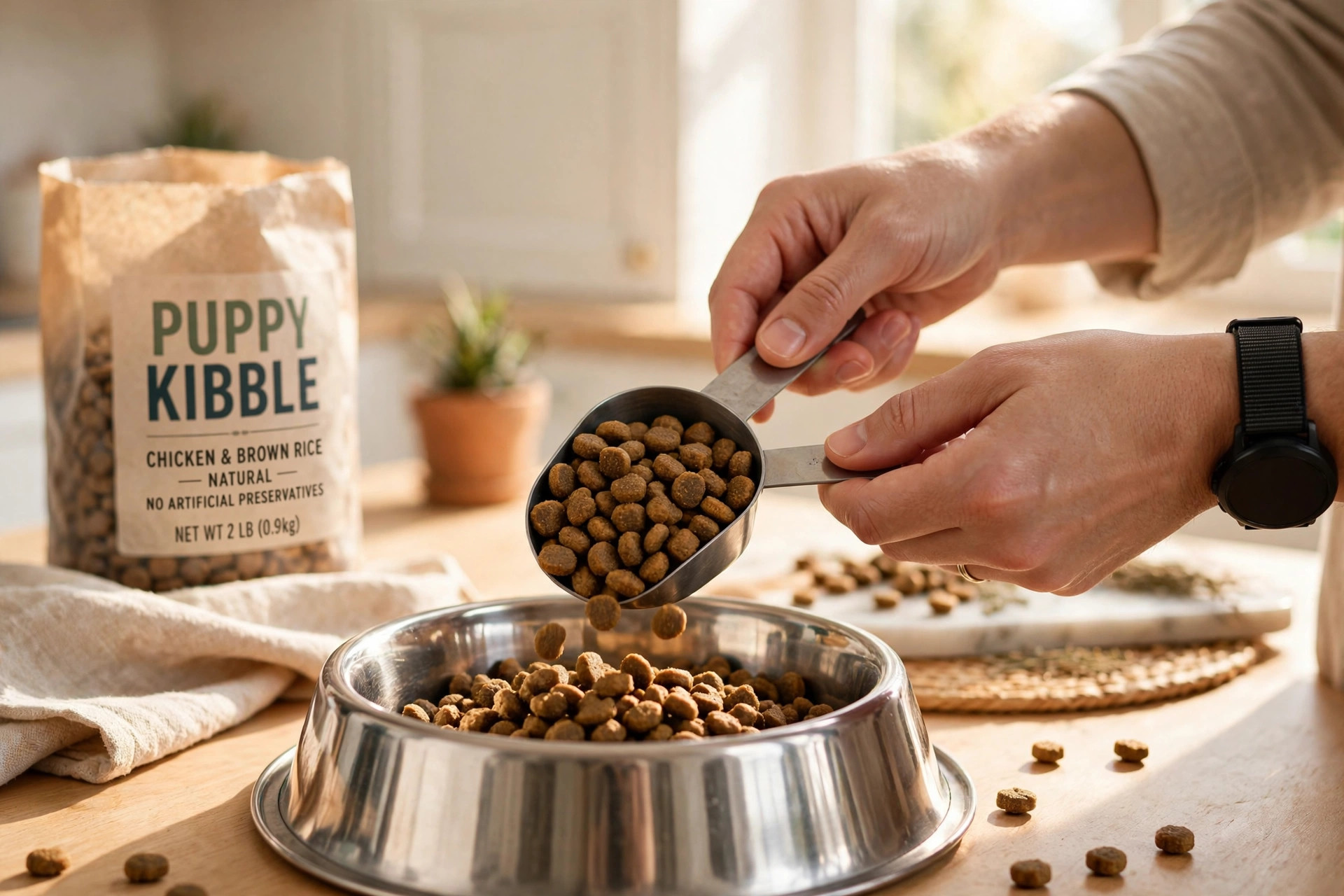
Puppies eat little and often — small stomachs, huge energy bills.
Use the food bag’s feeding chart as a starting point, then adjust by
body condition: you should be able to feel (not see) your puppy’s
ribs, and see a visible waist from above.
-
8–12 weeks: 4 meals a day. Newly weaned puppies have tiny
stomachs and the highest relative calorie needs of their lives.
Keep meals small, consistent and on a clock — routine also helps
house training. -
3–6 months: 3 meals a day. Growth is explosive now — many
puppies gain a pound or more a week. This is the phase where
overfeeding does the most quiet damage, so watch the waistline,
not just the bowl. -
6–12 months: 2 meals a day. Growth slows (small breeds may be
nearly done; large breeds are barely halfway). Start thinking
about the adult-food transition (see below). -
Treats: keep them under 10% of daily calories. Training a
puppy burns through treats fast — use tiny pea-sized pieces or
break treats in half, and subtract a little kibble from meals on
heavy training days.
Weigh your puppy every 2–4 weeks and adjust portions if the
rib-check drifts. Puppies grow in spurts — a slightly lean puppy is
always healthier than a chubby one, especially for the joints.
Large-breed puppies: the special rules
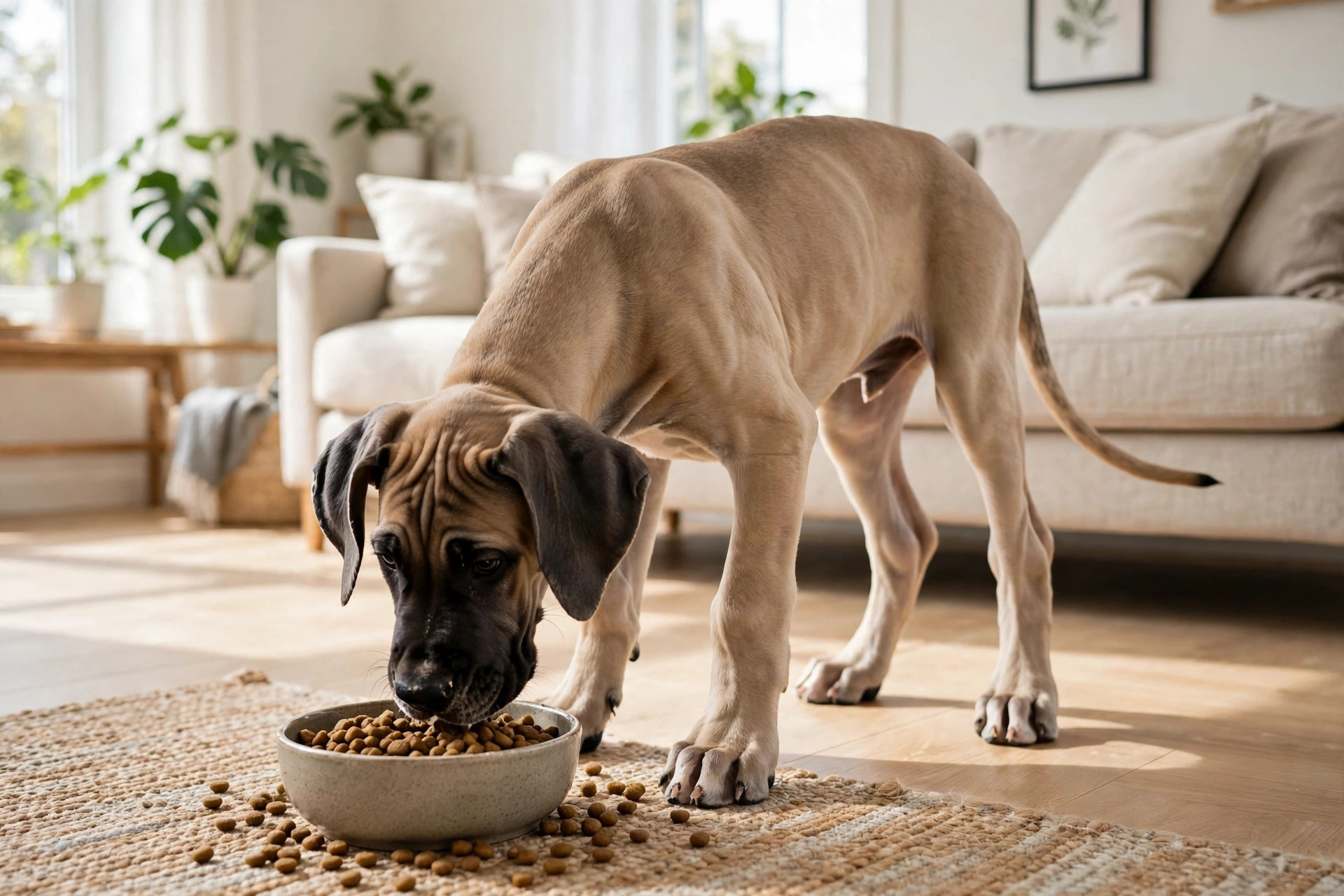
If your puppy is expected to top 25 kg (55 lb) as an adult, the
rules change. Large and giant breeds are prone to developmental
orthopedic disease — essentially, growing too fast for their own
skeleton. The fix is counterintuitive: slow the growth down.
-
Feed a large-breed puppy formula. These are engineered with
slightly lower fat and controlled calcium — the two levers that
most affect growth rate. A regular puppy food can push a big-breed
pup to grow faster than its joints can handle. -
Watch calcium. Excess calcium is the classic large-breed
mistake — well-meaning owners add bone meal or dairy “for strong
bones” and overshoot. The food already contains the right amount;
don’t supplement minerals unless your vet tells you to. -
Keep them lean. A large-breed puppy should look almost
skinny next to a chubby littermate. Studies consistently link
lean growth in large breeds to fewer joint problems later. If
strangers say “he’s a bit thin”, you’re probably doing it right. -
Expect a long puppyhood. Giant breeds may stay on puppy food
for 18–24 months. Patience is the whole strategy.
5 puppy feeding mistakes to avoid
-
Overfeeding “because he’s growing.” Growth needs fuel, not
excess. An overweight puppy is set up for joint trouble — keep
the rib-check honest. -
Too many treats. Puppy training is treat-heavy by nature.
Tiny pieces, and count them against the day’s food. -
Switching foods every other week. Puppies’ guts are
sensitive; constant brand-hopping causes the diarrhoea owners
then blame on the food. Pick one good food and commit. -
Free-feeding the bowl all day. Leaving kibble down
constantly makes it impossible to track intake and teaches
grazing. Timed meals build routine and appetite awareness. -
Table scraps and “puppy treats” from the table. Rich human
food is the fastest route to pancreatitis in a young dog — and
begging habits form in a week and last a lifetime.
When to switch to adult food
There’s no single birthday — it depends on breed size, because
breeds finish growing at different rates:
- Small breeds (under 10 kg adult): switch around 9–12 months.
- Medium breeds (10–25 kg): switch around 12 months.
- Large and giant breeds (over 25 kg): switch around 12–18
months, sometimes later for true giants — ask your vet.
Switching isn’t a single event. Transition over 10–14 days:
start with roughly 25% new food mixed into 75% old, move to 50/50,
then 75/25, then 100% new. Rushing the switch is the number-one
cause of the post-transition diarrhoea that sends owners back to
the old bag. And the switch moment is a good time for a vet
check-in — a quick weight and body-condition assessment confirms
the timing is right.
Safety notes
-
Toxic foods are non-negotiable: chocolate, grapes and
raisins, xylitol (birch sugar in some peanut butters), onions,
garlic and macadamia nuts can seriously harm or kill a puppy.
Keep them out of reach, not just out of the bowl. -
No cooked bones, ever. They splinter. Rawhide chews are a
choking and blockage risk for enthusiastic puppies — choose
size-appropriate chews and always supervise. -
Fresh water, always. Puppies dehydrate faster than adults —
the water bowl should never be empty, and wash it daily. -
Puppy milk is a myth for weaned pups. Once weaned, puppies
don’t need milk, and most are lactose intolerant — it causes
exactly the tummy trouble owners are trying to avoid.
The bottom line
Feed a named-protein puppy food with an AAFCO growth statement,
measure meals by age and body condition rather than by the bag’s
maximum, keep large-breed puppies lean and slow-growing, and
transition to adult food on your breed’s timeline — not the
calendar’s. Do that, and you’ve handled the single biggest lever
you have over how your puppy turns out.
FAQs
How many times a day should I feed my puppy?
Four meals a day from 8–12 weeks, three meals from 3–6 months, and
two meals from about 6 months onward. Timed meals beat free-feeding
— they let you track intake and build a routine that helps with
house training.
Is grain-free puppy food better?
Not necessarily. Grain-free became trendy, but grains are a fine
energy source for most puppies, and some grain-free formulas have
been linked to heart concerns in dogs. Unless your vet diagnoses a
specific grain issue, a quality grain-inclusive puppy food is a
solid, well-studied choice.
Can puppies eat adult dog food in a pinch?
For a meal or two, yes — it won’t harm them. As a steady diet, no:
adult food lacks the calorie density, protein levels and DHA a
growing puppy needs, and the mineral balance isn’t tuned for growth.
My puppy is always hungry — am I underfeeding?
Probably not. Puppies are professional beggars — it’s a survival
instinct, not a nutrition report. Trust the rib-check and the scale,
not the sad eyes. If weight gain stalls or the ribs become
prominent, then increase portions and check with your vet.
When should a large-breed puppy switch to adult food?
Large breeds typically switch around 12–18 months, and giant breeds
sometimes later — they finish growing much later than small dogs.
Use a large-breed puppy formula until then, keep growth lean, and
confirm timing with your vet at a check-up.