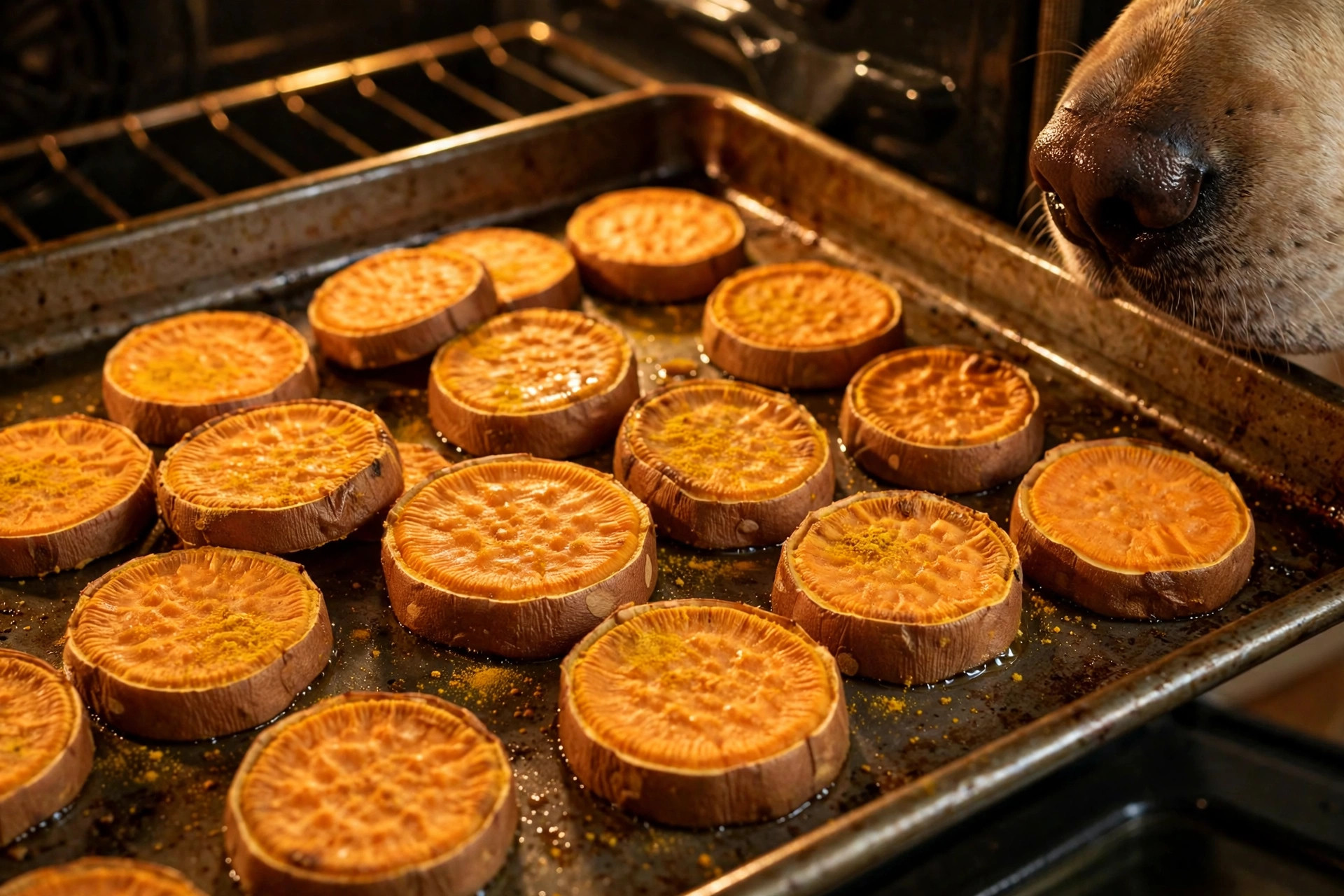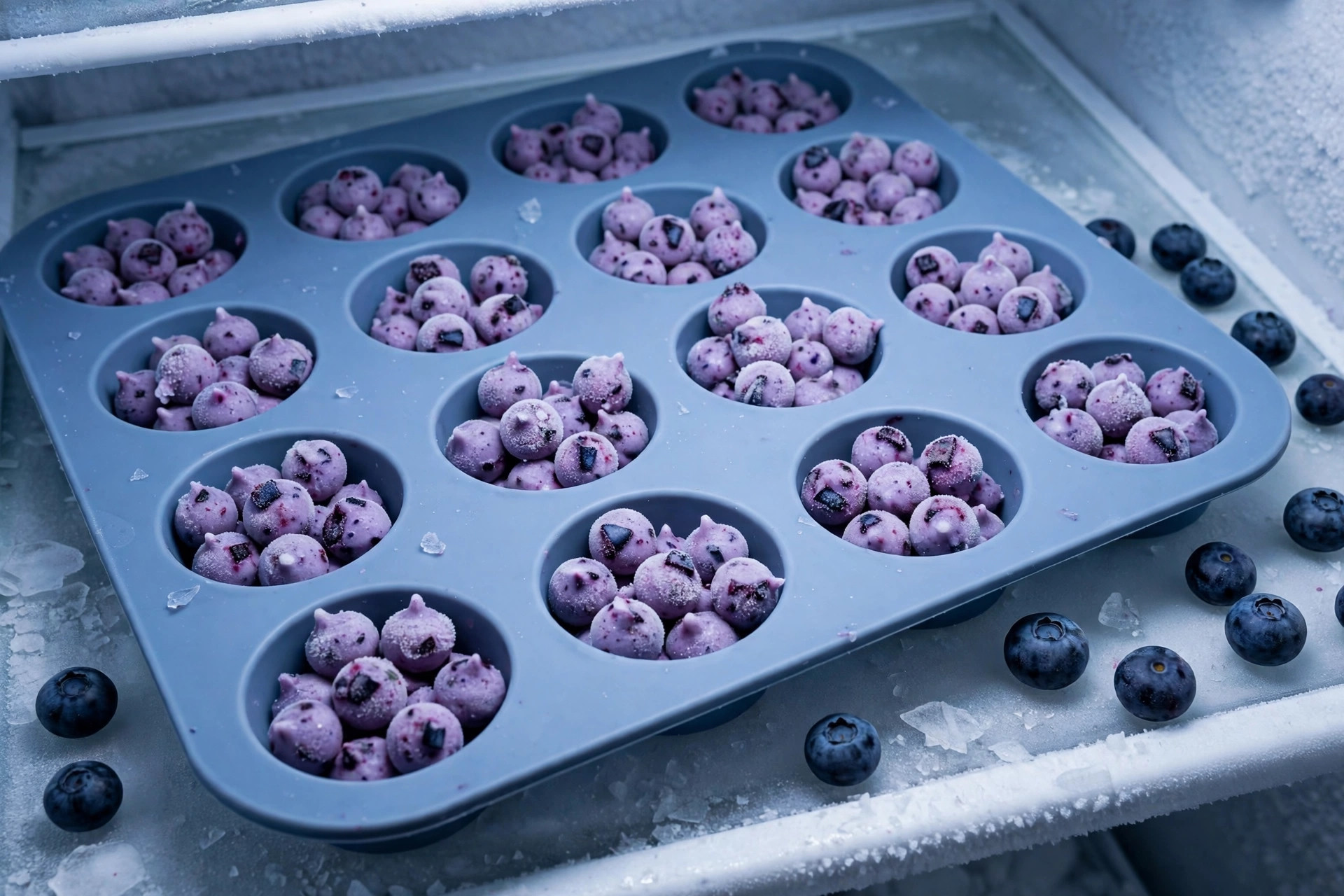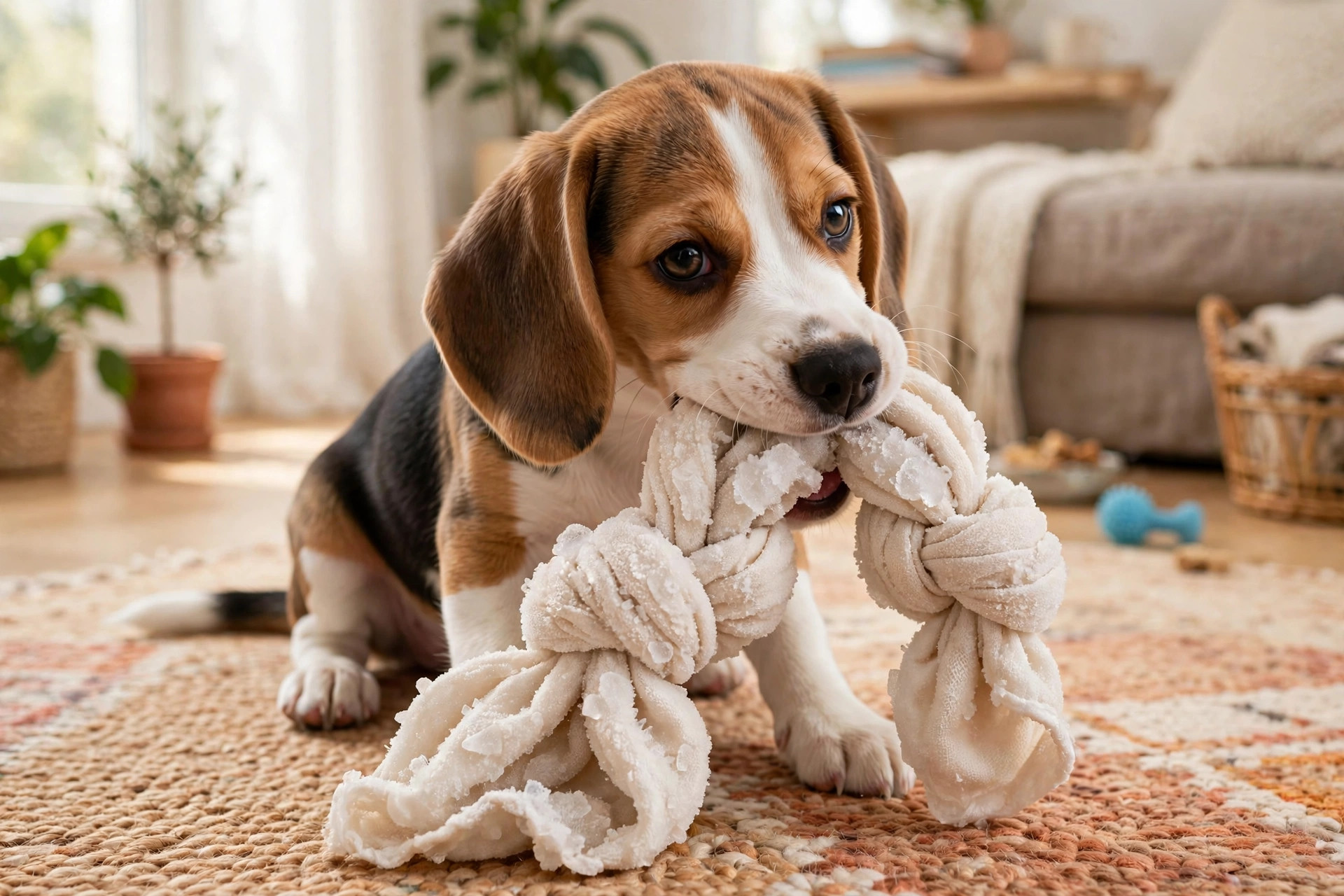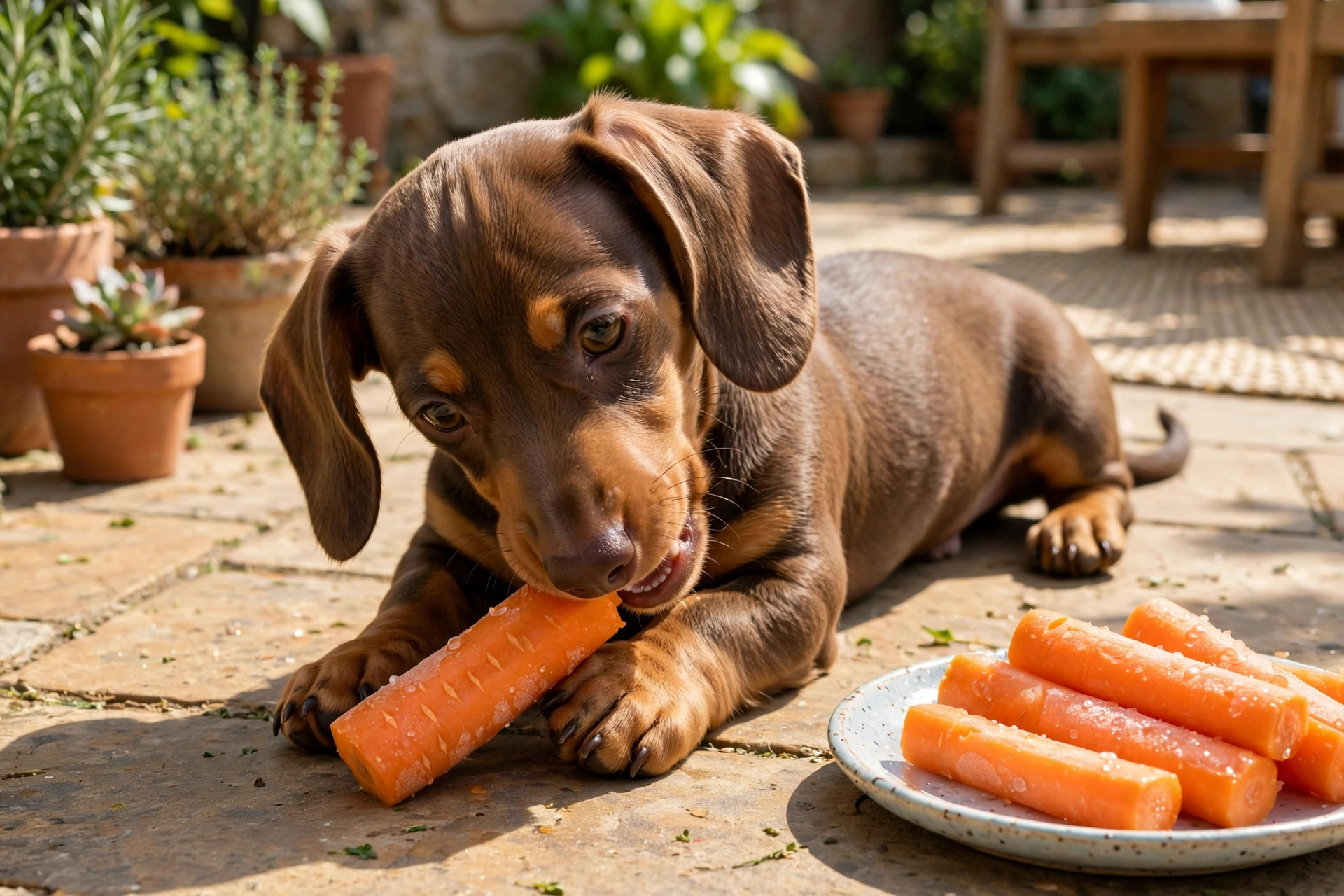
Golden retriever catching a homemade grain-free dog treat in a bright kitchen.

Homemade Dog Treats Grain Free: 6 Easy Recipes Dogs Love

{
“title”: “Homemade Dog Treats Grain Free: 6 Easy Recipes Dogs Love”,
“slug”: “homemade-dog-treats-grain-free”,
“excerpt”: “Homemade dog treats grain free — 6 easy recipes with coconut, almond and chickpea flour, plus what grain-free really means and the vet facts to know first.”,
“meta_description”: “Homemade dog treats grain free — 6 easy recipes with coconut, almond and chickpea flour, plus what grain-free really means and the vet facts to know first.”,
“featured_image_alt”: “Golden retriever catching a homemade grain-free dog treat in a bright kitchen.”,
“content_html”: “

Walk down the dog treat aisle and \”grain-free\” is on half the bags. At home, though, most homemade treat recipes still start with wheat flour or oats — and oats are a grain. So if your dog genuinely needs grain-free treats, the usual recipes do not help.

\n

This guide is different. Every recipe below is fully grain-free: no wheat, no corn, no rice, no oats, no barley. Instead they use coconut flour, almond flour, chickpea flour and tapioca — flours that behave differently from wheat, so the guide also explains how each one works, how much to use, and which one suits which recipe. There is also an honest section on when grain-free is worth it and when it is not, including what vets say about grain-free diets.

\n

What \”grain-free\” actually means

\n

Grain-free means no grains at all — not just no wheat. That includes the grains people often forget are grains:

\n

    \n

  • Wheat, barley, rye — the obvious ones, and the ones most often linked to dog food sensitivities.
  • \n

  • Oats — a grain, even though oat flour is often sold as a \”healthy\” swap. An oat-flour biscuit is flour-free but it is not grain-free.
  • \n

  • Rice and corn — both grains, and both common in shop-bought treats.
  • \n

\n

Grain-free is not the same as low-carb, and it is not the same as gluten-free. A gluten-free biscuit can still contain rice or oats. A grain-free biscuit contains none of them — which is why the recipes below use nut and seed flours, coconut flour, and root starches instead.

\n

Why go grain-free? And when not to

\n

Most dogs do not need grain-free treats. Grains are not harmful to most dogs, and a healthy dog digests oats and rice perfectly well. Grain-free is worth considering in three situations:

\n

1. Your vet suspects a grain sensitivity. True grain allergies in dogs are uncommon — beef, dairy and chicken are far more common triggers — but some dogs do react to wheat or corn. If your vet has suggested a trial, grain-free treats keep the trial clean. Our best dog food for sensitive stomachs guide explains how an elimination trial works.

\n

2. Your dog has a sensitive stomach. Some dogs with recurring soft stools or gassy tummies do better on a simpler, grain-free treat. It is not a cure, but removing one variable often helps — and the pumpkin and coconut in these recipes are both famously gentle on digestion.

\n

3. You want treat variety. Even for a healthy dog, rotating treat types is good. Grain-free recipes use different ingredients, so they add variety to a treat jar that is otherwise all wheat and oats.

\n

When grain-free is not the right call: if your dog is happy and healthy on normal treats, there is no reason to switch. Grain-free is a tool for a specific job, not a badge of a better treat. And if your dog has a diagnosed medical condition, ask your vet before changing anything — including treats.

\n

The vet note: grain-free diets and heart health

\n

You may have heard about a possible link between grain-free diets and a heart condition called dilated cardiomyopathy (DCM) in dogs. Here is what is actually known, in plain terms:

\n

    \n

  • The US Food and Drug Administration (FDA) investigated reports of DCM in dogs eating grain-free diets, particularly diets heavy in peas, lentils and potatoes as main ingredients.
  • \n

  • No direct cause has been proven. The link is an association, not a confirmed cause, and the investigation is ongoing.
  • \n

  • The concern is about a dog’s whole diet — what they eat every day, meal after meal — not about an occasional treat.
  • \n

\n

What that means for this guide: these are treats, not meals. They make up a small part of your dog’s day, they are rotated with other treats, and none of the recipes use peas or lentils as a main ingredient. If your dog eats a grain-free diet as their main food, talk to your vet about it — that is a diet question, and it deserves a vet’s answer. For treats, the recipes below are a safe, varied addition to a normal diet.

\n

The grain-free flour guide

\n

Grain-free flours do not behave like wheat flour. Each one has its own personality, and knowing it saves you from crumbly biscuits and soggy centres.

\n

Coconut flour — the sponge. Coconut flour absorbs an enormous amount of liquid — roughly four times its own weight. Use about a quarter of the amount you would use of wheat flour, and add an extra egg or a splash of water to keep the dough moist. It gives a soft, slightly sweet biscuit that dogs love. Best for: soft chews and training bites. Watch out for: using too much. A dough that looks dry will often be fine after five minutes of resting.

\n

Almond flour — the rich one. Almond flour is ground almonds, so it is high in healthy fats and protein and gives a tender, crumbly biscuit. It browns faster than wheat flour, so bake at a slightly lower temperature and check five minutes early. Best for: soft-baked chews and biscuits for older dogs. Watch out for: dogs with nut sensitivities — almonds are not toxic to dogs, but any nut flour should be introduced in small amounts first.

\n

Chickpea flour — the sturdy one. Chickpea flour (also called gram flour or besan) is the closest to wheat flour in behaviour. It holds together well, makes a firm biscuit, and is high in protein and fibre. Best for: crunchy biscuits and shaped treats. Watch out for: it has a slightly beany smell when raw, which disappears completely in the oven.

\n

Tapioca starch — the binder. Tapioca is a starch from cassava root, not a flour. On its own it makes a chewy, almost gummy texture — useful in small amounts (a tablespoon or two) to help a grain-free dough hold together. Best for: adding chew to soft treats and no-bake recipes. Watch out for: using too much, which turns biscuits rubbery.

\n

A good rule for converting any wheat-flour recipe: replace 1 cup of wheat flour with ¾ cup of chickpea flour, or ¼ cup of coconut flour plus an extra egg, or 1 cup of almond flour baked 10°C cooler. Test a small batch first — grain-free doughs vary more than wheat doughs, and a test batch costs you ten minutes.

\n

The 6 recipes

\n

All six recipes are grain-free, and all six keep treats under 10% of your dog’s daily food. Introduce one new recipe at a time and watch for any tummy reaction over the next day.

\n
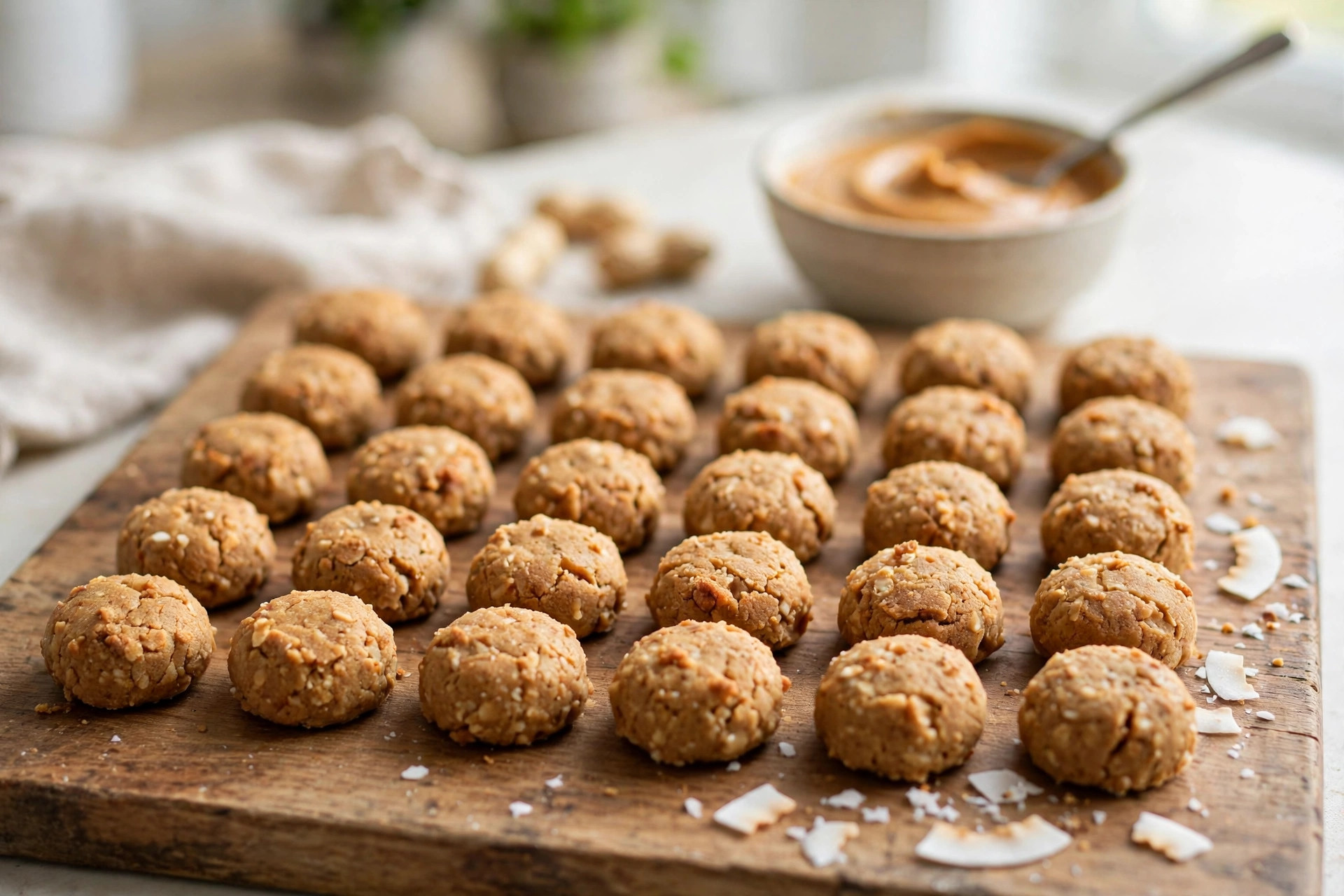
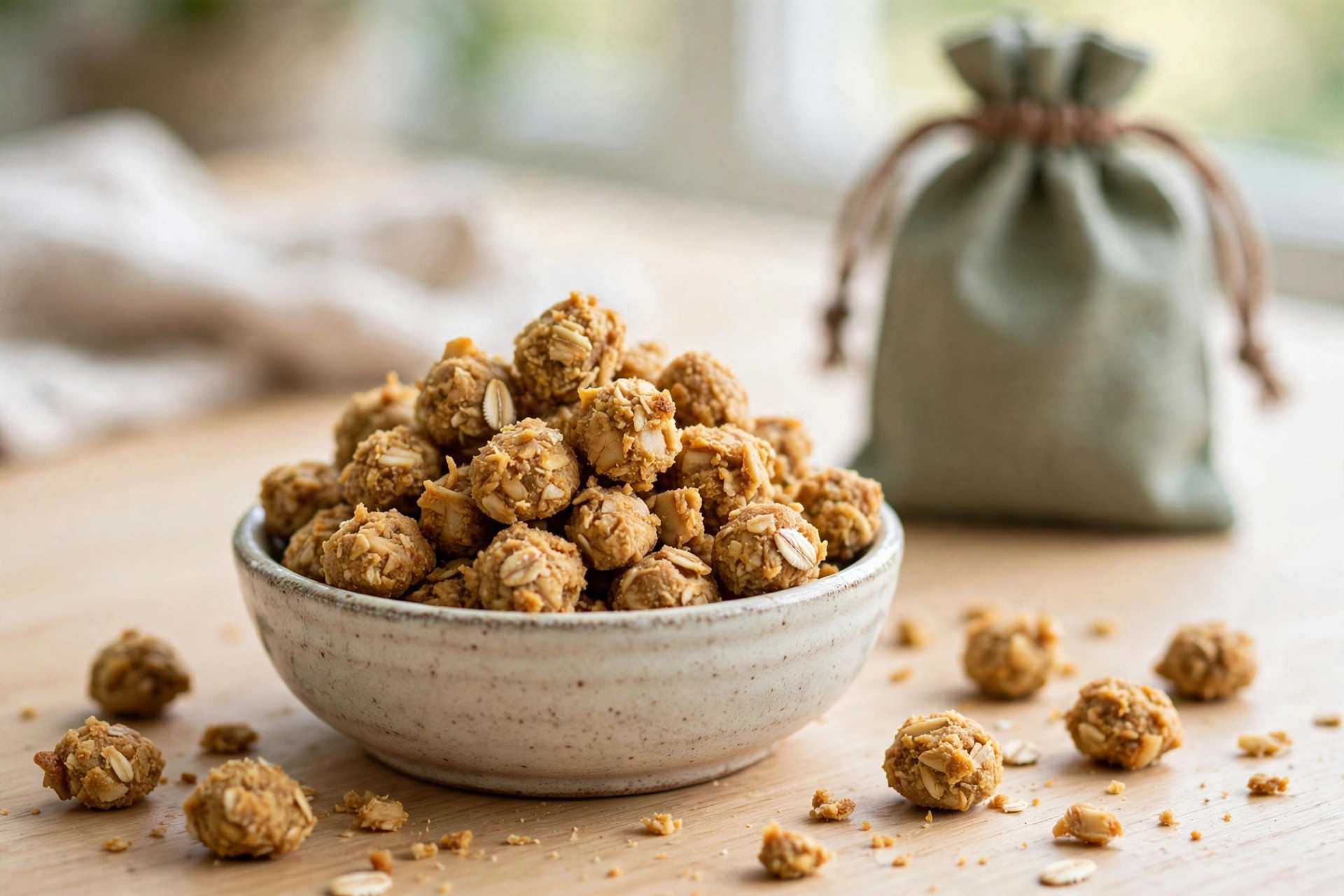
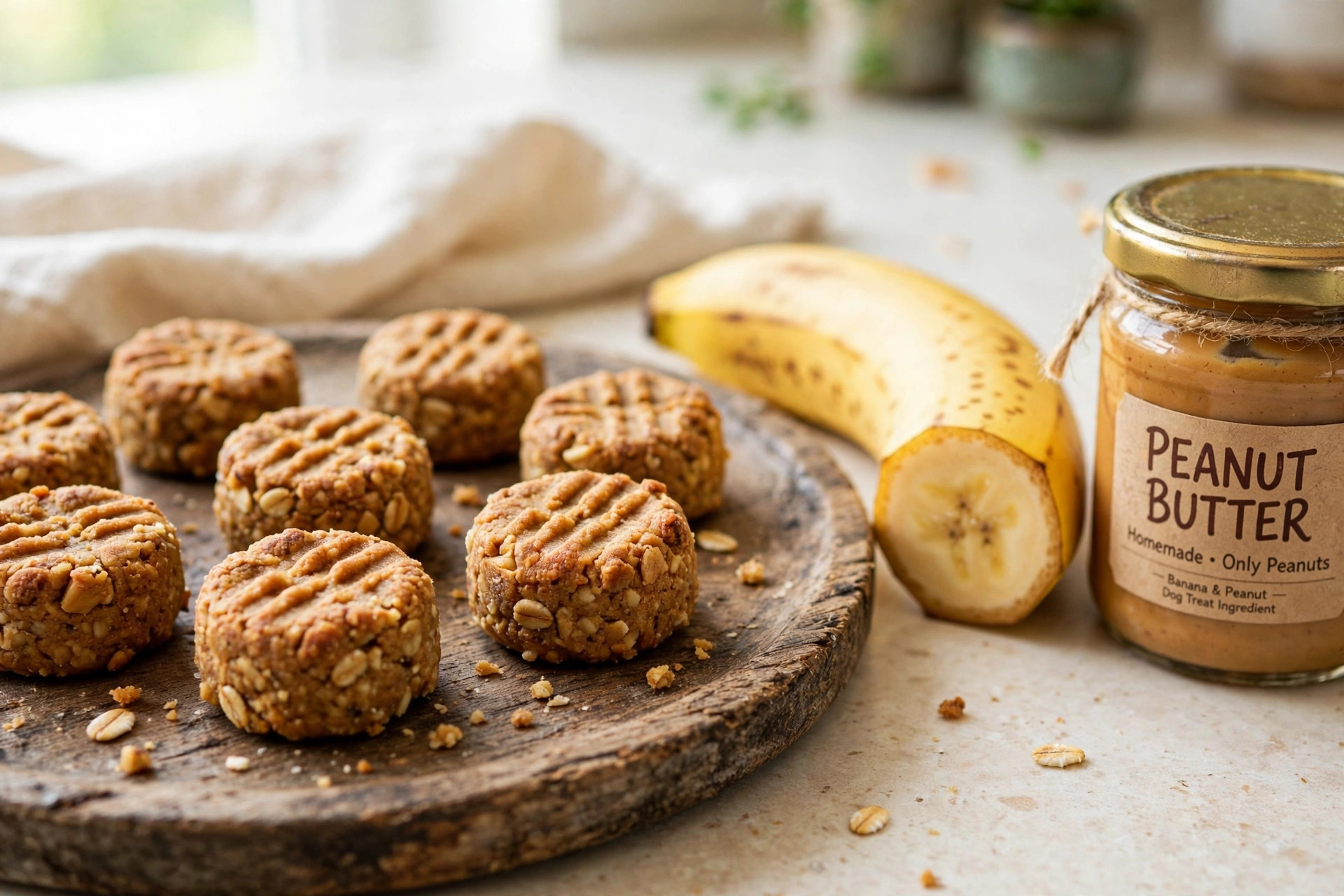
Peanut butter coconut flour bites.

1. Peanut Butter & Coconut Flour Bites

\n

The easiest recipe on this list, and the one to start with. Coconut flour makes a soft, crumbly bite that even small dogs can manage.

\n

Ingredients

\n

    \n

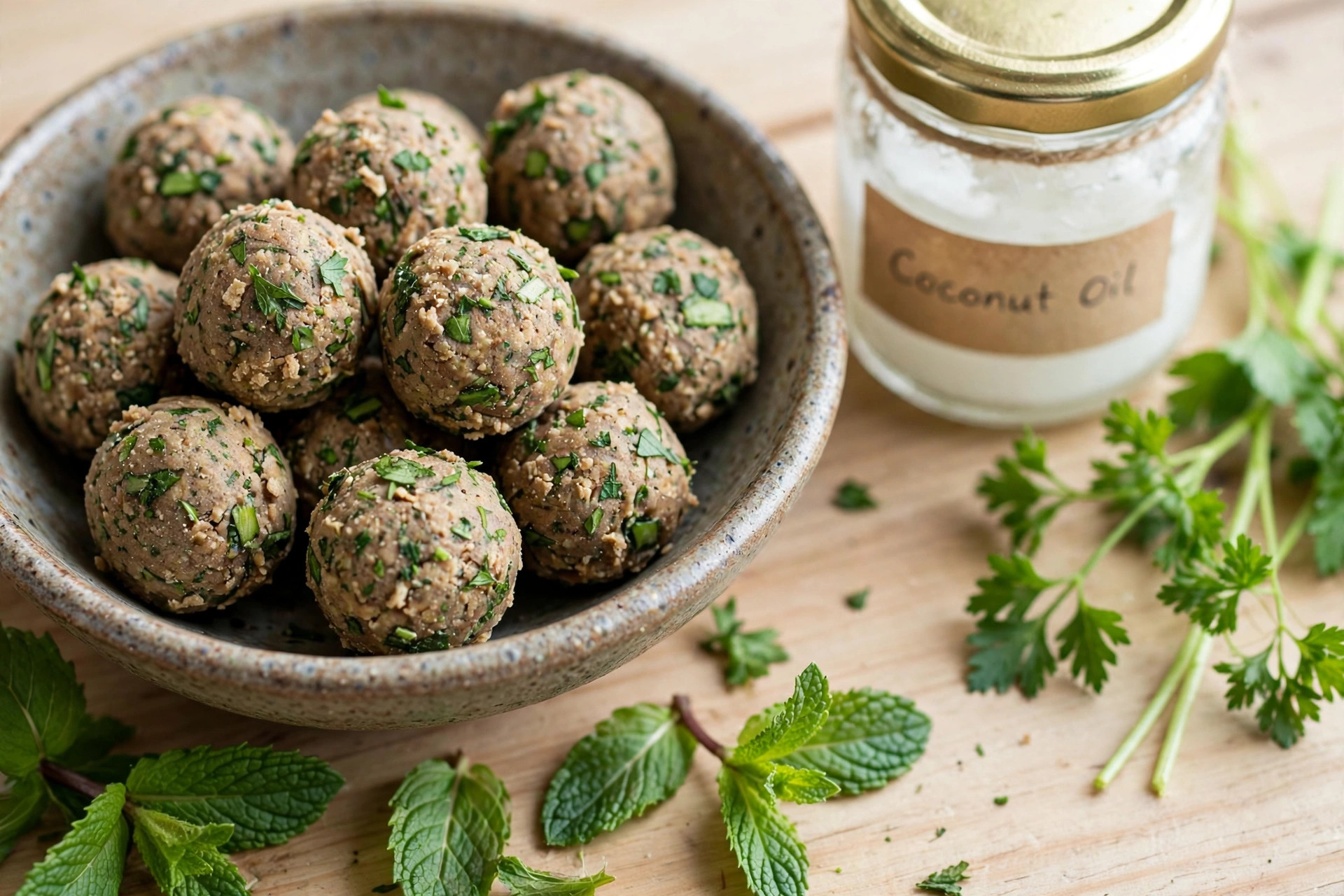
  • ½ cup (130 g) smooth peanut butter (xylitol-free — check the label)
  • \n

  • 2 eggs
  • \n

  • ¼ cup (30 g) coconut flour
  • \n

  • 1 tbsp coconut oil, melted
  • \n

\n

Method

\n

    \n

  1. Heat the oven to 175°C / 350°F. Line a baking tray.
  2. \n

  3. Stir the peanut butter, eggs and coconut oil together, then mix in the coconut flour. Rest the dough for 5 minutes — coconut flour keeps absorbing liquid, and the dough will firm up.
  4. \n

  5. Roll into small balls, about the size of a grape, and flatten slightly with a fork.
  6. \n

  7. Bake 12–15 minutes until set and lightly golden at the edges. Cool completely.
  8. \n

\n

Makes ~30 small bites. Keeps 1 week in an airtight tin, 2 weeks in the fridge, 3 months frozen. A good training treat — small, soft and smelly, which is exactly what a training treat should be.

\n
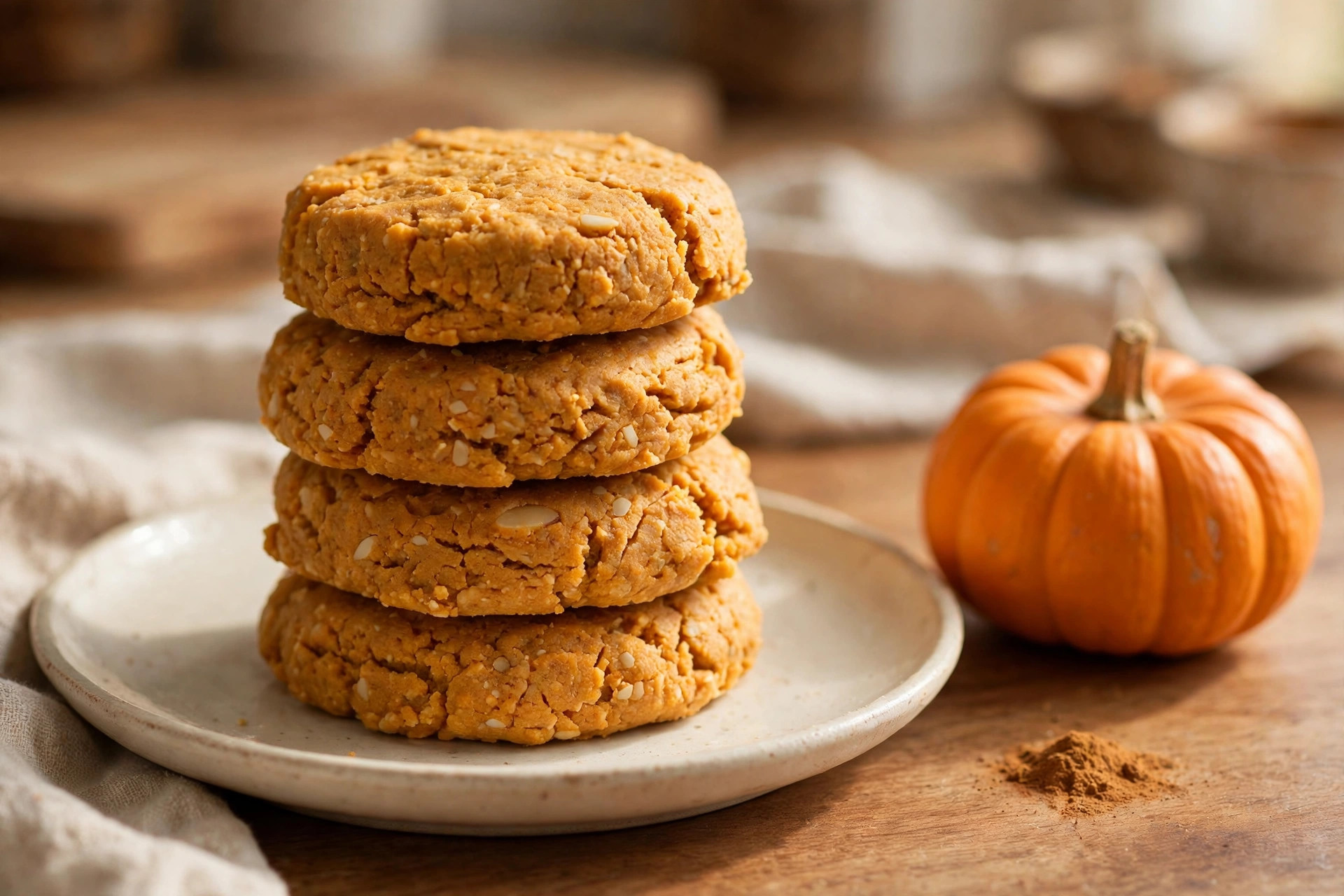
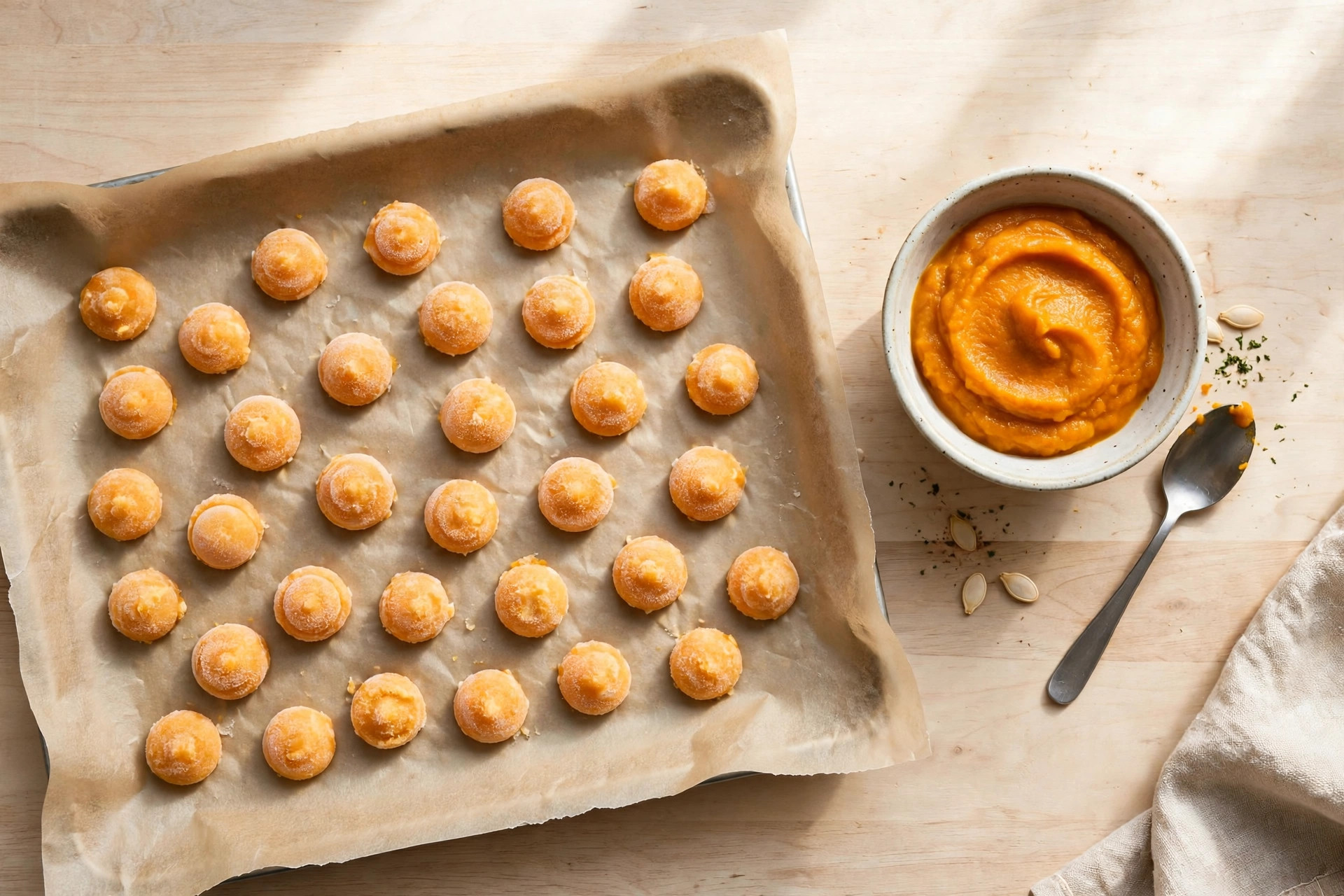
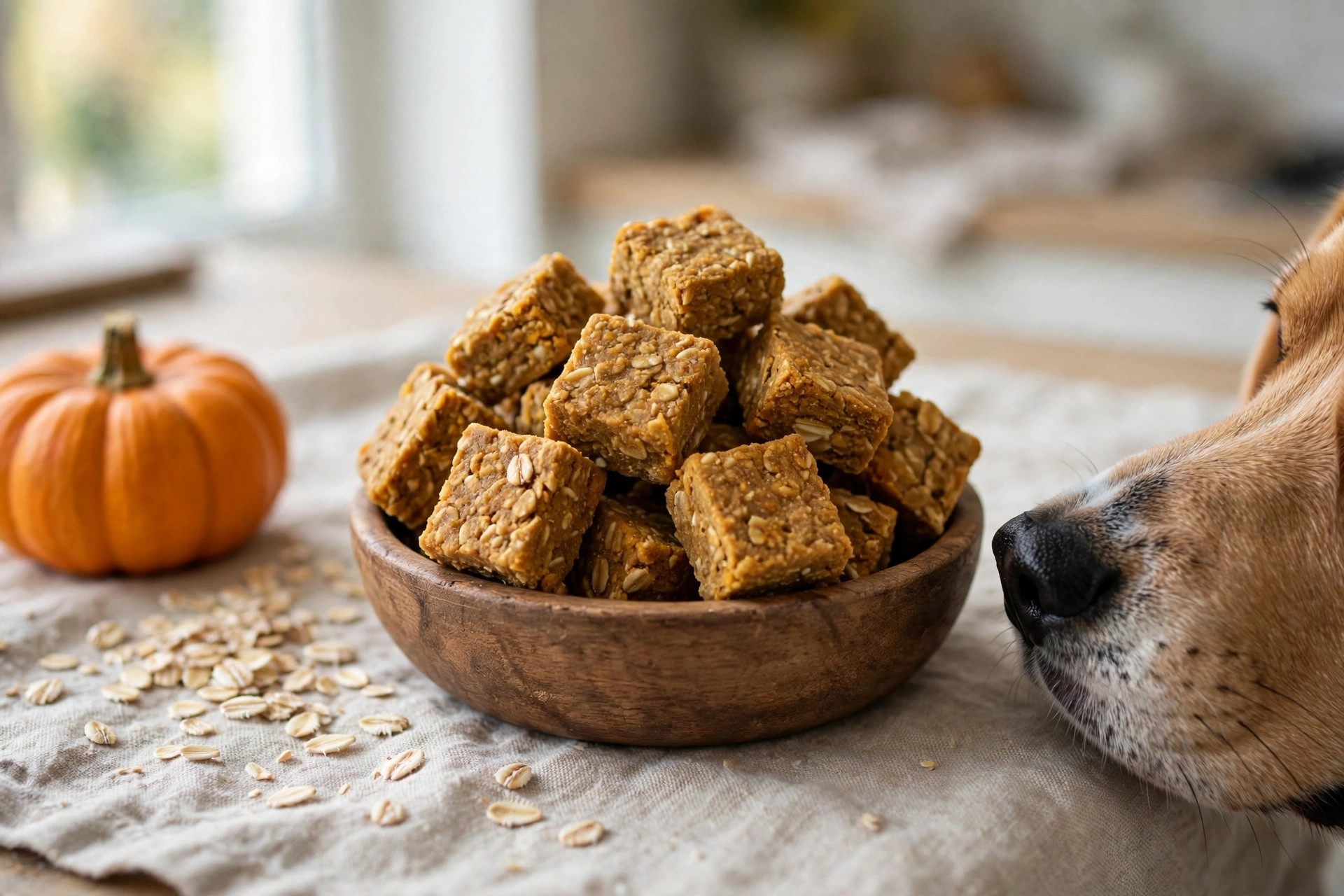
Pumpkin almond flour soft chews.

2. Pumpkin & Almond Flour Soft Chews

\n

Soft, moist, and gentle on digestion — pumpkin is the classic sensitive-stomach ingredient, and almond flour keeps them tender for older dogs and puppies.

\n

Ingredients

\n

    \n

  • 1 cup (240 g) plain pumpkin purée (not pie filling)
  • \n

  • 1 egg
  • \n

  • 1 cup (100 g) almond flour
  • \n

  • 2 tbsp tapioca starch
  • \n

  • ½ tsp cinnamon
  • \n

\n

Method

\n

    \n

  1. Heat the oven to 165°C / 325°F — almond flour browns fast, so bake cooler than usual.
  2. \n

  3. Mix the pumpkin, egg and cinnamon, then stir in the almond flour and tapioca starch to form a soft dough.
  4. \n

  5. Drop teaspoons of dough onto a lined tray and flatten gently.
  6. \n

  7. Bake 18–20 minutes until set but still soft in the middle. Cool completely — they firm up as they cool.
  8. \n

\n

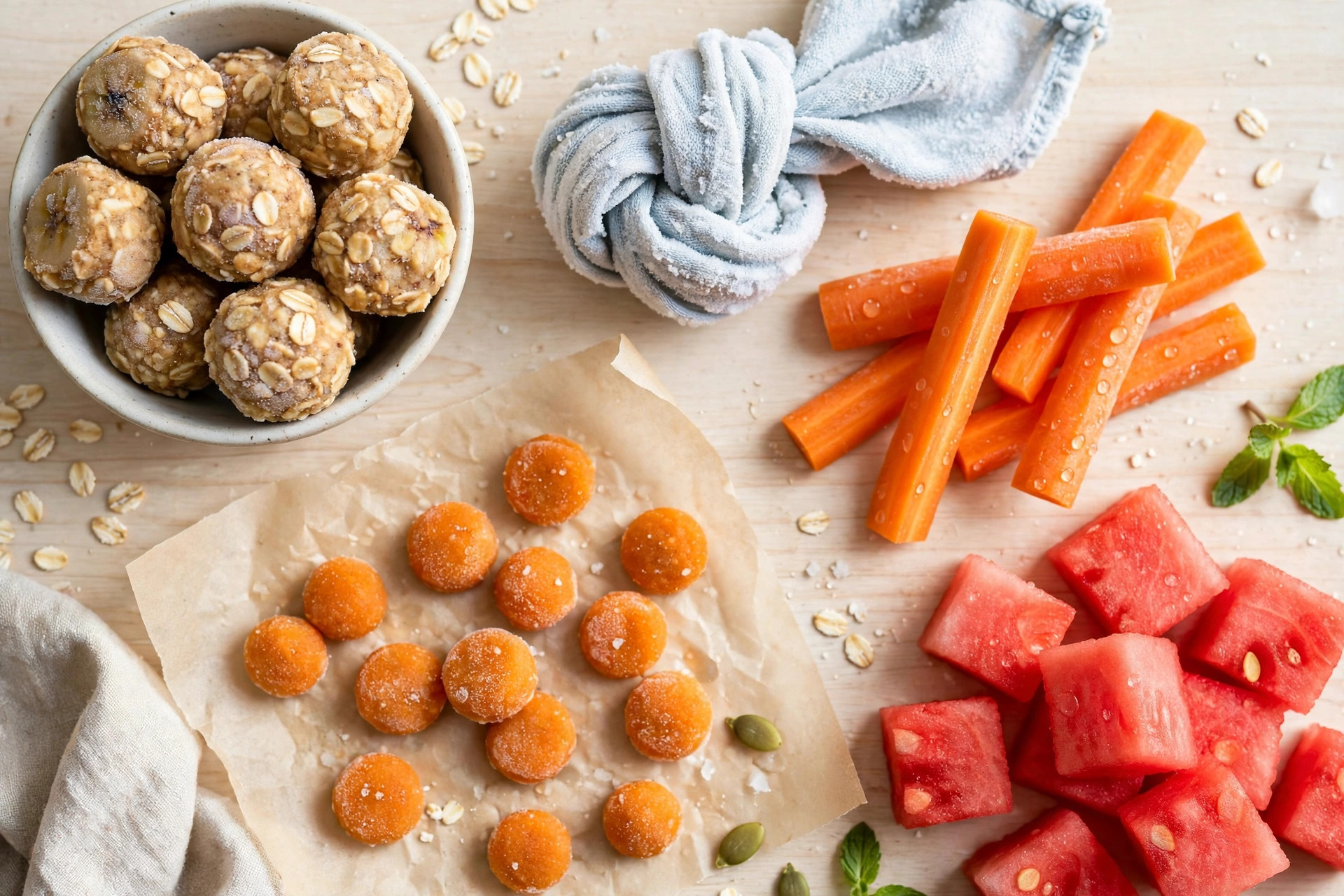
Makes ~24 soft chews. Keeps 1 week in the fridge, 3 months frozen. For more pumpkin ideas, our no-bake dog treats guide has a frozen pumpkin recipe that needs no oven at all.

\n
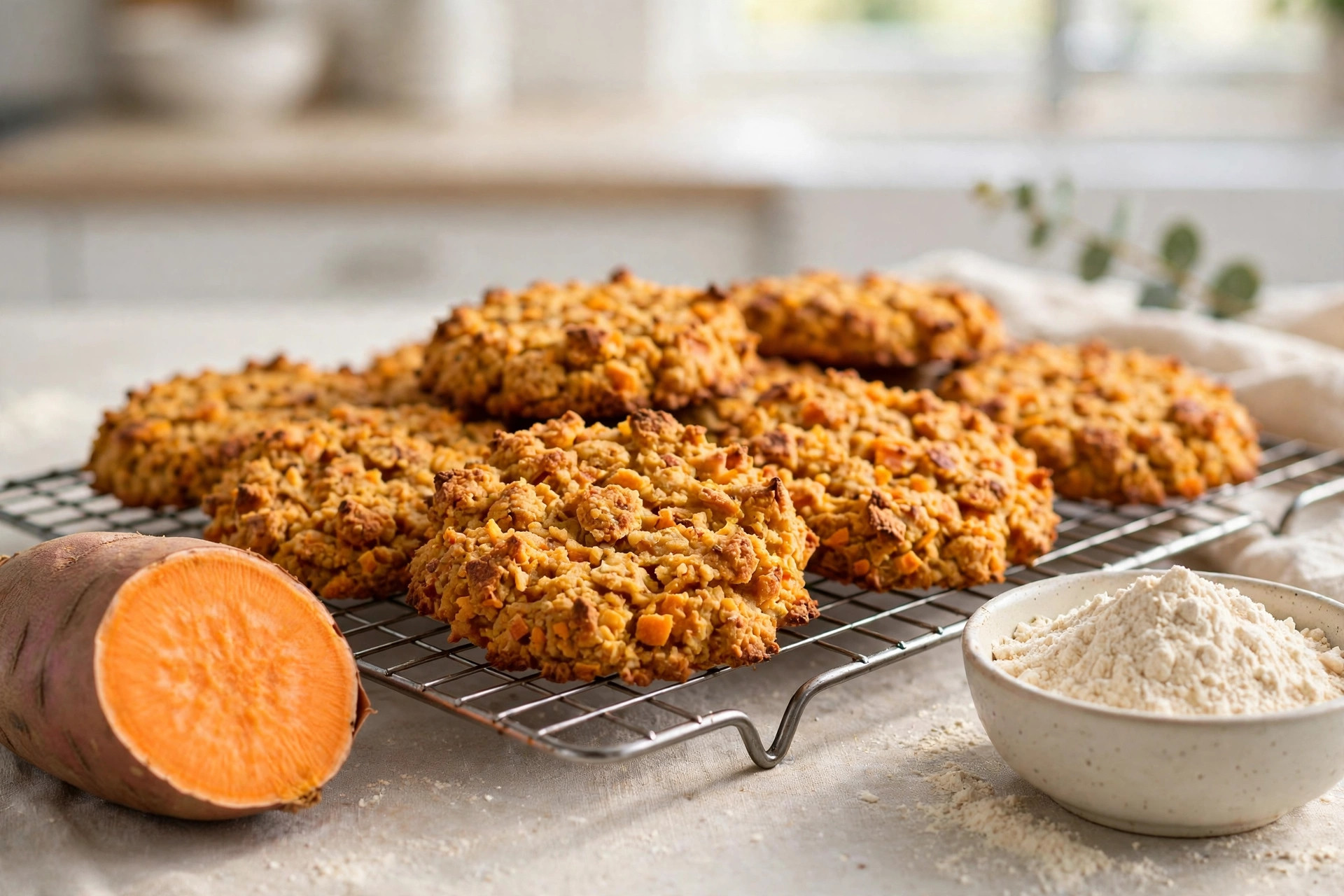
Sweet potato chickpea biscuits.

3. Sweet Potato & Chickpea Flour Biscuits

\n

The crunchiest recipe here, and the sturdiest — these hold their shape in a treat pouch and do not crumble in a pocket. Chickpea flour gives them a firm, satisfying snap.

\n

Ingredients

\n

    \n

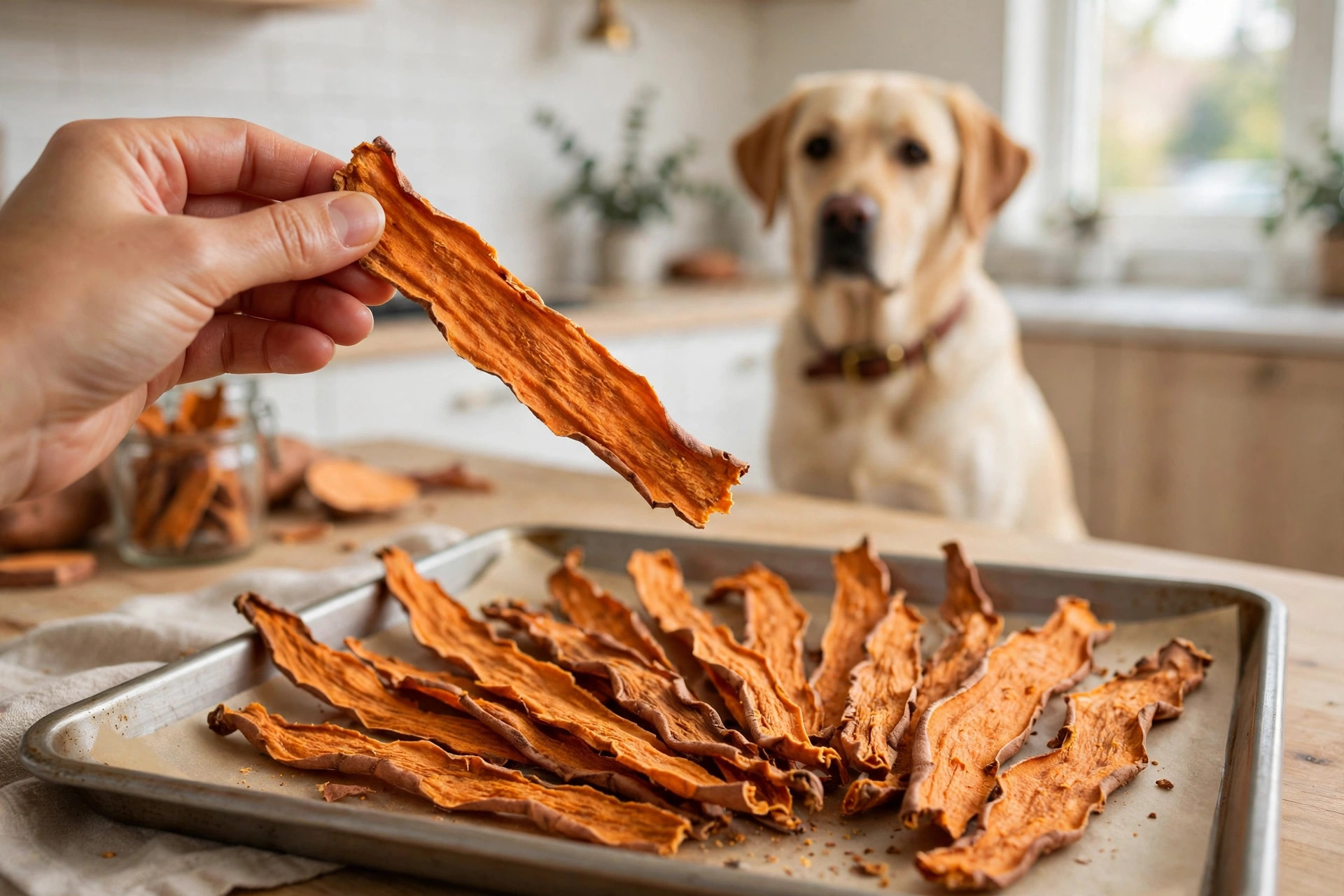
  • 1 cup (200 g) mashed cooked sweet potato, cooled
  • \n

  • 1 egg
  • \n

  • 1 cup (120 g) chickpea flour
  • \n

  • 1 tbsp coconut oil, melted
  • \n

  • 1 tbsp chopped fresh parsley (optional — freshens breath)
  • \n

\n

Method

\n

    \n

  1. Heat the oven to 180°C / 350°F. Line a baking tray.
  2. \n

  3. Mix the sweet potato, egg and coconut oil, then work in the chickpea flour to form a firm dough. Add a spoon of water only if it crumbles.
  4. \n

  5. Roll out to about 6 mm (¼ inch) thick and cut into shapes, or slice into squares with a knife.
  6. \n

  7. Bake 25–30 minutes until firm and golden. For extra crunch, turn the oven off and leave the biscuits inside for 30 minutes to dry out.
  8. \n

\n

Makes ~28 biscuits. Keeps 2 weeks in an airtight tin. Sweet potato is also the star of our homemade dental treats — the crunch helps clean teeth as your dog chews.

\n

4. Banana & Tapioca Frozen Chews (no-bake)

\n

No oven, no flour at all — just banana, yoghurt and a little tapioca to hold them together. These are the summer recipe, and the easiest one to make with children helping.

\n

Ingredients

\n

    \n

  • 2 ripe bananas, mashed
  • \n

  • ½ cup (120 g) plain Greek yoghurt (no xylitol, no artificial sweeteners)
  • \n

  • 2 tbsp tapioca starch
  • \n

  • 1 tbsp smooth peanut butter (xylitol-free)
  • \n

\n

Method

\n

    \n

  1. Mash the bananas, then stir in the yoghurt, peanut butter and tapioca starch until smooth.
  2. \n

  3. Spoon into silicone moulds or an ice-cube tray.
  4. \n

  5. Freeze at least 4 hours. Pop out and serve outside or on an easy-clean floor — they melt.
  6. \n

\n

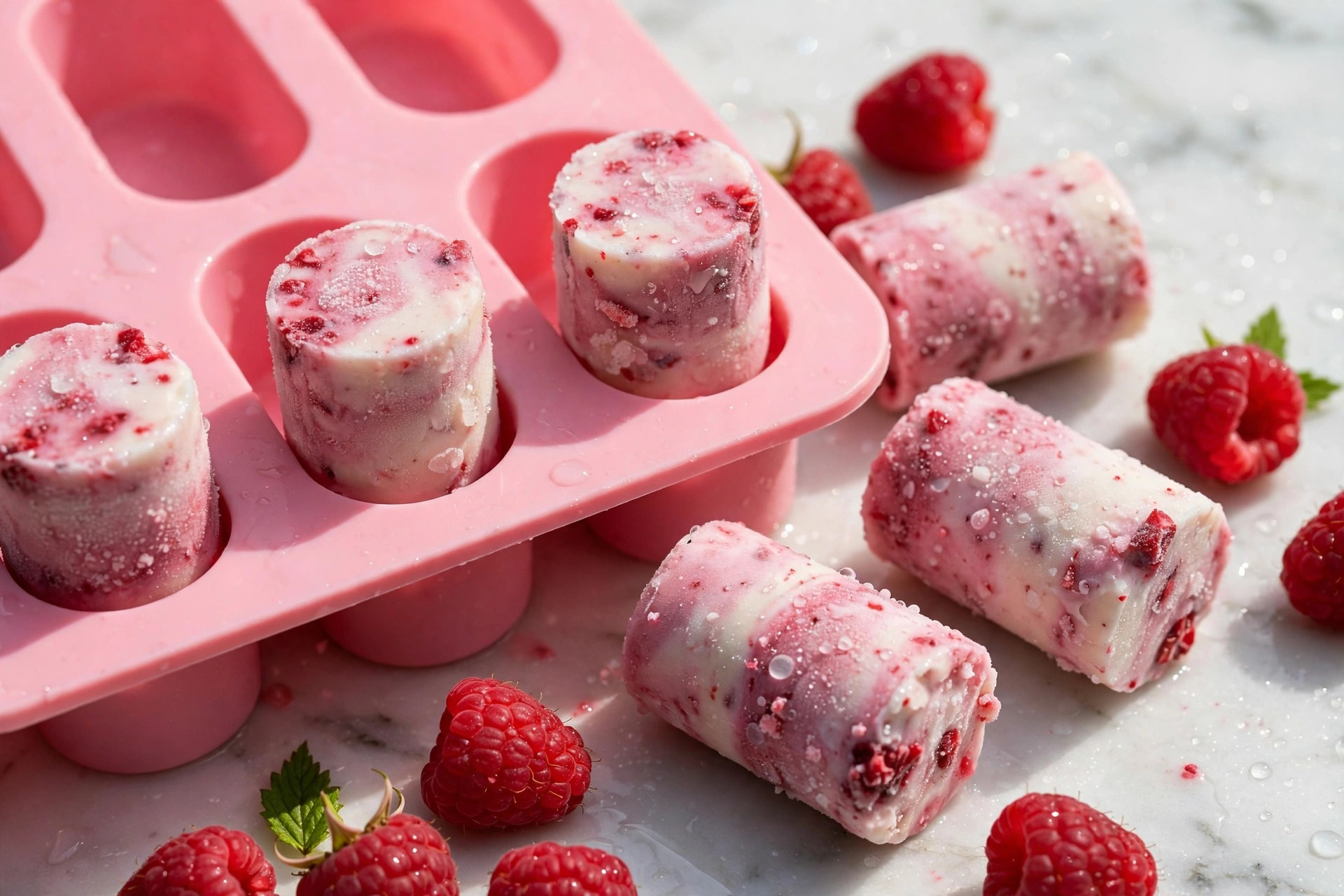
Makes ~16 chews depending on mould size. Keeps 1 month in the freezer. If your dog loves frozen treats, our homemade teething treats guide has more freezer recipes that soothe sore gums too.

\n

5. Chicken & Coconut Flour Training Bites

\n

Small, soft, and high-value — the treat you reach for when you need your dog’s full attention. Chicken is the smell that makes most dogs sit up and listen.

\n

Ingredients

\n

    \n

  • 1 cup (150 g) cooked chicken breast, finely chopped or blitzed
  • \n

  • 1 egg
  • \n

  • ¼ cup (30 g) coconut flour
  • \n

  • 1 tbsp plain Greek yoghurt
  • \n

\n

Method

\n

    \n

  1. Heat the oven to 175°C / 350°F. Line a baking tray.
  2. \n

  3. Blitz the chicken, egg and yoghurt together, then mix in the coconut flour. Rest 5 minutes.
  4. \n

  5. Roll into pea-sized balls — training treats should be tiny, so your dog can eat one in a second and get back to work.
  6. \n

  7. Bake 12–14 minutes until set. Cool completely.
  8. \n

\n

Makes ~40 tiny bites. Keeps 3 days in the fridge, 3 months frozen — freeze in small bags so you can defrost one training session’s worth at a time. For the full training-treats system — the low, medium and high-value hierarchy and the 10% calorie rule — see our dog training treats recipe guide.

\n

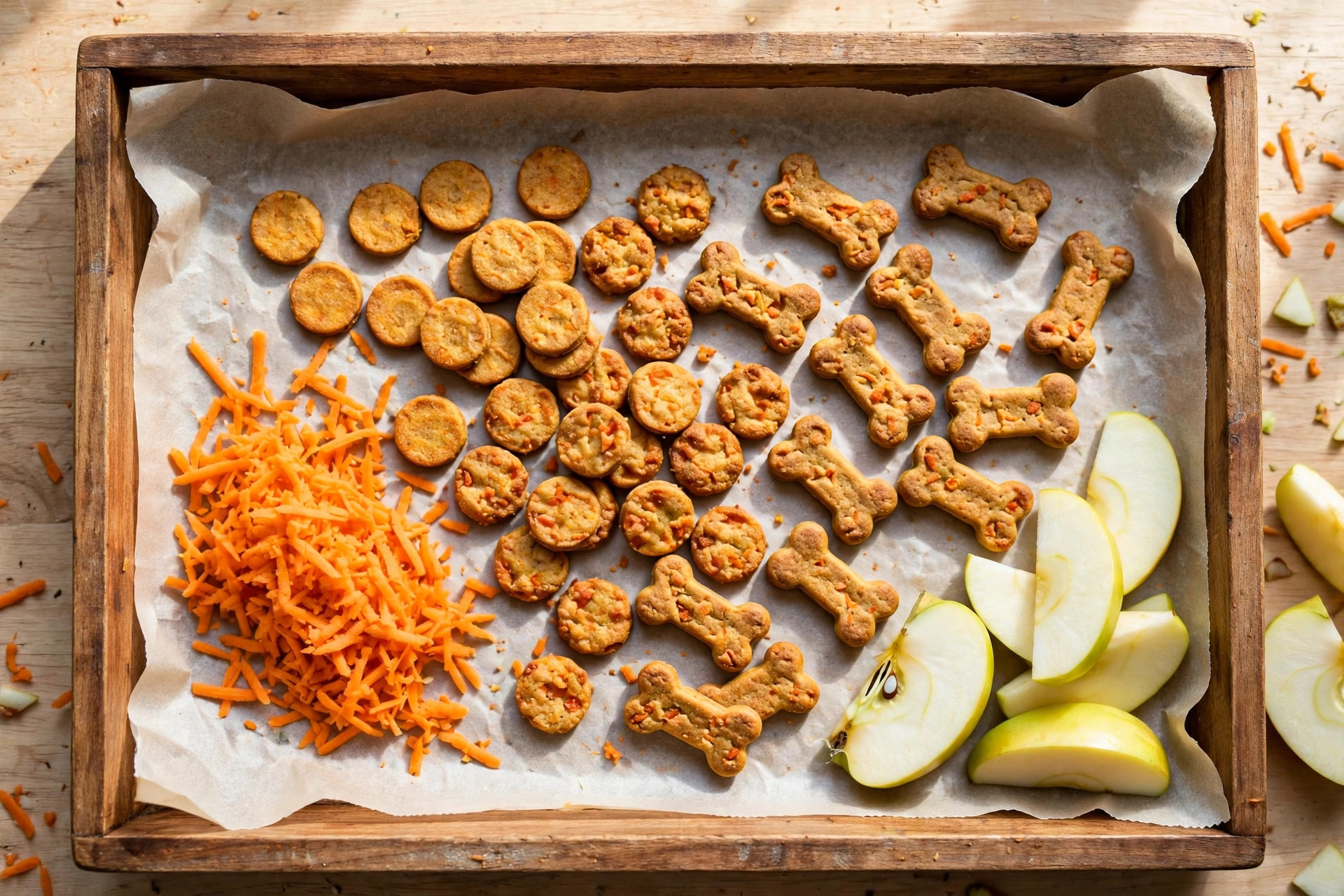
6. Apple & Carrot Grain-Free Crunchers

\n

The lunchbox biscuit: apple for sweetness, carrot for crunch, chickpea flour to hold it together. These are the firmest biscuits in the guide and the best for stuffing into a puzzle toy.

\n

Ingredients

\n

    \n

  • 1 small apple, grated (no seeds — apple seeds contain amygdalin)
  • \n

  • 1 medium carrot, grated
  • \n

  • 1 egg
  • \n

  • 1 cup (120 g) chickpea flour
  • \n

  • 1 tbsp coconut oil, melted
  • \n

\n

Method

\n

    \n

  1. Heat the oven to 180°C / 350°F. Line a baking tray.
  2. \n

  3. Mix the grated apple, carrot, egg and coconut oil, then work in the chickpea flour to form a firm dough.
  4. \n

  5. Roll out to 6 mm (¼ inch) and cut into rounds or squares.
  6. \n

  7. Bake 25–28 minutes until firm and golden at the edges. Cool completely — they crisp up as they cool.
  8. \n

\n

Makes ~26 biscuits. Keeps 2 weeks in an airtight tin. Apple and carrot are also two of the safest everyday additions to a dog’s bowl — our single-ingredient dog treats guide has more one-ingredient ideas that pair well with these.

\n
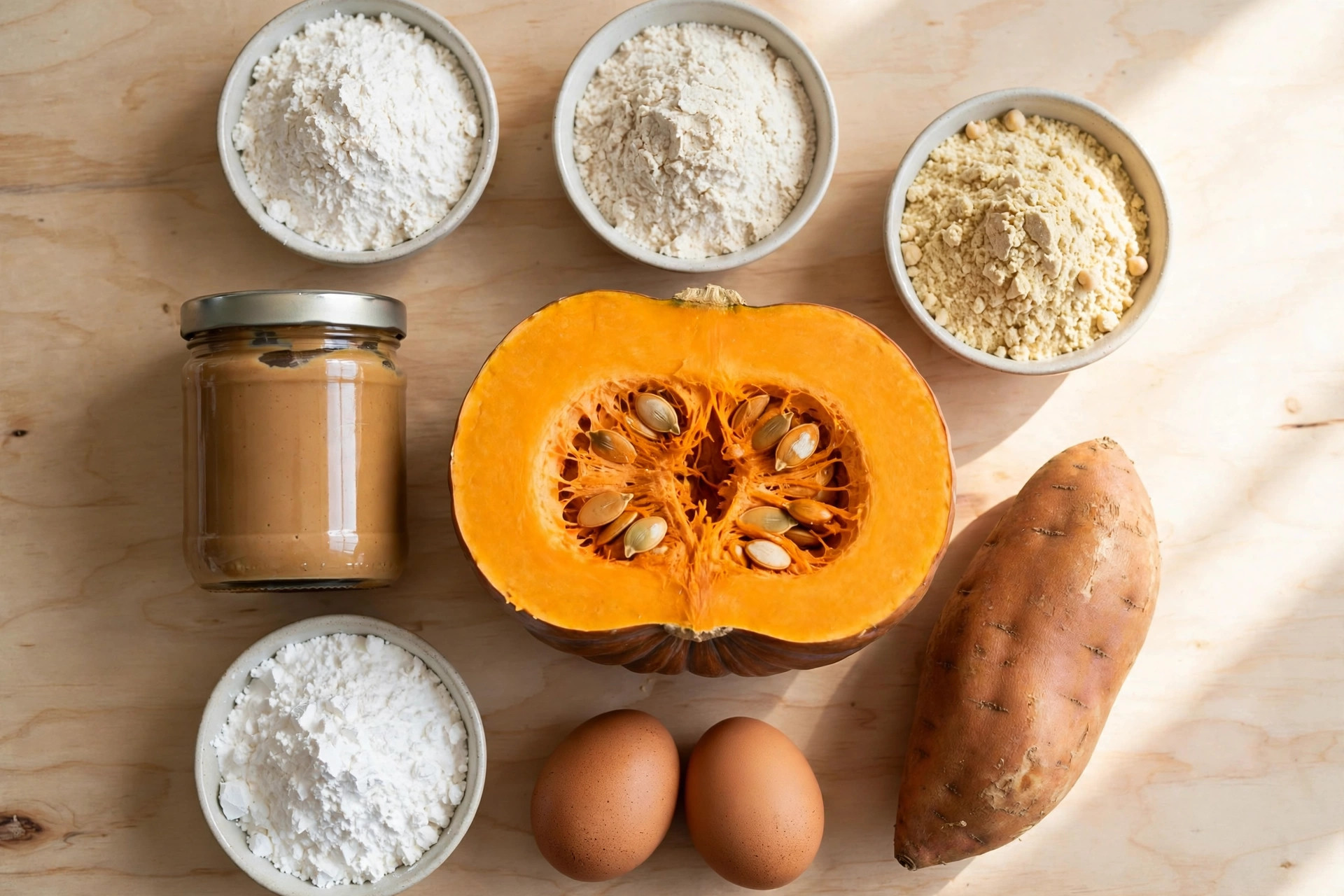
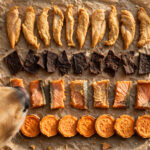
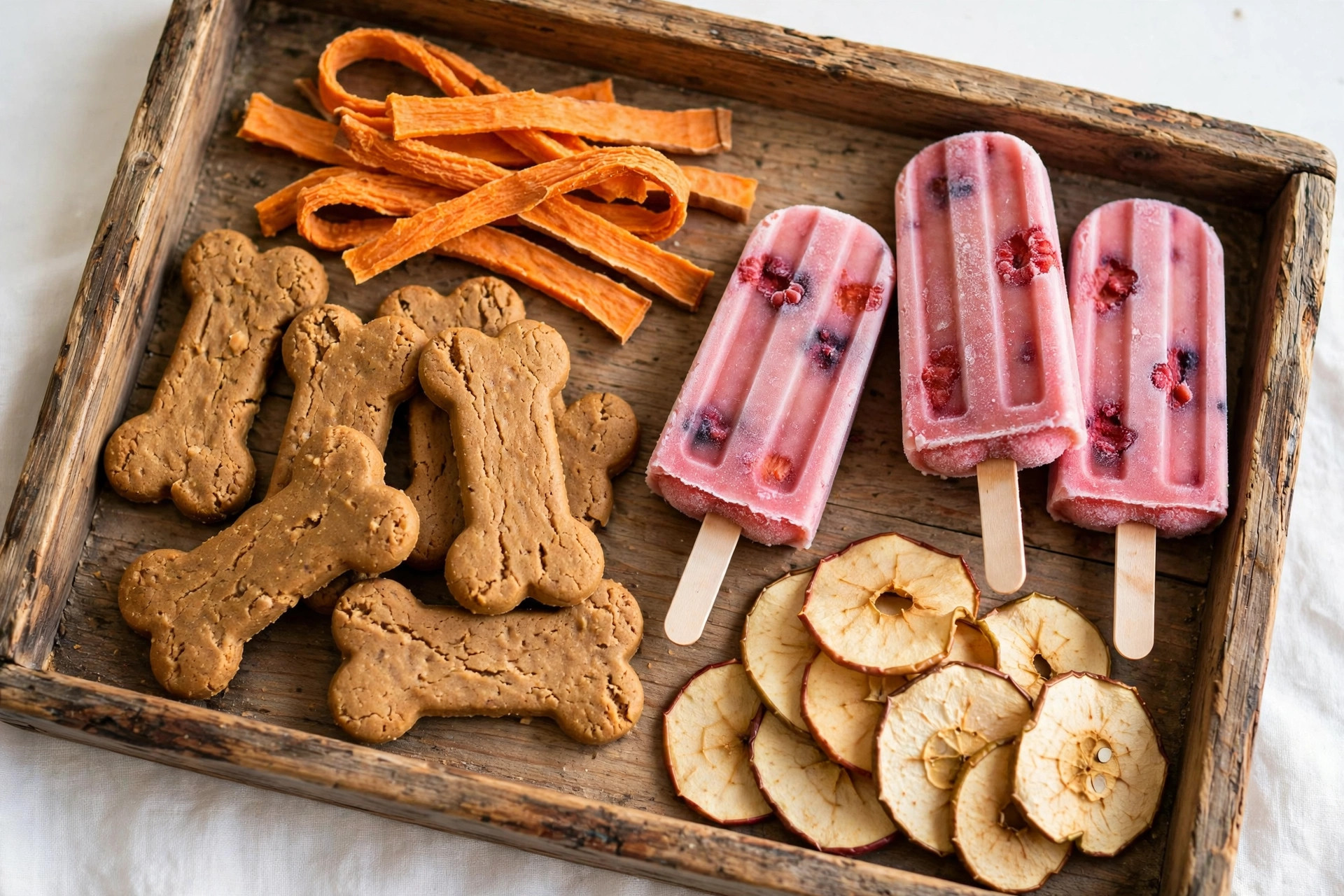
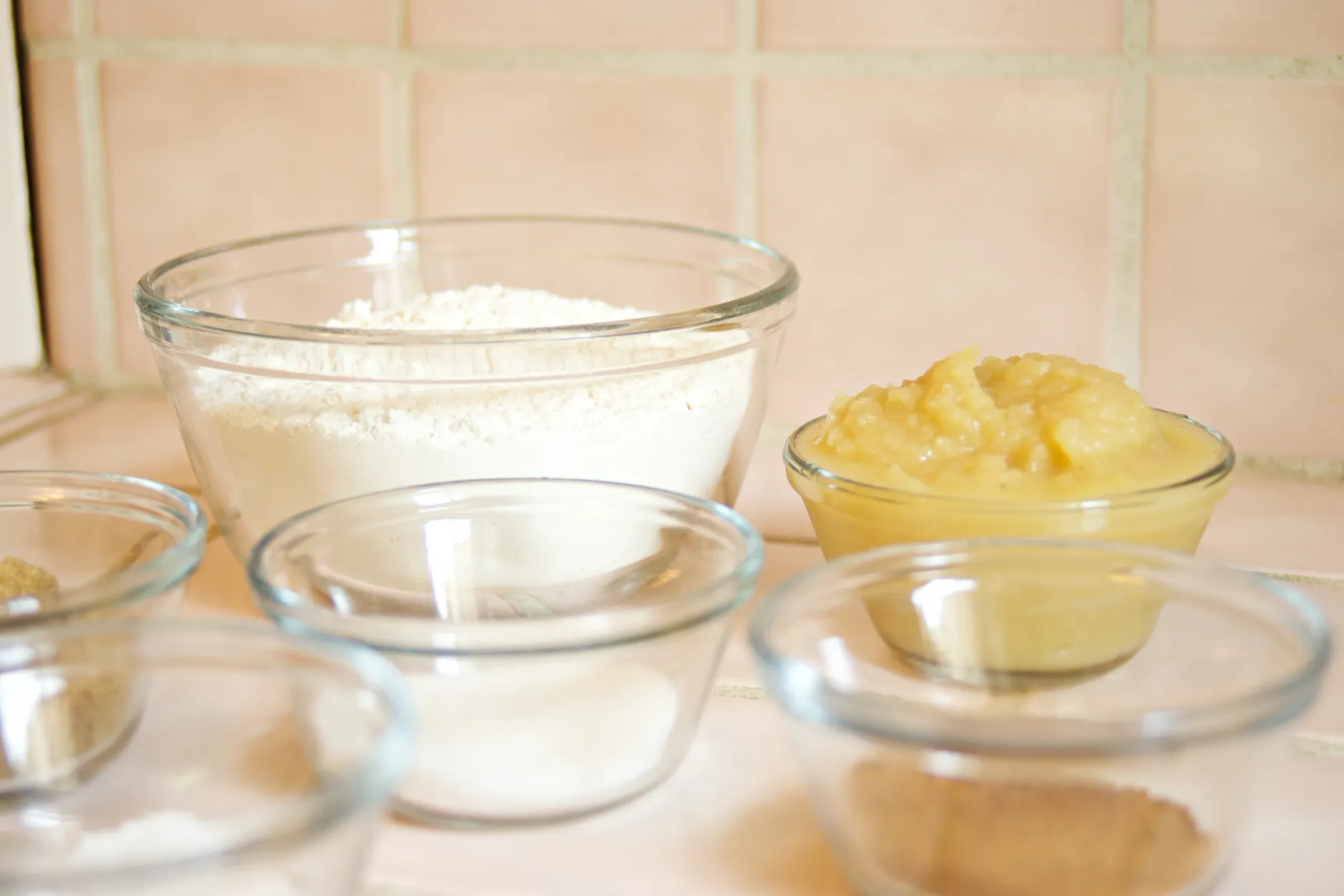
Grain free treat ingredients flatlay.

How to store grain-free treats

\n

Grain-free treats go stale faster than wheat treats, because the flours hold moisture differently. Three rules keep them good:

\n

    \n

  • Cool completely before storing. Warm treats sweat inside a tin, and damp treats grow mould in days. Wait until they are fully cool to the touch.
  • \n

  • Airtight tin, cool cupboard. Baked biscuits keep 1–2 weeks in an airtight tin. Soft chews go in the fridge and keep about a week. Frozen treats stay in the freezer for up to 3 months.
  • \n

  • Freeze in batches. Grain-free doughs freeze beautifully. Make a double batch, bake half, and freeze the other half as dough balls — then bake fresh whenever the tin runs low.
  • \n

\n

Mistakes to avoid

\n

    \n

  • Swapping flours one-for-one. Coconut flour is not a straight swap for wheat flour — use a quarter of the amount and add an extra egg. Chickpea flour is the closest to a one-for-one swap.
  • \n

  • Skipping the rest. Coconut flour doughs need 5 minutes to absorb the liquid. If you bake straight away, the dough is too wet and the biscuits spread.
  • \n

  • Baking almond flour too hot. Almond flour browns fast. Drop the temperature by 10°C and check five minutes early, or the edges burn while the middle is still soft.
  • \n

  • Using pie filling instead of pumpkin purée. Pumpkin pie filling contains nutmeg and other spices dogs should not eat. Plain purée only.
  • \n

  • Forgetting the xylitol check. Every peanut butter and yoghurt label needs checking. Xylitol (also listed as \”birch sugar\”) is extremely toxic to dogs, and it hides in \”sugar-free\” products.
  • \n

  • Going grain-free for the wrong reason. If your dog is healthy on normal treats, grain-free adds nothing. Save it for a vet-suggested trial, a sensitive stomach, or simple variety — not because a bag in the shop told you grains are bad.
  • \n

  • Treating treats as meals. Even the best homemade treat is still a treat. Keep all treats under 10% of your dog’s daily food, and count training treats — forty tiny bites still add up.
  • \n

\n

FAQs

\n

Are grain-free dog treats better than normal treats?\nNot automatically. For most dogs, a normal wheat or oat treat is perfectly healthy. Grain-free treats are better for dogs with a suspected grain sensitivity, a sensitive stomach, or a vet-recommended grain-free trial. For everyone else, they are simply a useful variety.

\n

Can puppies have grain-free treats?\nYes, in small pieces, from about 12 weeks — the soft chews (recipes 2 and 5) are the best starting point because they are gentle on puppy teeth and easy to break into smaller pieces. Introduce one new recipe at a time.

\n

Is coconut flour safe for dogs?\nYes, in treat-sized amounts. Coconut flour is just dried, ground coconut meat. It is high in fibre, so introduce it slowly — a sudden large amount can loosen stools. The amounts in these recipes are modest and spread across a batch.

\n

Is almond flour safe for dogs?\nYes, in small amounts. Almonds are not toxic to dogs, but they are high in fat, so almond-flour treats are best as an occasional recipe rather than an everyday one. Dogs with nut sensitivities should skip recipe 2 and use one of the other five.

\n

What is the difference between grain-free and flour-free treats?\nFlour-free treats contain no flour, but they often use oats, which are a grain. Grain-free treats contain no grains at all — no wheat, oats, rice, corn or barley. Our homemade dog treats without flour guide covers the flour-free side; this guide covers the fully grain-free side.

\n

Can I freeze grain-free treats?\nYes — all six recipes freeze for up to 3 months. Baked biscuits defrost at room temperature in about an hour. The frozen banana chews (recipe 4) are designed to be served frozen. For more freezer-friendly ideas, our homemade freeze-dried dog treats guide covers the other end of the shelf-life spectrum.

\n

My dog has allergies. Are these recipes safe?\nThese recipes avoid grains, but they still contain common allergens — chicken, egg, peanut, almond, dairy. If your dog has a known allergy, check each recipe against it and use the swaps: sunflower seed butter instead of peanut butter, a flax egg (1 tbsp ground flax + 3 tbsp water, rested 5 minutes) instead of egg. For a full allergy plan, our dog probiotics guide and our allergy-food guide explain elimination diets and gut support in detail.

\n

The bottom line

\n

Grain-free treats are not better treats — they are different treats, for a specific job. If your dog needs them, the six recipes above give you a full rotation: soft chews for training, crunchy biscuits for the treat jar, and a frozen no-bake for hot days, all without a single grain. Start with the peanut butter and coconut flour bites tonight — they take fifteen minutes, they use four ingredients, and they will tell you within one batch whether your dog is a grain-free convert.

\n

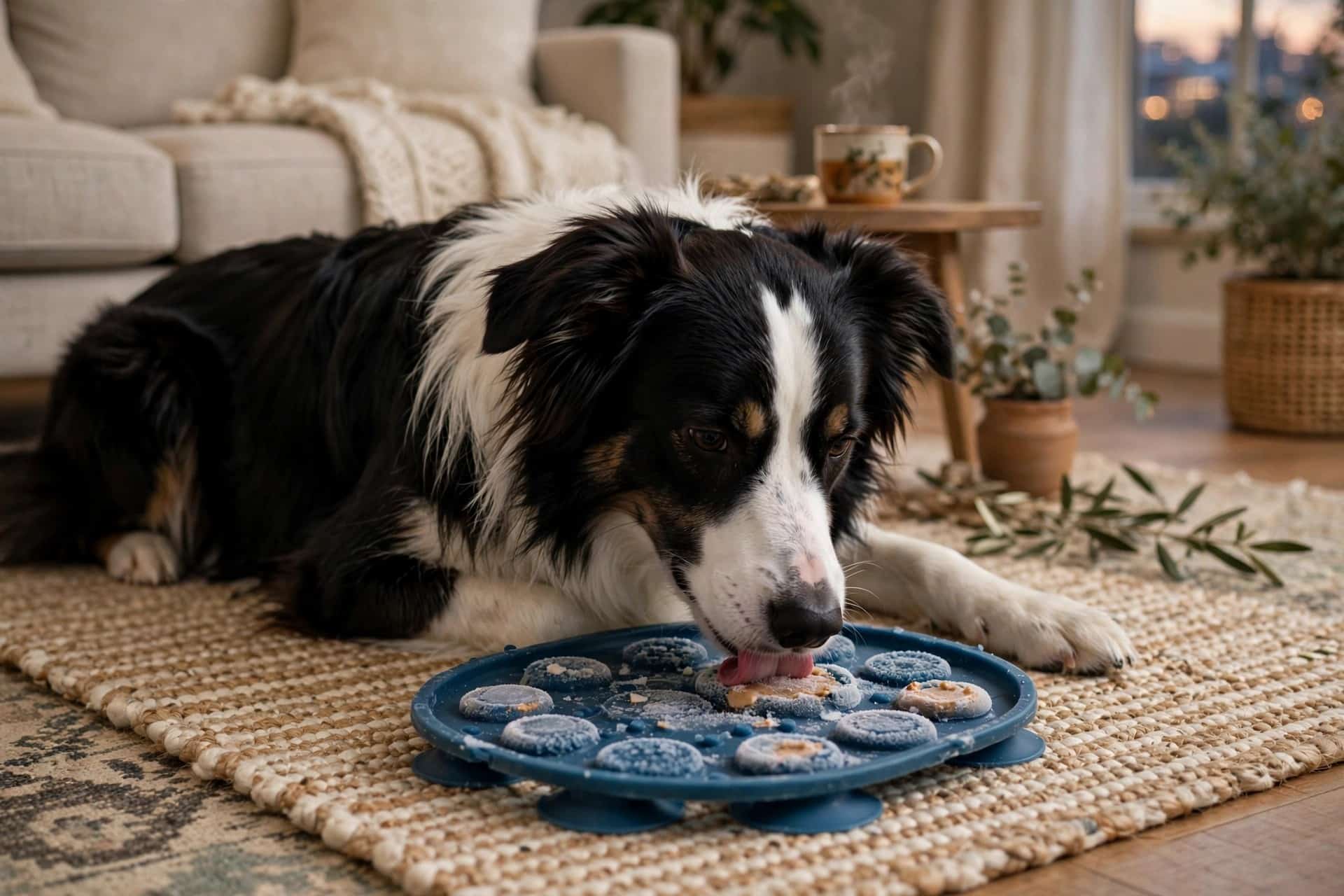
Pin this for later 📌 — and if your dog’s tummy is the reason you went grain-free, our best dog food for sensitive stomachs guide and our lick mat recipes both pair well with a gentler treat routine.

“,
“source_draft”: “/home/hatch/workspace/goals/pinterest-pin-automation-for-petsmush-com/files/homemade-dog-treats-grain-free-post-draft.md”,
“status”: “publish”
}

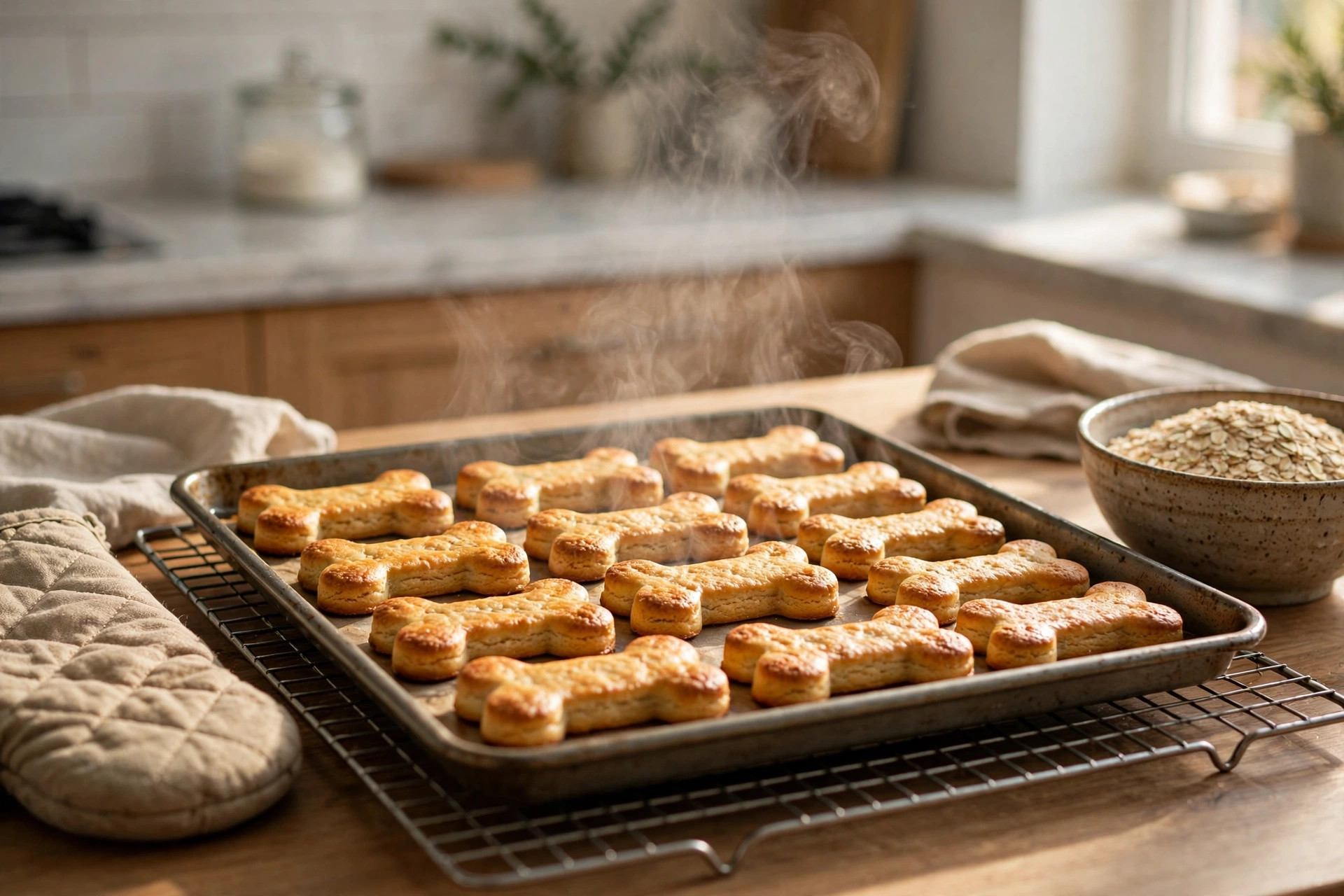
Freshly baked homemade dog biscuits being packed into kraft paper bags on a kitchen table.

Dog Treat Business: How to Start Selling Homemade Dog Treats from Home

{
“title”: “Dog Treat Business: How to Start Selling Homemade Dog Treats from Home”,
“slug”: “dog-treat-business”,
“excerpt”: “How to start a dog treat business from home: pick a niche, perfect 3 recipes, price for profit, sort the legal side, and find your first customers.”,
“meta_description”: “How to start a dog treat business from home: pick a niche, perfect 3 recipes, price for profit, sort the legal side, and find your first customers.”,
“featured_image_alt”: “Freshly baked homemade dog biscuits being packed into kraft paper bags on a kitchen table.”,
“content_html”: “

Every week, someone bakes a tray of dog biscuits, watches their own dog go mad for them, and thinks: I could sell these. It is a good instinct — and it is also a harder business than it looks from the outside. The good news is that a dog treat business is one of the cheapest food businesses to start: you already have the kitchen, the recipes are simple, and your first customers are probably already in your phone contacts. The hard part is not the baking. It is the pricing, the labelling, and the unglamorous work of finding people who will pay, week after week, for something they could technically make themselves.

\n

This guide walks through the whole thing in order: whether it can actually make money, how to pick a niche that sells, the recipes to start with, the legal and labelling side, how to price for a real profit, where to sell, and how to find your first ten customers. No hype, no promises of easy money — just the steps that work.

\n

Baking dog treats home kitchen.

Can a dog treat business actually make money?

\n

Yes — but probably not the way the social media posts suggest. A home dog treat business is a real, modest business, not a passive income machine. Here is what the numbers usually look like.

\n

A bag of 150 grams of homemade biscuits costs roughly £1.50 to £3.00 to make, depending on the ingredients — oats and peanut butter are cheap, freeze-dried meat and novel proteins are not. That same bag sells for £5 to £9 at a farmers’ market or online, depending on your area and how good the branding is. After packaging, labels, market stall fees, and your time, a realistic profit is £2 to £4 per bag. Sell 50 bags a week and you are making £100 to £200 a week before tax — a genuine side income, and a solid foundation to grow from. Sell 10 bags a week and you are covering the cost of your own dog’s treats with a little left over.

\n

The two things that decide whether you make money are volume and repeat customers. One-off buyers at a market are nice; subscribers who order every fortnight are what pay the bills. Everything in this guide is aimed at the second group.

\n

Be honest with yourself about time, too. A batch of biscuits takes about an hour from mixing to bagging, and a market day takes five to six hours including the drive, the stall, and the packing up. If you price your treats without counting your time, you will work very hard for very little. Price them as if your hour is worth something — because it is.

\n

Step 1 — Pick a niche, not a catalogue

\n

The biggest mistake new sellers make is offering twenty different treats. A stall with twenty flavours looks like a shop; a stall with three excellent ones looks like a specialist. Specialists charge more and get remembered. Pick one niche and own it.

\n

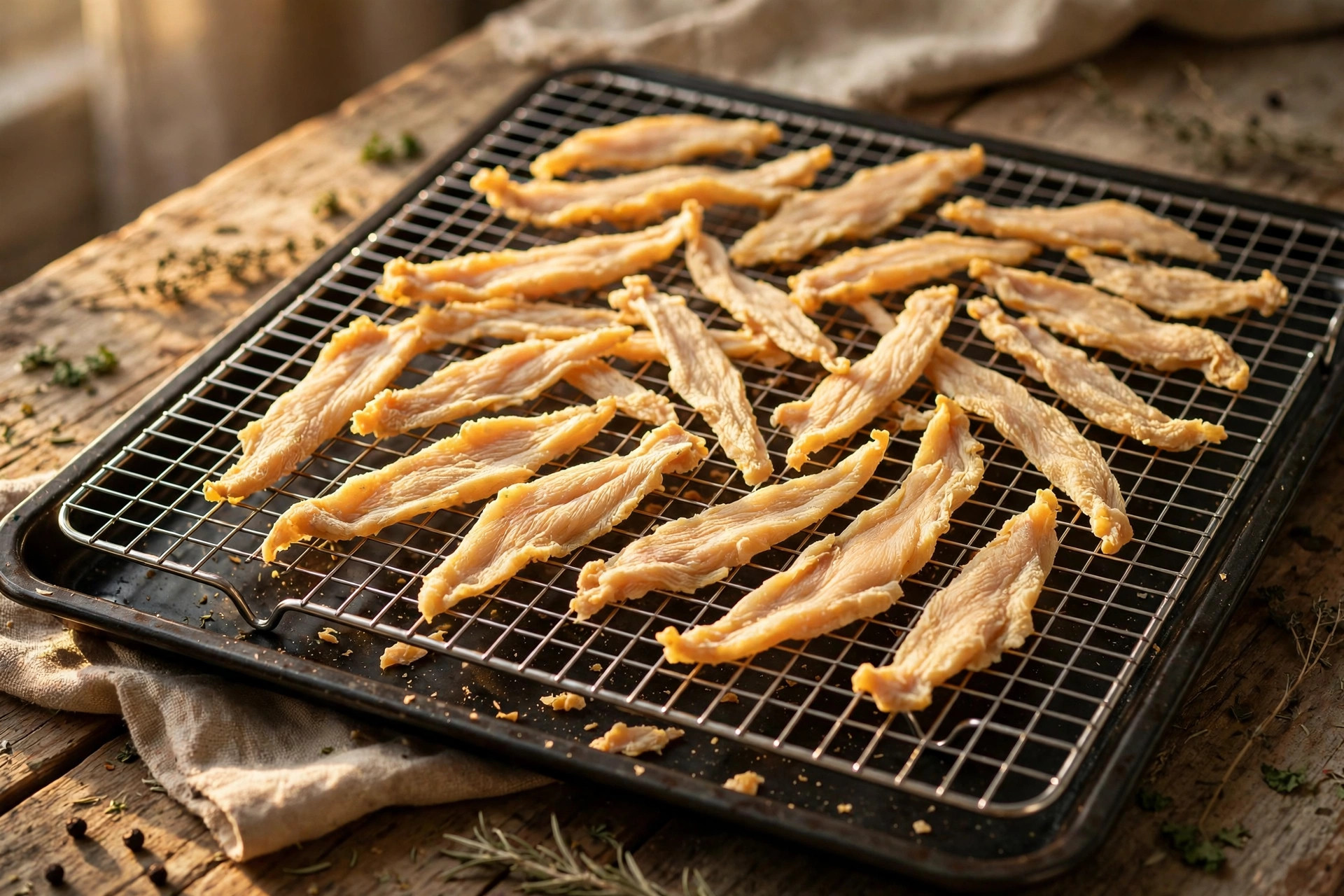
Single-ingredient treats. One protein, nothing else — dried chicken, beef liver, sweet potato. Our single-ingredient dog treats guide explains why owners with allergy-prone dogs love these, and why they are the easiest treats to make honestly. Low ingredient cost, simple labelling, and a clear story.

\n

Allergy-friendly treats. Grain-free, limited-ingredient, or free from the common triggers (wheat, chicken, dairy). This is the niche with the most desperate customers: an owner whose dog reacts to everything will pay well for a treat they trust, and they will tell every other allergy-dog owner they know.

\n

Training treats. Small, soft, smelly, and sold in bulk bags for owners who train daily. Training treats are bought on repeat more than any other kind, because a training owner gets through a bag in a week. The recipes are simple and the margins are good.

\n

Celebration treats. Birthday cakes, gotcha-day boxes, and seasonal gift sets. Higher price per item, lower volume, and very seasonal — but a single birthday cake can sell for the price of six bags of biscuits. Our pumpkin spice dog birthday cake recipe is a good starting point for this niche.

\n

Dental and functional treats. Treats with a job: mint and parsley for breath, crunchy textures for teeth, or calming ingredients for anxious dogs. Our homemade dental treats and dog treats for bad breath guides cover the angles that sell here — but be careful with claims (more on that below).

\n

Pick the niche that matches what you already bake well and what the dogs around you actually need. If half your friends have itchy dogs, allergy-friendly is your niche. If you train your own dog every day, training treats are. Do not pick a niche because it sounds profitable — pick the one you can talk about for an hour without notes.

\n

Step 2 — Perfect three recipes (and test them properly)

\n

Start with three recipes, not ten. Three is enough to look like a real range, and few enough that you can make them all well, every time, in one baking session. Choose recipes that:

\n

    \n

  • Use ingredients you can buy every week, from the same supplier, at a stable price. A recipe that depends on a seasonal ingredient will break your pricing.
  • \n

  • Keep well. A treat that goes stale in three days is a returns problem, not a product. Aim for at least two weeks of shelf life at room temperature, or a product that freezes well. Dehydrated and baked-dry treats last longest; soft, moist treats need a shorter best-before date and a fridge note on the label.
  • \n

  • Survive posting. If you plan to sell online, your treats will be dropped, shaken, and left in a hot van. Pack a test bag, post it to yourself, and see what arrives. Crumbs in the bottom of the bag are normal; a bag of dust is a recipe problem.
  • \n

  • Taste-test with real dogs, not just your own. Give free samples to ten dogs of different sizes and breeds, and ask the owners honestly: did the dog finish it? Did they come back for more? Would they pay for it? Your own dog will eat anything you make. Strangers’ dogs are the real test.
  • \n

\n

Write each recipe down exactly — weights in grams, oven temperature, baking time, cooling time, and storage. The moment you start selling, a recipe is a specification, not a habit. If a batch comes out different, you need to know what changed. Keep a notebook: batch number, date, oven, and any notes. It feels over the top for three bags a week; it is essential when a customer asks why this batch tastes different from the last one.

\n

Good starting points on this site: our 3-ingredient dog treats guide is the simplest possible launch range, our no-bake dog treats guide works well for summer sellers without a big oven, and our homemade freeze-dried dog treats guide covers the longest-shelf-life option of all.

\n

Step 3 — The legal and labelling side (do this before your first sale)

\n

This is the step most people skip, and the one that matters most. Dog treats are pet food, and pet food is regulated — even when it is baked in a home kitchen. The rules vary a lot by country and by state or region, so treat this section as a checklist of things to check locally, not as legal advice.

\n

Register the business. In many places, anyone making and selling pet food must register with their local authority or food standards body first. In the UK, for example, you register with your local council as an animal feed business. In the US, the rules are set state by state — some states have cottage food rules that cover pet treats, others do not, and some require a licensed commercial kitchen. Search for your local rules before you sell a single bag, and keep a note of what you found.

\n

Label every bag properly. At a minimum, a dog treat label should list: the product name, the net weight, the full ingredient list in descending order of weight, feeding guidance (treats are a snack, not a meal), a best-before date, storage instructions, and your business name and contact details. In the EU and UK, you also need to list the analytical constituents (protein, fat, fibre, ash, moisture) — which means getting a lab analysis done for each recipe, usually a one-off cost per recipe. Allergens matter too: if a treat contains wheat, egg, dairy, or peanut, say so clearly.

\n

Be careful with claims. You can say a treat \”supports dental health\” only if you can back it up, and you cannot claim a treat treats or cures any condition. Words like \”calming\”, \”hypoallergenic\”, \”vet approved\”, and \”all-natural\” all carry legal weight in different markets. Keep your claims modest and provable: \”made with three ingredients\”, \”baked in small batches\”, \”no added sugar\”. If in doubt, leave the claim off the label.

\n

Keep a paper trail. For every batch, record the batch number, the date, the supplier and batch of each ingredient, and how many bags you made. If a supplier ever recalls an ingredient, you need to know which of your bags used it. This is also what an inspector will ask to see.

\n

Insurance. A simple product-liability policy for a home food business is usually inexpensive, and it is the one cost you should never skip. If a dog ever gets sick and the owner blames your treats, insurance is the difference between a bad week and a business-ending bill.

\n

Step 4 — Cost it, then price it for a real profit

\n

Most home sellers underprice. They price by guessing what a bag \”feels\” worth, or by copying a competitor, and they forget half their costs. Do it properly, once, in a spreadsheet.

\n

Cost per bag = ingredients + packaging + labels + your time + a share of the fixed costs.

\n

Work out the ingredient cost per bag exactly: weigh what goes into one batch, divide by the number of bags it fills. Add the bag, the label, the sticker, and the twist tie or seal — packaging is usually 30p to 80p a bag, and it surprises people. Add your time at a real hourly rate, even a modest one: if a batch takes an hour and fills 10 bags, that is 6 minutes a bag. Then add a share of the fixed costs — the market stall fee, the website, the insurance — spread across the bags you expect to sell that month.

\n

Then set the price. A common starting point is cost × 2.5 to × 3 for retail, which leaves room for wholesale later (a shop will want 40 to 50% of your retail price). If your cost per bag is £2.50, a £6.50 to £7.50 retail price is about right. If that feels high, do not cut the price — cut the cost. A cheaper recipe, a bigger batch, or a simpler bag will do more for your profit than a lower price ever will.

\n

Do not race to the bottom. There will always be someone selling cheaper biscuits. You are not competing with them. You are competing on trust, on ingredients an owner can pronounce, and on a treat their dog actually finishes. Price like a specialist, not a discounter.

\n

Homemade dog treats packaging labels.

Step 5 — Packaging and branding that earns the price

\n

Owners buy with their eyes first and their dog’s opinion second. Your packaging has to do three jobs: keep the treats fresh, carry the legal label, and look worth the price.

\n

Bags. Kraft paper stand-up pouches with a resealable zip are the standard for a reason: they look homemade, they keep treats crisp, and they cost very little. Clear windows let the treats show through, which sells more than any label. Buy them in bulk once you know your sizes — a hundred bags at a time is usually the price break.

\n

Labels. A simple, clean label beats a busy one. Product name, your business name, ingredients, weight, best-before, and one honest line about what makes it special. Print them at home to start with — a basic label printer pays for itself in a month — and move to printed labels once you are selling steadily.

\n

The small touches that get remembered. A handwritten \”thank you\” card in the first few orders. A free sample of a new flavour tucked into a repeat order. A stamp with your logo instead of an expensive printed bag. None of this costs much, and it is what turns a one-time buyer into someone who tells their dog group about you.

\n

Photography. You do not need a studio. A clean kitchen table, natural light from a window, and your dog eating the treat will outsell a professional shot of a bag on a white background. Take a photo of every batch — you will need the pictures for your shop, your social posts, and your market stall banner.

\n

Dog treats market stall.

Step 6 — Where to sell

\n

You do not need to be everywhere. Pick one channel, get good at it, and add a second only when the first is working.

\n

Farmers’ markets and dog events. The best first channel. You meet the dogs, you watch them eat the treat in front of you, and you get honest feedback in real time. A stall costs £20 to £60 a day depending on the market, and a good market day can sell 40 to 80 bags. Bring samples — a dog that tastes the treat sells it for you.

\n

Online — your own shop or a marketplace. Etsy and similar marketplaces bring the customers to you, but they take a cut and you compete with thousands of sellers. Your own simple shop (a basic website with an order form is enough to start) keeps the full price but needs you to drive the traffic yourself. Either way, posting treats needs sturdy packaging and a shelf life that survives the post — dehydrated and baked-dry treats travel best.

\n

Local pet shops and vets. A small pet shop will often take a few bags on consignment or wholesale if you ask nicely and leave samples. Wholesale means you earn less per bag — remember the 40 to 50% rule — but a shop that reorders every month is steadier than a market. Vets and groomers are good for referral, not for selling: leave a sample tub and a card, not a sales pitch.

\n

Subscription and repeat orders. The goal is not one sale; it is a customer who orders every fortnight. Offer a simple subscription — same bag, same day, every two weeks, with a small discount for committing. Even ten subscribers at £7 a fortnight is £140 a month you can count on, and it is the steadiest income a treat business has.

\n

Seasonal lines. Christmas, Easter, and Halloween are the biggest treat-selling weeks of the year. A small seasonal range — gift boxes, advent treats, birthday sets — can earn in a month what a normal month earns in three. Plan them eight weeks ahead, not the week before.

\n

Weighing dog treat ingredients.

Step 7 — Finding your first ten customers

\n

Your first ten customers are the hardest, and they are also the most important — because they are the ones who will tell the next fifty. Here is how to find them without spending money on ads.

\n

    \n

  • Give samples to people you know. Ten free bags to ten dog owners you know, with one ask: tell me honestly what your dog thought, and tell one other dog owner if they liked it. Word of mouth is the whole marketing plan at this stage.
  • \n

  • Post the baking, not the selling. A short video of biscuits coming out of the oven, a photo of your dog taste-testing, a picture of the first market stall — these get shared. A post that just says \”buy my treats\” does not.
  • \n

  • Join local dog groups. Not to sell — to be useful. Answer a question about treats, share a recipe, help someone whose dog will not eat. When people trust you, they buy from you. When you only ever post adverts, they mute you.
  • \n

  • Ask for one review per customer. A review with a photo of the dog eating the treat is worth ten reviews without one. Put the best ones on your shop page and your stall.
  • \n

  • Follow up once. A short message a week after a first order — \”How did Biscuit like them?\” — is the difference between a one-time buyer and a repeat customer. Do not chase people who do not reply.
  • \n

\n

Mistakes to avoid

\n

    \n

  • Selling before the recipes are tested. A bad first batch does more damage than a late launch. Test first, sell second.
  • \n

  • Pricing without counting your time. If your hour is free, your business is a hobby. Hobbies are fine — just do not call them a business.
  • \n

  • Copying a competitor’s label. Your label is your legal responsibility. Write your own, check it against your local rules, and keep it honest.
  • \n

  • Making treats with unsafe ingredients. Chocolate, xylitol, grapes, raisins, onions, garlic, macadamia nuts, and cooked bones never belong in a dog treat — and xylitol hides in some peanut butters, so check the label every time. Our natural dog treats guide explains how to keep a treat range genuinely clean.
  • \n

  • Over-promising on shelf life. A soft treat that goes mouldy in a customer’s cupboard will end the relationship. Be conservative with your best-before dates and honest about storage.
  • \n

  • Growing too fast. Ten happy customers are better than a hundred rushed ones. Grow when the baking, the labelling, and the posting all still work — not before.
  • \n

\n

FAQs

\n

How much money do I need to start a dog treat business?\nVery little — usually under £100 to £200 for your first batch of bags, labels, and ingredients, plus the cost of registering the business and a basic insurance policy if your area requires them. Most people start with the oven and mixer they already own. The real cost is your time, not your money.

\n

Do I need a licence to sell dog treats from home?\nIt depends where you live. Many places require you to register as a pet food business with your local authority before you sell, and some require a licensed kitchen or an inspection. Check your local food standards or agriculture department rules before your first sale — the rules are usually simple, but they are not optional.

\n

How long do homemade dog treats last?\nBaked-dry treats keep for two to four weeks in a sealed bag at room temperature; soft, moist treats keep for three to five days in the fridge; dehydrated and freeze-dried treats can last two to three months. Always put a best-before date on the bag, and be conservative — a treat that goes stale early costs you a customer.

\n

What is the most profitable dog treat to sell?\nTraining treats and single-ingredient treats usually have the best margins: cheap ingredients, simple recipes, and customers who buy on repeat. Celebration cakes have the highest price per item but the lowest volume. The most profitable treat is the one you can make well, in batches, with ingredients you can buy reliably.

\n

Can I sell dog treats on Etsy or at a farmers’ market?\nYes, both are common first channels — but check the rules first. Marketplaces have their own policies for pet food, and some markets require proof of registration or insurance before they will give you a stall. Ask the market organiser what they need before you book.

\n

Should I offer subscriptions?\nYes, as soon as you have a few repeat customers. A simple fortnightly subscription — same bag, same day, small discount — is the steadiest income a treat business has, and it turns your baking into a predictable routine instead of a weekly scramble for orders.

\n

Do I need to get my treats lab tested?\nIn some markets, yes — the EU and UK require analytical constituents (protein, fat, fibre, ash, moisture) on the label, which means a lab analysis per recipe. In other markets, a full analysis is not required for small sellers. Check your local rules; if an analysis is needed, it is usually a one-off cost per recipe, not per batch.

\n

The bottom line

\n

A dog treat business starts with three good recipes, a niche you can talk about, and a price that pays for your time. Register the business, label every bag properly, cost every batch honestly, and sell where you can watch dogs eat your treats in front of you. Your first ten customers will come from people you know and dogs who loved the sample — and if you look after those ten, they will bring the next fifty. Start small, start legal, and let the treats do the talking.

\n

Pin this for later 📌 — and if you want the recipes to build your range from, our 3-ingredient dog treats guide is the fastest place to start, and our single-ingredient dog treats guide is the niche most new sellers begin with.

“,
“source_draft”: “/home/hatch/workspace/goals/pinterest-pin-automation-for-petsmush-com/files/dog-treat-business-post-draft.md”,
“status”: “publish”
}
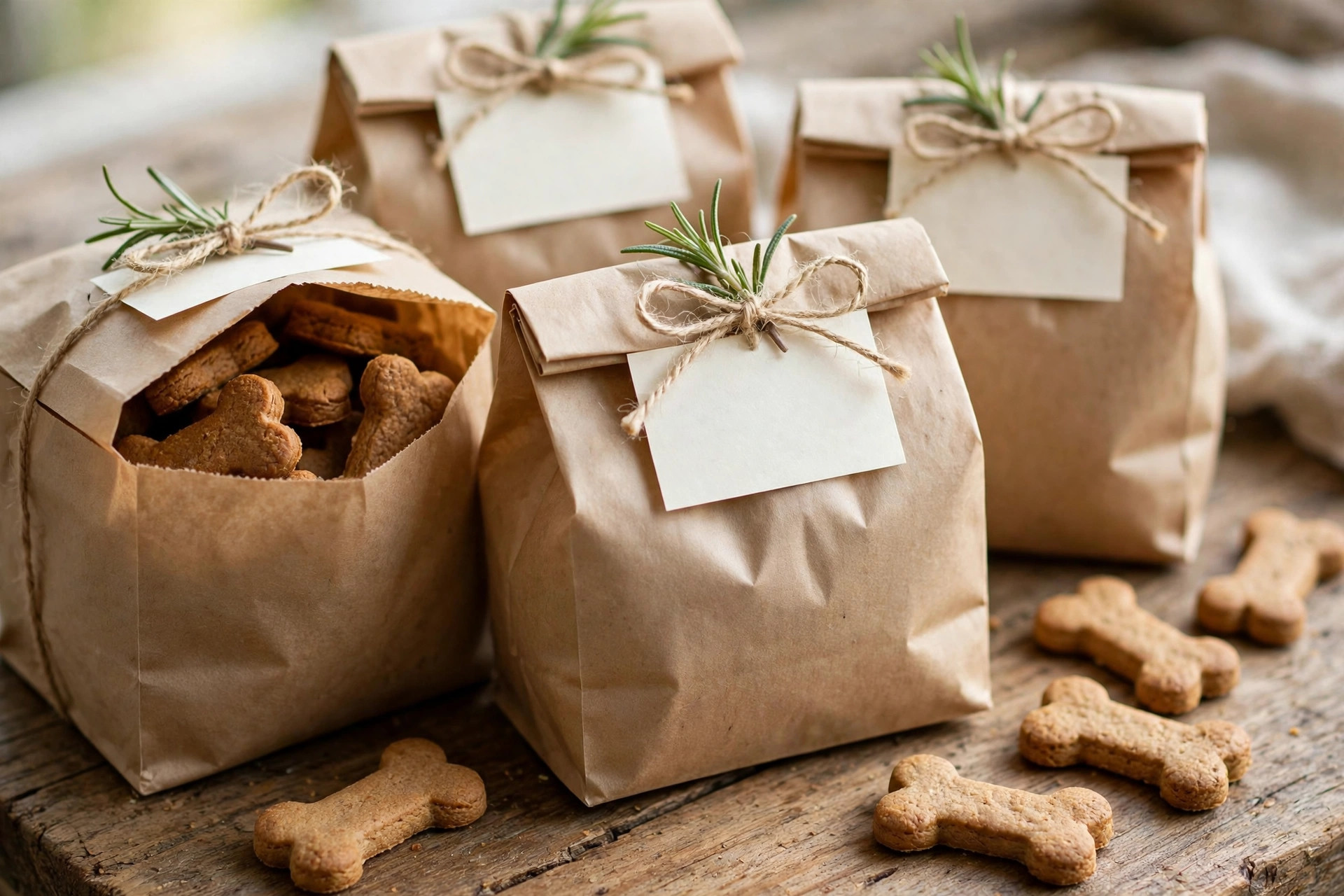
A golden retriever puppy sitting attentively while its owner holds a small homemade training treat.

Dog Training Treats Recipe: 6 Easy Recipes Your Dog Will Work For

{
“title”: “Dog Training Treats Recipe: 6 Easy Recipes Your Dog Will Work For”,
“slug”: “dog-training-treats-recipe”,
“excerpt”: “The best dog training treats are small, soft and smelly — 6 easy homemade recipes, the 3 rules of a good training treat, and how many to use per session.”,
“meta_description”: “The best dog training treats are small, soft and smelly — 6 easy homemade recipes, the 3 rules of a good training treat, and how many to use per session.”,
“featured_image_alt”: “A golden retriever puppy sitting attentively while its owner holds a small homemade training treat.”,
“content_html”: “

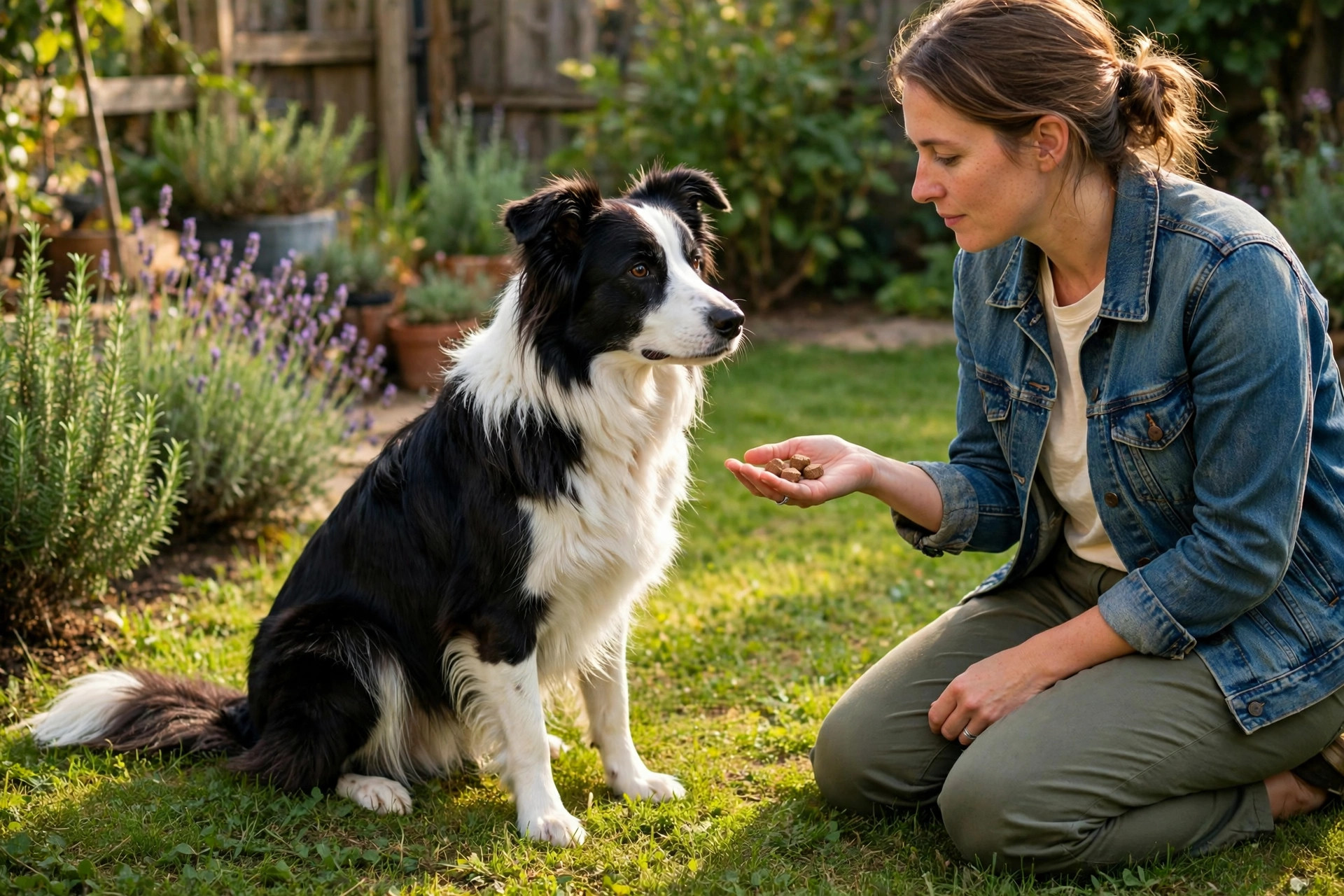
Every dog trainer will tell you the same thing: the treat is the paycheque. Get it right and your dog will happily repeat a behaviour a hundred times. Get it wrong — too big, too hard, too boring — and your training sessions stall, your dog loses interest, and you end up with a pocket full of crumbs and a dog who has wandered off to sniff the fence.

\n

The good news is that the best training treats are not the expensive ones in the pet shop. They are small, soft, smelly, and cheap to make at home — and the recipes below take under half an hour each. This guide covers what makes a treat work for training, six recipes your dog will actually work for, how to use them in a session without overfeeding, and the mistakes that turn a good training treat into a bad one.

\n

Making dog training treats.

What makes a good training treat

\n

A training treat is not a chew, a biscuit, or a meal. It is a tiny, instant reward, and it has to pass three tests.

\n

Small. A training treat should be about the size of a pea — no bigger than your little fingernail. Your dog needs to swallow it in a second and be ready for the next repetition. A treat that takes ten seconds to chew breaks the rhythm of the session, and a large treat means your dog is full after a dozen repetitions. If you can cut a normal biscuit into four pieces, you have four training treats.

\n

Soft. Hard, crunchy biscuits slow a dog down. A good training treat is soft enough to be swallowed almost without chewing: cooked chicken, soft baked bites, cheese, or anything with a moist, bendable texture. Soft treats also work for puppies, older dogs with worn teeth, and any dog who gets distracted by the sound of their own crunching.

\n

Smelly. Dogs choose with their noses first. A treat that smells strongly — liver, tuna, cheese, peanut butter, bacon — is worth far more to a dog than a plain biscuit, especially outside where there are competing smells. This is why the highest-value treats in this guide use fish, liver, and cheese: the smell alone keeps your dog’s attention on you.

\n

If a treat passes all three tests, it will work for training. If it fails even one, save it for another time — a crunchy biscuit is fine as an occasional snack, but it is a poor training tool.

\n

The treat hierarchy: low, medium and high value

\n

Not every behaviour deserves the same pay. Smart trainers use a hierarchy, and it saves you money and keeps your dog keen.

\n

Low value treats are your everyday currency: pieces of your dog’s normal kibble, or plain baked oat bites. Use them for easy, well-known behaviours at home, where your dog is calm and there is nothing competing for their attention.

\n

Medium value treats are for new behaviours and mild distractions: soft chicken bites, cheese cubes, or the peanut butter and banana chews below. Use them when you are teaching something new, or when you are training in the garden rather than the kitchen.

\n

High value treats are the big guns: liver brownies, tuna treats, anything with a strong smell. Use them for the hard stuff — recall outside, training around other dogs, or the first week of a brand-new behaviour. High-value treats are also the ones to keep in your pocket on walks, for the moments that really matter.

\n

Rotate the levels. If you pay with high-value treats for every single repetition, they stop being special — and you will have nothing left to offer when you really need your dog’s attention. If you only ever use kibble, your dog will check out the moment something more interesting appears. The hierarchy keeps every treat working.

\n

How many treats can I use in a session?

\n

This is the question every owner asks, and the answer is simpler than most people expect: treats should make up no more than 10% of your dog’s daily calories. For a medium dog eating 400 grams of food a day, that is roughly 40 grams of treats — which sounds like a lot until you realise a single large shop-bought biscuit can weigh 15 grams on its own.

\n

The trick is to keep treats tiny. A ten-minute training session with 30 repetitions should use about 30 pea-sized treats — roughly 15 to 20 grams of soft baked treats, or a few slices of cooked chicken cut small. Count them into a pouch before you start, and when the pouch is empty, the session is over. That rule alone stops most overfeeding.

\n

If your dog is on a weight-loss plan, or has a sensitive stomach, cut the day’s meals back slightly on training days, or use part of the daily food allowance as the low-value treats. Our best dog food for sensitive stomachs guide covers how to keep a sensitive dog’s diet steady when treats are part of the routine.

\n

Chicken oat training bites.

Recipe 1 — Chicken and oat training bites

\n

This is the workhorse recipe: the one to make in a big batch on Sunday and use all week. The chicken makes it smelly enough for medium-value work, the oats hold it together, and it stays soft for days.

\n

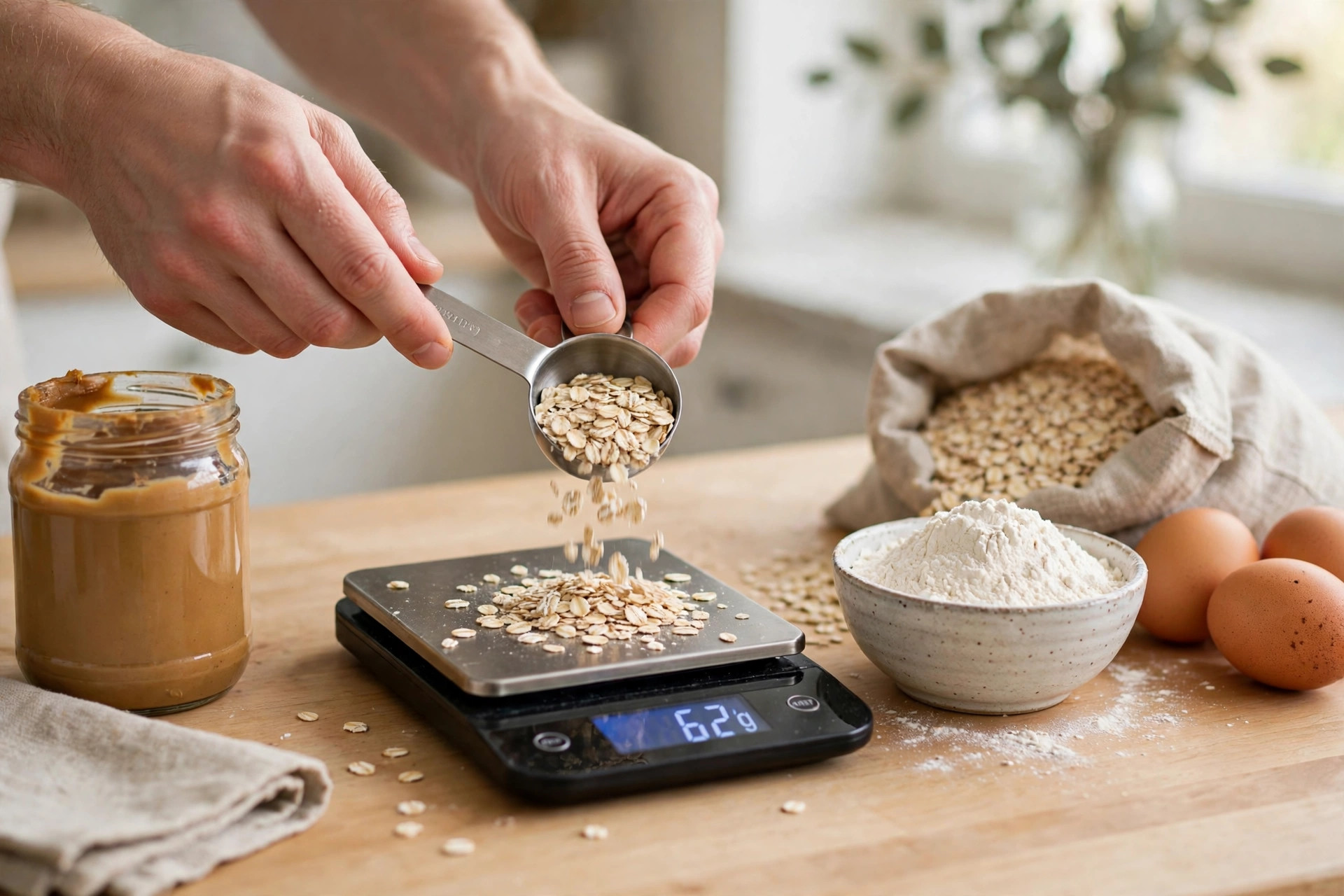
Ingredients: 200 g cooked chicken breast (or thigh, skin removed), 100 g rolled oats, 1 egg, 1 tablespoon plain yoghurt.

\n

Method: Preheat the oven to 180°C. Blitz the oats in a food processor until they look like coarse flour. Add the chicken and egg, and blend until you have a thick, sticky dough — add the yoghurt a spoon at a time if it looks dry. Press the dough into a lined baking tray about 1 cm thick. Bake for 18 to 20 minutes, until firm at the edges but still soft in the middle. Cool, then cut into pea-sized squares.

\n

Storage: 5 days in the fridge in a sealed tub, or 3 months in the freezer. Cut before freezing, so you can grab a handful straight from the bag.

\n

Why it works: chicken is the most reliable training smell there is, and the oat base keeps the calorie count low — about 4 calories a bite. Use these for everyday training at home and in the garden.

\n

Recipe 2 — Peanut butter and banana soft chews

\n

For dogs who go mad for peanut butter, this is the recipe. The banana keeps them soft and sweet-smelling, and the dough is soft enough to pinch into pieces by hand — no knife needed.

\n

Ingredients: 1 ripe banana, mashed, 3 tablespoons peanut butter (xylitol-free — check the label every time), 120 g oat flour, 1 egg.

\n

Method: Mash the banana in a bowl, stir in the peanut butter and egg, then fold in the oat flour until you have a soft dough. Roll into a log about 2 cm thick, then slice into pea-sized rounds. Bake at 170°C for 12 to 14 minutes — they should be set on the outside and soft inside. Cool completely before using.

\n

Storage: 4 days in the fridge, or freeze in small bags for up to 2 months.

\n

Why it works: the peanut butter smell carries well outdoors, which makes these a good medium-to-high-value treat for garden training. If your dog has never had peanut butter before, offer a tiny piece first and watch for any reaction. For more peanut butter ideas, our homemade peanut butter oat dog treats guide has a firmer, longer-lasting version.

\n

Tuna training treats tray.

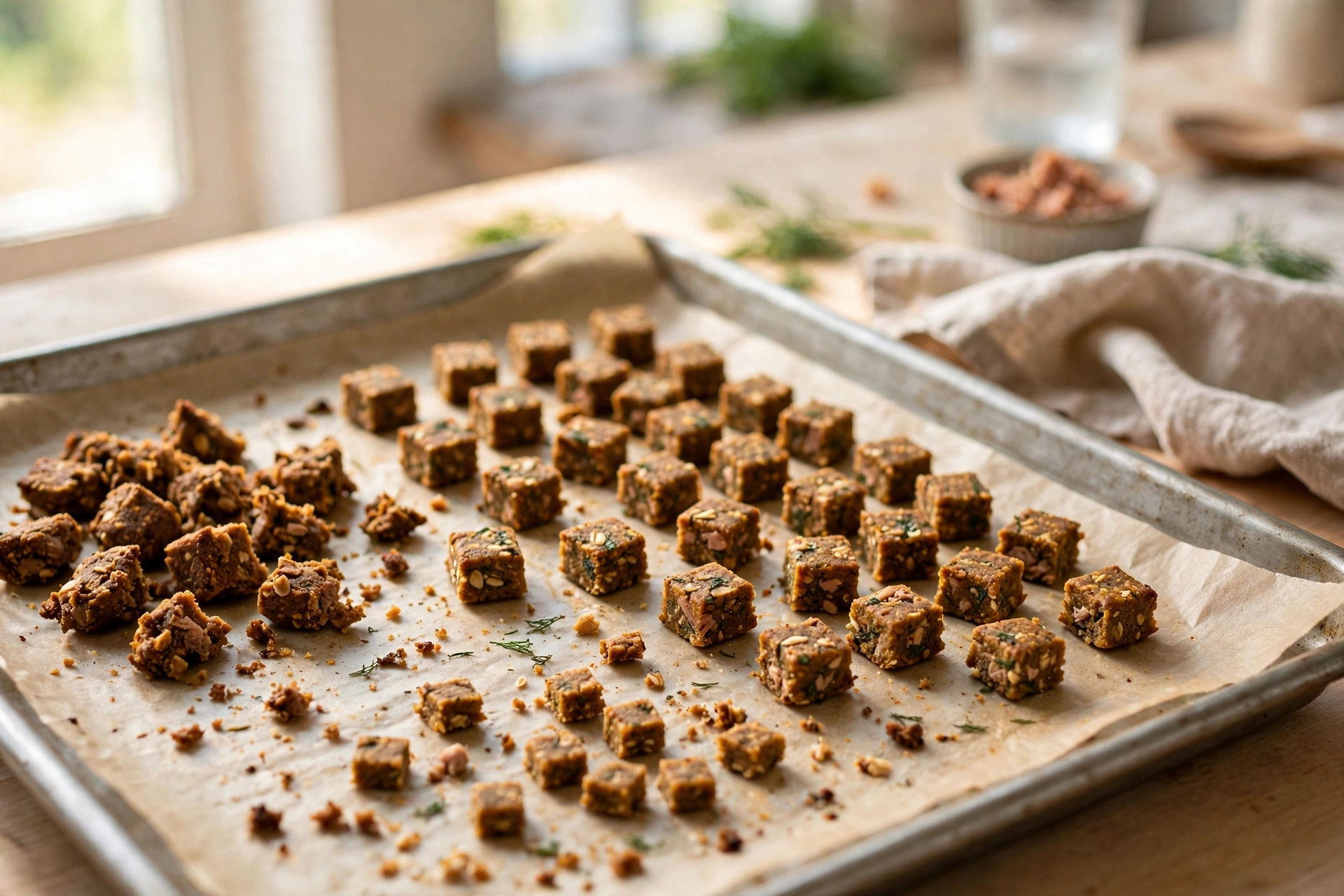
Recipe 3 — Tuna training treats

\n

Tuna is the secret weapon of trainers who work with distracted dogs. The smell is so strong that most dogs will ignore a squirrel for a piece of tuna. These bake into a firm, sliceable slab that cuts into hundreds of tiny treats.

\n

Ingredients: 1 tin of tuna in spring water (drained), 1 egg, 60 g plain flour, 1 tablespoon grated carrot.

\n

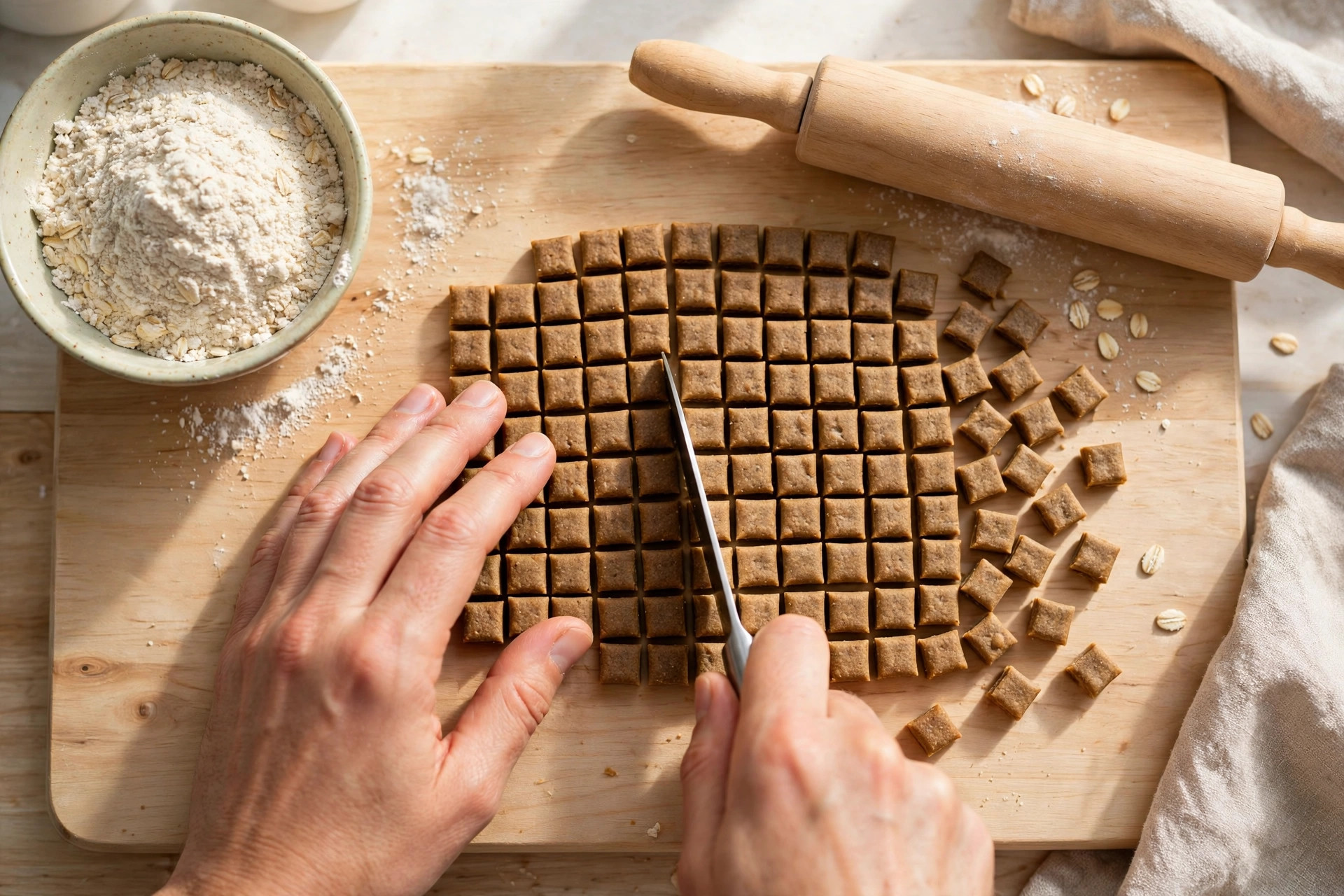
Method: Preheat the oven to 180°C. Blend the tuna, egg, flour and carrot into a smooth paste. Spread thinly — about 5 mm — on a lined baking tray. Bake for 15 minutes, until the edges are golden and the centre is firm. Cool, then cut into pea-sized squares with a pizza cutter.

\n

Storage: 3 days in the fridge, or freeze flat in bags for up to 2 months. These are best used within a day or two of baking, while the smell is strongest.

\n

Why it works: tuna is high value, full stop. Use these for recall training, training around other dogs, and any session where you need your dog’s full attention. A little goes a long way — you will not need many.

\n

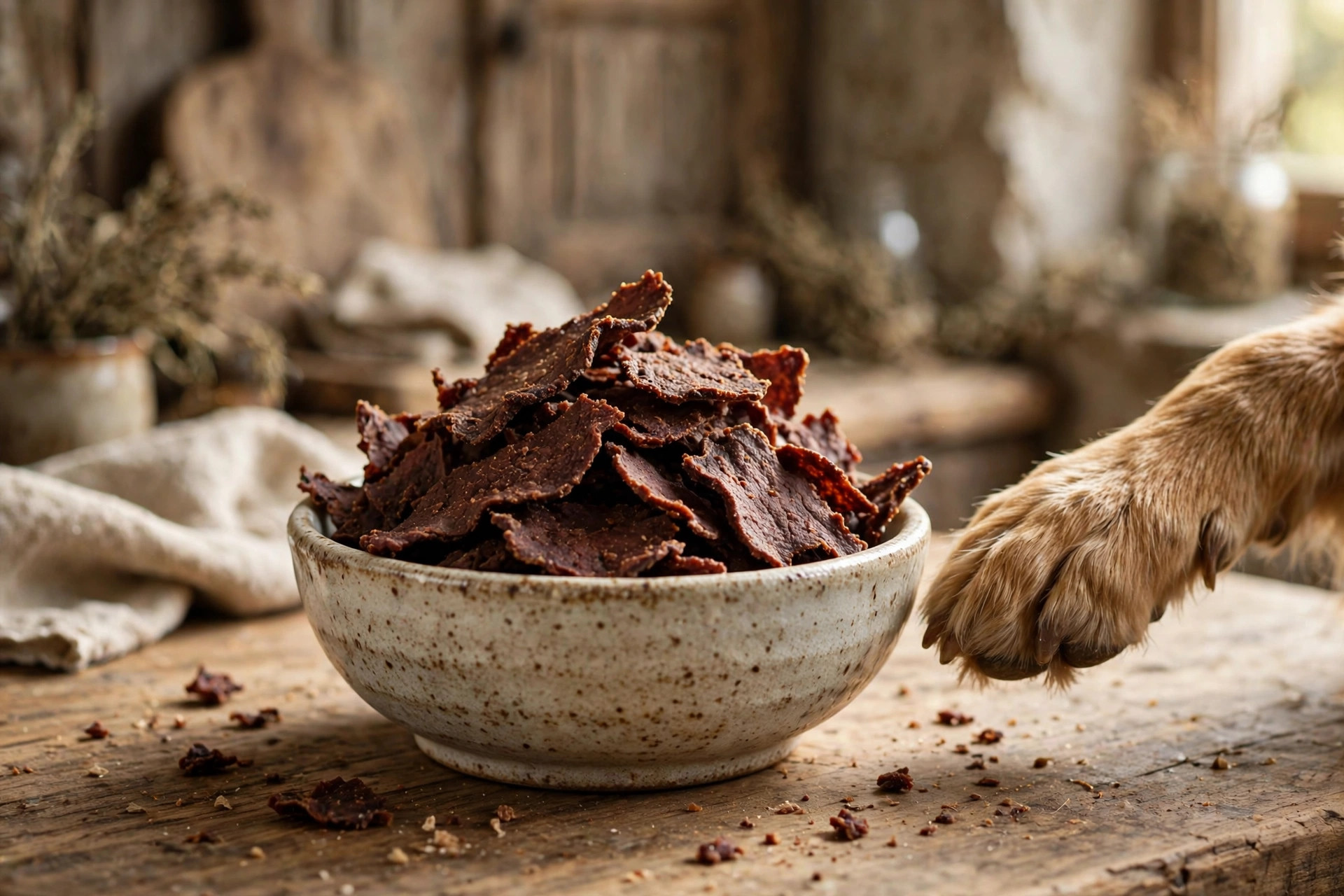
Recipe 4 — Liver brownies

\n

Ask a trainer what their highest-value treat is and most will say liver. These brownies are dense, dark, and smellier than anything else in this guide — and dogs will do almost anything for them. The name is a joke; there is no chocolate in them, and there never should be.

\n

Ingredients: 250 g chicken livers, 1 egg, 60 g oat flour, 1 tablespoon parsley (optional, for the smell).

\n

Method: Preheat the oven to 180°C. Blend the livers and egg into a smooth liquid, then stir in the oat flour. Pour into a lined tray, about 1 cm thick. Bake for 20 minutes, until set. Cool, then cut into pea-sized cubes. They will feel soft and slightly sticky — that is exactly right.

\n

Storage: 4 days in the fridge, or freeze in small portions for up to 3 months.

\n

Why it works: liver is the highest-value treat most dogs ever meet, which makes these perfect for the hardest training jobs — recall from a distance, settling around visitors, and the first week of any new behaviour. Use them sparingly, because rich food in large amounts can upset a sensitive stomach.

\n

Recipe 5 — Pumpkin and carrot soft bites

\n

The gentle option: the one for puppies, older dogs, and any dog with a delicate stomach. Pumpkin is famously kind to digestion, and the carrot adds a little sweetness without any strong smell — so these sit at the low-to-medium end of the hierarchy.

\n

Ingredients: 120 g pumpkin purée (plain, not pie filling), 1 grated carrot, 100 g oat flour, 1 egg, 1 teaspoon ground flaxseed (optional).

\n

Method: Mix the pumpkin, carrot, egg and flaxseed in a bowl, then stir in the oat flour until you have a soft dough. Roll into small balls the size of a pea, flatten slightly, and bake at 175°C for 15 minutes. They should be soft and bendable when cool.

\n

Storage: 5 days in the fridge, or 2 months in the freezer.

\n

Why it works: these are the training treats you reach for with a new puppy, a dog with a sensitive stomach, or a long session where you will use a lot of treats. They are low in fat and easy to digest, so you can afford to be generous with them. If you are working with a young puppy, our puppy training first 12 weeks guide covers which behaviours to teach first — and these bites are gentle enough to use from the very first session.

\n

Dog training session treats.

Recipe 6 — Cheese and sweet potato training squares

\n

Cheese is the other great training smell, and sweet potato gives these squares a soft, chewy texture that holds together in a pocket without crumbling. They are the best all-rounder in this guide: medium value, easy to make, and popular with almost every dog.

\n

Ingredients: 100 g cooked sweet potato, mashed, 80 g grated cheddar, 100 g oat flour, 1 egg.

\n

Method: Mash the sweet potato, stir in the cheese and egg, then fold in the oat flour. Press into a lined tray about 1 cm thick and bake at 180°C for 16 to 18 minutes, until the edges are lightly golden. Cool, then cut into pea-sized squares.

\n

Storage: 4 days in the fridge, or 2 months in the freezer. Bring them to room temperature before training — cold cheese is less smelly.

\n

Why it works: cheese and sweet potato together hit the sweet spot between smell and softness, and the squares hold their shape in a treat pouch without turning to crumbs. If your dog is a cheese fan, our cheesy bacon dog training rewards recipe is another good one to try — it uses the same cheese base with a bacon twist.

\n

How to use treats in a training session

\n

The recipes are only half the job. How you deliver the treat matters as much as what is in it.

\n

Time it right. Reward within one second of the behaviour you want. If your dog sits and you fumble in your pocket for five seconds, you have rewarded whatever they did five seconds later — probably standing up again. Keep the treats in a pouch on your hip, not in a sealed bag in your pocket.

\n

Mark it, then pay it. Use a marker word (\”yes\”) or a clicker the instant the behaviour happens, then follow with the treat. The marker tells the dog exactly which moment earned the pay, and it buys you the second you need to reach for the treat.

\n

Fade the treats gradually. Treats are a teaching tool, not a permanent wage. Once your dog knows a behaviour well, start rewarding every second or third repetition, then every fifth, then randomly. If you pay every time forever, the behaviour stops when the treats stop. A random reward schedule is actually stronger than a constant one — it is the same reason a slot machine keeps people playing.

\n

End on a win. Always finish a session with something your dog can do easily, and pay well for it. The last repetition is the one they remember.

\n

What to avoid in training treats

\n

    \n

  • Chocolate, xylitol, grapes, raisins, onions and garlic. All are toxic to dogs, and xylitol hides in some peanut butters and sugar-free products — always read the label. Our single-ingredient dog treats guide explains how to read treat labels properly.
  • \n

  • Cooked bones and hard chews. They are a choking risk and far too slow for training.
  • \n

  • Treats bigger than a pea. If it takes more than a second to eat, it is too big. Cut it in half — then in half again.
  • \n

  • Shop-bought treats with a long ingredient list. If you cannot pronounce half the ingredients, your dog probably should not be eating them.
  • \n

  • Overfeeding. Treats are part of the day’s food, not extra. Count them, use the pouch rule, and cut the next meal back if a session was long.
  • \n

  • Training on a full stomach. A dog who has just eaten has no reason to work for food. Train before meals, not after them — a slightly hungry dog is a motivated dog.
  • \n

\n

Storage and batch prep

\n

Training treats are a weekly habit, not a daily chore. Make one batch on a Sunday, cut it into pea-sized pieces, and freeze it in small bags of about 30 treats each. Take one bag out the night before a training day and keep it in the fridge. A frozen bag is ready in an hour, and you never have to bake mid-week.

\n

Keep three bags in rotation: one low-value (pumpkin bites), one medium (chicken and oat), and one high-value (tuna or liver). That way you always have the right pay for the job, and your dog never knows which pocket holds the good stuff — which keeps them guessing, and guessing keeps them watching you.

\n

Label every bag with the recipe and the date. Frozen treats keep for two to three months, but a bag that has been in the freezer since spring is a bag you should throw away.

\n

FAQs

\n

How small should a training treat be?\nAbout the size of a pea, or your little fingernail. Your dog should swallow it in under a second and be ready for the next repetition. If you are cutting treats by hand, cut them smaller than you think — most people cut them twice as big as they need to.

\n

Can I just use kibble as a training treat?\nYes, for low-value work at home. Kibble is free (it comes out of the daily food allowance), it is already the right size for most dogs, and it works well for easy behaviours in a quiet room. It will not hold your dog’s attention outdoors, though — save the smelly treats for that.

\n

How many treats can my dog have in a day?\nTreats should stay under 10% of daily calories. For a medium dog, that is roughly 40 grams of soft treats a day, or about 30 to 40 pea-sized pieces. If you are doing two training sessions a day, split the allowance between them and cut the next meal back a little.

\n

Are homemade training treats safe for puppies?\nYes — and they are often better than shop-bought ones, because you control the ingredients. Start with the pumpkin and carrot bites (Recipe 5), which are the gentlest, and introduce new proteins one at a time. Teething puppies do well with softer treats; our homemade teething treats guide has recipes designed for sore gums.

\n

Can I use these treats for a dog with a sensitive stomach?\nStick to the pumpkin and carrot bites and the chicken and oat bites, introduce them slowly, and watch the stool for a day or two. Avoid the liver brownies and tuna treats for sensitive dogs until you know they tolerate richer food.

\n

Do I have to bake, or can I use shop-bought treats?\nYou can buy good training treats — look for small, soft, smelly ones with a short ingredient list. But homemade costs a fraction of the price, you know exactly what is in them, and a single batch gives you hundreds of treats. If you want a no-oven option, our no-bake dog treats guide has eight recipes that need no baking at all, and our 3-ingredient dog treats guide is the fastest starting point of all.

\n

The bottom line

\n

A training treat is a tool, not a snack — and the best ones are small, soft, and smelly. Keep your treats pea-sized, keep them in a pouch on your hip, match the value of the treat to the difficulty of the job, and never let treats pass 10% of the day’s food. Bake one batch on a Sunday, freeze it in small bags, and you will have a week’s worth of pay in the freezer for less than the price of one bag of shop-bought treats. Start with the chicken and oat bites for everyday work, keep the tuna treats and liver brownies for the moments that really matter, and your dog will be watching you — waiting for the next one — for the whole session.

\n

Pin this for later 📌 — and if you want to keep building your dog’s skills, our puppy training first 12 weeks guide shows what to teach first, and in which order.

“,
“source_draft”: “/home/hatch/workspace/goals/pinterest-pin-automation-for-petsmush-com/files/dog-training-treats-recipe-post-draft.md”,
“status”: “publish”
}
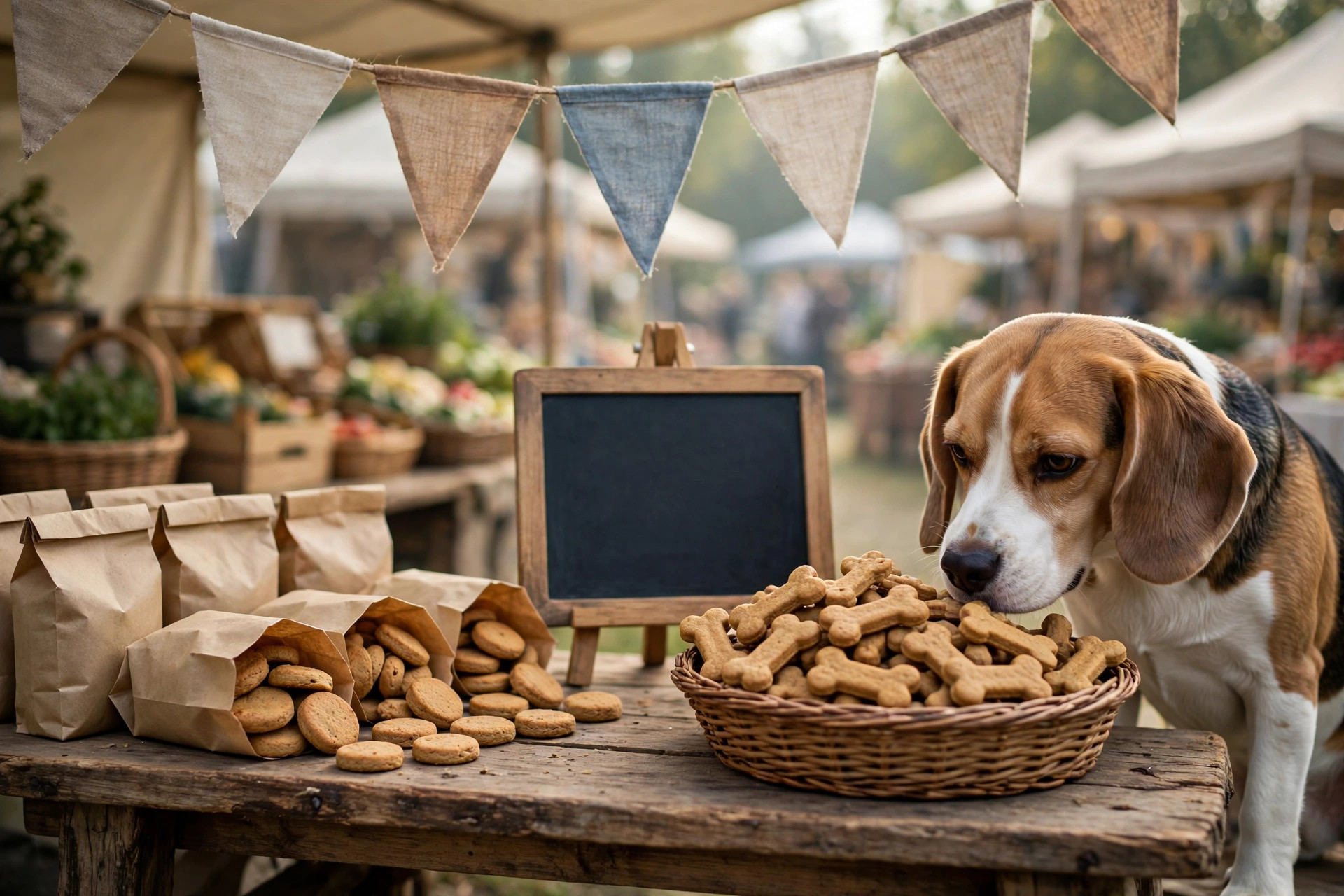
Golden retriever watching a tray of easy homemade DIY dog treats cooling on a kitchen counter.

Easy DIY Dog Treats: 7 Recipes for First-Time Bakers

If you have never baked for your dog before, the treat aisle can feel like a trap: long ingredient lists, mystery “meat meals”, and prices that make you wonder what is actually in the bag. The good news is that the easiest DIY dog treats are genuinely easy. No stand mixer, no piping bags, no dog-bone cutter required — just a bowl, a baking tray, and ingredients you probably already have in the kitchen.

This guide is for first-time bakers. Every recipe below takes 15 minutes of hands-on time or less, uses pantry staples, and is hard to get wrong. If you can mash a banana, you can make every treat on this list — and your dog will not care that your biscuits are not perfectly round.

Before you bake — the 5 rules
1. Peanut butter must be xylitol-free. Check the label: xylitol (also listed as “birch sugar”) is extremely toxic to dogs. Plain peanuts-only peanut butter is the safest pick.
2. Plain pumpkin purée, not pie filling. Pumpkin pie filling has spices like nutmeg, which dogs should not eat. The tin should list one ingredient: pumpkin.
3. No chocolate, ever. For anything that needs a chocolatey look, use carob chips — they are dog-safe and sold in most pet and health-food shops.
4. No grapes, raisins, onion or garlic. They turn up in human baking all the time and they are all toxic to dogs. Keep them out of the bowl entirely.
5. Treats are treats. Keep them under about 10% of your dog’s daily food, and introduce one new recipe at a time so you can spot a sensitive stomach early.

What you need (nothing special)

You do not need a dog-baking kit. A mixing bowl, a fork, a baking tray lined with baking paper, and a knife are enough for every recipe here. A rolling pin helps for the biscuits but the bottom of a mug works just as well. For the frozen recipes, any silicone mould, ice-cube tray or small muffin tin will do.

If you are buying anything, buy oat flour or make your own: blitz rolled oats in a blender for 30 seconds and you have it. Oat flour is gentler on sensitive stomachs than wheat flour, and it is the base for most of the recipes below.

Banana oat cookies dog treats.

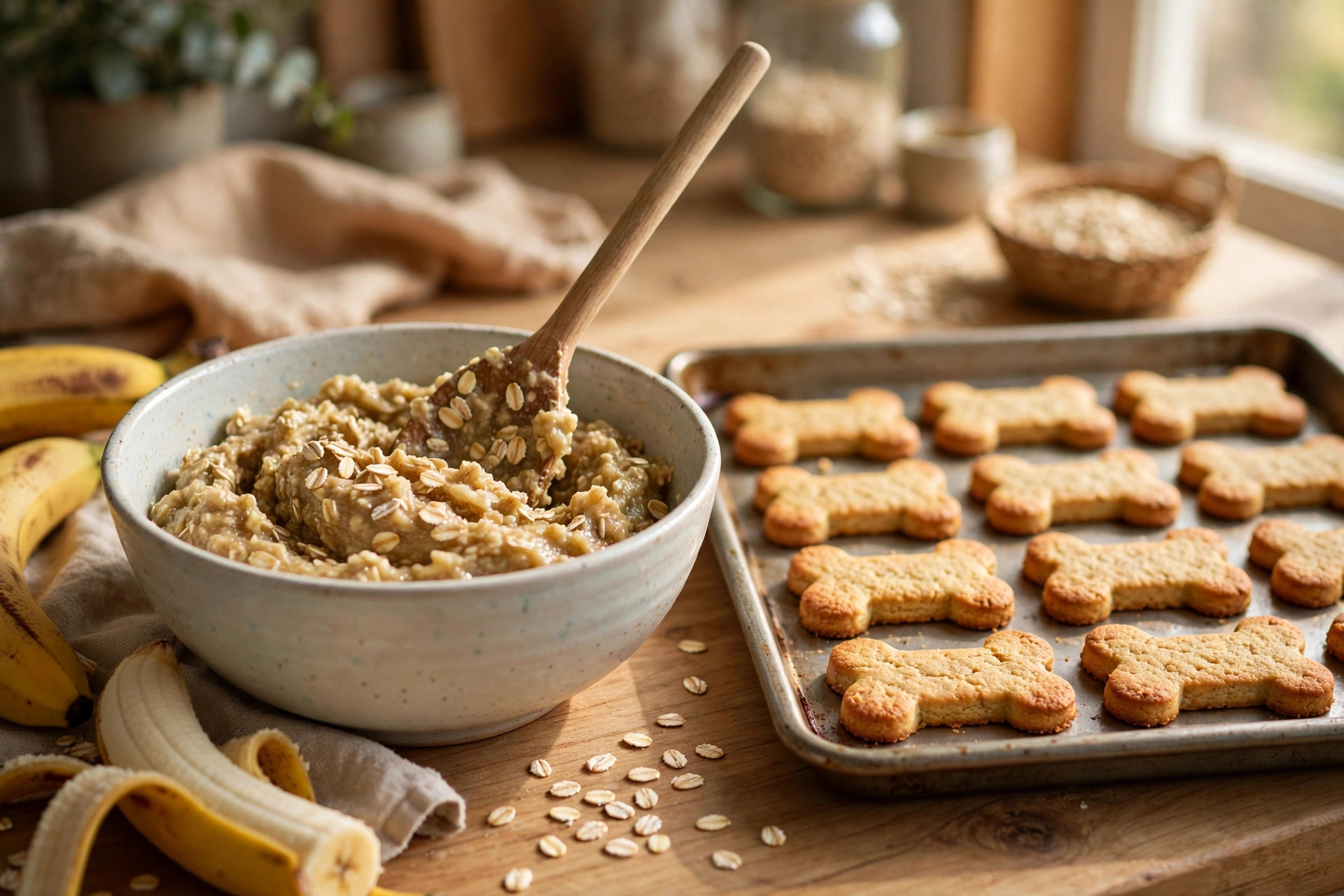
1. Banana Oat Cookies (the first bake)

The recipe to start with. Three ingredients, one bowl, and a smell that will bring your dog to the kitchen before the oven is even hot.

Ingredients

  • 2 ripe bananas, mashed
  • 1½ cups (150 g) oat flour
  • 1 egg

Method

  1. Heat the oven to 175°C / 350°F. Line a baking tray.
  2. Mash the bananas in a bowl, stir in the egg, then mix in the oat flour until you have a soft dough. If it is sticky, add flour a spoon at a time.
  3. Drop spoonfuls onto the tray and flatten with a fork.
  4. Bake 15–18 minutes until set and lightly golden at the edges. Cool completely.

Makes ~20 small cookies. Keeps 1 week in an airtight tin, 2 weeks in the fridge, 3 months frozen. A good first bake for puppies from 12 weeks — bake 3 minutes less for a softer chew.

Peanut butter pumpkin balls dog treats.

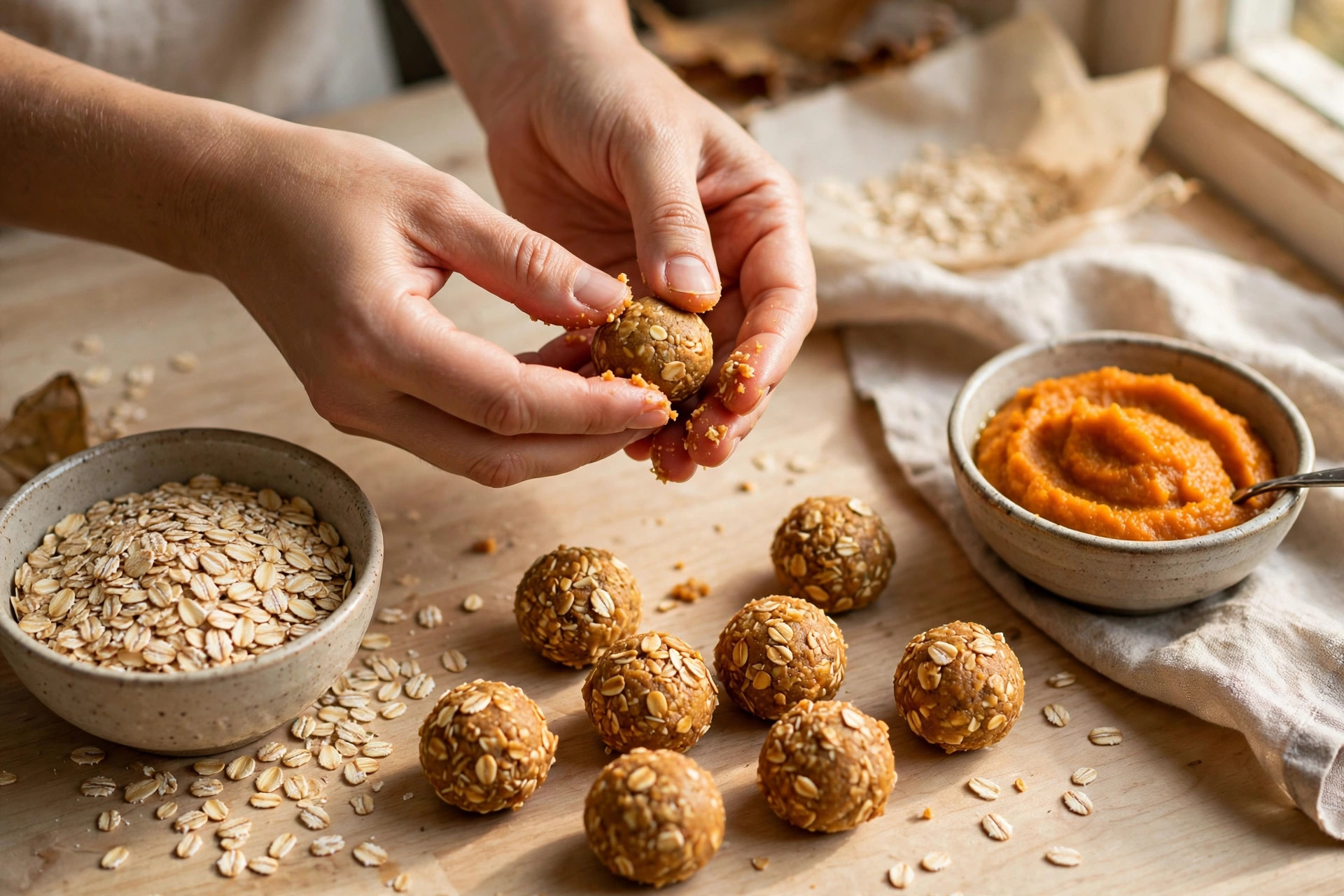
2. Peanut Butter Pumpkin Balls (no-bake)

No oven, no rolling, no waiting. These are the fastest treats on this list and the ones most dogs go maddest for.

Ingredients

  • ½ cup (130 g) smooth peanut butter (xylitol-free!)
  • ½ cup (120 g) plain pumpkin purée
  • 1 cup (100 g) rolled oats

Method

  1. Stir the peanut butter and pumpkin together until smooth.
  2. Mix in the oats until the mixture holds together when squeezed.
  3. Roll into small balls (about a walnut size) and chill in the fridge for 30 minutes so they firm up.

Makes ~18 balls. Keeps 1 week in the fridge, 2 months frozen. Roll them smaller for training rewards — they are soft enough to break in half.

3. Apple Cinnamon Drops (one bowl, four ingredients)

Warm-spiced and naturally sweet, these are the easiest drop cookies you will ever make — no rolling pin, no cutters, just a spoon and a tray.

Ingredients

  • 1 cup (240 g) unsweetened applesauce
  • 1 egg
  • 2 cups (200 g) oat flour
  • 1 tsp cinnamon

Method

  1. Heat the oven to 175°C / 350°F.
  2. Mix everything into a soft dough.
  3. Drop teaspoons of dough onto a lined tray and flatten with a fork.
  4. Bake 18–22 minutes until set and lightly golden.

Makes ~30 small drops. A good pick for older dogs — bake 5 minutes less for a softer chew. Use plain applesauce with no added sugar or sweetener.

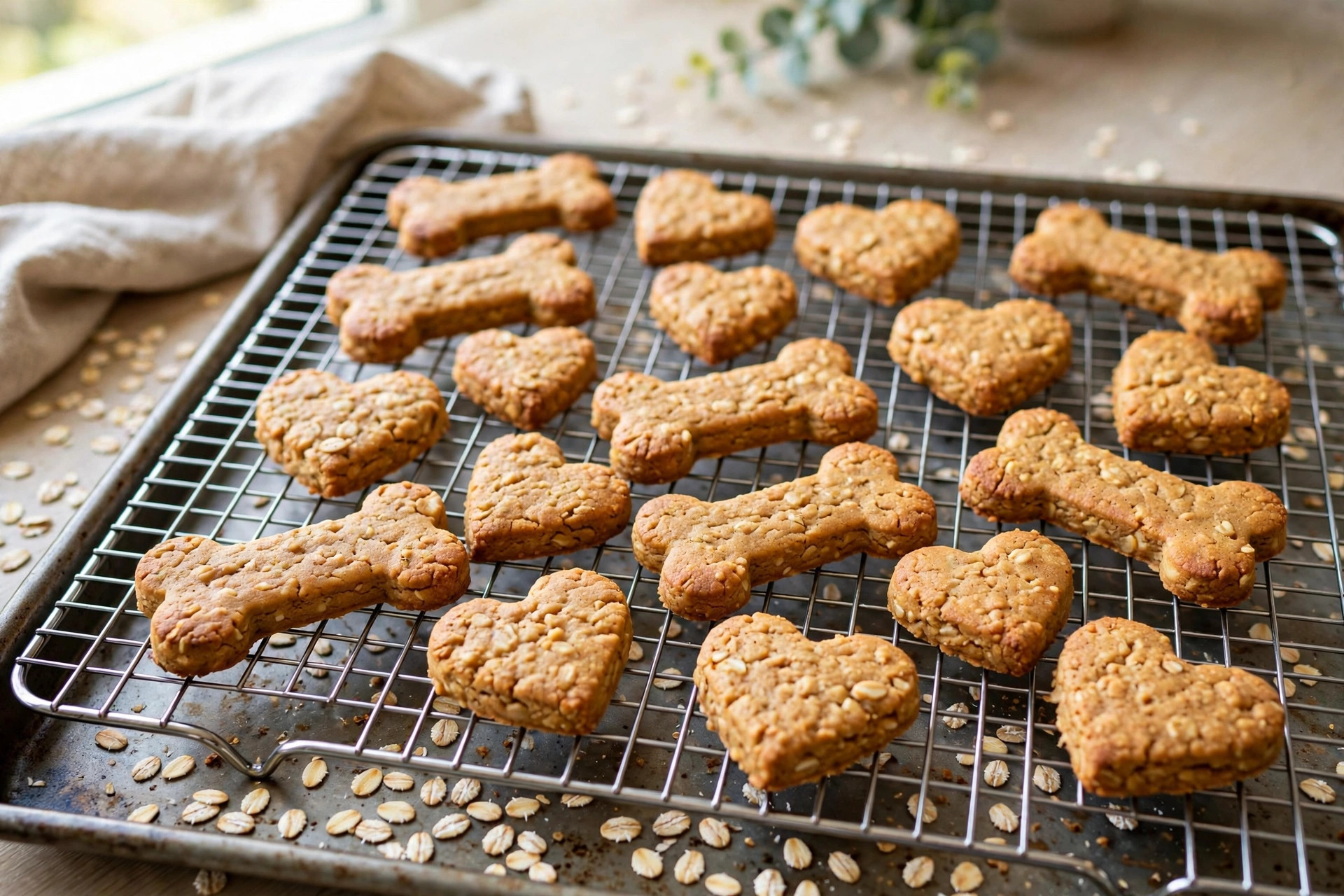
Mixed homemade dog biscuits tin.

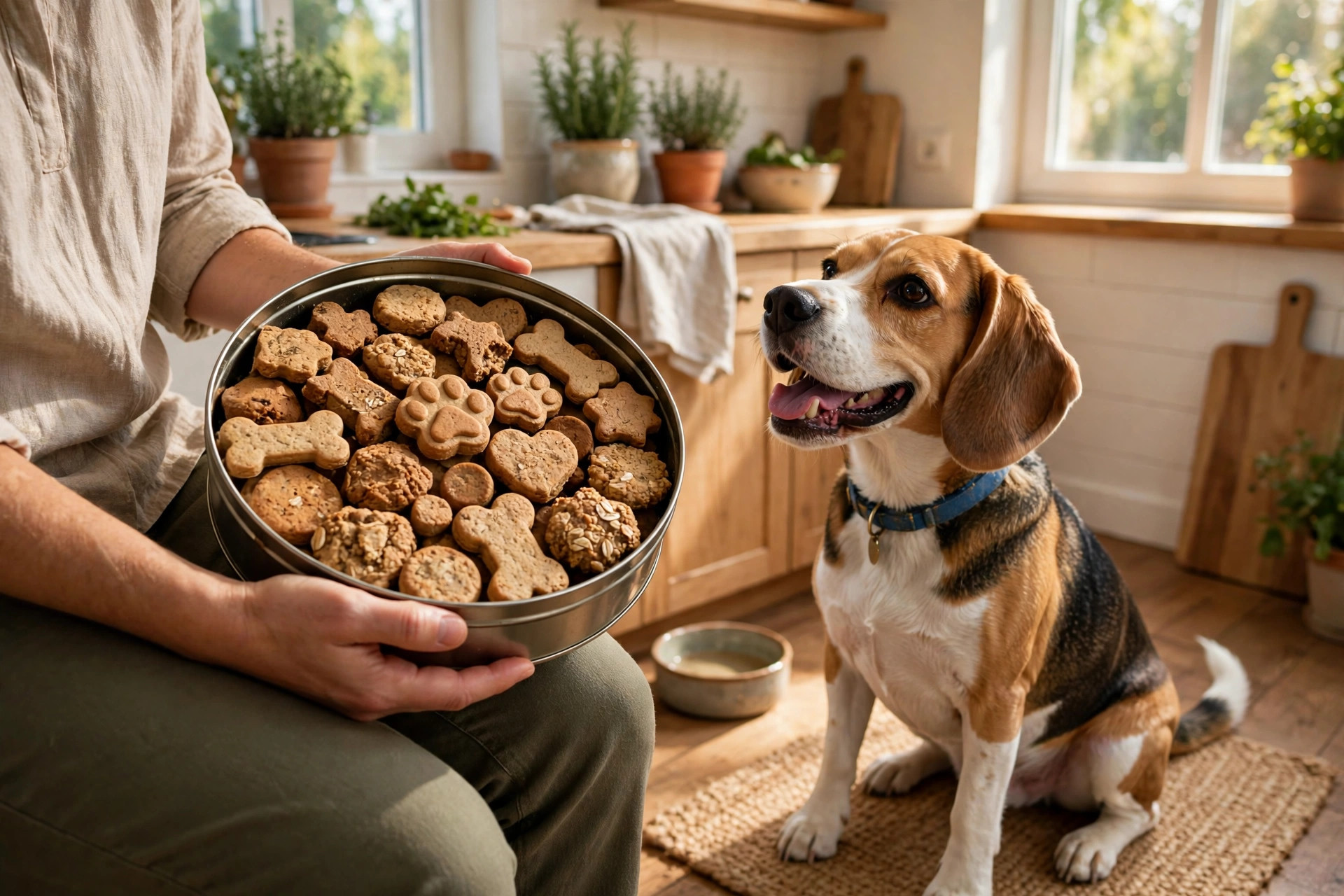
4. Carrot Parsley Biscuits (crunchy, and good for breath)

Grated carrot keeps these moist inside and crunchy outside, and the parsley is not just decoration — it genuinely helps with dog breath.

Ingredients

  • 1 cup (110 g) grated carrot
  • 2 cups (240 g) wholemeal flour (or oat flour)
  • 1 egg
  • 2 tbsp chopped fresh parsley

Method

  1. Heat the oven to 175°C / 350°F.
  2. Mix everything into a firm dough. Add a splash of water if it crumbles.
  3. Roll out to about 6 mm (¼ inch) thick and cut into squares or strips — a knife is fine, no cutter needed.
  4. Bake 20–25 minutes until firm and golden. Cool completely.

Makes ~24 biscuits. Keeps 2 weeks in an airtight tin. The crunch makes them a good everyday biscuit for dogs that like to chew.

Frozen yoghurt berry dog treats.

5. Frozen Yoghurt Berry Bites (two ingredients, zero baking)

The summer recipe, and the one to make when the oven feels like too much effort. Two ingredients, five minutes of work, and a freezer does the rest.

Ingredients

  • 1 cup (245 g) plain yoghurt (check: no xylitol, no artificial sweeteners)
  • ½ cup (75 g) blueberries (or strawberries, halved)

Method

  1. Spoon yoghurt into silicone moulds or an ice-cube tray, filling each about two-thirds full.
  2. Drop a blueberry or two into each one.
  3. Freeze at least 4 hours. Pop out and serve outside or on an easy-clean floor — they melt.

Makes ~12 bites depending on mould size. Keeps 1 month in the freezer. Perfect for teething puppies — the cold soothes sore gums. If your pup is teething, our homemade teething treats for puppies have more cold-chew ideas.

6. Sweet Potato Coconut Chews (one ingredient, plus a brush of oil)

One ingredient, endless patience payoff: chewy sweet potato rounds that keep a dog busy far longer than a biscuit. The coconut oil is optional — it just deepens the colour.

Ingredients

  • 2 large sweet potatoes
  • Optional: 1 tsp coconut oil

Method

  1. Heat the oven to 120°C / 250°F (low and slow is the trick).
  2. Slice the sweet potatoes into rounds about 6 mm (¼ inch) thick.
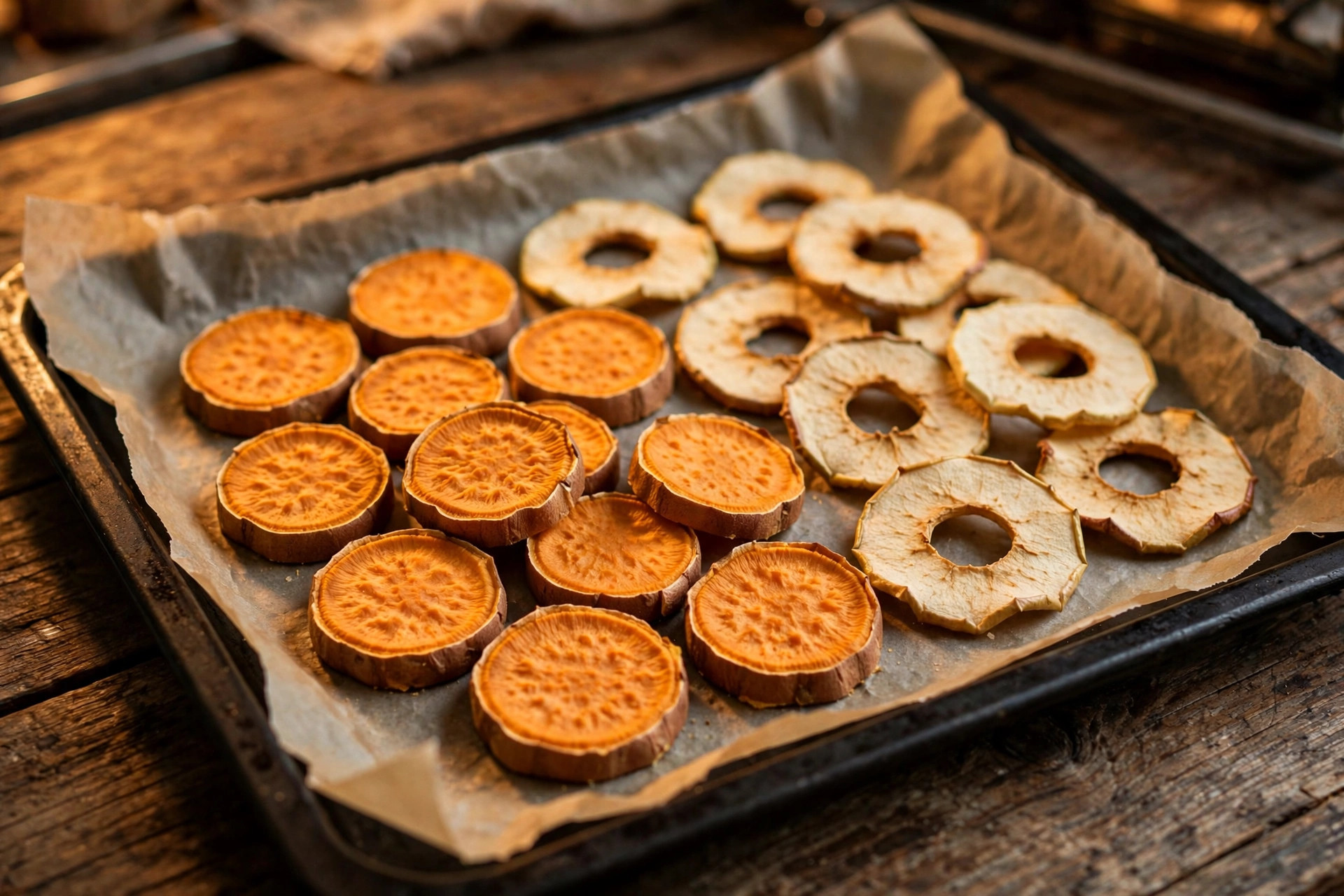
  3. Lay on a lined tray (brush lightly with coconut oil if using) and bake 2½–3 hours, turning halfway, until chewy-dry at the edges.
  4. Cool completely — they firm up as they cool.

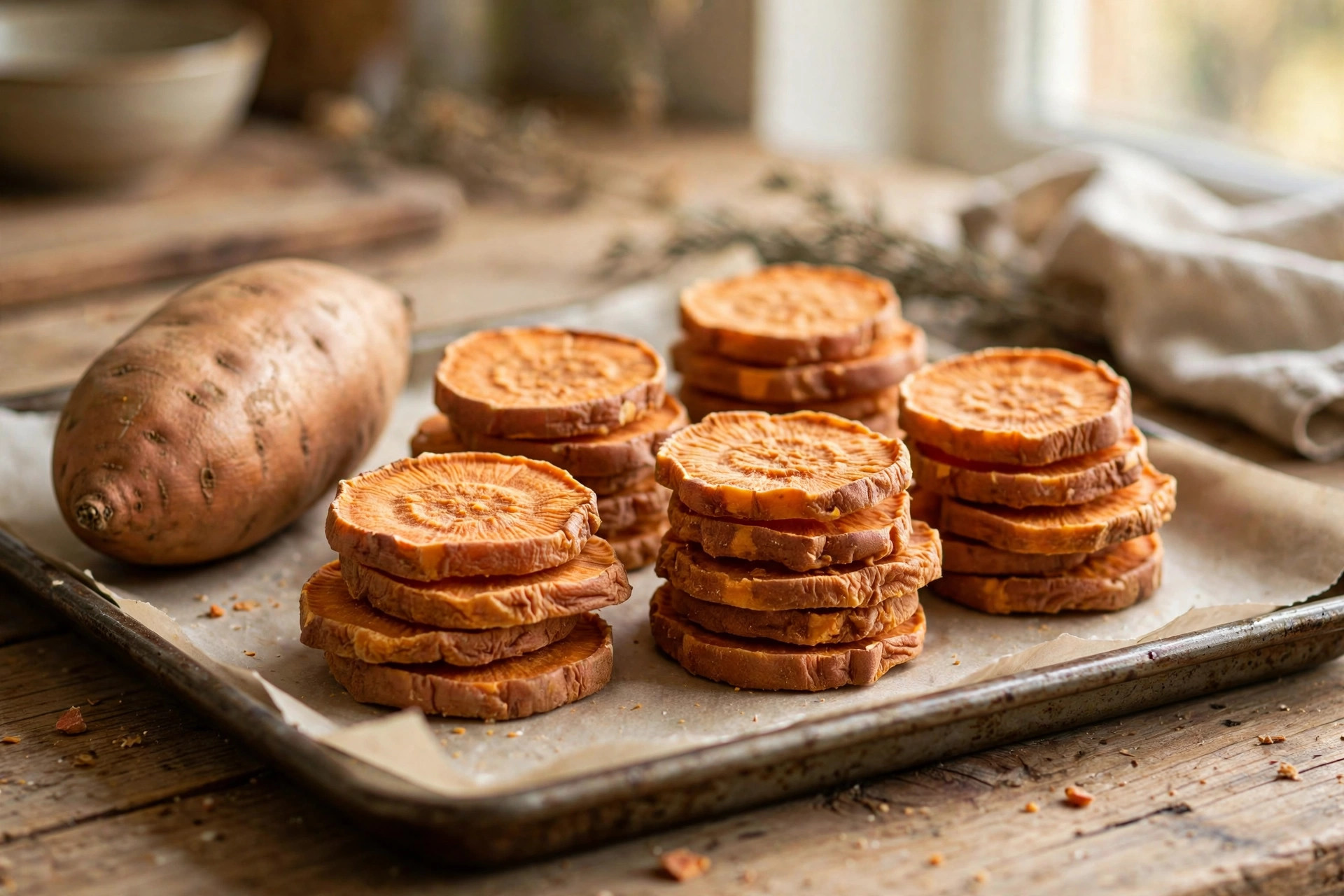
Makes ~25 chews. Keeps 2 weeks in the fridge. Great for dogs who cannot have grains, and a good long-lasting chew for a dog that inhales biscuits.

7. Tuna Training Bites (tiny, smelly, irresistible)

The training-treat recipe. Tuna is so high-value to most dogs that these tiny squares will hold a recall in a distracting park — and they cost a fraction of shop-bought training treats.

Ingredients

  • 1 tin (145 g) tuna in spring water, drained
  • 1 egg
  • ½ cup (50 g) oat flour

Method

  1. Heat the oven to 175°C / 350°F.
  2. Blitz the tuna, egg and flour together (a fork and a bit of elbow grease works if you have no blender) into a thick paste.
  3. Spread the paste about 1 cm (½ inch) thick on a lined tray.
  4. Bake 15–20 minutes until firm, then cut into tiny squares while still warm.

Makes ~40 tiny bites. Keeps 3–4 days in the fridge, 1 month frozen. Cut them small — training treats should be pea-sized, not biscuit-sized, or your dog will be full before the session ends.

How to store homemade dog treats

Homemade treats have no preservatives, so storage matters more than it does for shop-bought ones. Baked biscuits keep about a week in an airtight tin at room temperature, two weeks in the fridge, and three months in the freezer. Soft treats and anything with fresh meat or fish (like the tuna bites) belong in the fridge and last 3–4 days. Frozen treats keep a month or more in a sealed bag.

The easiest system is to bake a double batch, keep a week’s worth in the tin, and freeze the rest in small bags. Defrost at room temperature for an hour before serving — never microwave a frozen treat until it is hot in the middle.

Mistakes first-time bakers make

  • Baking too hot. Dog biscuits burn fast. 175°C / 350°F is the ceiling for most recipes; lower and slower is safer than hotter and faster.
  • Making them too big. A treat should be a mouthful or two, not a meal. Small treats are also easier to use for training, and they last longer.
  • Skipping the cool-down. Warm biscuits feel soft and fall apart; they firm up as they cool. Always cool completely before you judge them — or serve them.
  • Using the wrong peanut butter. “Reduced fat” and “sugar-free” peanut butters are the ones most likely to contain xylitol. Plain, full-fat, peanuts-only peanut butter is the safe pick.
  • Storing soft treats on the counter. Anything soft, meaty or fishy goes in the fridge. A biscuit that goes mouldy in three days is a wasted batch — and a vet visit waiting to happen.

Quick safety recap

  • ✅ Pumpkin, peanut butter (xylitol-free), banana, apples, berries, sweet potato, oats, plain yoghurt, carrots, tuna in spring water — all dog-safe in treat-sized amounts.
  • ❌ Chocolate, xylitol/birch sugar, raisins and grapes, onion, garlic, nutmeg, cooked bones, and anything “sugar-free” you have not label-checked.
  • 🐶 Puppies from about 12 weeks can have these in small pieces — start with the softer recipes and just one or two pieces the first day. Dogs with allergies should try one new ingredient at a time.

FAQs

I have never baked for my dog. Which recipe should I try first?
The Banana Oat Cookies (recipe 1). Three ingredients, one bowl, fifteen minutes, and almost impossible to get wrong. If the dough is too sticky, add flour; if it crumbles, add a splash of water. That is the whole skill.

Can I use wheat flour instead of oat flour?
Yes, in the same amounts. Oat flour is just gentler on sensitive stomachs and easier to make at home. If your dog has a wheat sensitivity, stick with oats — our easy homemade dog treats without flour have more flour-free ideas.

How long do homemade dog treats last?
Baked biscuits: about a week in a tin, two weeks in the fridge, three months in the freezer. Soft and meaty treats: 3–4 days in the fridge. Frozen treats: a month or more. When in doubt, freeze them — a frozen treat is never a wasted treat.

Can puppies have these treats?
Yes, in small pieces, from about 12 weeks — start with the softer recipes (1, 2 and 5) and just one or two pieces the first day. The frozen yoghurt bites are especially good for teething puppies.

My dog has a sensitive stomach. Which recipe is gentlest?
The Banana Oat Cookies. Banana and oats are famously easy on digestion, and there are only three ingredients to keep track of. Introduce any new treat one at a time and watch the next day’s stools.

Do I need a dog-bone cutter or special moulds?
No. A knife, a fork and a spoon cover every recipe here. Squares, drops and balls are just as good as bone shapes — your dog will not be checking.

The bottom line

Easy DIY dog treats are not a project — they are a fifteen-minute habit. Mash a banana, stir in oats, bake, done. Start with the Banana Oat Cookies, keep the five safety rules in mind, and freeze the extras so there is always a homemade treat in the house. Once the first batch is gone (it will be gone fast), the rest of the recipes on this list are waiting — and if you want to go simpler still, our 3-ingredient dog treats and no-bake dog treats are the next step.

Pin this for later 📌 — and if your pup loved the frozen recipes, try our puppy popsicles next: frozen treats made for hot days and teething puppies.

Golden retriever licking a frozen treat from a Pupsicle-style freezable dog toy.

Homemade Pupsicle Refills: Frozen Treats for Your Dog’s Pupsicle Toy

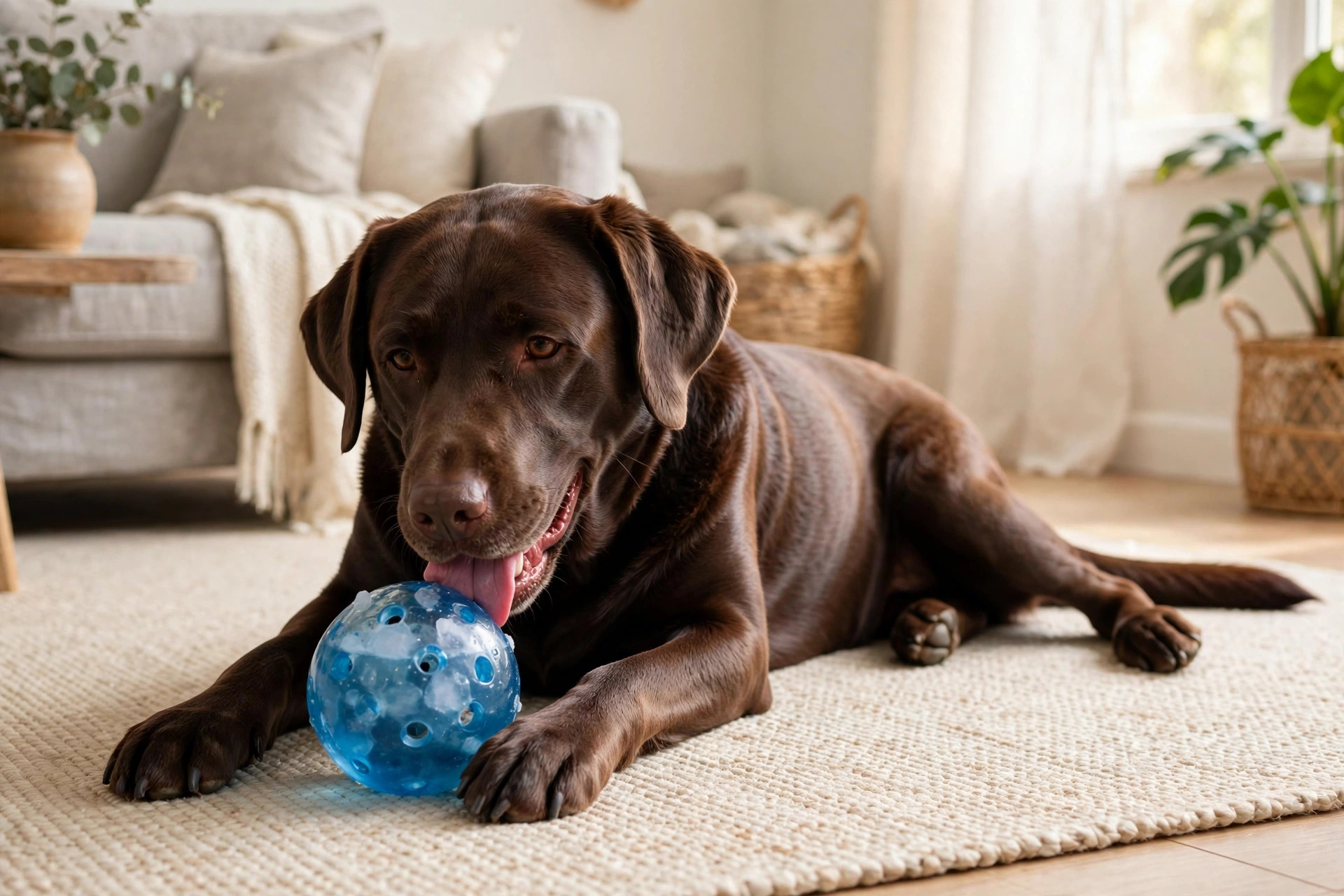
The Pupsicle — the freezable treat-ball toy that has become its own search category in 2026 (27,100 monthly searches, up 83% year on year, per risingtrends.co) — is genius: pop a frozen refill inside, hand it to your dog, and you get 20–30 minutes of quiet licking. The catch is the official refill packs. They work, but they cost real money over a month of daily use, and you have zero say over what is inside them.

Homemade pupsicle refills solve both problems. You control every ingredient, each refill costs pennies, and you can tune the recipe to your dog — low-calorie for the dog on a weight plan (see our dog weight loss food plan), extra-aromatic for the picky eater (see our best dog food for picky eaters guide), or novel-protein for the sensitive stomach (our sensitive-stomach guide covers the approach).

The concept is simple: blend a dog-safe mixture, freeze it into the shape your toy takes (most Pupsicles use a round ball or disc cavity), pop it in, done. Below are the ground rules, then seven refill recipes worth rotating.

For more frozen ideas, see our lick mat recipes for dogs (the same mixtures work on lick mats) and our homemade teething treats for puppies — several of those doubles as pupsicle refills.

The ground rules for DIY refills

A refill is a frozen treat, not a meal. Four rules keep it safe:

  1. Xylitol is the killer. Some peanut butters and “sugar-free” yoghurts contain xylitol (also labelled birch sugar), which is toxic to dogs in tiny amounts. Read every label before it goes in the blender.
  2. Budget the calories. Treats and toppers together stay under 10% of daily calories. A medium dog on 800 kcal a day gets ~80 kcal of treats — one modest pupsicle refill, not three.
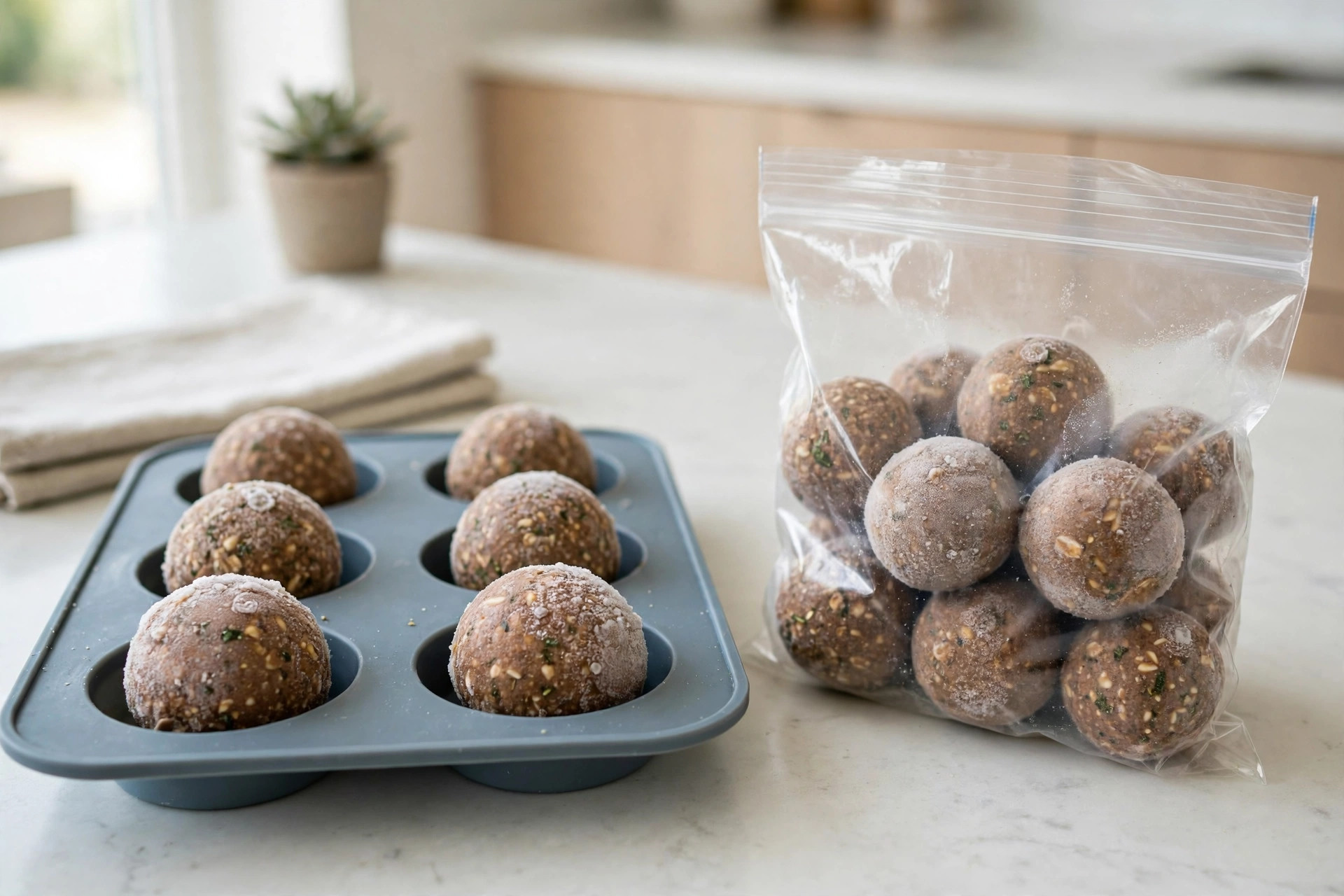
  3. Freeze solid, thaw the surface. Freeze refills for at least 4–6 hours (overnight is safest). Run the frozen ball under warm water for 5 seconds before loading — it slides in easily and the surface softens a touch.
  4. Supervise, always. The toy is durable; the refill is food. Take the toy up when the refill is gone, and retire any toy with cracks or chewed edges.

Hard no’s in every refill: chocolate, grapes, raisins, macadamia nuts, onion, garlic, alcohol, coffee, and anything sweetened with xylitol.

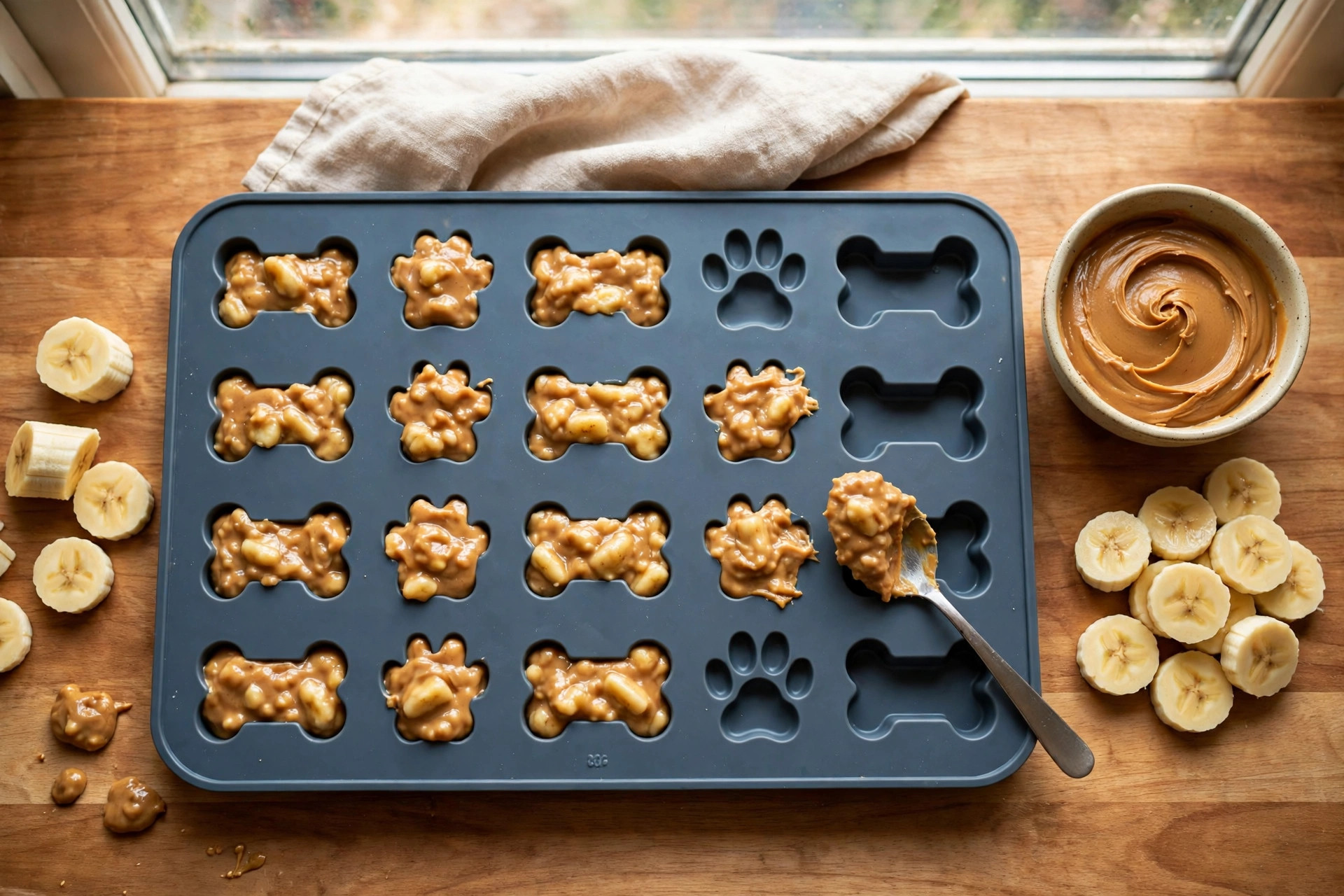
1. Classic peanut butter banana

The crowd-pleaser and the cheapest refill on this list. Use plain peanut butter (peanuts + salt only — no xylitol, no palm oil) and ripe banana.

Make it: mash one ripe banana with 2 tablespoons of peanut butter and 60 ml of plain water or unsweetened yoghurt. Press into a silicone muffin tray or round ice-cube mould, freeze 6+ hours. One ball per session for a medium dog.

Good for: first-timers (high acceptance rate), picky dogs. Watch: calorie-dense — peanut butter is ~95 kcal per tablespoon, so measure, do not eyeball.

Silicone moulds filled with homemade peanut butter banana pupsicle refill mixture, with banana slices.

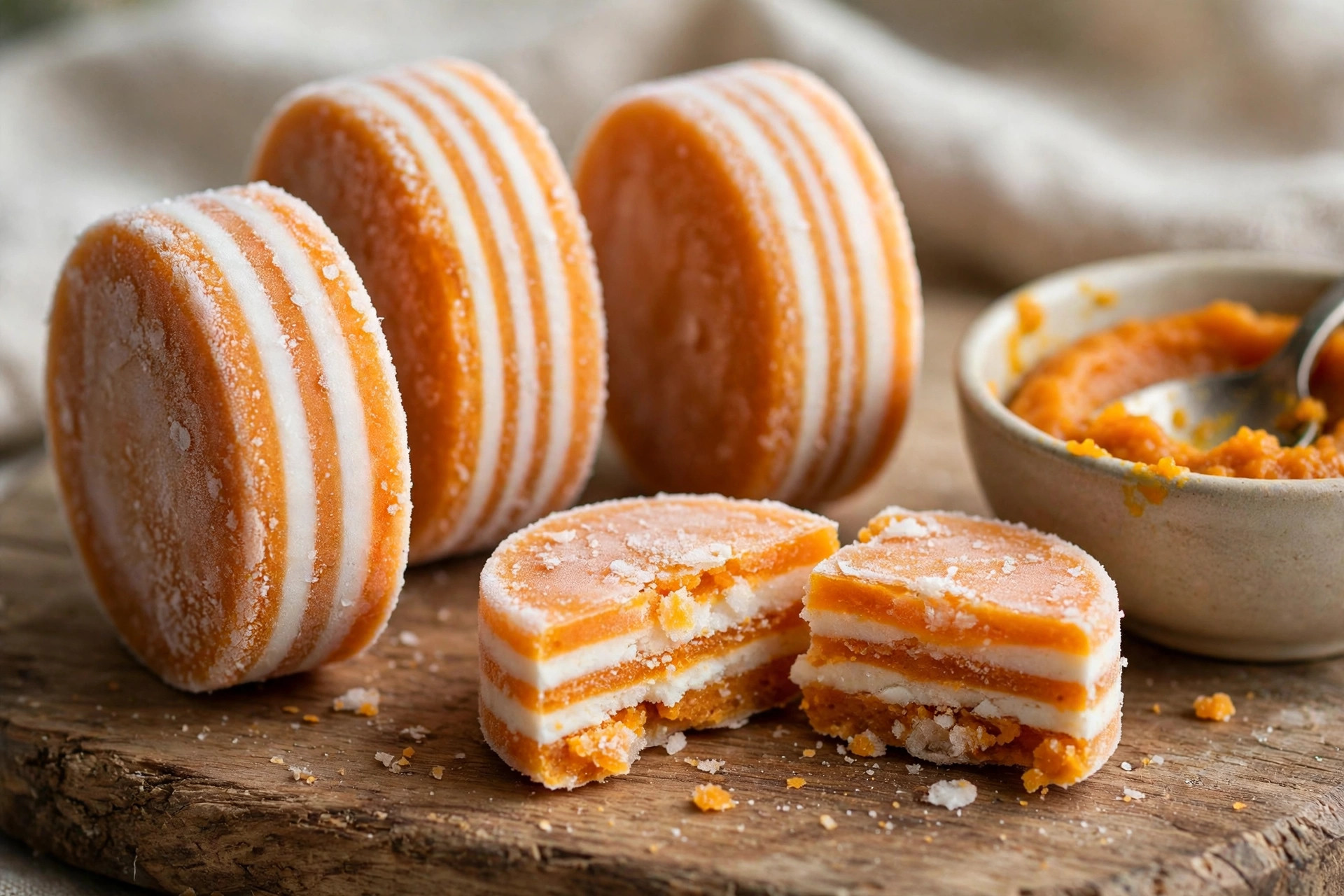
2. Pumpkin-yoghurt layers

The pretty one — orange and white stripes that look like a proper store-bought refill. Plain canned pumpkin (100% pumpkin, not pie filling) plus plain unsweetened yoghurt.

Make it: whisk 100 g pumpkin purée with 2 tablespoons yoghurt; separately, whisk 100 g yoghurt with a drizzle of honey (a teaspoon — optional). Pour alternating layers into the mould and freeze between layers for crisp stripes. Fibre-rich, easy on digestion.

Good for: dogs with touchy stomachs, Instagram-worthy refills. Watch: yoghurt must be plain and unsweetened — flavoured yoghurts hide sugars and sometimes xylitol.

Layered orange and white pumpkin-yoghurt frozen pupsicle refills for dogs.

3. Chicken broth savoury pop

For dogs that turn up their nose at sweet things: a savoury, meaty refill. Plain homemade chicken broth — no onion, no garlic, no stock cubes — plus shredded chicken.

Make it: warm 150 ml plain broth, stir in 50 g of shredded cooked chicken, pour into moulds and freeze. Add a few kibble bits into the mixture before freezing for a crunchy surprise layer. Our bone broth for dogs guide has the safe recipe.

Good for: seniors who prefer softer food, dogs recovering from illness, protein motivation for training. Watch: store-bought “broths” frequently contain onion or garlic powder — read the label or make your own.

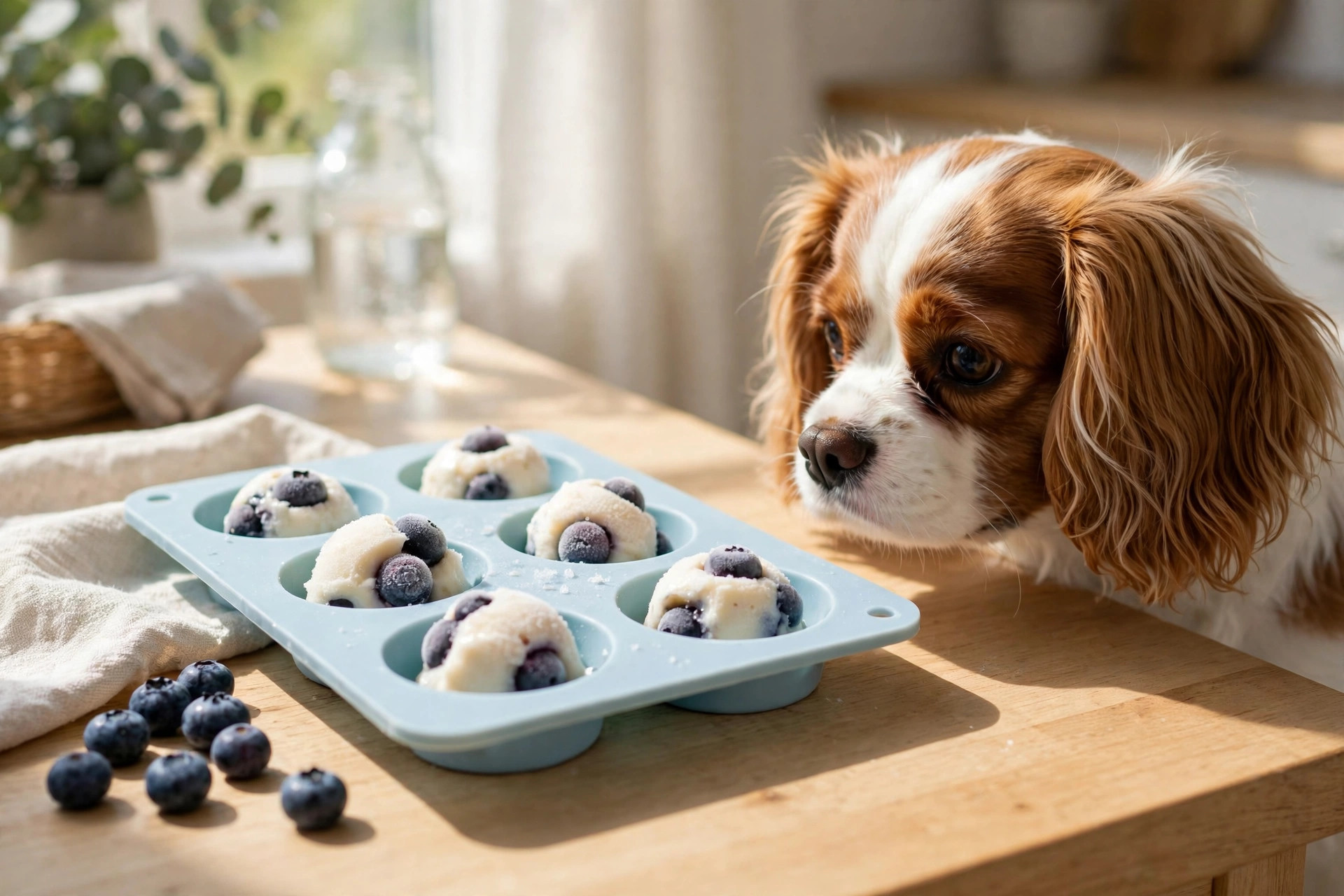
4. Blueberry coconut dots

The antioxidant refill. Blueberries are a safe, low-calorie fruit dogs tend to love; unsweetened coconut flakes add texture.

Make it: blend 80 g blueberries with 100 ml plain yoghurt until mostly smooth. Stir in a tablespoon of unsweetened coconut flakes, pour into moulds, freeze. Tart, bright, and only a few dozen calories per ball.

Good for: calorie-conscious dogs (see our dog weight loss food plan), hot days. Watch: blend well for small dogs — whole blueberries are a mild choking shape for tiny mouths.

5. Sardine & sweet potato

The omega-3 powerhouse. Sardines packed in water (not oil, not brine) plus cooked mashed sweet potato — a savoury refill with real nutrition credentials, echoing our salmon oil for dogs routine.

Make it: mash 2 water-packed sardines with 100 g cooked sweet potato (no skin), thin with 2 tablespoons warm water, freeze in moulds. Smelly to make, irresistible to dogs.

Good for: coat and skin support, extremely picky eaters (few dogs refuse fish). Watch: twice a week at most — fish is rich, and variety beats volume.

6. Apple-oat mush

The breakfast refill. Unsweetened apple sauce (or one grated apple, no seeds) plus cooked plain oats — gentle, fibrous, filling.

Make it: stir 100 g unsweetened apple sauce into 80 g cooked oats, add a pinch of cinnamon (Ceylon cinnamon, a pinch only — cassia in quantity is not ideal), freeze. Soft texture, easy lick.

Good for: senior dogs, dogs that like mild flavours. Watch: apple seeds contain amygdalin — grate around the core or use sauce. No cinnamon “doses” — a pinch for aroma, not a spoonful.

7. Surprise-centre broth ball

The enrichment refill — plain broth frozen around a hidden centre. The centre makes the dog work through the layers instead of licking it flat in ten minutes.

Make it: fill moulds one-third with plain broth, freeze 2 hours. Drop a small smear of peanut butter or a single blueberry in the centre, top up with broth, freeze overnight. The frozen shell melts into the surprise.

Good for: fast eaters, clever dogs that demolish simple refills too quickly (pairs with our slow feeder dog bowls strategy), rainy-day boredom. Watch: keep the centre small — it is a flavour reward, not a second meal.

How to fit and store your refills

Match the mould to your toy: round silicone ice-cube trays fit most ball-style toys; if yours takes a disc, freeze in a shallow ramekin. Pop frozen refills into a labelled freezer bag — they keep 2–3 months, and you can batch a month’s worth in one Sunday session.

Fridge rule for mixtures: any unfrozen mixture keeps 3 days refrigerated; once frozen, use within 3 months. If a refill looks freezer-burned or smells off, it goes in the bin, not the toy.

One more trick: freeze a thin broth “shell” in the mould first, then press your main mixture in. The shell gives a harder first layer that slows power-lickers down — the same idea behind our frozen enrichment treats.

Batch of homemade frozen pupsicle refill balls in a silicone tray and freezer bag.

When NOT to hand over a frozen refill

Frozen treats are safe for most dogs, but check with your vet first if:

  • Your dog has pancreatitis history (or is a prone breed like miniature schnauzers): even modest fat additions can trigger a flare — stick to broth and pumpkin refills.
  • Your dog has dental fractures or worn teeth: very hard frozen blocks can crack teeth. Soften the surface under warm water and supervise closely.
  • Your dog is on a therapeutic diet (kidney, urinary, allergy, weight-loss): frozen extras can unbalance a precision diet. Clear it with the vet.
  • Puppies under 12 weeks: their nutrition is exact; ask the vet before adding frozen extras.

And never leave a dog unattended with a frozen refill — not because the food is dangerous, but because enthusiastic chewers can break chunks off faster than you expect.

Chocolate labrador licking a frozen treat ball toy on a living room rug.

FAQs

What exactly is a Pupsicle?
It is a freezable treat-dispensing ball toy: you freeze a ball-shaped treat (the “refill”), pop it into the toy’s cavity, and the dog licks and works at it. The DIY versions here fit any similar freezable ball toy, not just the branded one.

Can I use these mixtures on a lick mat?
Yes — every recipe here doubles as a lick-mat spread. See our lick mat recipes for mat-specific ratios (thinner mixtures spread better).

How long should a refill take my dog?
A well-frozen ball in the toy typically lasts 15–30 minutes of licking for a medium dog. If yours finishes in five, freeze harder (overnight, colder setting) or use the surprise-centre technique.

Are frozen treats bad for dogs’ teeth?
Frozen food itself is fine; the risk is biting hard on a rock-solid block. Run the refill under warm water for a few seconds before loading and supervise — licking is the goal, not crunching.

Can puppies have pupsicle refills?
From about 12 weeks, yes, in small amounts — broth, pumpkin and banana mixtures are the gentlest starters. Teething puppies especially love them (see our teething treats). Very young puppies should get vet clearance first.

How many refills can my dog have per day?
One per day is the sensible ceiling for most dogs, and it must fit inside the 10% treat-calorie budget. A pupsicle refill is enrichment, not a meal replacement.

The bottom line

Homemade pupsicle refills are the rare win-win: cheaper than store packs, fully under your control, and endlessly customisable to your dog. Batch a month’s worth on a Sunday, freeze them in silicone trays, and the daily 20 minutes of quiet licking costs you almost nothing. Start with peanut butter banana or the broth ball, keep it under 10% of daily calories, and rotate the seven recipes here — your dog’s enrichment routine just got an upgrade.

Golden retriever choosing from a board of homemade 3-ingredient dog treats in a kitchen.

3-Ingredient Dog Treats: 7 Easy Recipes With What You Have

Some weeks you want a weekend baking project; other weeks you just want the dog to have something homemade without a 14-item shopping list. These 3-ingredient dog treats are for the second kind of week. Every recipe below uses exactly three ingredients — the kind of things already sitting in most kitchens — and none of them asks you to be a pastry chef.

Three-ingredient baking also has a real advantage for dogs with sensitive stomachs or allergies: fewer ingredients means fewer suspects if something disagrees with your dog. And if you like this minimal style, our single-ingredient dog treats guide goes even simpler, while the no-bake dog treats roundup covers the oven-free options.

The ground rules first

Three rules apply to every recipe here:

  1. Peanut butter must be xylitol-free. Xylitol (also listed as “birch sugar”) is extremely toxic to dogs. Check the label every time — formulations change.
  2. Plain pumpkin purée, never pie filling. Pie filling contains nutmeg and other spices dogs should not eat, and sometimes xylitol.
  3. Treats stay under 10% of daily calories. Homemade or not, treats are the side dish, not the main course.

Homemade peanut butter banana dog treat bites on a wooden board with banana and peanut butter jar.

Recipe 1 — Peanut butter banana bites

The crowd-pleaser. Soft-baked, naturally sweet, and the dough comes together in one bowl.

You will need: 1 ripe banana, ½ cup xylitol-free peanut butter, 1 cup oat flour.

Method: Mash the banana until smooth, stir in the peanut butter, then fold in the oat flour until a firm dough forms. Roll into teaspoon-sized balls and flatten slightly with a fork. Bake at 175°C / 350°F for 15–18 minutes until firm at the edges. Cool completely. Makes about 20 bites; keeps 1 week in an airtight tin.

Recipe 2 — Pumpkin oat biscuits

Three-ingredient baking at its simplest: pumpkin, oats, egg. Fibre-rich and gentle on digestion.

You will need: ½ cup plain pumpkin purée, 1½ cups oat flour, 1 egg.

Method: Mix everything into a firm dough, roll to about 6 mm (¼ inch), and cut into shapes with a bone cutter or a knife. Bake at 175°C / 350°F for 20–25 minutes until firm. Cool fully — they crisp as they cool. Makes about 24 biscuits; keeps 1 week at room temperature, 2 weeks in the fridge.

Hands cutting bone-shaped pumpkin oat dog biscuits from rolled dough.

Recipe 3 — Apple oat rounds

No added sugar, no fat, just gentle sweetness from the apple.

You will need: ¾ cup unsweetened applesauce, 2 cups oat flour, 1 egg.

Method: Stir the applesauce and egg together, then mix in the oat flour to form a soft dough. Drop rounded teaspoons onto a lined tray and flatten with the back of a spoon. Bake at 175°C / 350°F for 18–22 minutes until set and lightly golden. These bake up a little softer than the pumpkin biscuits, which makes them a good pick for older dogs. Makes about 26 rounds.

Recipe 4 — Sweet potato chews with turmeric

One of the cheapest treats on this list, and dogs love the chewy texture.

You will need: 2 large sweet potatoes, 1 teaspoon coconut oil, a pinch of turmeric.

Method: Heat the oven low — 120°C / 250°F. Slice the sweet potatoes into rounds about 6 mm (¼ inch) thick and brush lightly with coconut oil. Dust with the turmeric. Bake 2½–3 hours, turning halfway, until chewy-dry at the edges. Cool completely — they firm up as they cool. Makes about 25 chews; keeps 2 weeks in the fridge. Great for dogs who cannot have grains.

Homemade sweet potato chews for dogs baking on a tray, dog watching.

Recipe 5 — Frozen blueberry yoghurt dots

No oven at all. These take five minutes of work plus freezer time.

You will need: 1 cup plain unsweetened yoghurt (no xylitol), ½ cup blueberries, ½ ripe banana.

Method: Mash the banana, stir in the yoghurt, then fold in the blueberries. Spoon small dots onto a parchment-lined tray and freeze for 2–3 hours. Pop off and store in a freezer bag for up to 1 month. Serve one or two at a time — cold, creamy, and portion-controlled by design.

Frozen blueberry yoghurt dots for dogs in a silicone mould tray.

Recipe 6 — Carrot cake balls

Grated carrot keeps these moist without any oil or butter.

You will need: 1 cup finely grated carrot, 1 cup oat flour, 3 tablespoons xylitol-free peanut butter.

Method: Mix everything into a sticky dough and roll into walnut-sized balls. Flatten slightly and bake at 175°C / 350°F for 20 minutes until set. The carrot keeps the centres soft even after baking, so these suit puppies and seniors too. Makes about 18 balls; keeps 1 week in the fridge.

Recipe 7 — Chicken stock frozen bones

The savoury one — perfect for dogs who find sweet treats boring.

You will need: 1 cup unsalted chicken stock (no onion or garlic), ½ cup cooked shredded chicken, 1 tablespoon chopped fresh parsley.

Method: Warm the stock just enough to stir easily, mix in the chicken and parsley, and pour into silicone bone moulds or an ice cube tray. Freeze at least 4 hours. Store frozen for up to 1 month. One bone is a satisfying, low-calorie chew — serve outside or on a washable floor, because they melt.

Safety recap

  • ✅ Pumpkin purée (plain), peanut butter (xylitol-free), oats, banana, applesauce, sweet potato, blueberries, plain yoghurt, carrot, cooked chicken, parsley — all dog-safe in treat-sized amounts.
  • ❌ Xylitol/birch sugar, chocolate, grapes and raisins, onion and garlic, nutmeg, pumpkin pie filling, anything “sugar-free” you have not label-checked.
  • Introduce one new recipe at a time, especially for dogs with sensitive stomachs. If you spot itching, loose stools or vomiting, stop that recipe and see your vet.

FAQs

Are 3-ingredient dog treats actually healthy?
They can be, with the right ingredients. Simple recipes with whole foods — pumpkin, oats, peanut butter, sweet potato — are far better than treats padded with fillers and artificial flavours. Keep portions within the 10% treat rule and they are a perfectly healthy part of the diet.

Can I make these gluten-free?
Most of these recipes already are, if you use certified gluten-free oats. Dogs rarely need gluten-free diets, but if your vet has your dog off grains, swap the oat flour for coconut flour (use about a third less, since it absorbs more liquid).

My dog is allergic to peanut butter — what can I swap in?
Sunflower seed butter (xylitol-free) works as a one-for-one swap in recipes 1 and 6. Pumpkin purée is another binder option, though the dough will be softer — add oat flour a spoon at a time until it holds.

Can puppies have these treats?
Yes, in small pieces from about 12 weeks. Bake recipes 1, 2, 3 and 6 a few minutes less for a softer chew, and introduce one recipe at a time.

How long do homemade 3-ingredient treats keep?
Baked treats: 1 week at room temperature in an airtight tin, 2 weeks in the fridge, 3 months frozen. Frozen treats: 1 month in the freezer. Sweet potato chews: 2 weeks refrigerated.

Can I double a batch?
Yes for all seven. The baked recipes freeze well for up to 3 months — defrost at room temperature for up to an hour before serving.

The bottom line

Three ingredients, one bowl, a happy dog. Start with the peanut butter banana bites if your dog is a classic treat lover, the frozen blueberry dots if you want zero oven time, or the sweet potato chews if grains are off the table. Seven recipes, twenty-one ingredients total — and not a single one you cannot pronounce.

Golden retriever puppy chewing a homemade frozen teething treat in a bright kitchen.

Homemade Teething Treats for Puppies (Soothing & Safe)

There is a special kind of chaos that arrives with a teething puppy: the chewed table leg, the damp socks, the tiny needle teeth testing every surface in the house. Teething is uncomfortable — and a puppy in pain chews to relieve it. The good news is that the right homemade teething treats for puppies can do double duty: they soothe those sore, swollen gums and redirect all that chewing energy onto something safe, cold and delicious.

This guide covers five simple teething treats you can make with everyday ingredients, the science of why cold works, and — just as important — the items you should never hand a teething puppy, no matter how convincing those eyes are.

When do puppies teeth — and what does it feel like?

Most puppies start teething at around 3 to 4 weeks old (those first needle-sharp baby teeth), lose them from about 12 weeks, and finish growing their full set of 42 adult teeth by 6 to 7 months. The roughest stretch is usually between 4 and 6 months, when the baby teeth fall out and the adult teeth push through.

Classic signs your puppy is teething: chewing everything in sight, drooling more than usual, fussiness or whining, bleeding gums (a little blood on a chew toy is normal), reduced appetite, and a sudden disinterest in hard kibble. Cold treats help because the chill numbs the inflamed gums — the same reason humans reach for an ice lolly for a sore throat.

What makes a good teething treat?

Before the recipes, here is the checklist a teething treat has to pass:

  • Cold, not rock-hard. Frozen is great; frozen-solid objects a puppy can crack a tooth on are not. Semi-frozen or thawed-for-a-few-minutes is the sweet spot for aggressive chewers.
  • Soft enough to give. If you cannot dent it with your thumbnail, it is too hard for baby teeth.
  • Supervision-sized. Nothing smaller than a puppy can swallow whole, and nothing that breaks into sharp shards.
  • Dog-safe ingredients only. No xylitol (birch sugar), no chocolate, no grapes or raisins, no onion or garlic, no macadamia nuts. Check every label — especially peanut butter.

Recipe 1 — Frozen banana-oat teething bites

The classic for a reason: soft, naturally sweet, and the banana gives the bites a creamy texture even from the freezer.

You will need: 1 ripe banana, 60 g rolled oats, 2 tablespoons plain unsweetened yoghurt (no xylitol).

Method: Mash the banana, stir in the oats and yoghurt, and drop teaspoon-sized mounds onto a parchment-lined tray. Freeze for 3 hours. Store in a freezer bag for up to 2 weeks. Serve one or two at a time — the cold soothes, the oats give a gentle chew.

Recipe 2 — Frozen chamomile washcloth chew

This is the oldest trick in the teething book, and puppies go mad for it.

You will need: 1 clean cotton washcloth (no loose threads), 1 cup weak chamomile tea, cooled.

Method: Soak the washcloth in the tea, wring it out well, twist it into a knot or braid, and freeze flat in a zip bag. Chamomile is traditionally used for its calming properties, and the knotted frozen cloth gives the puppy something to gnaw that is cold all the way through. Retire the cloth once it starts to fray — ingested threads are a vet visit.

Beagle puppy chewing a frozen chamomile washcloth chew on a living room rug.

Recipe 3 — Cold carrot sticks

The simplest teething treat of all, and a favourite with vets because it adds almost no calories.

You will need: 1 large carrot per session.

Method: Peel the carrot, cut it into thick sticks (never thin coins a puppy could swallow), and chill in the fridge — not the freezer — for at least 2 hours. Fridge-cold is plenty for carrots; frozen carrots can splinter under a determined chewer. A thick cold carrot stick gives 10 to 15 minutes of satisfying gnawing.

Dachshund puppy gnawing a chilled carrot stick on a sunny patio.

Recipe 4 — Frozen pumpkin and yoghurt dots

Pumpkin is gentle on puppy stomachs and most dogs find it irresistible.

You will need: 120 g plain tinned pumpkin (pure pumpkin, not pie filling), 3 tablespoons plain unsweetened yoghurt.

Method: Whisk together, pipe or spoon small dots onto parchment, and freeze for 2 to 3 hours. The dots melt quickly in the mouth, so they suit younger puppies who are just starting to teethe. As with all dairy, keep portions small — a tablespoon or two of yoghurt per serving is plenty.

Frozen pumpkin and yoghurt teething treat dots on a parchment-lined baking tray.

Recipe 5 — Watermelon and cucumber coolers

For hot days when the gums are sore and the puppy is restless, these are pure refreshment.

You will need: seedless watermelon chunks and thick cucumber spears.

Method: Cut the watermelon into chunks too big to swallow whole and freeze for 2 hours; chill the cucumber spears in the fridge. Serve the watermelon semi-frozen (5 minutes on the counter first) so it yields under the teeth. Both are over 90 percent water, so they hydrate as they soothe — just remove any seeds first.

What NOT to give a teething puppy

Some popular “teething” suggestions are genuinely dangerous. Avoid all of these:

  • Ice cubes. They seem logical, but a whole ice cube is a choking hazard and can crack a tooth if the puppy bites down hard. Crushed ice in water is fine; cubes are not.
  • Hard bones, antlers and hooves. Anything you cannot dent with a thumbnail risks a slab fracture of a tooth — an expensive vet emergency.
  • Rawhide. It swells in the stomach, and teething puppies tear off and swallow large pieces.
  • Frozen solid toys or treats. Frozen is good; frozen-rock-hard is how teeth break. If it clinks on the counter, let it thaw a little.
  • Anything with xylitol, chocolate, grapes, raisins, onion or garlic. Teething desperation is not an excuse to skip the toxic-foods list.

Teething treat safety rules

Treats should make up no more than 10 percent of your puppy’s daily calories — teething or not. Serve frozen treats on a washable surface (melted banana on a rug is a memory you do not need), always supervise chewing sessions, and take the treat away once it is small enough to swallow. If your puppy has diarrhoea, vomiting, bleeding that will not stop, or a baby tooth that hangs on while the adult tooth erupts beside it (a “retained” tooth), call your vet rather than reaching for another treat.

For the full feeding picture as your puppy grows, see our guide to best puppy food by age and breed size. And once the adult teeth are in, our homemade dental treats help keep them clean.

Flat lay of five homemade puppy teething treats: banana-oat bites, frozen washcloth chew, carrot sticks, pumpkin dots and watermelon chunks.

FAQs

When do puppies start teething?
Baby teeth arrive at 3 to 4 weeks; they start falling out around 12 weeks, and the full adult set of 42 teeth is usually in by 6 to 7 months.

How long does the painful part last?
The most intense chewing phase is typically 4 to 6 months. Most puppies are noticeably more comfortable once the adult teeth finish erupting around 7 months.

Can I give my teething puppy ice?
Skip whole ice cubes — they are a choking risk and can crack teeth. Crushed ice in the water bowl is fine, and semi-frozen treats made for the purpose are safer.

Are frozen carrots safe for puppies?
Fridge-cold thick carrot sticks are excellent. Fully frozen carrots can splinter, so chill rather than freeze them, and always supervise.

My puppy swallowed a piece of treat — what now?
A small soft piece usually passes without issue, but watch for choking, gagging, vomiting or lethargy over the next 24 hours. If you see any of those, call your vet. This is why supervision and size-appropriate treats matter.

Can teething treats replace chew toys?
No — use both. Chew toys handle the all-day gnawing urge; frozen treats are the special-ops relief for the sorest moments.

The bottom line

A teething puppy is not being naughty — they are in discomfort, and chewing is how they cope. Five minutes of prep gives you a freezer full of gum-soothing relief: banana-oat bites, a knotted chamomile cloth, cold carrot sticks, pumpkin-yoghurt dots and watermelon coolers. Keep them soft, keep them cold (not rock-hard), keep them supervised — and keep the ice cubes, hard bones and rawhide far away. Your table legs will thank you.

Golden retriever crunching a homemade dental dog treat in a bright kitchen.

Homemade Dental Treats for Dogs (That Actually Help Their Teeth)

Most dogs over the age of three have some degree of dental disease —
tartar, gum inflammation, the works. Brushing is the gold standard,
but let’s be honest: most of us don’t manage it every day. That’s
where dental treats earn their place. The catch? Most shop-bought
“dental” treats are just ordinary treats with mint flavouring and a
clever label.

A treat that actually helps teeth does a real job: it scrubs as the
dog chews, keeps the jaw working for more than a few seconds, and
brings along ingredients that support gum health. These four
homemade recipes are built exactly that way — crunchy, chewy,
dog-safe, and cheap to make.

Quick reality check before we start: treats support dental health;
they don’t replace brushing or vet dental checks. If your dog
already has red gums, bad breath that clears a room, or broken teeth,
see the vet first — a treat won’t fix established dental disease.

What actually makes a treat “dental”?

Three things, and they matter in this order.

Texture that scrubs. The treat needs enough body to scrape
plaque as the dog chews. Hard, crunchy textures do mechanical
cleaning; treats that vanish in one gulp do nothing for teeth.
Size matters too — the treat should be big enough that the dog
has to chew it rather than swallow it whole.

Chewing time. Anything that keeps the jaw moving for 30
seconds or more wins over a treat that’s gone in a snap. This is
why chewy strips and dense crunchers outperform soft biscuits
every time.

Supporting ingredients. Parsley and mint freshen breath;
coconut oil has antimicrobial properties that help gum health;
crunchy raw veg like carrots and apples do the scrubbing work
for free.

The VOHC (Veterinary Oral Health Council) lists products with
proven plaque or tartar claims — worth checking if you ever buy
commercial. For homemade treats, there is no certification, so
we lean on the three principles above.

Recipe 1: Crunchy carrot and apple bites

Carrots and apples are the original dental treats — cheap,
crunchy, and most dogs love them. These baked bites concentrate
the crunch.

You need: 1 grated carrot, 1 grated apple (core and seeds
removed), 150 g oat flour, 1 egg, 1 tablespoon coconut oil
(melted), a pinch of cinnamon.

Method: mix everything into a firm dough, roll to about 1 cm
thick, and cut into coins or small bone shapes. Bake at 180°C
(350°F) for 25–30 minutes until hard and crisp — underbaking is
the enemy here; they should snap, not bend. Cool completely.

These keep two weeks in an airtight tin. The snap forces real
chewing, and the apple’s malic acid is mildly astringent, which
is why it turns up in so many fresh-breath products.

Crunchy homemade carrot and apple dental dog treats on a baking tray.

Recipe 2: Minty parsley and coconut-oil fresh-breath bites

For the dog whose breath could knock over furniture.

You need: 150 g oat flour, 2 tablespoons finely chopped fresh
parsley, 1 teaspoon finely chopped fresh mint (not garden mint
varieties with pennyroyal — culinary mint only), 2 tablespoons
melted coconut oil, 1 egg, water to bind.

Method: mix into a stiff dough, roll to 5 mm, and cut small
rounds. Bake at 170°C (325°F) for 20 minutes until firm and
golden at the edges. Coconut oil firms up as it cools, giving a
nice dense chew.

Parsley is a natural breath freshener and the coconut oil
supports gum health. Keep them small — these are daily
fresh-breath treats, one or two after dinner.

Homemade mint and parsley fresh-breath dog treats with coconut oil.

Recipe 3: Chewy sweet-potato strips

The slow-chew of the set. Sweet potato dehydrates into tough,
leathery strips that keep a dog working — exactly the extended
chewing that helps teeth.

You need: 2 large sweet potatoes, coconut oil (optional,
lightly brushed).

Method: scrub, slice lengthways into 5 mm strips (no need to
peel). Arrange on a lined tray, brush very lightly with coconut
oil if you like, and bake at 120°C (250°F) for 2–3 hours,
flipping once, until dry and leathery. They should bend
slightly, not snap.

Store refrigerated for up to a week or freeze in batches.
Because they take a while to chew through, these are the closest
homemade equivalent to a dental chew — just size each strip so
the dog can’t inhale it whole (see the safety notes below).

Homemade dehydrated sweet potato dental chews for dogs.

Recipe 4: Pumpkin and oat dental crunchers

A grain-light cruncher with pumpkin, which most dogs find
irresistible and which is gentle on stomachs.

You need: 120 g oat flour, 100 g plain pumpkin purée (not
pumpkin pie filling), 1 egg, 1 tablespoon ground flaxseed,
½ teaspoon cinnamon.

Method: mix, roll to 1 cm, cut into chunks, and bake at
180°C (350°F) for 30 minutes until completely hard. Let them
cool in the turned-off oven for extra crunch — residual heat
drives out the last moisture.

These are the batch-bake heroes: they keep three weeks in an
airtight container, and the flaxseed adds a little omega-3 for
gum tissue support.

Homemade pumpkin and oat dental crunchers for dogs in a wooden bowl.

How to use dental treats properly

After meals, not instead of them. A dental treat right after
dinner extends the chewing session when plaque is freshest —
that’s when mechanical cleaning counts most.

Respect the 10% rule. Treats should stay under 10% of daily
calories. For a medium dog, that usually means one to three of
these treats a day, depending on size — dental treats are still
calories.

Match the size to the dog. Small dogs get small coins;
big dogs get full strips. A treat the dog can swallow whole is
a choking risk and a dental waste.

Combine with brushing. Even three brushings a week plus a
daily dental treat dramatically outperforms treats alone. A
finger brush and dog toothpaste takes two minutes once you
both get the hang of it.

Treats to keep away from your dog’s teeth

Not everything marketed as a chew is tooth-friendly.

Rock-hard chews. Real bones, antlers, hooves and hard nylon
bones can crack teeth — slab fractures of the big upper
premolars are a classic vet-dentist repair job. If you can’t
dent it with your thumbnail, it’s too hard.

Xylitol. This sweetener (also labelled birch sugar) is
toxic to dogs and turns up in some “sugar-free” breath mints
and dental products. Never use it; check every label.

Sugary or sticky treats. Caramel-coated biscuits and
gummy treats stick to teeth and feed the bacteria that cause
plaque. The opposite of the point.

Ice cubes as chews. Crunching ice is a common cause of
cracked teeth. Fine in water bowls — not as a chew toy.

Safety notes

  • Always supervise when your dog gets a dental chew, especially
    the sweet-potato strips — remove the treat if it gets small
    enough to swallow.

  • Introduce new ingredients one at a time and watch for
    digestive upset or allergies (pumpkin and oats are usually
    gentle, but every dog differs).

  • Skip the mint if your dog is on any medication — check with
    your vet first.

  • These recipes are for dogs, not cats or other pets.

  • If your dog has kidney disease, diabetes or food allergies,
    ask your vet which of these recipes are safe before baking.

The bottom line

A good dental treat is simple: crunchy or chewy enough to scrub,
big enough to chew, and made from ingredients you’d recognise.
Bake a batch of the carrot-apple bites for crunch, keep sweet
potato strips for the serious chewers, and the minty bites for
fresh breath — and keep up with brushing and vet checks. Your
dog’s teeth will thank you every time they grin.

FAQs

Do dental treats really work for dogs?
They help, within limits. Treats with real crunch or extended
chew time reduce plaque mechanically — but they don’t replace
brushing or professional cleanings. Think of them as the floss
to brushing’s toothbrush.

How many dental treats can a dog have per day?
Treats of all kinds should stay under 10% of daily calories.
For most dogs that means one to three dental treats a day,
depending on the dog’s size and the treat’s size.

Are homemade dental treats as good as shop-bought ones?
Often better, because you control the hardness and the
ingredients — many commercial “dental” treats are just soft
biscuits with flavouring. What homemade treats lack is VOHC
certification, so lean on texture and chewing time as your
quality test.

Can puppies have dental treats?
Older puppies (over six months, with adult teeth coming in)
can have soft homemade dental treats, but avoid very hard
crunchers until the adult teeth are fully in — usually by
seven to eight months.

My dog swallows treats whole — what should I do?
Size up the treat or choose chewy options like the sweet
potato strips, and always supervise. A treat that isn’t
chewed does nothing for teeth and can be a choking hazard.

Golden retriever catching a homemade freeze-dried chicken treat in a bright kitchen, with a tray of treats and a mason jar on the counter.

Homemade Freeze-Dried Dog Treats (No Dehydrator Needed)

Freeze-dried treats are the darlings of the 2026 treat aisle:
single-ingredient, shelf-stable for months, and often sold as
“micro meals” rather than mere snacks. The freeze-dried and
gently-cooked formats are among the fastest-growing segments in pet
food right now — and the premium price tags show it. A small bag of
commercial freeze-dried liver can cost more than a whole chicken
breast at the grocery store.

Here’s the good news: the freeze-drying effect is reproducible at
home with gear you already own. No, you can’t replicate a true
commercial freeze-dryer on your kitchen counter — but you can make
crisp, nutrient-dense, single-ingredient dog treats with a freezer
method or a low oven, for a fraction of the store price. This guide
covers what freeze-drying actually is, the two no-dehydrator
methods, the proteins that work best, how to store them so they
stay crisp, and the safety rules that matter.

What “freeze-dried” actually means

True freeze-drying (lyophilisation) freezes the food solid, then
removes the ice through sublimation — the ice turns straight into
vapour without melting — under vacuum. The result keeps its shape,
most of its nutrients, and almost all of its flavour, and it
re-hydrates readily. Dehydrating, by contrast, uses heat to drive
off moisture, which cooks the food lightly and changes its texture
and some nutrients.

The home methods below aren’t true freeze-drying either. They’re
“freeze-dried style” — slow moisture removal at very low
temperatures that lands you treats with the same practical
qualities: crisp, lightweight, concentrated in flavour, and
shelf-stable when stored right. For a dog, the distinction is
meaningless. For your wallet, the distinction is enormous.

Why make freeze-dried treats at home

Cost. A chicken breast costs a few pounds or dollars; the same
weight of commercial freeze-dried chicken treats can run ten times
that. Home methods use one ingredient and zero packaging.

Ingredient control. Commercial “freeze-dried” bags sometimes
include flavourings, glycerin for softness, or preservatives you
wouldn’t choose. At home the label is exactly one line long.

Training gold. Freeze-dried pieces are aromatic, crumbly, and
easy to break into training-size bits — which is why trainers have
always loved them. Homemade batches mean you never ration the good
stuff on a training day.

Allergy-friendly. Dogs with protein allergies or sensitivities
often do best on single, novel proteins. Making your own means you
control the exact protein with zero cross-contamination from a
factory line.

Method 1: The freezer method (no special gear at all)

This is the closest to real freeze-drying you can get at home, and
it’s almost entirely hands-off. It works because a frost-free
freezer is constantly cycling dry air past your food — slowly
pulling moisture out over days.

  1. Prep the protein. Trim all visible fat (fat doesn’t dry, it
    goes rancid — this is the single biggest cause of failed
    batches). Slice lean chicken breast, turkey breast or beef liver
    into thin, even pieces — about 3–5 mm thick. Thin and even is
    everything: thick centres stay chewy and won’t keep.

  2. Flash-freeze on a tray. Lay the slices in a single layer on a
    parchment-lined tray, not touching. Freeze solid, at least 4–6
    hours, ideally overnight.

  3. Transfer to the drying setup. Move the frozen pieces into a
    paper bag or onto a rack set over a tray — something breathable
    that still protects from freezer smells. Put them back in the
    coldest part of the freezer.

  4. Wait. Leave them undisturbed for 7–14 days. Check by
    snapping a piece in half: fully dried treats snap cleanly with
    no bend and no cold, damp spot in the middle. Under-dried
    pieces go back in for another few days.

  5. Store immediately. Dried treats start absorbing humidity the
    moment they leave the freezer (see storage rules below).

This method is slow but genuinely close to commercial texture —
light, crisp, and intensely flavoured. Chicken breast and turkey
breast give the cleanest results.

Hands slicing a chicken breast into thin even strips on a wooden cutting board for homemade dog treats.

Method 2: The low-and-slow oven method (faster, same idea)

No dehydrator needed — a standard oven at its lowest setting does
the job. This is technically dehydrating rather than
freeze-drying, but thin slices dried at very low heat come out
remarkably close to freeze-dried texture: crisp, shattery, and
concentrated.

  1. Prep and slice exactly as above — lean protein, 3–5 mm
    slices, fat trimmed aggressively.

  2. Set up the oven. Preheat to its lowest setting (around
    70–80°C / 160–175°F; prop the door ajar with a wooden spoon if
    your oven runs hot). Line a tray with parchment or a wire rack.

  3. Dry for 4–8 hours, flipping the pieces halfway. Chicken
    breast slices typically finish in 4–6 hours; denser liver takes
    longer. The snap test is your guide, same as above.

  4. Cool completely before storing — residual warmth means
    residual moisture, which means mould.

The oven method is the practical weekday choice: same-day treats
from one chicken breast. The freezer method is the purist’s choice:
slower, but the closest texture to the premium bags.

Tray of thin freeze-dried chicken treat slices being pulled from a low home oven.

The best proteins for freeze-dried treats

Not everything dries well. Lean muscle and organ meats are the
winners:

Excellent choices: chicken breast, turkey breast, beef liver
(dry in thin strips — it’s rich, so feed sparingly), chicken hearts,
salmon fillet (skinless), venison, rabbit.

Workable with care: beef round or sirloin (trim hard), pork
loin (very lean cuts only, cooked through to safe temperatures
first if you prefer).

Avoid: fatty cuts, bacon, sausage, anything cured or smoked,
ground meat with high fat content (it goes rancid instead of
drying), and any meat with seasoning, marinades, garlic or onion.

Raw or pre-cooked? Both work. Raw-start treats dry into the
classic freeze-dried chew. If raw handling worries you, lightly
poach the protein first, then slice and dry — you lose a little of
the raw-food appeal but gain peace of mind, and dogs don’t mind
either way. Whichever you choose, the same hygiene rules as any raw
feeding apply: clean boards, clean hands, and treats for healthy
adult dogs rather than puppies or immunocompromised dogs unless
your vet says otherwise.

Never include cooked bones. This bears repeating in a treat
guide: dried or cooked bones splinter. Treats only — no bones, no
exceptions.

Flat-lay of lean proteins for homemade freeze-dried dog treats: chicken breast, turkey slices, beef liver strips and salmon fillet.

A simple starter recipe: freeze-dried chicken treats

  • 500 g skinless chicken breast, all fat trimmed
  • Parchment paper, a tray, and either a freezer or an oven
  1. Slice. Partially freeze the breast for 30–45 minutes so it
    firms up, then slice 3–5 mm thick across the grain.

  2. Dry. Freezer method: freeze solid on the tray, then move to
    a paper bag in the freezer for 7–14 days. Oven method: 70–80°C
    for 4–6 hours, flipping halfway.

  3. Snap-test and store. Every piece should snap cleanly. Cool
    fully, then jar immediately.

Yield: roughly 150 g of treats — about two weeks of training
rewards for one medium dog.

Storage rules: how to keep them crisp

Freeze-dried treats are moisture magnets. One humid afternoon in
an open bowl and your crisp batch turns leathery — and leathery
means a shorter shelf life.

  • Airtight is non-negotiable. Glass mason jars with tight lids
    beat zip bags; vacuum-sealed bags beat both for long storage.

  • Add a desiccant. A food-safe silica packet in the jar keeps
    batches crisp for months. Don’t skip this if your kitchen is
    humid.

  • Cool, dark, dry. A pantry shelf is fine; above the stove is
    not. Properly dried and stored treats keep 4–6 weeks at room
    temperature, 3–4 months in the fridge.

  • Watch for trouble. Any soft spots, off smell, or visible
    mould means the batch didn’t dry fully — compost it and slice
    thinner next time. Fatty or rancid-smelling batches go straight
    in the bin.

Mason jars of homemade freeze-dried dog treats with silica gel packets on a pantry shelf.

Safety notes

  • Trim fat aggressively. Undried fat turns rancid and can cause
    digestive upset — this is the most common homemade-treat mistake.

  • Slice thin and even. Thick or uneven pieces dry on the
    outside and stay raw-damp inside, which is a spoilage risk, not
    a feature.

  • Supervise new treats. Any new treat gets a supervised trial
    run, especially for gulpers — break pieces small for fast
    eaters.

  • Count the calories. Dried treats are concentrated: a little
    goes a long way. Treats should stay within about 10% of daily
    calories, same as any single-ingredient treats.

  • Xylitol check. If you ever buy pre-made “freeze-dried” treats
    instead, read the label — xylitol (birch sugar) is toxic to dogs
    and occasionally appears in flavoured products.

  • Raw-handling hygiene. Wash hands, boards and trays after
    handling raw meat, and keep raw-treat prep away from human food
    prep surfaces.

The bottom line

Freeze-dried treats earned their premium reputation honestly —
they’re about as close to pure, concentrated meat as a treat gets.
But the premium price is for the commercial equipment, not the
concept. One chicken breast, a sharp knife, and either a week in
the freezer or an afternoon in a low oven gets you the same
crisp, aromatic, single-ingredient rewards for a tenth of the
cost. Start with chicken breast, master the snap test, and store
every batch airtight with a desiccant. Your dog’s training
sessions — and your treat budget — will both improve.

FAQs

Can you really freeze-dry treats without a freeze dryer?
True commercial freeze-drying needs a vacuum chamber, but the
freezer method gets remarkably close: a frost-free freezer slowly
sublimates moisture from thin-sliced lean meat over 7–14 days,
producing crisp, lightweight treats with the same practical
qualities.

Which is better for dog treats: a dehydrator or the freezer method?
A dehydrator (or low oven) is faster — hours instead of days — and
very reliable. The freezer method is slower but needs no extra
equipment and produces a texture closer to commercial freeze-dried
treats. Both beat store-bought on price.

How long do homemade freeze-dried treats last?
Fully dried treats stored airtight with a desiccant keep 4–6 weeks
at room temperature and 3–4 months refrigerated. Any batch that
feels soft, smells off, or shows mould was under-dried — discard it.

What meat is best for homemade freeze-dried dog treats?
Lean chicken breast and turkey breast are the easiest starters.
Beef liver (in thin strips, fed sparingly), chicken hearts, salmon
and venison all dry beautifully. Avoid fatty, cured or seasoned
meats — fat goes rancid instead of drying.

Are freeze-dried treats safe for puppies?
Freeze-dried single-ingredient treats are generally fine for
puppies over about 12 weeks in small, soft pieces — but stick to
pre-cooked-then-dried meat for young puppies rather than raw-start
treats, and check with your vet first.

Why did my treats come out chewy instead of crisp?
Almost always one of three things: slices cut too thick, fat left
on the meat, or the batch pulled before it was fully dry. Slice
3–5 mm, trim all visible fat, and don’t skip the snap test — a
finished treat snaps cleanly with no bend.

Single-ingredient dog treats — dehydrated chicken, beef liver, salmon skin and sweet potato chews arranged on parchment paper.

Single-Ingredient Dog Treats: What Counts, What to Avoid & Easy DIY Ideas

If you’ve ever squinted at the back of a dog treat bag and wondered what half the words even mean, you’re not alone. Treat labels read like chemistry experiments: “natural flavour”, “mixed tocopherols”, “menadione sodium bisulfite complex” — on a bag of something your dog eats every single day.

That’s exactly why single-ingredient dog treats are booming. The idea is beautifully simple: one ingredient. Chicken breast. Beef liver. Sweet potato. Nothing else. No fillers, no flavour enhancers, no mystery powders. What you see is what your dog gets — and for dogs with allergies, sensitive stomachs, or picky humans, that transparency is gold.

This guide covers what “single-ingredient” actually means on a label, the proteins and produce worth rotating through, the red-flag additives to dodge, and 5 single-ingredient DIY treats you can make this weekend.

What does “single-ingredient” actually mean?

On an honest label, it means the treats contain one food item and nothing else — for example, freeze-dried chicken breast should list exactly that: “chicken breast”. No salt, no oil, no preservatives (freeze-drying and dehydrating preserve the food naturally).

But read carefully, because marketing stretches the term:

  • “Made with single ingredients” is not the same as single-ingredient. It can still hide glycerin, “natural flavours” or tocopherols at the bottom of the label.
  • “Single-protein” only promises one meat source — the treat can still contain ten other ingredients (binders, starches, colourings).
  • Ingredient splitting tricks the eye: a label that lists “chicken breast, chicken, chicken fat” is not single-ingredient, however premium it sounds.

The test is simple: if the ingredient list has more than one item — or anything you can’t buy in a grocery store — it’s not a true single-ingredient treat.

Owner reading the ingredient list on a dog treat bag with a golden retriever watching.

Why dog owners are switching to single-ingredient treats

Allergy detective work. When a dog is itchy or has tummy trouble, vets run elimination diets. Single-ingredient treats let you reward your dog without introducing five mystery ingredients that muddy the results.

Sensitive stomachs. Fewer ingredients means fewer things to react to. Dogs with chronic soft stools often do noticeably better on simple treats.

Senior dogs. Older dogs with kidney or liver concerns benefit from treats without added sodium, phosphorus-rich meals, or rendered by-products.

Training clarity. High-value, smelly single-ingredient proteins (freeze-dried liver, salmon) are the gold standard for recall training — and you know exactly what’s in every reward.

Proteins worth rotating

Variety matters — rotating proteins reduces the chance of your dog developing a sensitivity to any one of them, and it keeps training rewards exciting.

  • Chicken breast — lean, cheap, universally loved. Dehydrated strips are the classic starter DIY treat.
  • Beef liver — the highest-value training treat in most trainers’ pouches. Nutrient-dense, so keep pieces tiny.
  • Salmon — rich in omega-3s for skin and coat. Dried salmon skins make an incredible crunchy chew.
  • Turkey breast — a gentle, low-fat option; great for dogs who are sensitive to chicken.
  • Duck breast — a novel protein worth trying if your dog reacts to common poultry.
  • Lamb lung — light, airy, and easy to break into small training bits.

One caution: organs like liver and kidney are vitamin-A and nutrient powerhouses, which is exactly why portion size matters — a little goes a long way.

Fruits and veggies that work as single-ingredient treats

Not every single-ingredient treat has to be meat. These are all dog-safe as the sole ingredient:

  • Sweet potato — sliced and slow-baked into chews; the natural sweetness makes them a favourite.
  • Pumpkin — plain purée frozen into cubes, or dehydrated into crisps.
  • Apple — thin rings, seeds removed (seeds contain amygdalin — toss the core).
  • Banana — sliced and dehydrated into chewy chips; naturally sweet, so use sparingly.
  • Carrot — frozen whole carrots are a classic teething soother; dehydrated carrot chips crunch beautifully.
  • Blueberry — frozen blueberries are tiny, easy training rewards with almost no calories.

Fruits to never use: grapes and raisins are toxic to dogs, even in small amounts. Skip them entirely.

Red-flag additives to avoid on treat labels

When a “simple” treat label sneaks in extras, these are the ones to watch for:

  1. “Natural flavour” / “animal digest” — vague by design; often used to make low-quality treats palatable.
  2. Vegetable glycerin / glycerine — a humectant that keeps soft treats chewy; harmless in tiny amounts but a sign the treat isn’t truly single-ingredient.
  3. Carrageenan — a thickener linked to gut irritation in sensitive animals; common in soft-moist treats.
  4. Menadione (vitamin K3) — a synthetic vitamin K supplement with no place in a treat; a marker of cheap formulation.
  5. Rendered meals (“meat and bone meal”, “poultry by-product meal”) — undefined source, undefined quality.
  6. Added sugars, corn syrup, molasses — treats don’t need sweeteners; they’re there for shelf appeal to humans.
  7. Artificial colours (Red 40, Yellow 5, Blue 2) — purely cosmetic; dogs don’t care what colour their treat is.
  8. BHA / BHT / ethoxyquin — synthetic preservatives; choose treats preserved by dehydration or freeze-drying instead.

5 easy single-ingredient DIY treats

You don’t need a dehydrator to start (though it helps). An oven on its lowest setting with the door cracked works for all of these.

1. Dehydrated chicken breast strips

Slice chicken breast into 5 mm strips against the grain. Lay on a rack over a tray and dry at 75°C / 170°F for 4–6 hours until completely dry and leathery. They should snap, not bend.

Dehydrated chicken breast strips on a wire rack — homemade single-ingredient dog treats.

2. Beef liver crisps

Slice liver while it’s still slightly frozen (much easier). Dry at 75°C / 170°F for 5–7 hours until brittle. Break into pea-sized training bits — liver is rich, so small pieces only.

Dehydrated beef liver crisps in a ceramic bowl with a dog's paw reaching in.

3. Salmon skin crunchies

Save the skins when you cook salmon fillets. Scrape off excess fat, lay flat, and dry at 75°C / 170°F for 3–4 hours until crisp. Omega-3 packed and dogs go wild for them.

4. Sweet potato chews

Slice sweet potato into 6 mm rounds. Bake low and slow at 120°C / 250°F for 2½–3 hours, flipping halfway. They firm up as they cool — chewy at the edges, soft in the middle.

Sweet potato chews and dried apple rings on a baking tray.

5. Apple rings

Core an apple and slice into 5 mm rings. Dry at 70°C / 160°F for 4–5 hours until leathery. A naturally sweet, almost zero-calorie chew.

Storage: fully dried treats keep 2–3 weeks in an airtight jar at room temperature, or 2 months in the freezer. If a treat feels soft or smells off, toss it — without preservatives, moisture is the enemy.

Safety notes

  • Dry completely. The single biggest DIY mistake is under-drying. Any residual moisture invites mould. When in doubt, dry longer.
  • Cool before storing. Trapped steam in a sealed jar undoes hours of dehydrating.
  • Supervise new chews. Even single-ingredient chews can splinter or be swallowed whole by enthusiastic gulpers — watch the first few.
  • Introduce one protein at a time. Especially for allergy-prone dogs, add a new treat protein every few days so you can spot reactions.
  • Treats are still treats. Keep all treats — however wholesome — under ~10% of daily calories.

FAQs

Are single-ingredient treats better than regular treats?
For most dogs, yes in one clear way: you know exactly what’s in them. They’re especially valuable for allergy-prone, senior, or sensitive dogs. A high-quality multi-ingredient treat isn’t “bad” — it’s just harder to audit.

Can puppies have single-ingredient treats?
Yes — they’re actually ideal for puppies, since fewer ingredients means easier digestion and clearer allergy tracking. Use tiny pieces and stick to gentle proteins like chicken or turkey at first.

Freeze-dried vs dehydrated — which is better?
Both preserve food without additives. Freeze-drying retains slightly more nutrients and gives a lighter, crunchier texture; dehydrating is cheaper to do at home. Either beats a treat preserved with BHA.

My dog is allergic to chicken. What single-ingredient treats can I use?
Try novel proteins: duck, turkey, lamb lung, or salmon. Single-ingredient treats shine here — with a one-item label, you always know the protein source.

How do I know a store-bought treat is truly single-ingredient?
Flip the bag. The ingredient list should have exactly one item, in plain language. If you see anything you can’t buy at a grocery store, put the bag back.

Final word

Single-ingredient treats are the closest thing to a “what you see is what you get” promise in the treat aisle. Whether you buy freeze-dried or dry your own this weekend, you’re giving your dog rewards with nothing to hide. Start with chicken strips — they’re cheap, nearly foolproof, and if our natural dehydrated treats roundup is anything to go by, your dog will be obsessed by batch two.

Pin this for later 📌 — and if you want more from-scratch ideas, browse our Dog Treats category next.

Natural homemade dog treats — bone biscuits, sweet potato chews, frozen berry pops and apple chips on a wooden tray.

12 Natural Dog Treats With Simple Ingredients (No Nasties)

Walk down any pet aisle and half the bags shout “natural” at you. But here’s the thing: in pet food, natural isn’t a tightly regulated word. A treat can call itself natural and still pack in glycerin, vague “meat meals”, and enough sugar to make a nutritionist wince.

The most reliable way to keep treats natural is the same way it’s always been: make them yourself, from ingredients you’d put in your own cooking. Below are 12 natural dog treat ideas — all tested, all built on short ingredient lists, and all free of the additives that make dog owners read labels twice. Many use fewer than five ingredients.

Before you bake — the 4 rules
1. Peanut butter must be xylitol-free. Check the label: xylitol (also listed as “birch sugar”) is extremely toxic to dogs.
2. Use plain pumpkin purée, NOT pumpkin pie filling — the filling has spices like nutmeg, which dogs shouldn’t eat.
3. Never chocolate, grapes, raisins, or macadamia nuts. For “chocolatey” decoration, use carob chips — they’re dog-safe.
4. Treats are treats. Keep them under ~10% of your dog’s daily food, and introduce new recipes one at a time.

What “natural” should actually mean

When you bake at home, natural is simple: a recognisable ingredient, minimal processing, no artificial colours, flavours or preservatives. When you buy, use this quick checklist:

  • ✅ Named whole ingredients first (“sweet potato”, “peanut butter”, “oats”)
  • ✅ Short ingredient list — under 10 is a good sign
  • ❌ Avoid: artificial colours, added sugars, propylene glycol, vague terms like “meat and animal derivatives”, and anything “sugar-free” that might hide xylitol

Homemade wins every time — and it’s cheaper too. Here’s where to start.

Natural homemade dog treats — bone biscuits, sweet potato chews, frozen berry pops and apple chips on a wooden tray.

Baked biscuits (longest lasting)

1. Peanut Butter & Oat Bones
Our classic homemade peanut butter treats — just peanut butter, banana, egg and oats, baked until crunchy. Dogs lose their minds over these, and there’s nothing in them you couldn’t eat yourself (though we’d recommend your own snacks too).

Homemade peanut butter dog biscuits cooling on a wire rack.

2. Pumpkin Oatmeal Pup Cookies
Pumpkin is the gentlest ingredient in a dog’s pantry — great for digestion. These soft pumpkin and oat cookies take 20 minutes and one bowl. Full method: see the pumpkin oatmeal recipe post.

3. Carrot & Oat Squares
Grated carrot, oats, a spoonful of coconut oil. Naturally sweet, crunchy, and a good one for dogs who need a lighter treat — carrots are low in calories and high in fibre.

4. Apple & Cinnamon Bites
Unsweetened applesauce, oat flour, a pinch of cinnamon, one egg. Drop-spoon cookies, baked 18–22 minutes at 175°C / 350°F. Softer bake for older dogs: take them out 5 minutes early.

No-bake & frozen (easiest)

5. Frozen Berry Yoghurt Pops
Plain yoghurt (xylitol-free!) and a handful of strawberries or raspberries, layered in silicone moulds and frozen. See our frozen berry treats post for the marbled technique — two ingredients, zero baking, huge tail-wag payoff.

Frozen berry yoghurt pops for dogs in a pink silicone mould with fresh raspberries.

6. Peanut Butter Banana Ice Cubes
Mash one banana into ½ cup plain yoghurt with a tablespoon of xylitol-free peanut butter. Pour into ice cube trays, freeze overnight. Perfect for hot days — and for stuffing into Kongs.

7. Watermelon “Popsicles”
Seedless watermelon blended with a little coconut water, frozen in moulds. Hydrating, low-calorie, and dogs genuinely seem to like the ice-cold crunch. Remove any seeds first — even in “seedless” fruit, check.

Chews & jerky (slow and satisfying)

8. Sweet Potato Chews
One ingredient, sliced thin and baked low and slow (120°C / 250°F for about 3 hours) until chewy. Our sweet potato chews guide walks through it — the chewiness keeps dogs occupied, and they’re naturally grain-free.

Homemade dried sweet potato chews for dogs stacked on a baking tray.

9. Apple Chips
Core and slice an apple into thin rounds, bake at 120°C / 250°F for 2 hours, flipping once. Crisp, sweet, and a nice breath-freshener too. Skip the cinnamon if your dog’s stomach is fussy.

10. Chicken Jerky Strips
Slice chicken breast 3 mm thin, bake at 110°C / 230°F for 3–4 hours until completely dry. No salt, no marinade, no seasoning — just chicken. Cool fully and refrigerate; they keep about 2 weeks.

Homemade chicken jerky strips for dogs on a wooden cutting board.

Protein bites (training gold)

11. Salmon & Pumpkin Bites
Tinned salmon (in spring water, drained), pumpkin purée and oat flour, baked into pea-sized bites. Stinky to humans, irresistible to dogs — ideal high-value training rewards. Our salmon treat post has the full recipe.

12. Turkey & Blueberry Meatballs
Lean turkey mince, a handful of blueberries and an egg, rolled small and baked at 175°C / 350°F for 18 minutes. Soft, smelly (in a good way), and freezer-friendly for a month.

How to store homemade treats

  • Baked biscuits: 1 week in an airtight tin, 2 weeks in the fridge, 3 months in the freezer.
  • Frozen treats: 1 month in a sealed container — label them, because frozen berry pops look suspiciously like human desserts.
  • Jerky & chews: fridge only, 2 weeks max. They contain no preservatives — that’s the point, so respect the shelf life.
  • General rule: if it smells off, bin it. Homemade treats have no preservatives by design.

FAQs

Are natural dog treats better than store-bought?
Not automatically — but homemade natural treats let you control every ingredient, avoid additives, and skip the preservatives that give commercial treats their long shelf life. Store-bought can be fine if the ingredient list is short and transparent.

Can I give my puppy these treats?
Yes, in small pieces, from about 12 weeks. Start with the softer recipes (the apple bites and protein bites) and introduce one new recipe per day.

What should I avoid in shop-bought “natural” treats?
Artificial colours, added sugars, propylene glycol, vague “meat derivatives”, and anything labelled sugar-free that could contain xylitol. If the ingredient list reads like a chemistry exam, it’s not natural.

How many treats per day?
Treats — homemade or not — should stay under about 10% of your dog’s daily calories. For a medium dog that’s roughly 20–30 small biscuits’ worth of room, depending on size.

Final word

Natural shouldn’t need a marketing department. Pick a recipe from the list, check your peanut butter label once, and bake a batch this weekend — your dog won’t care about the packaging, but they’ll absolutely notice the difference.

Pin this for later 📌 — and if you’re baking for the holidays, our Christmas dog treats are next on your list.

Homemade gingerbread-style dog biscuits shaped like stars and Christmas trees cooling on a wire rack

5 Christmas Dog Treats to Bake as Gifts (Dog-Safe, No Chocolate)

Christmas gift lists start earlier than you think — and if you’re anything
like me, your dog is the first name on the list. Store-bought dog treats
are fine, but homemade Christmas dog treats make a genuinely lovely gift:
for your own pup’s stocking, for the dog-obsessed friend in your life, or
as a batch to hand out at the family Christmas dinner.

These 5 recipes are all dog-safe, use everyday ingredients, and each one
packs well in jars or gift boxes — because a pile of warm biscuits is a
present, but a pile of warm biscuits in a ribbon-tied box is a gift. I’ve
also included packaging and shelf-life notes under every recipe so your
gifts arrive fresh.

Just like our other homemade treat recipes, everything below skips the
things dogs can’t have and keeps it simple enough to bake in an afternoon.

Before you bake — the Christmas safety rules
1. No chocolate, ever. Christmas baking is full of it — keep your
batch dog-only, and decorate with carob (dog-safe) if you want a
chocolatey look.
2. No nutmeg. It sneaks into human gingerbread recipes, but nutmeg
is toxic to dogs in quantity. These recipes use ginger and cinnamon
only — skip any “holiday spice mix” with unknown ingredients.
3. Xylitol check, as always. Peanut butter and any sugar-free
ingredient must be xylitol-free (also sold as “birch sugar” or “wood
sugar”). Read the label every time.
4. Watch the gift pile. Grapes, raisins (mince pies!), macadamia
nuts and alcohol are all common at Christmas and all dangerous for
dogs. Keep your dog’s gift box well away from the human one.

1. Gingerbread-Style Pup Cookies

The headliner. These look and smell like proper Christmas gingerbread —
minus the nutmeg, molasses overload and everything else dogs shouldn’t
touch. Ginger and cinnamon are fine for dogs in these small amounts, and
the cookie-cutter shapes make them perfect for gifting.

Ingredients

  • 2½ cups (250 g) oat flour (or finely ground rolled oats)
  • 1 tbsp ground ginger
  • 1 tsp ground cinnamon
  • 1 egg
  • ¼ cup (60 ml) unsweetened applesauce
  • 2 tbsp honey (optional, dogs can have small amounts)

Method

  1. Heat the oven to 175°C / 350°F. Line two baking trays.
  2. Whisk the flour, ginger and cinnamon together. Stir in the egg,
    applesauce and honey to form a firm dough — add a spoon of flour if
    it’s sticky, a splash of water if it crumbles.

  3. Roll out to about 6 mm (¼ inch) thick. Cut stars, trees and hearts
    with Christmas cutters (or a knife — rustic is fine).

  4. Bake 20–25 minutes until firm and lightly golden. Cool completely
    on a wire rack.

Makes ~30 small cookies. Keeps 2 weeks in an airtight tin, 3 months
frozen. Gift them in: a small kraft box lined with tissue, or a glass jar
with a ribbon and a hand-written tag (“Baked for [dog’s name] with love”).

Homemade gingerbread-style dog biscuits shaped like stars and Christmas trees cooling on a wire rack

2. Cranberry Apple Bites

Red, festive, and naturally sweet-tart. Cranberries are safe for dogs in
small amounts and give these bites their Christmas colour; apple keeps
them moist. No dyes needed — holiday colour straight from fruit.

Ingredients

  • 1 cup (120 g) fresh or frozen cranberries (no added sugar)
  • 1 small apple, peeled and grated
  • 2 cups (200 g) oat flour
  • 1 egg
  • 1 tbsp coconut oil, melted

Method

  1. Heat the oven to 175°C / 350°F. Line a baking tray.
  2. Blitz the cranberries to a rough chop (frozen is fine — no need to
    thaw). Mix with grated apple, egg and coconut oil.

  3. Fold in the oat flour to form a soft dough.

  4. Roll into small balls (about 2 cm / ¾ inch), flatten slightly, and
    bake 18–22 minutes until set. Cool completely.

Makes ~24 bites. Keeps 1 week in an airtight tin in the fridge, 2 months
frozen. Gift them in: a small cellophane bag tied with twine and a sprig
of rosemary — they look like tiny Christmas baubles.

Red cranberry apple dog treats in a cellophane gift bag tied with twine and a sprig of rosemary

3. Frozen “Snow” Yoghurt Pops

Not every Christmas treat comes out of the oven. These frozen pops are
the easiest recipe on this list — mix, freeze, gift. They’re especially
good for dogs in warm climates, or as a light after-dinner treat when the
baked goods are getting a bit much.

Ingredients

  • 1 cup (250 g) plain Greek yoghurt (xylitol-free)
  • ½ banana, mashed
  • 2 tbsp unsweetened shredded coconut
  • A handful of blueberries (for decoration)

Method

  1. Stir the yoghurt, banana and coconut together until smooth.
  2. Spoon into silicone moulds (star or tree shapes if you have them —
    ice-cube trays work too). Press a blueberry into the centre of each.

  3. Freeze at least 4 hours, until solid. Pop out and serve.

Makes ~12 pops (depends on mould size). Keep frozen — they’ll last
2–3 months. Gift them in: a small freezer bag inside an insulated pouch
with a tag reading “keep frozen — serve straight from the freezer”. These
are best gifted to someone local, on the same day.

Frozen star-shaped yoghurt dog treats with blueberries and a golden retriever waiting behind

4. Peanut Butter Candy-Cane Twists

These are the showpiece: two-tone twisted biscuits that look like tiny
candy canes but contain zero sugar. One half is classic peanut butter
dough, the other is tinted red with beetroot powder — a dog-safe way to
get that peppermint-swirl look.

Ingredients

  • 1 cup (260 g) smooth peanut butter (xylitol-free!)
  • ¾ cup (180 g) plain pumpkin purée
  • 2 eggs
  • 2½ cups (300 g) wholemeal or oat flour, divided
  • 1 tbsp beetroot powder (for the red half)

Method

  1. Heat the oven to 175°C / 350°F. Line a baking tray.
  2. Mix the peanut butter, pumpkin and eggs, then divide into two bowls.
    Mix 1¼ cups flour into each bowl to form two doughs — add the
    beetroot powder to one half.

  3. Roll a small rope of each dough (about the thickness of a pencil),
    twist them together, and bend the top into a cane hook.

  4. Bake 20–25 minutes until firm. Cool completely.

Makes ~16 twists. Keeps 2 weeks in an airtight tin, 3 months frozen.
Gift them in: stood upright in a small jam jar like a bouquet of candy
canes — tie the jar with ribbon and add a tag. This is the gift that gets
photographed.

Two-tone peanut butter candy cane dog biscuits standing in a glass jam jar with a red ribbon

5. Sweet Potato Wreath Chews

The simplest and the healthiest: one ingredient, sliced thin and
dehydrated (or slow-baked) into chewy “wreath” rings. Sweet potato is a
favourite for good reason — most dogs go mad for it, and it keeps well
without refrigeration.

Ingredients

  • 2 large sweet potatoes, scrubbed
  • (Optional) a pinch of cinnamon

Method

  1. Heat the oven to its lowest setting (about 120°C / 250°F). Line
    trays with baking paper.

  2. Slice the sweet potatoes into 6 mm (¼ inch) rounds. Use a small
    round cutter (or a bottle cap) to punch out the centre of each slice
    — that’s your wreath hole.

  3. Arrange on the trays, dust very lightly with cinnamon if you like,
    and bake 3–4 hours, flipping halfway, until dried but still a little
    pliable — chewy, not brittle.

  4. Cool completely. They’ll crisp up slightly as they cool.

Makes ~20 wreaths. Keeps 3–4 weeks in a paper bag or airtight jar at
room temperature. Gift them in: a clear jar with a wide red ribbon —
the orange rings stacked inside look like a string of mini wreaths.

Kraft gift box of assorted homemade Christmas dog treats with a red ribbon and gift tag

How to package dog treats as gifts

The packaging is what turns baking into gifting. A few rules I’ve
learned the hard way:

  • Always include a fresh-by date. Write it on the tag: “Best by
    [date], keep in an airtight tin.” Nobody wants to guess.

  • List the ingredients on the tag. The other dog’s owner may have
    allergy concerns — a simple list (“oats, peanut butter, egg,
    pumpkin”) is a kindness.

  • Separate by type. Put the frozen snow pops in their own bag (they
    melt), and keep the chewy wreaths away from the soft bites so nothing
    goes soggy.

  • Don’t use real chocolate anywhere in the gift box — not even a
    decorative chocolate coin on top. It sends the wrong signal, and one
    dropped box is all it takes.

FAQs

Can dogs eat Christmas cookies?
Human Christmas cookies are usually a no — chocolate, nutmeg, xylitol
and macadamia nuts are all common in them. These recipes are built
dog-first, so they’re the safe way to let your pup join in.

How far ahead can I bake Christmas dog treats?
The baked recipes (gingerbread cookies, cranberry bites, candy-cane
twists) freeze beautifully for up to 3 months. Bake a batch now, freeze
it, and you’ll have gifts ready all December without a last-minute
panic.

What should I never put in dog treats at Christmas?
Chocolate, xylitol (birch sugar), nutmeg, grapes and raisins, macadamia
nuts, alcohol, and onion or garlic powder. When in doubt, leave it out —
plain ingredients are always safest.

Can puppies have these treats?
Mostly yes, in small pieces — but skip the honey for very young puppies
and keep portions tiny. As always, introduce one new treat at a time and
watch for any tummy upset.

Dog enjoying a pumpkin lick mat — an easy freezable enrichment treat

10 Easy Lick Mat Recipes for Dogs (Freezable Treats That Calm & Enrich)

If your dog inhales dinner in nine seconds and then spends the evening
looking for trouble, a lick mat might be the cheapest upgrade you ever
make. It’s a simple silicone mat with a textured surface: spread it with
something tasty, freeze it, and let your dog work at it lick by lick.

Licking is naturally soothing for dogs — it releases calming endorphins,
which is why lick mats have become a go-to for fireworks nights, bath
time, crate training and dogs who just need a job to do. Freezing the
spread stretches a two-minute snack into twenty minutes of quiet,
focused enrichment, and it slows down fast eaters at the same time.

Here are 10 easy lick mat recipes for dogs, from a two-ingredient
classic to a shiny-coat sardine smash. Every one freezes well, so you
can batch-prep a week of calm in one go.

Calm dog enjoying a frozen lick mat on a rug

Before You Start: The Basics

You only need three things:

  • A silicone lick mat (suction cups on the back stop it sliding)
  • Dog-safe spreads and toppings from the recipes below
  • Freezer space for a flat tray or plate

Safety first, every time:
– Peanut butter must be xylitol-free — check the label; xylitol
(sometimes listed as “birch sugar”) is extremely toxic to dogs.
– Always supervise. A determined chewer can bite chunks off a mat —
take it away once the food is gone.
– Treats and toppers should stay under 10% of your dog’s daily
calories. These recipes are enrichment, not meals.
– Introduce new ingredients one at a time, in small amounts,
especially for puppies and dogs with sensitive stomachs.
– Wash the mat with hot soapy water after every use — the grooves
trap food.

The 10 Lick Mat Recipes

1. Pumpkin Peanut Butter Classic

The one to start with. Spread 3 tbsp pumpkin purée (plain purée, not
pie filling) mixed with 1 tbsp xylitol-free peanut butter across the
mat in a zigzag. Freeze 2–3 hours. Pumpkin is gentle on digestion and
most dogs lose their minds for this combo.

2. Banana Yoghurt Swirl

Mash half a ripe banana into 3 tbsp plain Greek yoghurt (no
added sugar or sweeteners). Swirl it into the grooves and freeze 2
hours. Probiotics from the yoghurt plus potassium from the banana make
this the gut-friendly option.

Blueberry and Greek yoghurt swirl spread on a silicone lick mat

3. Blueberry Kefir Cooler

Pour 4 tbsp plain kefir over the mat and press a small handful of
blueberries
(halved for small dogs) into it. Freeze 2–3 hours.
Antioxidant-rich, tangy, and brilliant for hot afternoons.

Sweet potato mash with fresh parsley spread on a lick mat

4. Sweet Potato & Parsley Mash

Spread 4 tbsp mashed cooked sweet potato over the mat and scatter
1 tsp finely chopped fresh parsley on top. Freeze 2 hours. Sweet
potato brings fibre and beta-carotene; parsley is the classic
doggy-breath helper in small amounts.

5. Bone Broth Gelatin Layer

Warm 100ml low-sodium bone broth (no onion or garlic), pour it
thinly over the mat so it settles into every groove, then chill in the
fridge 1 hour to set, or freeze 2 hours for a longer session. Hydrating,
joint-friendly, and ideal for senior dogs.

6. Apple & Cinnamon Crunch

Spread 3 tbsp unsweetened applesauce, sprinkle with a pinch of
Ceylon cinnamon
and 1 tbsp finely diced apple (no seeds, no core).
Freeze 2 hours. Smells like apple pie; the diced apple keeps a little
crunch even frozen.

7. Sardine Smash (Shiny-Coat Special)

Mash 2 sardines in water (drained, no added salt) with 1 tbsp
mashed cooked egg
and spread thinly. Freeze 1–2 hours — this one is
pungent, so maybe an outdoor mat. The omega-3s are fantastic for skin
and coat; once a week is plenty.

8. Watermelon Mint Refresher

Blend a cup of seedless watermelon with 2 mint leaves, pour
over the mat and freeze 2 hours. Mostly water, so it’s the lightest
recipe here — perfect post-walk cool-down in warm weather.

9. Golden Carrot & Turmeric

Mix 3 tbsp finely grated carrot into 3 tbsp plain yoghurt with
¼ tsp turmeric and a tiny pinch of black pepper (it helps the
turmeric absorb). Freeze 2 hours. A gentle anti-inflammatory boost that
suits active and older dogs alike.

10. Berry Oat Smoothie

Blend a handful of strawberries, 3 tbsp rolled oats and 3
tbsp plain yoghurt
into a thick smoothie, spread and freeze 2–3
hours. The oats make it extra filling — a good one before you head out
and want the mat to last.

Stack of prepared frozen lick mats stored in a freezer

Freezing & Storage Tips

  • Spread thinly. A thin layer frozen hard lasts far longer than a thick
    layer served soft.

  • Freeze mats flat on a tray; once solid, stack them with baking paper
    between each.

  • Prepped mats keep up to a week in the freezer. Thaw 2–3 minutes at
    room temperature so your dog’s tongue doesn’t stick.

  • Rotate recipes across the week — novelty is half the enrichment.

FAQs

How long will a lick mat keep my dog busy?
A soft spread lasts 2–5 minutes; frozen, most dogs get 15–25 minutes.
Determined lickers finish faster — spread thinner and freeze longer.

Can puppies use lick mats?
Yes, from around 8–10 weeks, with soft, simple recipes like the banana
yoghurt swirl. Keep portions tiny and always supervise.

How often can I give a lick mat?
Once a day is fine for most dogs as part of their treat allowance.
Lower-calorie recipes like watermelon or bone broth suit daily use;
richer ones like the sardine smash are a weekly treat.

How do I clean a lick mat properly?
Hot soapy water and a bottle brush for the grooves, or the top rack of
the dishwasher. Let it dry fully before reusing so no moisture sits in
the texture.

A lick mat won’t fix every behaviour problem — but twenty quiet minutes
while you drink a coffee in peace? That part is very real. Start with
the pumpkin classic, freeze a few spares, and let the licking do the
rest.

Homemade Dog Food Toppers

Homemade Dog Food Toppers

Why this recipe works

If your dog turns their nose up at plain kibble, these simple homemade food toppers will completely change mealtime. You only need a few whole-food ingredients that you probably already have in your fridge.

Store-bought meal mixers can cost a fortune and often hide mystery ingredients. Making your own is cheaper, and you control every single bite that goes into your pet’s bowl.

  • Uses simple, dog-safe pantry staples like sweet potatoes and lean turkey
  • Adds a massive burst of moisture and flavor to dry kibble
  • Stashes easily in the freezer for busy weeknights

This approach is ideal for picky eaters, senior dogs who need extra encouragement to eat, or just pampering your pup on a regular Tuesday. You will love how fast it comes together while they clean their bowls.

Flavor snapshot

When you warm up these toppers, you get a rich, meaty aroma that instantly gets your dog’s attention. It smells like a simple homemade stew with just a hint of sweet potato and fresh broth.

Serve it slightly warm, not hot, so the textures really shine for your pet. Your dog will notice a satisfying mix of tender meat, soft veggies, and a little bit of gravy that coats their regular dry food.

The flavor is deeply savory without any added salt, balanced out by the natural sweetness of carrots. It tastes wholesome and plain in the best way possible for a canine palate.

There aren’t any heavy, lingering odors left in your kitchen after feeding time. Your happy pup will just spend a few extra minutes licking their bowl clean because the savory broth flavor sticks around.

Ingredients checklist

Making these dog food toppers at home is pretty easy, and your dog will go crazy for the smell. You’ll just need a few basic items from your regular grocery store to get started.

Here is everything you need to grab, broken down into simple groups so it is easy to shop:

  • Base: 1 pound of lean ground turkey and 2 cups of cooked plain brown rice.
  • Modifiers: 1 cup of grated carrots and 1 cup of steamed, chopped green beans.
  • Garnish: 2 tablespoons of chopped fresh parsley and 1 tablespoon of plain olive oil.

Grab your meat from the local butcher if you want to save a little money on quality cuts. Just remember to let everything cool completely before you spoon it over their regular kibble.

Method & timing

Making these simple food toppers is super easy and takes about 20 minutes total from start to finish. You’ll just need a skillet and a few fresh ingredients your dog already loves.

  1. Brown 1 pound of ground turkey in a skillet over medium heat for about 8 to 10 minutes until fully cooked. (Why it matters: starting with lean meat prevents an oily upset stomach later.)
  2. Stir in 1 cup of diced carrots and 1/2 cup of chopped green beans, cooking for another 5 minutes until tender.
  3. Turn off the burner and let the veggie mix cool down completely before you portion it out.

Spoon about 2 tablespoons right over your dog’s regular kibble at dinner time. You can keep the rest in a sealed glass container in the fridge for up to 4 days.

Frozen Berry Dog Treats

Frozen Berry Dog Treats

Why this recipe works

These frozen berry dog treats are a total lifesaver on hot afternoons when your pup needs to cool down. They take about 5 minutes of active prep time and use just three simple ingredients.

Dogs go crazy for the sweet and tangy flavor combination of real fruit and plain yogurt. Here is why this recipe works so well for your furry best friend:

  • Uses plain Greek yogurt for a boost of gut-friendly probiotics
  • Features antioxidant-rich blueberries and strawberries
  • Contains zero artificial sweeteners or weird preservatives

Just blend everything together, pour the mixture into silicone molds, and freeze until solid. They make a fantastic snack for training rewards or hot summer days.

Flavor snapshot

When your pup bites into these frozen treats, they get a great mix of fruity sweetness and cool relief. The initial aroma is all about fresh berries, which gets dogs excited right away.

The texture starts out quite firm straight from the freezer, but it softens up nicely as your dog licks and chews. That icy temperature is fantastic for hot afternoons, and it gives them a fun, long lasting snack.

Here is what your dog will experience with every bite:

  • Cold temperature for instant cooling on warm days
  • Creamy yogurt blended with natural fruit flavors
  • A satisfying crunch that melts into a smooth texture

The taste balances the mild tang of plain yogurt with the sweet juice of berries. Your dog will probably keep licking their nose afterward because of the lingering, pleasant fruit flavor.

Ingredients checklist

Hey friends, making these frozen berry treats is super easy and your pup is going to go crazy for them on hot summer afternoons. You only need a few wholesome items that you might already have sitting in your fridge right now.

Let us break down the exact ingredients you need to grab before you start mixing.

  • 2 cups plain, unsweetened Greek yogurt for your base, but always check the label to make sure it has zero xylitol, which is toxic to dogs
  • 1 cup mixed fresh or frozen blueberries and pitted strawberries as your fruit modifier, roughly chopped so they mix well
  • 1 tablespoon unrefined organic coconut oil as an extra modifier to help give your dog a shiny coat

Grab a standard silicone ice cube tray to mold these into fun, bite-sized portions. You can even toss a whole extra berry into each mold as a nice little garnish. You are totally ready to get moving on the recipe now.

Method & timing

Hey friends, making these treats takes about 10 minutes of active time before they hit the freezer. You’ll only need a blender and a silicone mold to get started.

  1. Toss 1 cup of plain yogurt, 1 cup of fresh blueberries, and 1 ripe banana into your blender. (Why it matters: Using plain yogurt avoids hidden sugars that might upset dog bellies.)
  2. Blend on high for about 45 seconds until the mixture is completely smooth and bright purple.
  3. Pour the liquid into your silicone paw molds, leaving a tiny bit of space at the top so they don’t overflow.
  4. Freeze for at least 4 hours, or until they pop out of the molds cleanly without breaking.

Pop the frozen treats into a freezer bag and keep them stored for up to 2 months. Your pup will love you for this on hot summer afternoons.