Roughly 60% of dogs in the US carry more weight than they should (dataintelo, 2026) — and most of their owners don’t realise it. Extra weight doesn’t just slow a dog down. It strains the joints, shortens breath, raises the risk of diabetes and arthritis, and can shave years off a dog’s life. The good news: unlike so many health problems, this one is genuinely fixable at home — with food, portions and movement, not magic supplements or crash diets.
This is the owner-action plan: how to score your dog’s body yourself, how much to actually feed, the low-calorie swaps that keep the bowl satisfying, and how to build exercise back up safely. It’s a slow plan on purpose. Slow is what works.
Start with the vet, not the bowl. Extra weight can be a symptom — low thyroid, Cushing’s disease and some medications all cause weight gain that no diet fixes. Book one weigh-in and ask for two numbers: your dog’s ideal (target) weight, and whether any condition needs treating first. Everything below assumes a healthy dog with a food-and-lifestyle problem, which is the most common case.
Step 1: score your dog’s body at home
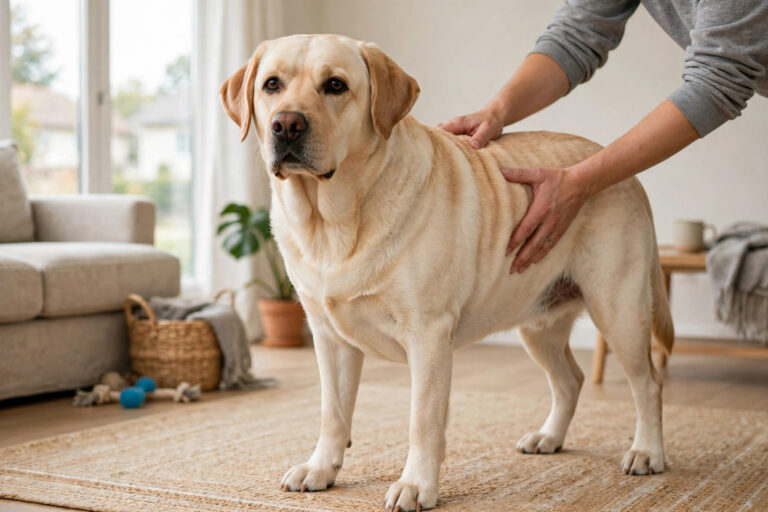
You can’t manage what you can’t measure, and the bathroom scale lies — it tells you total weight, not whether that weight is fat. Vets use a 1-to-9 body condition score, and you can learn the basics in two minutes.
-
The rib test. Run your hands along your dog’s sides with light pressure, like you’re petting through a thin blanket. Ribs should be easily felt with a slight fat covering — if you have to press to find them, that’s fat on top.
-
The waist test. Look down at your standing dog from above. Behind the ribs there should be a visible waist — an inward curve. A barrel with no curve is the classic overweight silhouette.
-
The tuck test. From the side, the belly should tuck up from the chest toward the hind legs. A belly that hangs level or sags is another fat flag.
On the 1-9 scale, 4-5 is ideal, 6-7 is overweight, 8-9 is obese. Be honest with yourself here — studies keep finding owners score their own dogs a point or two lighter than the vet does. If you’re unsure, ask the vet to score your dog at the weigh-in visit and learn what “right” feels like.
Step 2: figure out how much to feed (for the target weight)
This is where most weight-loss plans go wrong. People feed for the weight the dog is, not the weight the dog should be — so an overweight dog keeps getting overweight rations forever.
-
Feed for target weight. Get your dog’s ideal weight from the vet (or estimate: most overweight dogs need to lose 10-20% of current weight). Work your portions from that number, not the current one.
-
Ignore the bag’s generosity. Feeding-guide amounts on packaging are written for active, intact dogs at a healthy weight — they’re maintenance ceilings, not prescriptions. For a spayed/neutered couch-lover trying to lose weight, start roughly 10-15% below the guide for the target weight and adjust from there.
-
The 10% rule. Cut the current daily ration by about 10% as a starting point — no more. A dog that was getting 3 cups goes to about 2¾. Big cuts backfire: hunger makes dogs miserable, begging worse, and scavenging more creative.
-
Weigh every two weeks. Same scale, same time of day, ideally before breakfast. Safe loss is 1-2% of body weight per week — for a 30 kg dog, that’s 300-600 g a week. Faster than that and you’re cutting too hard; no loss for a month and you trim another 10%.
If the maths feels fiddly, ask your vet for a calorie target at the weigh-in visit. One number from the vet beats a week of guesswork.
Step 3: weigh the food — ditch the scoop
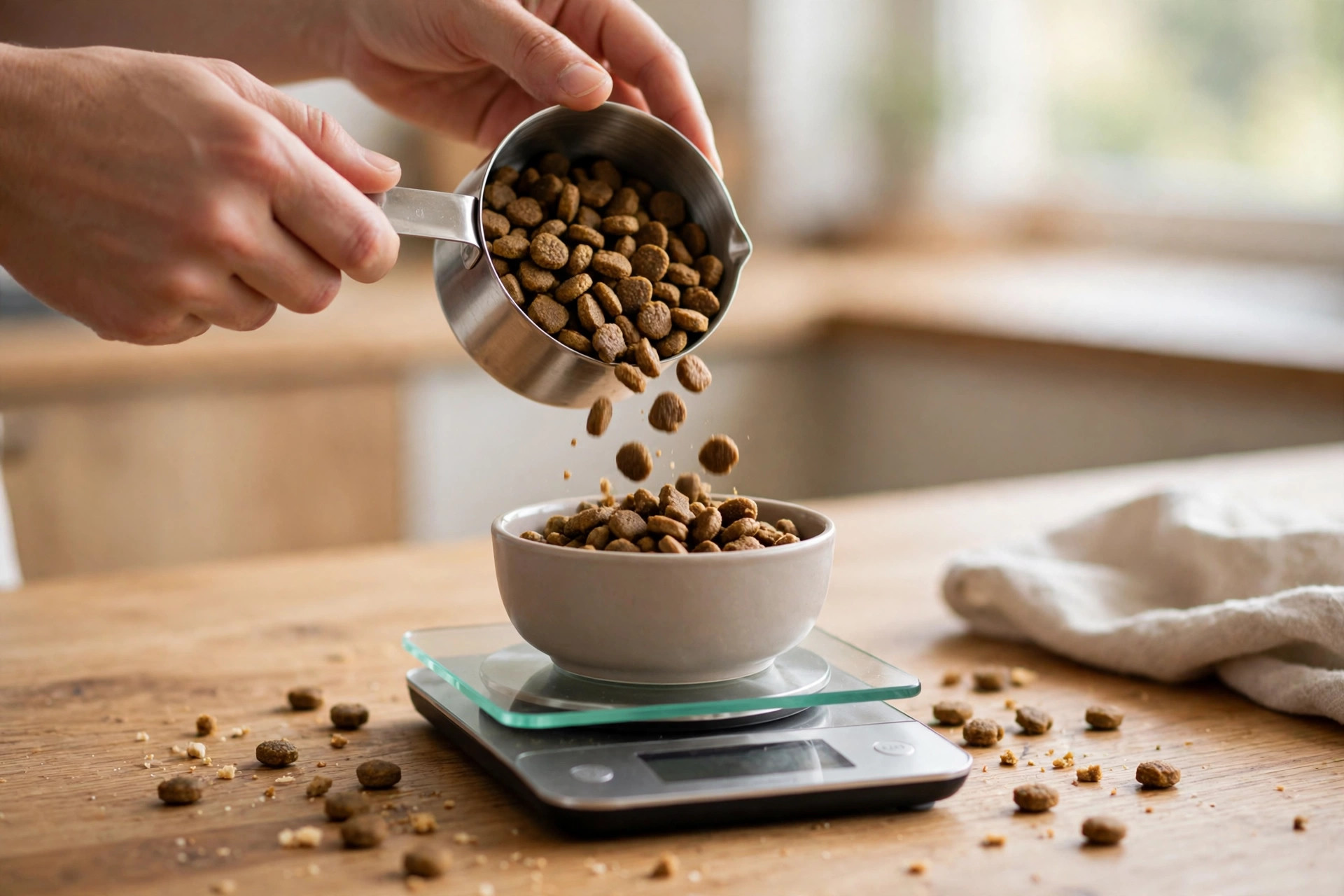
Here’s the uncomfortable truth: studies of owners using measuring cups find most over-pour by 20% or more. A “cup” of kibble from your scoop can be a cup-and-a-third from mine. When you’re trying to lose weight, that error is the whole diet.
-
Use a kitchen scale. Weigh the daily ration in grams, split it between meals. A £10 scale removes all the guesswork and makes the two-week weigh-ins actually meaningful.
-
Pre-portion the day. Measure the whole day’s food each morning (or the night before). Treats, toppers and training rewards come out of that allowance — nothing extra appears from the bag.
-
One person feeds. In multi-person households, the dog that gets “a little extra from Dad” defeats the scale. Put one name on the job for a few months.
-
Timed meals, no grazing. Meals down for 15-20 minutes, then the bowl comes up. Free-feeding and weight loss don’t mix.
Step 4: low-calorie swaps that keep the bowl satisfying
Cutting food makes dogs feel cheated — unless you replace volume, not just calories. The trick is bulk without the energy: water-rich, fibre-rich additions that fill the stomach for almost no calories.
-
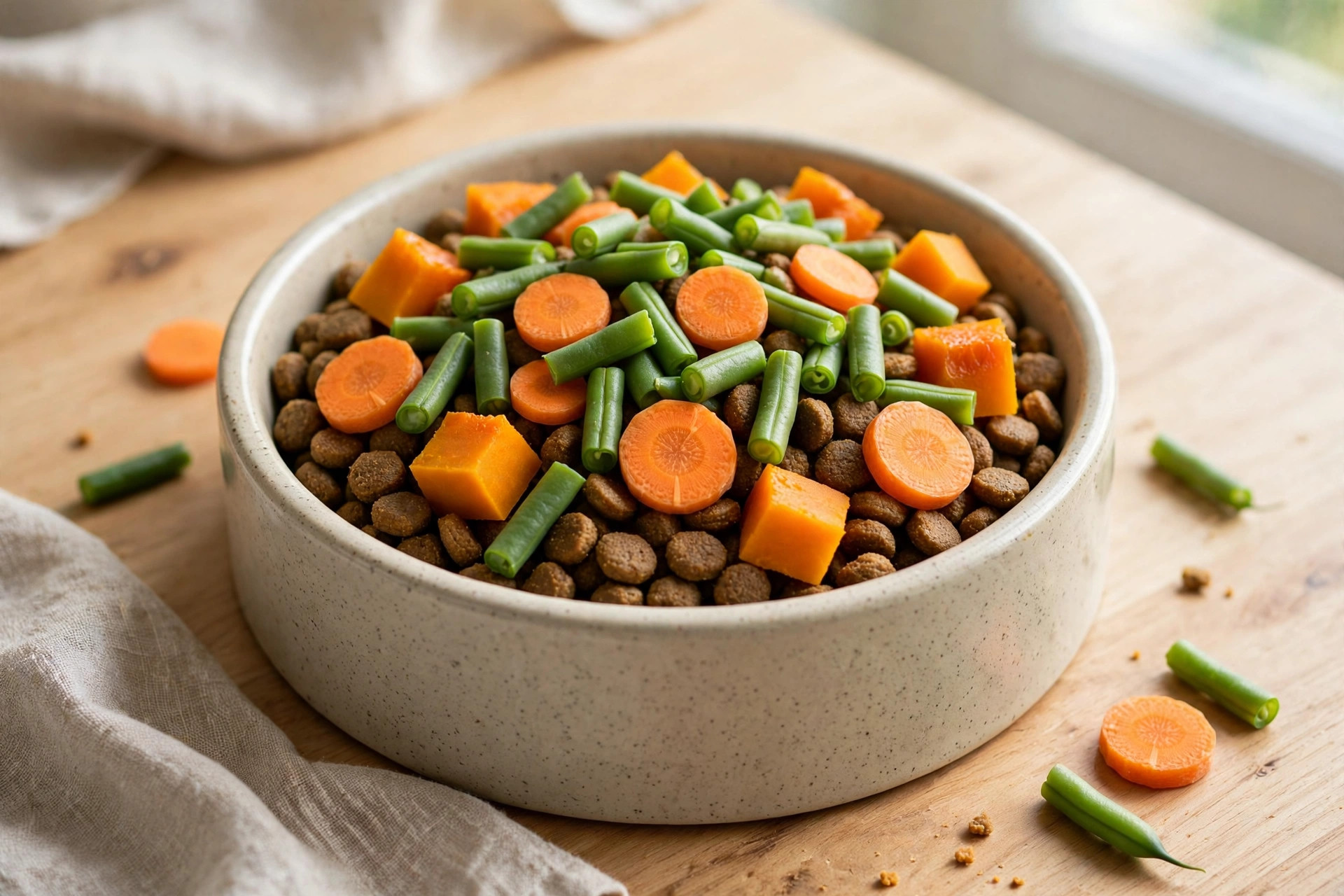
Green beans, carrots, plain pumpkin. A handful of frozen-thawed green beans or carrot coins mixed through the meal adds chew time and volume for a fraction of the calories. Plain canned pumpkin (not pie filling) does the same job and most dogs love it.
-
Soak the kibble. Warm water over the meal adds volume and aroma with zero calories — and it slows fast eaters down a little.
-
Swap the treats, not the love. Commercial treats are calorie bombs. Replace them with pea-sized training treats, or single pieces of kibble taken from the day’s ration — the dog gets the ritual, the diet keeps the calories. Treats and extras should stay under 10% of daily calories.
-
Slow the eating. A dog that inhales dinner in 40 seconds feels hungry ten minutes later. Our slow feeder guide shows how maze bowls and lick mats stretch a meal out — a slower meal genuinely helps an overweight dog feel fuller.
-
Keep it palatable. A weight-loss food only works if the dog actually eats it — and a dog that hates the new diet will hold out for scraps. If your dog turns up their nose, our picky eater guide has the warming and topper tricks that make reduced portions worth eating.
What not to feed: no crash diets, no skipped meals, no “human diet” food. And the usual toxic suspects never belong in the bowl — xylitol (some peanut butters), chocolate, grapes, onion and garlic are dangerous at any weight.
Step 5: build exercise back up — gently
You can’t out-walk a bad diet, but movement matters: it preserves muscle while fat comes off, and muscle is what keeps the metabolism working. The mistake is starting too hard with a heavy dog.
-
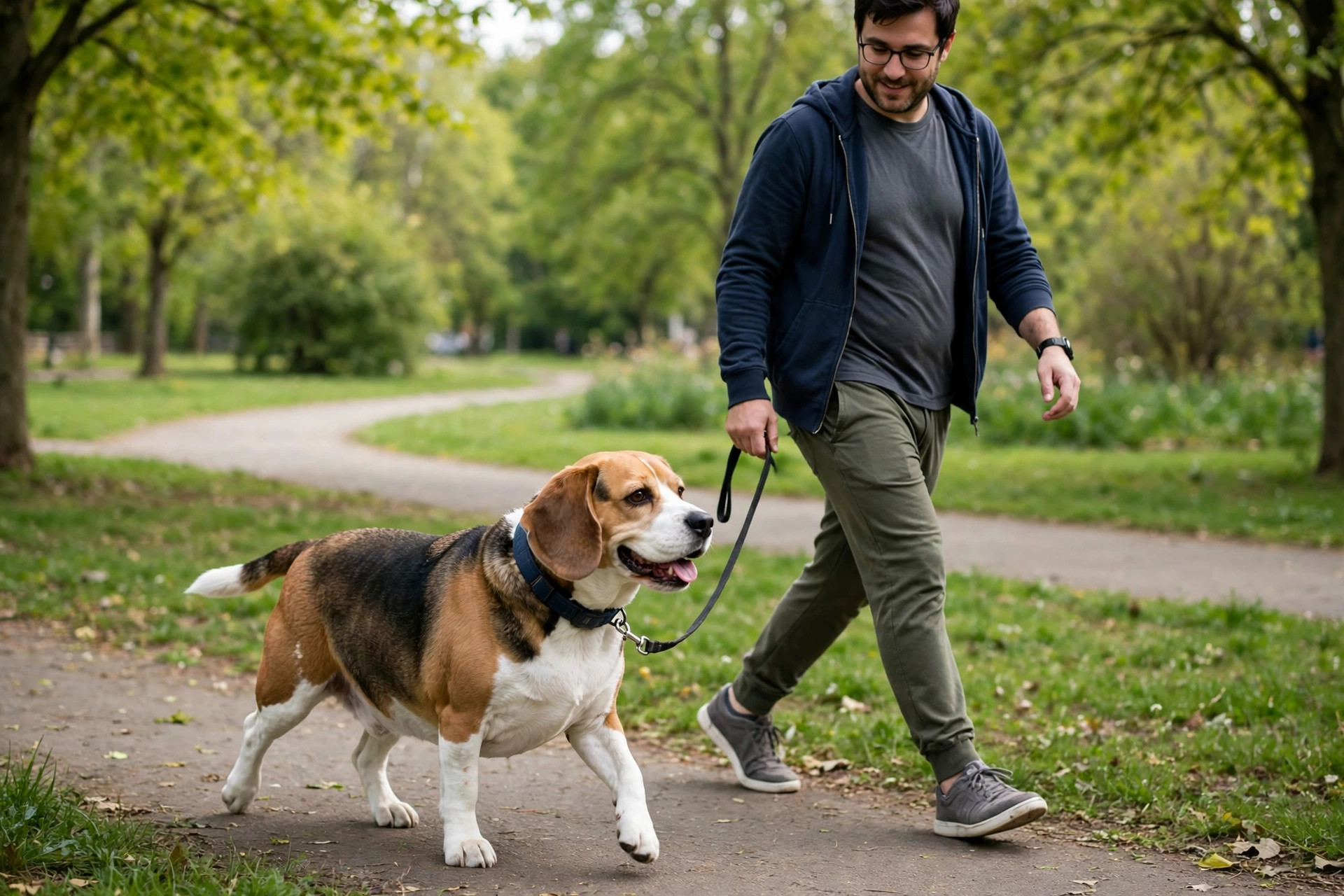
Start where the dog is. For a very overweight dog, two gentle 10-minute walks a day beats one heroic hour. Increase by about 5-10 minutes per walk each week.
-
Low impact first. Flat walks and (if the dog likes water) swimming are kind to loaded joints. Skip the fetch marathons and stairs until the weight is moving down.
-
Watch the signals. Heavy panting that doesn’t settle, lagging behind, limping the next morning — all mean you went too far. Back off, then build again more slowly.
-
Play counts. Tug games, nose-work, food puzzles and short training sessions all burn energy and keep the brain busy — which also cuts down on boredom begging.
Arthritic or senior dogs need the vet’s sign-off on the exercise plan before you start. Pain and weight gain feed each other, and sorting the pain often unlocks the movement.
When to call the vet
The plan is working if the scale trends down 1-2% a week and the dog’s energy holds steady. Call the vet if: no loss after a month of honest portion control (something else may be going on), the dog is lethargic or losing weight much faster than 2% a week, there’s sudden appetite loss, vomiting, or the rib/waist tests aren’t improving despite the numbers dropping.
FAQs
Can I just feed less of the same food? Often, yes — for modest weight loss, a measured 10-20% reduction of a complete, balanced food works fine. For bigger losses or very small dogs (where cuts get tiny), a vet-recommended weight-management formula keeps nutrients adequate at lower calories.
Should I switch to a “light” formula? Light formulas help because they’re less calorie-dense, so the bowl looks fuller for fewer calories. But they’re not magic — you still have to measure. And transition any new food over 7-10 days.
Are weight-loss dog treats worth it? Mostly marketing. You’re better off using tiny pieces of the daily ration or low-calorie whole foods (carrot coins, blueberries, green beans) as rewards.
My dog begs constantly on the diet — what do I do? Begging usually peaks in week one and fades as the routine settles. Don’t reward it with food — reward with play, a walk, or a training game. Splitting the daily ration into three smaller meals also helps.
How long until I see results? The scale moves in 2-4 weeks; visible waist and rib changes take 6-12 weeks. Think months, not days — that’s normal and healthy.
The bottom line
Dog weight loss is gloriously unglamorous: score the body honestly, feed for the target weight, weigh the food, bulk the bowl with low-calorie veg, and walk a little more each week. Aim for 1-2% a week, weigh every fortnight, and keep the vet in the loop. No crash diets, no guilt — just a plan your dog can live with until the ribs are easy to feel and the waist is back.