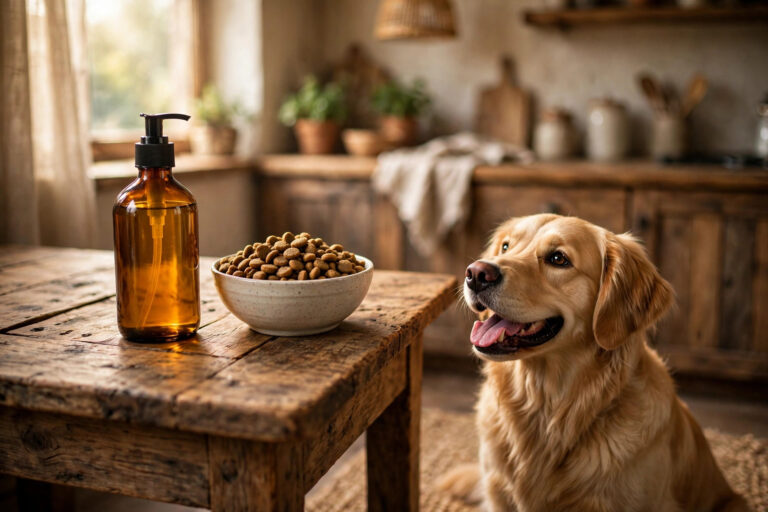
Walk down any pet aisle and you’ll find it: salmon oil, the amber
bottle everyone seems to be adding to their dog’s bowl. It’s one of
the most widely recommended canine supplements — vets suggest it for
itchy skin, dull coats and stiff senior joints, and many owners swear
they can see the difference in a month. But dosage labels are
confusing, quality varies wildly between brands, and giving too much
can do more harm than good.
This guide covers what salmon oil actually does for dogs, the right
dose by body weight, how to spot a quality bottle (and dodge the
rancid ones), and the three safety rules that matter.
What is salmon oil — and why do vets recommend it?
Salmon oil is simply oil rendered from salmon tissue, rich in the
omega-3 fatty acids EPA (eicosapentaenoic acid) and DHA
(docosahexaenoic acid). Dogs can’t make meaningful amounts of these
fats on their own — they have to come from food. And most commercial
diets, especially kibble, are heavy on omega-6 fats and light on
omega-3s, which skews the balance toward inflammation.
EPA and DHA feed into the body’s anti-inflammatory pathways. That’s
the single mechanism behind almost every claimed benefit: calm skin,
suppler joints, a glossier coat. Think of salmon oil less as a
miracle cure and more as restoring a fatty-acid balance that modern
dog food often gets wrong.
The real benefits of salmon oil for dogs
Skin and coat. This is the benefit most owners notice first.
Omega-3s support the skin’s moisture barrier, which can mean less
flaky, dry skin, less dandruff on dark furniture, and a coat that
looks genuinely glossier. Dogs with seasonal itch often get some
relief — not a cure for allergies, but a meaningful part of the
picture. Most owners report visible coat changes within 4–6 weeks.
Joint support for seniors. EPA’s anti-inflammatory action is
useful for older dogs with early arthritis stiffness. It won’t
replace prescribed joint medication, but alongside it, many vets
consider omega-3s a sensible daily addition for stiff, creaky dogs —
and a good complement to other whole-food joint supporters like
bone broth, which adds collagen to the mix.
Heart and brain health. DHA is a structural fat in brain and eye
tissue — which is why puppy formulas are often DHA-enriched. In
older dogs, omega-3s are studied for their role in supporting normal
cognitive function and heart health as part of a balanced diet.
Immune and recovery support. As a modulator of inflammatory
response, salmon oil is a reasonable daily staple for very active
dogs and a gentle nutritional extra for dogs recovering from illness
— ask your vet about timing after surgery or a GI episode.
Picky eaters. The fishy smell that puts you off is exactly what
makes salmon oil the homemade food
topper dogs inhale first. A pump over kibble can turn bowl-refusers
into bowl-emptiers.
Salmon oil dosage for dogs: how much to give
The number that matters is milligrams of combined EPA + DHA per
day — not the milligrams of total oil on the label. A capsule that
says “1,000 mg salmon oil” might contain only 200–300 mg of EPA+DHA;
that gap is where most dosing mistakes start.
The widely used veterinary starting range is 75–100 mg of combined
EPA + DHA per kilogram of body weight per day. In practice:
- Small dogs (under 10 kg): roughly 500–1,000 mg EPA+DHA per day.
- Medium dogs (10–25 kg): roughly 1,000–2,000 mg EPA+DHA per day.
- Large dogs (over 25 kg): roughly 2,000–3,000 mg EPA+DHA per day.
Start at the lower end for two weeks, then work up — a sudden fatty
oil load can mean loose stools. And treat these as guide rails, not
prescriptions: dogs on blood-thinning medication, with pancreatitis
history, or with clotting disorders need a vet’s go-ahead first,
because high-dose omega-3s can slow clotting slightly.
One more caution on calories: fat carries 9 kcal per gram. A large
dog’s full dose can add 50–100 calories a day — meaningful for a dog
on a weight-management plan, so adjust meals accordingly.
How to choose a quality salmon oil
The supplement aisle is a minefield of rancid, vague and
overpriced bottles. Here’s the label checklist:
-
Wild-caught source, named on the label. “Wild Alaskan salmon
oil” beats generic “salmon oil” — wild fish generally carry fewer
contaminants than farmed, and a named source signals a brand with
something to prove. -
EPA and DHA listed separately. If the label only gives total
oil weight and won’t tell you the EPA+DHA content, skip it —
you can’t dose what you can’t measure. -
Third-party tested. Look for IFOS (International Fish Oil
Standards) certification or an equivalent — this screens for heavy
metals, PCBs and oxidation. Wild salmon is lower-risk than large
predator fish, but testing is still the gold standard. -
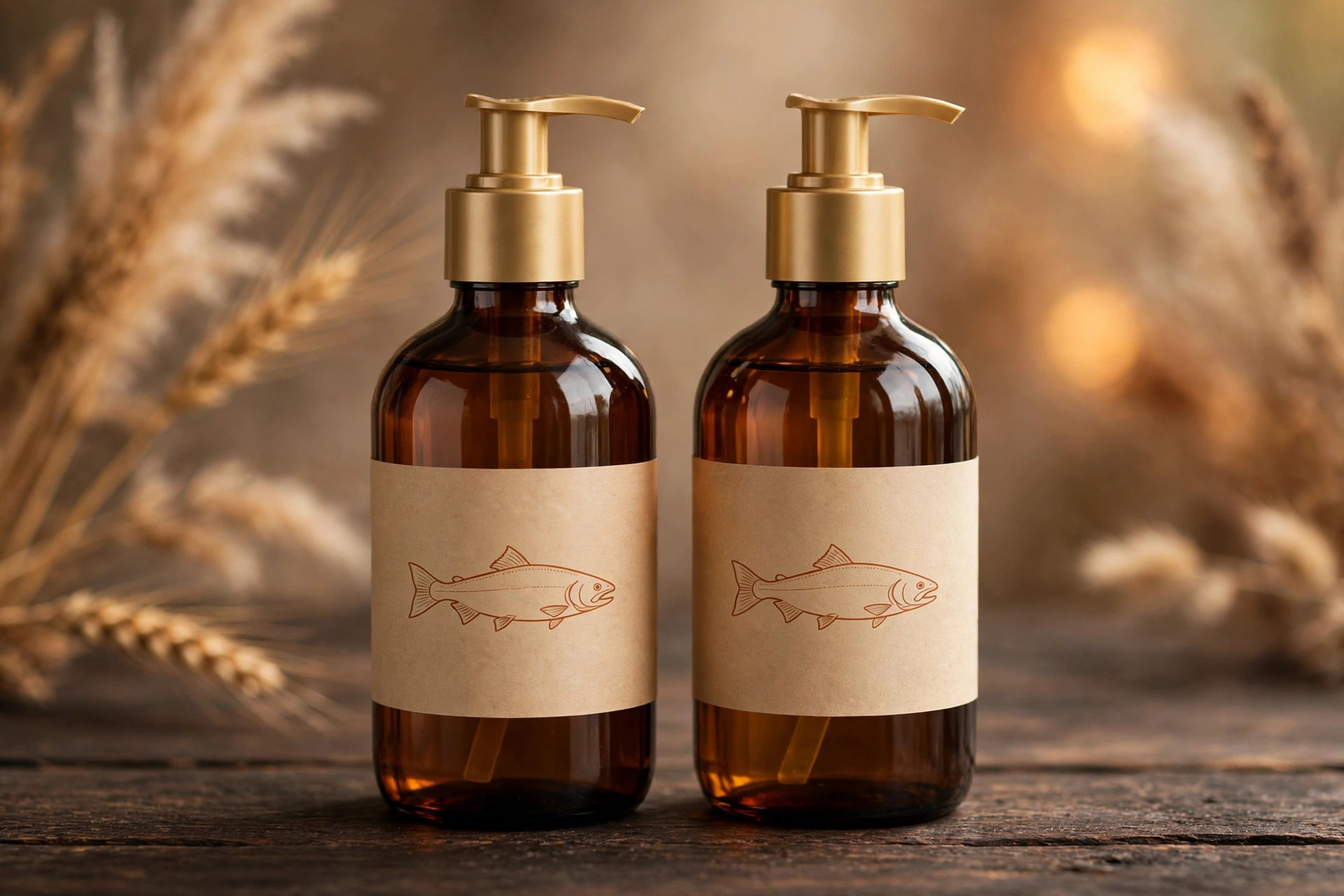
Dark bottle, pump top, sensible size. Light and air turn oil
rancid fast. A dark pump bottle you can finish within 60–90 days
beats a bargain gallon jug. Capsules are fine too — they dose
precisely and stay fresher, though large dogs need several. -
Nothing extra that shouldn’t be there. Plain oil only. Skip
products with artificial flavours or colours, garlic flavouring
(allium family — keep it out of the bowl), or xylitol in flavoured
formulas.
Rancid oil smells sharply “off” and loses its benefits — if it smells
wrong, bin it. Store opened bottles in the fridge and use within
about 90 days.
How to give salmon oil to your dog
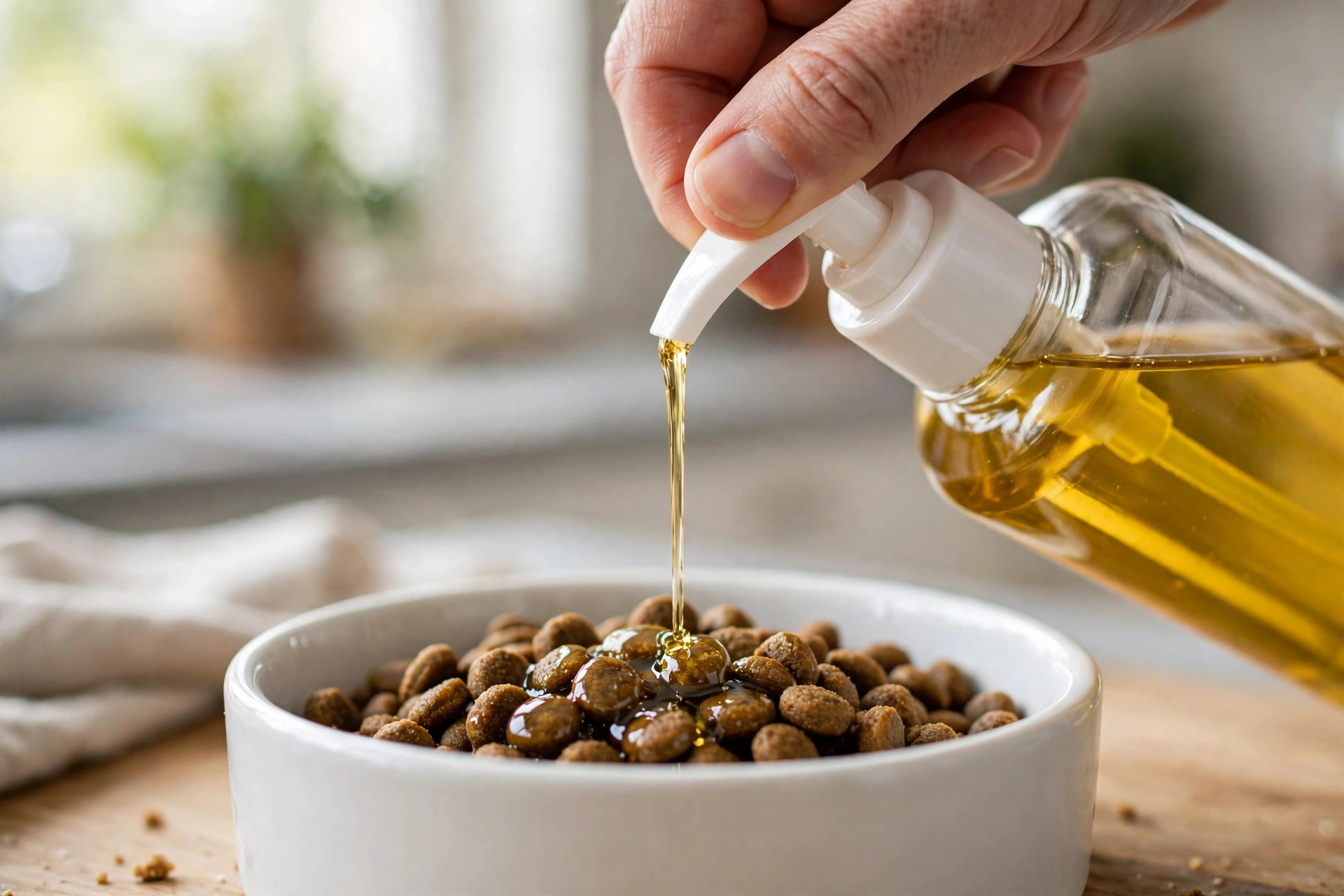
This is the easy part. Pump or squeeze the daily dose directly over
your dog’s food and mix it through — most dogs find the smell
irresistible. Introduce it gradually: half the dose for the first
3–4 days, then build to full. Give it with a meal (fat digests
better alongside food, and it avoids an oily empty stomach).
For the fussiest dogs, start with a single pump on something high-
value — a spoonful of plain yoghurt or a smear of peanut butter
(xylitol-free, always) — then transfer to the regular bowl once the
smell becomes associated with good things.

Safety notes: when to be careful
-
Pancreatitis or a very fatty-intolerant gut: check with your vet
first — concentrated fat is the wrong move for these dogs. -
Blood thinners or upcoming surgery: omega-3s can slow clotting;
vets usually pause fish oil before operations. -
Vitamin A confusion: salmon oil is not cod liver oil. Cod liver
oil carries high vitamin A, which is toxic in excess — the two are
not interchangeable at high doses. -
Vitamin E balance: very high, long-term omega-3 intake can
increase vitamin E needs — another reason to dose by the label, not
by enthusiasm. A good balanced diet plus the right supplements for
your dog’s needs covers this.
None of this means salmon oil is risky for the average healthy dog —
at sensible doses it’s one of the best-studied supplements in the
canine world. It just means “more is better” doesn’t apply.
The bottom line
Salmon oil earns its shelf space honestly: omega-3s that support
skin, coat, joints and brain, from a source dogs actually love the
smell of. Dose by EPA+DHA (75–100 mg/kg/day as a starting range),
buy wild-caught and third-party tested, store it cold, and introduce
it slowly. In 4–6 weeks, run your hand through your dog’s coat —
that’s usually where the proof shows up first.
FAQs
How much salmon oil should I give my dog per day?
Dose by combined EPA + DHA: roughly 75–100 mg per kg of body weight
daily as a starting range. Check the label for the actual EPA+DHA
content (not just total oil), start low for two weeks, and confirm
with your vet if your dog takes medication or has pancreatitis.
How long does salmon oil take to work?
Coat and skin changes typically show in 4–6 weeks of consistent daily
use. Joint comfort changes are subtler and take longer — give it at
least 6–8 weeks before judging.
Can puppies have salmon oil?
Yes, in weight-appropriate small doses — DHA supports brain and eye
development. Many puppy foods already include it; don’t double-dose
without checking the food’s existing omega-3 content.
Is human salmon oil safe for dogs?
Plain, unflavoured human-grade salmon oil is generally fine if the
EPA+DHA content is stated and it contains no xylitol, garlic
flavouring or added vitamin D megadoses. Pet-labelled oils make dosing
simpler, but the oil itself is the same.
Can salmon oil cause diarrhoea in dogs?
It can, usually from starting with a full dose too fast or from rancid
oil. Introduce gradually over a week and store the bottle in the fridge.
Persistent loose stools mean the dose is too high — drop back and
rebuild slowly.
Salmon oil vs fish oil: which is better for dogs?
Both deliver EPA and DHA. Salmon oil tends to be more palatable to dogs
and comes from a lower-contaminant fish; generic “fish oil” blends vary
more in source and quality. Either works if it’s third-party tested
with EPA+DHA stated on the label.