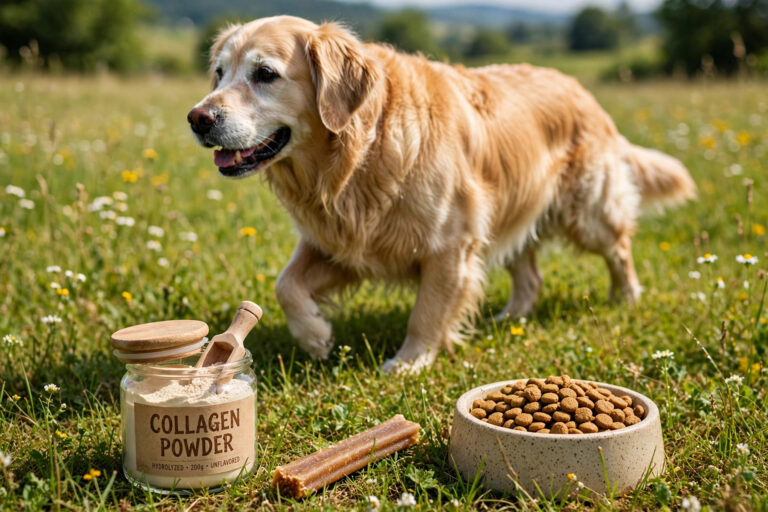
Collagen is having a moment — and not just in human wellness. It is
the most abundant protein in a dog’s body, the scaffolding that holds
together cartilage, tendons, skin and coat. And as of 2026 it has
become one of the fastest-growing corners of canine nutrition:
searches for “collagen for dogs” have climbed 83% year over year,
collagen sticks are up 230%, and pet supplement sales are surging
alongside them.
The question is the usual one with a trending supplement: is there
real substance behind the hype, or is this just marketing dressed up
in wellness language? This guide covers what collagen actually does
for dogs, which dogs benefit most, the right dose by body weight, the
truth about collagen sticks, and how to pick a product worth your
money.
What is collagen — and why does it matter for dogs?
Collagen is a structural protein made mostly of the amino acids
glycine, proline and hydroxyproline. In dogs it forms the framework
of articular cartilage (the smooth cushion inside joints), tendons
and ligaments, skin, the gut lining, nails and even blood vessel
walls. Puppies make it in abundance — which is one reason young dogs
bounce back from hard play so fast.
Production slows with age. From middle age onward, dogs synthesise
less collagen while the collagen they have breaks down faster under
mechanical stress — exactly the dynamic behind stiff senior joints,
thinner coats and slower skin repair. That’s the entire premise of
supplementation: replace a protein the body is gradually losing,
rather than add something exotic it never had.
Collagen supplements for dogs are usually hydrolysed collagen
(collagen peptides) — the protein broken into small peptides the gut
can absorb easily — or undenatured type II collagen (UC-II),
a minimally processed form that works through a different,
immune-modulating mechanism. Both have published canine research
behind them; they are not interchangeable, and the label should say
which one you’re buying.
It is also worth knowing the whole-food angle: slow-simmered
bone broth is a natural source of collagen
and gelatin, and many owners use broth plus a targeted supplement
together. Neither approach excludes the other.
The real benefits of collagen for dogs
Joint comfort and mobility. This is the headline benefit and the
best-studied one. Type II collagen is the main protein in joint
cartilage, and trials on dogs with early arthritis have shown
improved mobility scores on daily collagen supplementation. It does
not regrow cartilage overnight — think of it as giving the body the
raw material it needs for ongoing repair, plus (in the case of UC-II)
a signal that calms the immune attack on joint tissue. Most owners of
stiff seniors report easier rising and more willingness on walks
within 4–8 weeks.
Skin and coat. Collagen is a major component of the dermis, the
layer under the visible skin. Dogs getting collagen peptides tend to
show better coat gloss and less dry, flaky skin — the same
amino-acid building blocks that feed skin structure. It pairs well
with omega-3s like salmon oil, which work on
the skin’s fat-based moisture barrier; the two address different
layers of the same problem.
Gut lining support. The intestinal lining turns over constantly
and is collagen-rich. While the “leaky gut” claims in marketing go
further than the evidence, collagen’s glycine content does support
normal gut tissue maintenance — a reasonable extra for dogs with
sensitive digestion, alongside the usual dietary care.
Nails and connective tissue. Brittle, splitting nails are a small
but common complaint in older dogs, and collagen’s role in keratin-
adjacent connective tissue makes it a sensible addition here too.
Owners often notice firmer nails and less splitting after a couple of
months — a minor benefit, but a visible one.
Recovery support. Active and sporting dogs put enormous repetitive
stress on tendons and ligaments. Collagen peptides are a staple in
human sports nutrition for exactly this reason, and the same logic
applies to agility dogs, canicross partners and hard-working farm
dogs — supporting the connective tissue that takes the beating.
Who benefits most? Seniors with early stiffness, large and giant
breeds (whose joints carry more load from day one), very active dogs,
and dogs recovering from orthopaedic surgery — always with the vet’s
blessing on timing after an operation.

Collagen dosage for dogs: how much to give
Dosing depends on which form you’re using, because they work
differently:
Hydrolysed collagen peptides (powder): the common guide range is
roughly 1 gram of collagen peptides per 10 kg of body weight per
day, up to a practical ceiling. In plain terms:
-
Small dogs (under 10 kg): about 1 g per day (a quarter to half
teaspoon of typical powder). -
Medium dogs (10–25 kg): about 1–2.5 g per day.
- Large dogs (over 25 kg): about 2.5–5 g per day.
Undenatured type II collagen (UC-II): works at tiny doses —
studies in dogs typically use around 10 mg per day for a medium
dog, scaled roughly by size. If the product is UC-II, follow the
label; more is not better with this form.
Start at half the target dose for the first week — collagen is a
protein, not a drug, but any new supplement can mean loose stools if
introduced at full speed. Give it with food, which is also how
most powders are designed to be served (sprinkled over the bowl and
mixed in).
Give it time. Connective tissue turns over slowly: joint and coat
changes typically need 6–8 weeks of consistent daily use before
you judge. A supplement trialled for two weeks and abandoned tells
you nothing.
One calorie note: collagen is protein, about 4 kcal per gram. At the
doses above that’s trivial — even 5 g adds only ~20 kcal — so unlike
fatty supplements it needs no meal adjustment.
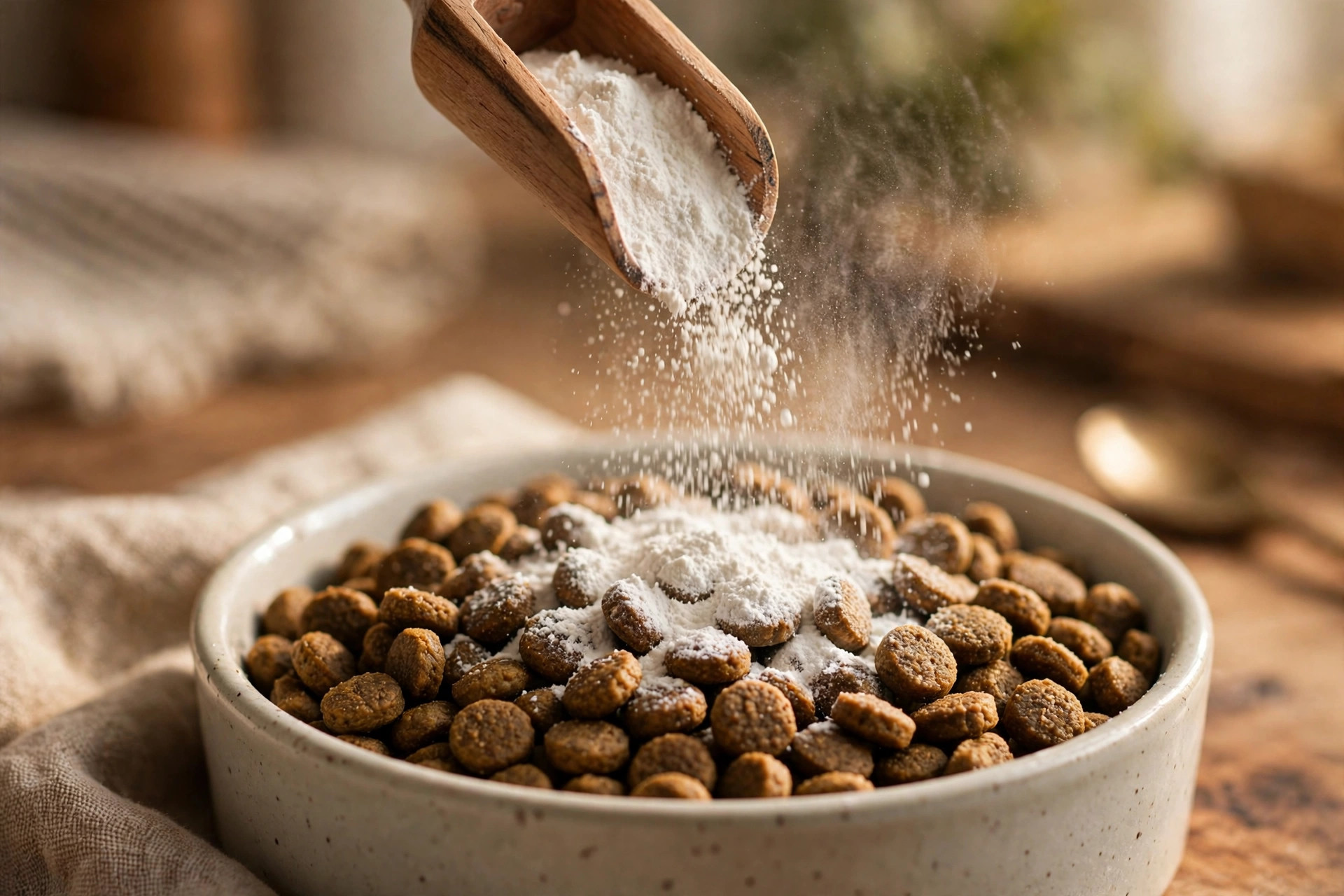
Collagen sticks: what are they — and are they safe?
Collagen sticks are the product driving that +230% search surge, so
they deserve their own section. They are long-lasting chews made from
the collagen-rich inner layer of beef hide (the corium), sometimes
with added flavour. They look a bit like bully sticks and serve the
same purpose: an extended, satisfying chew.
How they differ from rawhide. Traditional rawhide is the outer
hide layer, heavily processed, and notorious for swelling in the
stomach and causing blockages. Collagen sticks use the inner layer
and are generally more digestible — many are marketed as breaking
down more easily. “More digestible than rawhide” is a meaningful bar
to clear, but it is not the same as “risk-free.”
The honest safety picture. Any long-lasting chew carries the same
two risks: chunks breaking off (choking or blockage hazard for power
chewers and gulpers) and calorie load. Collagen sticks are still a
chew, not a supplement dose — a large stick can carry 50–100+
calories, which matters for weight management
and means they should replace part of the day’s treats, not add on
top. Supervise chewing, take the stick away when it gets small enough
to swallow, and skip them for dogs that try to inhale chews whole.
Sticks vs powder: which is better? They do different jobs. Powder
gives you a measured, daily, low-calorie collagen dose — the
supplement. Sticks give enrichment, dental scrubbing action and a
modest collagen intake — the chew. If your goal is joint support for
a stiff senior, the powder (or UC-II capsule) is the serious tool; if
your goal is a busy, happy chewer, the stick is the fun one. Plenty
of owners use both.

How to choose a quality collagen product
The supplement shelf is crowded, and collagen is easy to sell badly.
Here’s the label checklist:
-
Named collagen type on the label. “Hydrolysed bovine collagen
peptides” or “undenatured type II collagen (UC-II)” — not just
“collagen blend.” You need to know which form you’re dosing. -
Sourcing you can trace. Grass-fed bovine or wild marine
collagen from named origins beats mystery “collagen complex.”
Marine collagen is fine for dogs, but fish-sourced products should
state the species and testing, same as any fish oil. -
Third-party tested. Look for independent testing for heavy
metals and contaminants — non-negotiable for marine collagen and
reassuring for bovine. -
No junk in the ingredient list. Plain collagen plus maybe a
natural flavour. Skip products padded with fillers, artificial
flavours or sweeteners — and anything with xylitol, which is toxic
to dogs. -
Sensible format for your dog. Powder for precise daily dosing
(best for joint goals); chews or sticks for enrichment. Capsules
work for small dogs where a full scoop is overkill. -
Freshness and storage. Collagen powder is shelf-stable, but
buy a size you’ll finish in a few months and keep it sealed and
dry — clumped, stale powder mixes badly and dogs notice. The same
storage logic applies to all dog food and supplements.
Price per gram of actual collagen is the comparison that matters —
a big tub of “collagen chews” that is 90% filler is worse value than
a small bag of pure peptides.
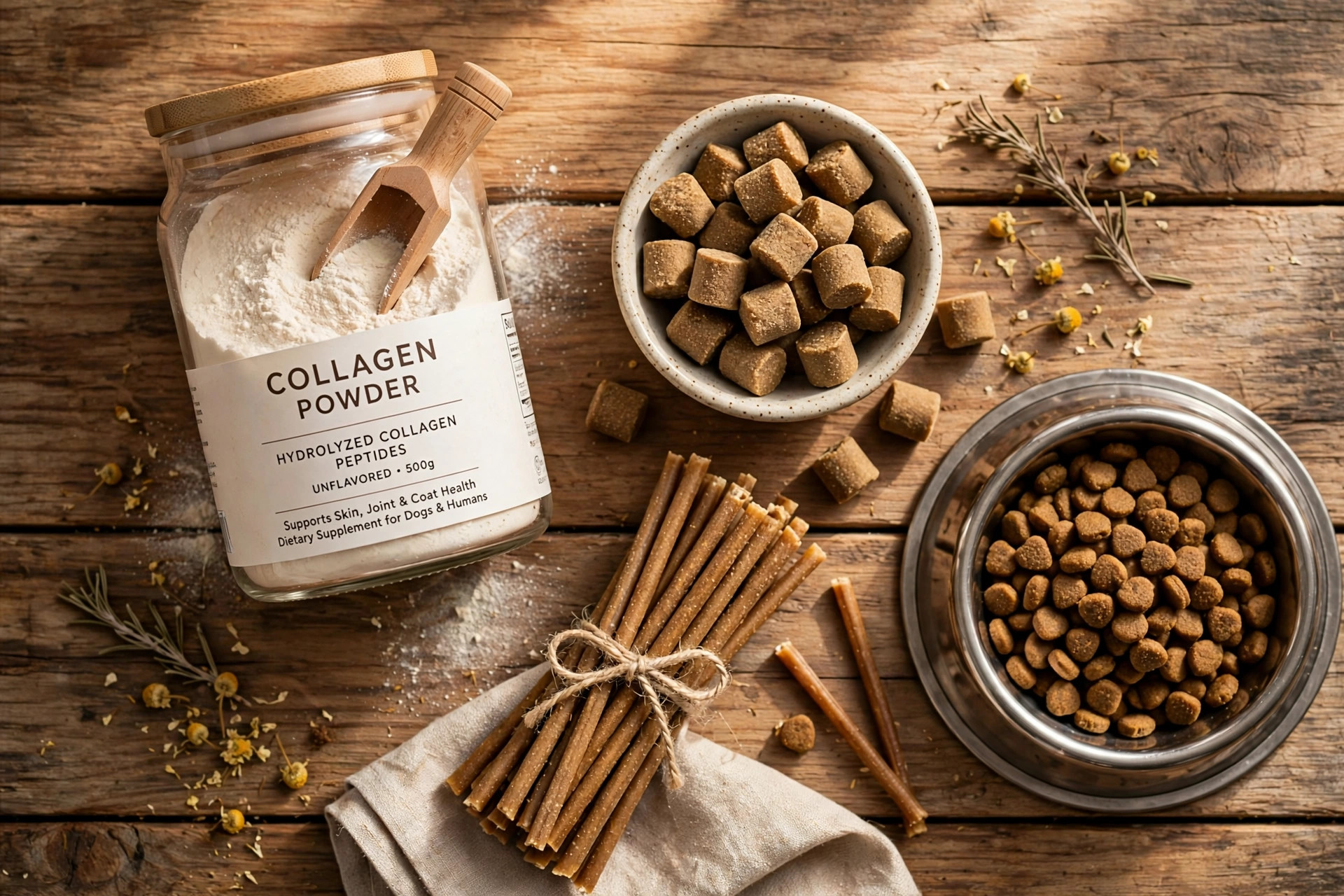
How to give collagen to your dog
Powder is the easy route: sprinkle the daily dose over food and mix
it through, ideally onto something slightly moist — a spoonful of
wet food, homemade food or a drizzle
of broth helps it cling instead of sitting at the bottom of the
bowl. Most unflavoured peptides are nearly tasteless, so picky eaters
rarely object.
UC-II usually comes as a small capsule or chew given once daily —
follow the product’s weight chart, since the effective dose is tiny
and form-specific.
Collagen sticks follow chew rules: offer after a meal (never on an
empty, ravenous stomach), supervise, and remove the last few inches.
One stick a few times a week is enrichment; it is not a substitute
for the daily powder dose if you’re targeting joints.
Safety notes: when to be careful
-
Post-surgery dogs: check with your vet on timing — nutritional
support is welcome during recovery, but the vet sets the schedule
after orthopaedic operations. -
Kidney disease or protein-restricted diets: collagen is protein.
Dogs on vet-managed restricted-protein diets should not get extra
protein without the vet’s approval. -
Allergies: bovine collagen won’t suit beef-allergic dogs;
marine collagen won’t suit fish-allergic ones. Match the source to
your dog. -
Gulpers and power chewers: collagen sticks are a supervised
chew only — if your dog destroys and swallows chews, sticks are
the wrong format. -
“More is better” doesn’t apply. UC-II in particular works at
milligram doses; doubling it doesn’t double the effect. Dose by
the label and your dog’s weight, not by enthusiasm — the same
discipline as any supplement.
For the average healthy adult dog, collagen peptides at sensible
doses are among the gentlest supplements you can add: it’s a food
protein, not a pharmaceutical, with a wide safety margin.
The bottom line
Collagen earns its place in the 2026 supplement boom more honestly
than most trends: it’s the literal building block of joints, skin
and connective tissue, dogs make less of it as they age, and the
canine research — especially on joint comfort — is genuinely
encouraging. Dose peptides by weight (about 1 g per 10 kg daily),
give it 6–8 weeks, buy a named, tested product, and treat collagen
sticks as what they are: a great chew with benefits, not a measured
dose. Run your hand over your senior’s coat and watch them rise in
the morning — that’s where the proof shows up.
FAQs
What does collagen do for dogs?
Collagen supplies the amino acids dogs use to maintain joint
cartilage, skin, coat, nails and gut lining. The best-supported
benefit is joint comfort and mobility in aging or very active dogs,
with coat and skin improvements as the most visible early sign.
How much collagen should I give my dog?
For hydrolysed collagen peptides, about 1 gram per 10 kg of body
weight daily is the common guide range. UC-II (undenatured type II)
works at much smaller doses — around 10 mg daily for a medium dog —
so follow that product’s label exactly.
How long does collagen take to work in dogs?
Connective tissue turns over slowly. Allow 6–8 weeks of consistent
daily use before judging joint or coat changes; two weeks is too
soon to tell.
Are collagen sticks safe for dogs?
Generally yes as a supervised chew — they’re more digestible than
traditional rawhide. The same chew rules apply: supervise, remove
small pieces, skip them for gulpers, and count the calories as part
of the day’s treats.
Collagen vs glucosamine: which is better for joints?
They work differently and are often combined. Glucosamine supports
cartilage metabolism; collagen supplies structural protein (and UC-II
modulates the immune response in joints). Many joint formulas include
both — they’re complementary, not competitors.
Can puppies have collagen?
Young, healthy puppies making their own collagen in abundance don’t
need supplementation. It’s a consideration for seniors, large breeds
under joint load, canine athletes and post-injury recovery — with
vet guidance.
Is marine or bovine collagen better for dogs?
Both work. Bovine is the most studied in dogs; marine is a good
alternative for beef-allergic dogs. What matters more than the source
is that it’s named, third-party tested and free of fillers.